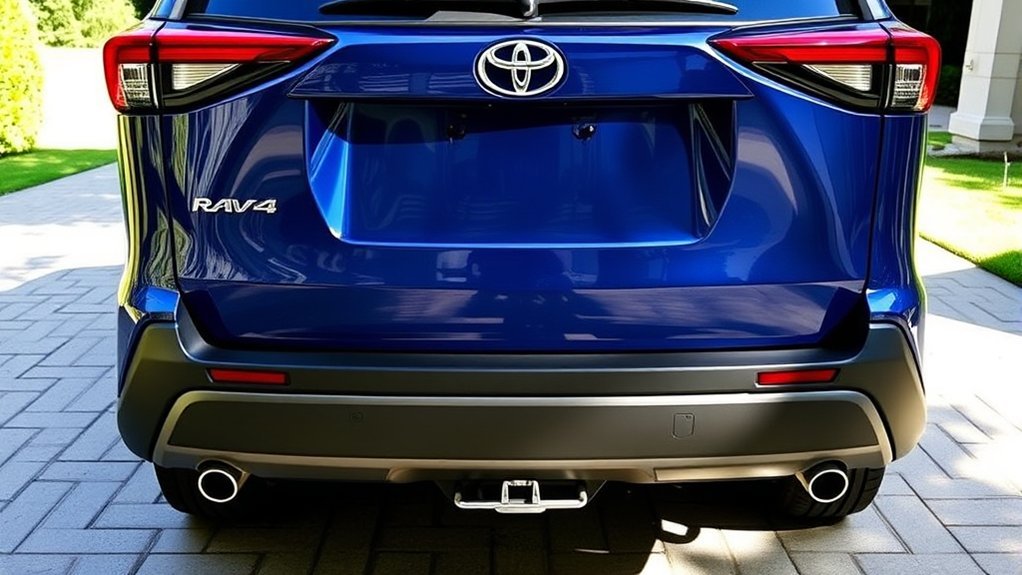
Yes, a 2025 Toyota RAV4 can accommodate a trailer hitch when the receiver, ball mount, wiring, and trailer are compatible with the exact vehicle. The hitch does not determine how much the RAV4 may tow. Your limit comes from Toyota’s rating for the vehicle’s powertrain, market, factory equipment, payload, and towing-package status.
Before buying a hitch, check the owner’s manual for your VIN, the certification and loading labels on the driver’s doorjamb, and Toyota’s build information. This is especially important because 2025 gas-model ratings can differ by factory towing-package status and market.
Quick Answer
A 2025 Toyota RAV4 can use a trailer hitch. Toyota lists a 1,500-pound rating for gas models without its factory towing package, 1,750 pounds for the Hybrid, and 2,500 pounds for the Plug-in Hybrid. Some factory-equipped gas configurations may be rated for 3,500 pounds. Verify your exact VIN before towing.
Key Takeaways
- Match the hitch to the exact year, powertrain, trim, bumper design, and liftgate equipment.
- A hitch receiver does not add Toyota’s factory towing package or raise the vehicle’s tow rating.
- Use the lowest rating among the vehicle, receiver, ball mount, hitch ball, wiring, and trailer equipment.
- Calculate capacity with the trailer fully loaded, not from its empty or “dry” weight.
- Tongue weight, passengers, cargo, and hitch accessories all use part of the RAV4’s available payload.
- Check the hitch connection, safety chains, lights, brakes, tires, mirrors, and load balance before every trip.
What’s in This Article
- What You Need to Know About Your RAV4’s Towing Capacity
- Which RAV4 Models Are Compatible With a Trailer Hitch?
- How to Verify Your RAV4’s Actual Tow Rating
- Installing a Trailer Hitch on Your RAV4
- Crucial Safety Tips for Towing With Your Toyota RAV4
- How to Improve Your RAV4’s Towing Setup
- How to Calculate Your Real Towing Limit
- Frequently Asked Questions
- Conclusion
What You Need to Know About Your RAV4’s Towing Capacity
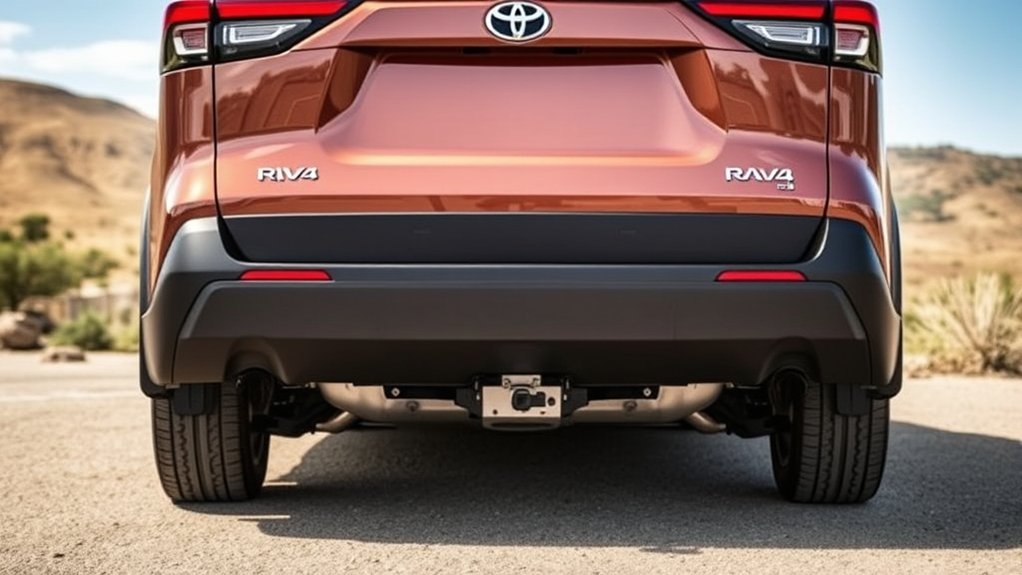
Your RAV4’s towing capacity depends on more than the engine. Toyota bases the limit on the powertrain, factory equipment, cooling and drivetrain configuration, hitch system, passengers, cargo, and trailer setup.
The 2025 RAV4 owner’s manual lists a Trailer Weight Rating of 1,500 pounds for gas vehicles without Toyota’s towing package and 3,500 pounds for vehicles equipped with that package. The 2025 RAV4 Hybrid owner’s manual lists 1,750 pounds. Toyota rates the 2025 RAV4 Plug-in Hybrid at up to 2,500 pounds in applicable markets.
| 2025 RAV4 Configuration | Maximum Trailer Weight Rating | Important Condition |
|---|---|---|
| Gas RAV4 without Toyota towing package | 1,500 lbs | An aftermarket receiver does not change this rating. |
| Gas RAV4 with Toyota factory towing package | 3,500 lbs | Confirm the package through the VIN, owner’s manual, and Toyota dealer records. |
| RAV4 Hybrid | 1,750 lbs | Includes the trailer and everything carried in or on it. |
| RAV4 Plug-in Hybrid | 2,500 lbs | Confirm the rating in the manual for the vehicle’s sales market. |
Note: Market matters. Toyota Canada offered a 2025 RAV4 Trail gas model rated at approximately 3,500 pounds, while its other gas grades were rated at approximately 1,500 pounds. Toyota’s U.S. 2025 announcement said the gas Adventure and TRD Off-Road grades were not offered for that model year. Do not choose a rating from a different country or trim.
The 2025 gas RAV4 uses a 2.5-liter four-cylinder engine with 203 horsepower. The Hybrid uses a 219-net-combined-horsepower hybrid system. The 2025 RAV4 Plug-in Hybrid produces 302 net combined horsepower.
Horsepower alone does not establish towing capacity. The vehicle must remain within its Trailer Weight Rating, Gross Combination Weight Rating, Gross Vehicle Weight Rating, Gross Axle Weight Ratings, tire limits, and available payload.
A higher-rated receiver cannot turn a 1,500-pound RAV4 configuration into a 3,500-pound tow vehicle.
Note: Toyota redesigned the RAV4 for 2026. The 2026 lineup uses different powertrains, trims, hitch equipment, and tow ratings. Do not apply a 2026 specification to a 2025 RAV4.
Towing Terms You Should Understand
- TWR: The maximum combined weight of the trailer and everything loaded in or on it.
- Unbraked TWR: The maximum trailer weight allowed without a trailer service-brake system.
- GCWR: The maximum combined operating weight of the RAV4, occupants, cargo, accessories, tongue weight, and loaded trailer.
- GVWR: The maximum permitted weight of the loaded RAV4.
- GAWR: The maximum permitted load on each vehicle axle.
- Payload: The amount of occupant, cargo, accessory, and tongue weight the vehicle can carry.
- Tongue weight: The downward load the trailer applies to the hitch ball.
Toyota’s 2025 gas and Hybrid manuals list an unbraked Trailer Weight Rating of 1,000 pounds. If the loaded trailer exceeds the applicable unbraked rating, it needs a trailer service-brake system. State, provincial, and local laws may require brakes at a lower weight.
Which RAV4 Models Are Compatible With a Trailer Hitch?
Many 2025 Toyota RAV4 models can accept a trailer hitch, but fitment must be confirmed before purchase. Differences in the rear bumper, exhaust, drivetrain, power liftgate, kick sensor, production plant, and sales market can affect compatibility.
Toyota lists a Genuine RAV4 tow hitch receiver with a ball mount and states that a towing wire harness is required and sold separately. Aftermarket receivers are also available, but the hitch application guide must list the exact vehicle configuration.
Power Liftgate and Kick-Sensor Compatibility
A hitch or other accessory mounted near the rear bumper can interfere with the foot-activated liftgate sensor. Depending on the hitch and vehicle, the sensor may need to be relocated, disabled, or removed. The operation setting may also need to be turned off in the vehicle.
Do not assume that a hitch fits solely because another 2019–2025 RAV4 uses the same general body style. Ask the seller or installer to verify the application by VIN and confirm in writing whether hands-free liftgate operation will remain available.
Warning: A receiver’s advertised Class III or maximum weight rating does not replace Toyota’s vehicle rating. The lowest-rated part or limit controls the setup.
How to Verify Your RAV4’s Actual Tow Rating
Use the following checks before buying towing equipment or connecting a trailer:
- Open the owner’s manual for the exact powertrain and production market. Find the Trailer Towing and Specifications sections.
- Check the driver’s doorjamb labels. Record the vehicle’s payload or load-carrying capacity, GVWR, and axle ratings.
- Ask a Toyota dealer to decode the VIN. Request confirmation of any factory towing package rather than assuming it is present.
- Check the receiver label. Record its maximum trailer and tongue-weight ratings.
- Check the ball mount and hitch ball. Each component must meet or exceed the planned loaded trailer and tongue weight.
- Read the trailer certification label. Note its GVWR, axle rating, tire specifications, and required ball size.
- Use the lowest applicable limit. Never average ratings or use the strongest component as the system limit.
Pro Tip: Keep photos of the vehicle labels, receiver label, ball-mount label, hitch-ball markings, and trailer certification plate on your phone. They make it easier to verify the setup when replacing equipment or loading for a trip.
Installing a Trailer Hitch on Your RAV4: A Step-by-Step Guide
Hitch installation varies by receiver design. Some aftermarket hitches mount below the bumper and require temporary exhaust lowering. An OEM-style receiver may involve bumper-panel removal, trimming, kick-sensor changes, or additional brackets. Always use the instructions supplied with the exact hitch.
At a Glance
| Time Required | Several hours for many first-time DIY installations; wiring and bumper work can add time |
| Difficulty | Moderate to advanced, depending on hitch design and wiring |
| Tools Needed | Torque wrench, sockets, extensions, trim tools, exhaust-hanger tool if required, safety glasses, and a safe lifting method |
| Cost | Varies by OEM or aftermarket receiver, wiring type, kick-sensor work, shipping, and professional labor |
Before You Begin
Gather the hitch receiver, the exact mounting hardware supplied with it, a calibrated torque wrench, socket set, trim tools, an exhaust-hanger tool if the instructions require one, safety glasses, wheel chocks, and the correct vehicle-specific wiring kit.
Many small trailers use a 4-pin connector for running lights, brake lights, and turn signals. A trailer with electric brakes normally needs additional wiring, commonly through a 7-pin connector, plus a compatible brake controller. A 7-pin socket alone does not operate electric trailer brakes unless the required control circuit and controller are installed correctly.
Read the complete hitch and wiring instructions before lifting the vehicle. Confirm whether the job requires bumper trimming, exhaust lowering, underbody-panel removal, kick-sensor changes, or disconnection of the 12-volt battery.
Warning: Never work under a RAV4 supported only by a jack. Use approved lifting points and properly rated jack stands or a vehicle lift. On Hybrid and Plug-in Hybrid models, do not touch orange high-voltage cables or high-voltage components.
Basic Installation Steps
- Confirm the application. Match the receiver part number to the exact 2025 RAV4 powertrain, trim, drivetrain, market, and liftgate equipment.
- Prepare the vehicle. Park on a level surface, set the parking brake, chock the wheels, and unload the cargo area.
- Create working clearance. Remove underbody or bumper panels and lower the exhaust only when the hitch instructions require those steps.
- Inspect the mounting points. Clean exposed threads and check for shipping plugs, corrosion, undercoating, or damage that could prevent the hitch from sitting flush.
- Raise the receiver into position. Use a second person or a suitable support because the receiver can be awkward and heavy.
- Start all fasteners by hand. Do not use an impact tool to start bolts, and do not cross-thread the welded frame nuts.
- Align and torque the receiver. Tighten the hardware in the sequence and to the torque values stated by the hitch manufacturer.
- Restore removed components. Reconnect exhaust hangers and reinstall panels while checking clearance around the receiver and exhaust.
- Install the wiring harness. Use a vehicle-specific converter and fused power connection. Do not make improvised connections to the vehicle’s lighting circuits.
- Address the kick sensor. Relocate, disable, or remove it only as instructed for the hitch and vehicle.
- Test the electrical system. Verify running lights, both turn signals, brake lights, hazards, and any trailer-brake or charging circuits.
- Complete a final inspection. Check torque, wire routing, exhaust clearance, receiver alignment, spare-tire access, and liftgate operation.
Professional installation is the safer choice when you do not have a torque wrench, proper lifting equipment, automotive wiring experience, or confidence working near the exhaust and bumper systems.
Parts and labor costs vary. The total may include the receiver, ball mount, hitch ball, pin or lock, wiring converter, connector bracket, brake controller, kick-sensor modification, bumper trimming, taxes, shipping, and installation labor. Obtain a written quote that lists each component and its warranty.
Pro Tip: After installation, connect the loaded trailer and check that the ball mount places it approximately level. The receiver may be installed correctly while the chosen ball mount still has the wrong rise or drop.
Crucial Safety Tips for Towing With Your Toyota RAV4
Safe towing starts before the RAV4 moves. The vehicle needs the correct receiver, secure coupler, crossed safety chains, working lights, suitable mirrors, properly inflated tires, enough braking capacity, and a trailer that is loaded within every applicable rating.
Proper Weight Distribution and Tongue Weight
Toyota recommends distributing the trailer load so that tongue weight is approximately 9% to 11% of the loaded trailer weight. This is a target range, not permission to exceed the receiver, ball mount, rear-axle, or vehicle payload limit.
| Loaded Trailer Weight | 9% Tongue Weight | 11% Tongue Weight |
|---|---|---|
| 1,000 lbs | 90 lbs | 110 lbs |
| 1,500 lbs | 135 lbs | 165 lbs |
| 1,750 lbs | 158 lbs | 193 lbs |
| 2,500 lbs | 225 lbs | 275 lbs |
| 3,500 lbs | 315 lbs | 385 lbs |
These calculations show the recommended distribution only. They do not override a lower tongue-weight or payload limit. Put heavy cargo low and close to the trailer axle. Avoid placing too much weight at the rear of the trailer because that can reduce tongue weight and promote sway.
After loading, the trailer should sit approximately level. A trailer that points sharply up or down may need a different ball-mount rise or drop.
Account for Payload and Passenger Weight
Tongue weight becomes part of the load carried by the RAV4. The following items all use vehicle payload:
- Driver and passengers.
- Luggage and cargo inside the RAV4.
- Roof cargo.
- Dealer-installed and owner-installed accessories.
- The receiver, ball mount, and hitch-mounted equipment.
- Trailer tongue weight.
For example, a RAV4 with 900 pounds of available load capacity does not have 900 pounds available for luggage after four occupants, a receiver, and trailer tongue weight are added. Use the vehicle’s actual loading label rather than a generic online payload figure.
Trailer Brakes, Wiring, and Safety Chains
Toyota’s 2025 gas and Hybrid manuals list a 1,000-pound unbraked Trailer Weight Rating. A trailer above the applicable unbraked limit needs service brakes, and local law may require them at a lower weight.
Use crossed safety chains with enough slack for turns but not enough to drag. Attach them to the vehicle’s designated safety-chain loops, not to the removable ball mount. If the trailer has a breakaway system, connect its cable to a separate secure point according to the trailer manufacturer’s instructions.
A 4-pin connector normally operates basic trailer lights. Electric trailer brakes generally require a compatible brake controller and additional wiring, commonly through a 7-pin connector. Verify that the controller, connector, trailer brakes, and RAV4 electrical system are compatible.
Driving With a Trailer
Toyota instructs drivers not to exceed 65 mph, the posted towing limit, or the trailer manufacturer’s limit, whichever is lower. Drive more slowly in crosswinds, rain, snow, rough roads, or heavy traffic.
- Allow substantially more stopping distance.
- Accelerate, brake, and steer smoothly.
- Make wider turns without crossing into another lane.
- Downshift or select a lower range before long descents when appropriate.
- Stop and inspect the connection after a short initial distance.
- Practice turning, stopping, and reversing away from traffic.
- Use a spotter while backing into a campsite, driveway, or boat ramp.
The owner’s manual may instruct you to disable certain driver-assistance features while towing because they may not operate properly with a trailer. Depending on equipment, these can include Lane Tracing Assist, dynamic radar cruise control, Parking Support Brake, Blind Spot Monitor, parking assist, and Rear Cross Traffic Alert. Follow the instructions for the exact vehicle rather than relying on a general list.
Warning: If the trailer begins to sway, keep the steering wheel steady, ease off the accelerator, and slow gradually. Do not make an abrupt steering correction or accelerate in an attempt to pull the trailer straight.
Regular Vehicle and Trailer Maintenance
Check engine oil, coolant level, brake condition, tire pressure, tire damage, and fluid leaks before a longer towing trip. Towing adds heat and load, so a minor maintenance problem can become more serious under sustained use.
Inspect both vehicle and trailer tires when cold. Use the pressure listed for the RAV4 on its doorjamb label and the pressure specified by the trailer or trailer-tire manufacturer. Do not use the maximum sidewall pressure as the RAV4’s normal inflation target.
Before every departure, verify:
- The coupler is fully seated and locked.
- The hitch pin or lock is installed.
- The safety chains are crossed and secured.
- The breakaway cable is attached correctly.
- The jack and stabilizers are raised.
- All trailer lights work.
- Trailer brakes operate correctly.
- Cargo cannot move or fall from the trailer.
- The tires and wheel fasteners are in safe condition.
- The mirrors provide a legal and useful view behind the trailer.
How to Improve Your RAV4’s Towing Setup With Simple Upgrades
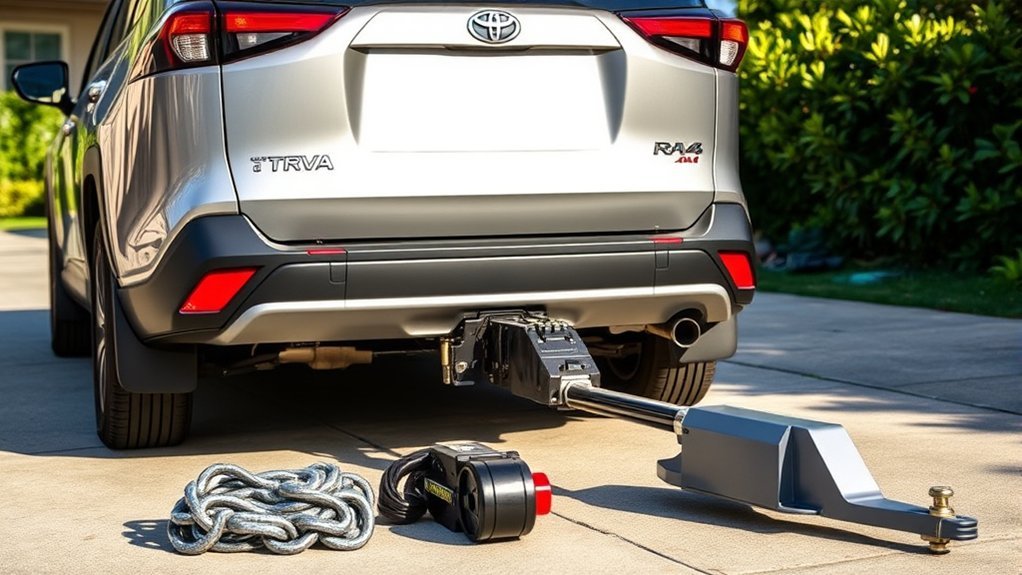
You can improve connection quality, visibility, braking, load control, and convenience, but you cannot safely raise Toyota’s factory tow rating with a receiver, suspension part, brake controller, or sway-control accessory.
Use the Correct Hitch System
Choose a receiver that fits the exact RAV4 and meets or exceeds the planned loaded trailer and tongue weight. Then verify the ratings for the ball mount, hitch ball, pin, and any adapter. The lowest rating in the complete system sets the limit.
| Upgrade | What It Can Improve | Raises Toyota’s Tow Rating? |
|---|---|---|
| Correct receiver and ball mount | Secure connection and proper trailer height | No |
| Vehicle-specific wiring harness | Reliable trailer-light connection | No |
| Compatible brake controller | Operation of compatible electric trailer brakes | No |
| Approved sway-control equipment | Additional sway resistance when required and correctly adjusted | No |
| Additional mirrors | Rearward visibility around a wide trailer | No |
Use a vehicle-specific powered converter or Toyota-compatible harness rather than improvised wire taps. Toyota’s RAV4 towing wire harness provides a 4-pin connector for the trailer’s running, brake, and turn-signal lights.
Approach Suspension Changes Carefully
Helper springs, replacement dampers, or sway bars may alter ride height or handling in some applications. They do not increase payload, axle ratings, GCWR, TWR, tire capacity, or tongue-weight limits.
If a correctly loaded trailer causes severe rear sag, do not treat a suspension accessory as permission to continue. Recheck the trailer weight, tongue weight, vehicle payload, ball-mount height, and rear-axle load. Reduce the load or have the setup inspected by a qualified towing specialist.
Optimize Trailer Loading and Sway Control
A balanced trailer usually improves stability more than adding parts to a poorly loaded trailer. Keep heavy items low and near the axle, maintain Toyota’s recommended tongue-weight range, and secure every item so it cannot shift.
Some factory towing-package configurations require sway-control equipment above a specified trailer weight. Follow the exact owner’s manual and use only equipment approved by the hitch and trailer manufacturers. Do not install a weight-distributing hitch unless Toyota and the receiver manufacturer both permit it for the specific vehicle and hitch.
Pro Tip: Weigh the loaded RAV4 and trailer at a public vehicle scale before a long trip. Separate axle measurements can reveal a rear-axle or payload problem even when the trailer itself is below its advertised maximum.
How to Calculate Your Real Towing Limit
The advertised towing figure is a ceiling, not an automatic allowance for every trip. Use this process to find the practical limit for the loaded combination.
- Find the vehicle TWR. Use the exact owner’s manual and confirmed factory equipment.
- Find the trailer’s loaded weight. Add the empty trailer, cargo, water, propane, batteries, accessories, food, tools, and any equipment mounted on the trailer.
- Calculate expected tongue weight. Start with 9%–11% of loaded trailer weight, then measure it with a suitable scale.
- Check remaining payload. Subtract occupants, vehicle cargo, accessories, hitch equipment, and tongue weight from the load-carrying capacity on the RAV4’s label.
- Check axle ratings. Confirm that the loaded front and rear axle weights remain below their GAWR values.
- Check the combination limit. The loaded RAV4 and trailer must remain below GCWR.
- Check every towing component. Receiver, ball mount, ball, coupler, chains, tires, wheels, axles, and brakes must all be within their ratings.
- Use the lowest result. That is the controlling limit for the trip.
A camper’s dry weight is not its towing weight. Water, propane, batteries, food, camping equipment, dealer-installed options, and personal cargo can add several hundred pounds. Use a scale whenever the loaded trailer is close to the RAV4’s limit.
Frequently Asked Questions
Does a 2025 RAV4 come with a trailer hitch?
Most 2025 RAV4 models do not include a trailer hitch as standard equipment. Toyota Genuine and aftermarket receivers are available. Confirm the exact fitment and whether wiring, a ball mount, a hitch ball, or kick-sensor work must be purchased separately.
Can a stronger hitch increase a 2025 RAV4’s towing capacity?
No. A stronger receiver cannot increase Toyota’s TWR, GCWR, GVWR, axle ratings, payload, or unbraked trailer limit. Use the lowest rating among the vehicle and every component in the towing system.
Does installing a hitch add Toyota’s factory towing package?
No. A receiver is only one part of a towing configuration. Installing one does not add factory drivetrain, cooling, axle, suspension, electrical, or other equipment and does not change the rating assigned to the VIN.
Do you need trailer wiring for a 2025 RAV4?
Yes, when the trailer has lights, electric brakes, a battery-charging circuit, or other electrical equipment. Many small trailers use a 4-pin lighting connector. Trailers with electric brakes commonly need a 7-pin connection and a compatible brake controller.
Will a trailer hitch affect the hands-free liftgate?
It can. Equipment near the rear bumper may block the foot-activated sensor. Depending on the hitch and vehicle, the sensor may need to be relocated, disabled, or removed. Confirm the result before installation.
Can you tow a camper with a 2025 RAV4?
Some lightweight campers can fit within a 2025 RAV4’s limits. Compare the camper’s fully loaded scale weight and measured tongue weight with the exact vehicle’s TWR, payload, GCWR, axle ratings, and hitch limits. Do not rely only on dry weight.
Can the RAV4 hitch carry a bike rack or cargo carrier?
Yes, when the rack or carrier fits the receiver and remains within the vehicle and hitch’s vertical-load limits. Add the carrier’s weight to the bikes or cargo. Because the load extends behind the receiver, the accessory manufacturer may require a lower effective capacity.
Safety Disclaimer: This article provides general towing information. Always follow the owner’s manual for your exact VIN, the instructions supplied with every towing component, the trailer manufacturer’s requirements, and all applicable towing laws.
Conclusion
Your 2025 Toyota RAV4 can use a trailer hitch, but safe compatibility involves more than finding a receiver that bolts to the frame. Confirm the vehicle’s factory equipment and towing rating, select components that fit the exact configuration, and calculate the trailer’s fully loaded weight and tongue weight.
Use a vehicle-specific wiring harness, account for passengers and cargo, and stay within the lowest vehicle or equipment rating. When fitment, factory towing-package status, kick-sensor operation, wiring, or trailer brakes are uncertain, have a Toyota dealer or qualified towing installer inspect the complete setup before you tow.
Sources
- Toyota USA: 2025 Toyota RAV4 Overview — U.S. grades, engines, horsepower, and model-year changes.
- Toyota 2025 RAV4 Owner’s Manual — TWR, towing-package ratings, unbraked TWR, tongue weight, speed, sway control, and safety instructions.
- Toyota 2025 RAV4 Hybrid Owner’s Manual — Hybrid TWR, GCWR, unbraked TWR, and towing precautions.
- Toyota USA: 2025 RAV4 Plug-in Hybrid — Plug-in Hybrid powertrain and model specifications.
- Toyota Canada: 2025 RAV4 Specifications — Canadian gas, Trail, and Hybrid towing ratings.
- Toyota Genuine RAV4 Tow Hitch Receiver — receiver, ball-mount, wiring, fitment, and kick-sensor guidance.