A Toyota RAV4 can tow a U-Haul trailer, but towing capacity is only one part of the decision. You must compare the RAV4’s braked and unbraked trailer limits, payload, tongue weight, hitch equipment, and U-Haul’s approval with the trailer’s actual loaded weight.
Quick Answer
Yes, many Toyota RAV4 models can tow a 4′ x 8′ U-Haul cargo trailer, but the load may be limited. The trailer weighs 850 lbs empty. Many 2023 RAV4 manuals cap an unbraked trailer at 1,000 lbs, leaving about 150 lbs for cargo unless the assigned trailer has service brakes and every higher limit is met.
Key Takeaways
- Check the towing and unbraked trailer ratings in the owner’s manual for your exact RAV4 model year and powertrain.
- The 4′ x 8′ U-Haul weighs 850 lbs empty and has a 2,500-lb maximum gross weight.
- For the 2023 RAV4 examples, Toyota requires trailer service brakes when the gross trailer weight exceeds 1,000 lbs.
- Tongue weight, passengers, luggage, and accessories all use the RAV4’s payload capacity.
- Use the lowest rating from the vehicle, hitch receiver, ball mount, hitch ball, trailer, rental contract, and applicable law.
- U-Haul recommends loading 60% of the cargo weight in the front half and towing at 55 mph or less.
At a Glance
| Time Required | 20 to 30 minutes for the vehicle, trailer, hitch, and payload checks; longer if you visit a public scale |
| Difficulty | Moderate |
| Tools Needed | Owner’s manual, door-jamb payload label, hitch labels, tire-pressure gauge, tape measure, and trailer paperwork; a public vehicle scale is recommended |
| Cost | The checks are free; scale, trailer-rental, hitch, wiring, and installation costs vary |
What’s in This Article
- What Is the Towing Capacity of a Toyota RAV4?
- Can the Toyota RAV4 Haul a U-Haul Trailer?
- Which U-Haul Trailers Can a RAV4 Tow?
- Braked Versus Unbraked Trailer Limits
- How to Calculate Your RAV4’s Towing Capacity and Trailer Weight
- Importance of Proper Trailer Loading and Balance
- Safety Measures for Towing With a RAV4
- What Towing Techniques Ensure Safety on the Road?
- How to Prepare Your RAV4 for Towing
- Top 5 Mistakes When Towing With a RAV4
- What Real-World RAV4 Towing Reports Can Tell You
- Frequently Asked Questions
- Conclusion
- Sources
What Is the Towing Capacity of a Toyota RAV4?
The Toyota RAV4 towing capacity depends on model year, trim, drivetrain, powertrain, and factory towing equipment. The 2023 Toyota RAV4 brochure lists 1,500 lbs for most gas trims, 3,500 lbs for Adventure and TRD Off-Road, 1,750 lbs for Hybrid grades, and 2,500 lbs for RAV4 Prime SE and XSE.
Toyota’s current 2026 RAV4 specifications advertise towing capacity of up to 3,500 lbs. That maximum applies only to eligible configurations. It does not change the rating of an older RAV4 or mean every 2026 grade can tow 3,500 lbs.
| RAV4 Model or Trim | Listed TWR | What It Means for U-Haul Towing |
|---|---|---|
| 2023 gas LE, XLE, XLE Premium, or Limited | 1,500 lbs | A 4′ x 8′ trailer must remain lightly loaded, with an even lower limit when it has no service brakes. |
| 2023 Adventure or TRD Off-Road | 3,500 lbs | Provides more braked-trailer capacity, although payload, hardware, GCWR, and U-Haul approval still apply. |
| 2023 RAV4 Hybrid | 1,750 lbs | Can carry more trailer cargo than a 1,500-lb model only when the trailer’s brake status and all other limits permit it. |
| 2023 RAV4 Prime SE or XSE | 2,500 lbs | Its TWR equals the 4′ x 8′ trailer’s maximum gross weight, but this does not automatically approve a full load. |
| 2026 RAV4 | Up to 3,500 lbs | Check the exact grade, drivetrain, owner’s manual, and vehicle label before selecting a trailer. |
Note: TWR means the maximum permitted weight of the trailer and everything loaded in it. It is not the amount of cargo you can put inside an empty trailer.
Can the Toyota RAV4 Haul a U-Haul Trailer?
Yes, a RAV4 can tow an approved U-Haul trailer when the full combination stays within every applicable limit. U-Haul lists its 4′ x 8′ cargo trailer at 850 lbs empty, with a 1,650-lb maximum cargo load and a 2,500-lb maximum combined trailer weight.
The empty 850-lb trailer fits below the main TWR of the 2023 RAV4 examples. The important question is how much weight you can add. That depends first on whether the assigned trailer has service brakes and then on payload, GCWR, hitch ratings, U-Haul’s validation, and the rental agreement.
Warning: Toyota’s 2023 RAV4 manuals list a 1,000-lb unbraked trailer limit. If the assigned 4′ x 8′ trailer has no service brakes, the 850-lb empty trailer may leave only about 150 lbs for cargo, even when the RAV4’s main tow rating is higher.
During the reservation process, U-Haul asks for the tow vehicle’s year, make, model, and other details. Its system may reject a trailer or reduce the permitted cargo load for a specific combination. A reservation result does not replace Toyota’s limits, and Toyota’s rating does not replace U-Haul’s rental conditions.
Towing Capacity Considerations
Compare all of the following numbers before you reserve or load a trailer:
- Your exact RAV4’s trailer weight rating.
- Your RAV4’s unbraked trailer weight rating.
- The vehicle’s GVWR, front and rear GAWR, GCWR, and payload allowance.
- The hitch receiver, ball mount, hitch ball, hitch pin, and coupler ratings.
- The trailer’s empty weight, cargo limit, and GVWR.
- The estimated and measured tongue weight.
- U-Haul’s vehicle-validation result and rental contract.
- Applicable state or provincial trailer-brake and towing laws.
The lowest applicable number controls the setup.
Safety and Stability Tips
Before leaving the rental location, confirm that the coupler is locked, the safety chains are crossed under the tongue, the wiring is connected, and every running light, brake light, and turn signal works. The connected trailer should sit level rather than tilting sharply up or down.
Load heavy items low and in the front half of the trailer. Secure everything to prevent cargo from sliding backward during acceleration or shifting sideways in a turn.
Which U-Haul Trailers Can a RAV4 Tow?
U-Haul’s cargo trailers have different empty and maximum weights. The following comparison is only a starting point. U-Haul must approve the exact tow vehicle and trailer, and the trailer’s brake equipment can reduce the usable limit.
| U-Haul Cargo Trailer | Empty Weight | Maximum Cargo | Trailer GVWR | RAV4 Compatibility |
|---|---|---|---|---|
| 4′ x 8′ | 850 lbs | 1,650 lbs | 2,500 lbs | The most practical enclosed option for many RAV4s, but cargo may be limited to about 150 lbs if the trailer is unbraked and a 1,000-lb unbraked TWR applies. |
| 5′ x 8′ | 900 lbs | 1,800 lbs | 2,700 lbs | Cannot be fully loaded behind a 1,500-, 1,750-, or 2,500-lb RAV4. A 3,500-lb configuration still needs brake, payload, hardware, and U-Haul approval. |
| 6′ x 12′ | 1,920 lbs | 2,480 lbs | 4,400 lbs | Already exceeds a 1,500- or 1,750-lb RAV4 rating while empty. It cannot be fully loaded behind any RAV4 rated at 3,500 lbs or less. |
U-Haul also requires the tow vehicle’s curb weight to exceed the loaded trailer’s weight. Its current size guide explains that the reservation system calculates compatibility and may set a vehicle-specific cargo limit.
Braked Versus Unbraked Trailer Limits
A vehicle can have two different trailer limits:
- TWR: The maximum gross trailer weight permitted when all specified conditions are met.
- Unbraked TWR: The lower maximum when the trailer has no service-brake system.
The 2023 gas RAV4, RAV4 Hybrid, and RAV4 Prime manuals list a 1,000-lb unbraked TWR. Toyota requires trailer service brakes when the gross trailer weight exceeds that number. Confirm the assigned trailer’s actual brake equipment at pickup instead of assuming that every trailer of one size is equipped identically.
An 850-lb empty trailer leaves about 150 lbs before reaching a 1,000-lb unbraked limit. The vehicle’s larger advertised towing capacity does not override that lower brake-dependent limit.
| RAV4 Main TWR | Cargo Based Only on Main TWR | Cargo Under a 1,000-lb Unbraked Limit | Important Condition |
|---|---|---|---|
| 1,500 lbs | About 650 lbs | About 150 lbs | The 650-lb figure applies only if the trailer has compliant service brakes and every other limit allows it. |
| 1,750 lbs | About 900 lbs | About 150 lbs | Payload and tongue weight may reduce the braked allowance. |
| 2,500 lbs | About 1,650 lbs | About 150 lbs | A fully loaded 4′ x 8′ trailer needs service brakes, sufficient payload, correctly rated hardware, measured weights, and U-Haul approval. |
| 3,500 lbs | Limited to the trailer’s 1,650-lb cargo rating | About 150 lbs | The higher vehicle rating does not increase the trailer’s own GVWR or remove the unbraked limit. |
How to Calculate Your RAV4’s Towing Capacity and Trailer Weight
Do not use one subtraction as the final answer. Work through the limits in this order.
- Find the main TWR and unbraked TWR in your exact RAV4 owner’s manual.
- Confirm whether the assigned rental trailer has service brakes.
- Add the trailer’s empty weight, cargo, tie-down equipment, and anything else carried in or on the trailer.
- Keep that gross trailer weight below the applicable braked or unbraked limit.
- Estimate tongue weight and include it in the RAV4’s payload calculation.
- Confirm that the loaded vehicle stays below GVWR and both axle ratings.
- Confirm that the loaded vehicle and loaded trailer together stay below GCWR.
- Check every hitch-component rating and U-Haul’s vehicle-specific cargo allowance.
- Measure the finished setup at a public platform scale whenever possible.
Gross Trailer Weight Formula
Gross trailer weight = empty trailer weight + cargo + equipment carried by the trailer.
For example, an 850-lb 4′ x 8′ trailer carrying 400 lbs of furniture has a gross trailer weight of approximately 1,250 lbs. That is below a 1,500-lb main TWR but above a 1,000-lb unbraked TWR, so the trailer would need service brakes under the 2023 RAV4 limits used in this article.
Payload and Tongue-Weight Formula
Remaining vehicle payload = door-jamb occupant-and-cargo limit minus passengers, cargo inside the RAV4, accessories, and trailer tongue weight.
For the 2023 RAV4 examples, Toyota specifies tongue weight of approximately 9% to 11% of gross trailer weight. A 1,500-lb trailer would therefore place roughly 135 to 165 lbs on the hitch. A 2,500-lb trailer would place roughly 225 to 275 lbs on the hitch. Check your own model-year manual because the specified range can differ.
Pro Tip: Calculate payload before packing the RAV4. Moving boxes from the trailer into the rear cargo area may reduce trailer weight while overloading the vehicle or rear axle.
Why Scale Weights Matter
Household estimates can be wrong by hundreds of pounds. A public platform scale can help you confirm the loaded RAV4, axle loads, combined weight, and trailer weight. Tongue weight can also be measured with suitable equipment or by following a scale procedure described in the owner’s manual.
Record the scale results and compare them with TWR, unbraked TWR, GVWR, front and rear GAWR, GCWR, payload, and the hardware ratings. Do not continue the trip if any limit is exceeded.
Importance of Proper Trailer Loading and Balance
Improper loading can cause the trailer to sway or whip. U-Haul’s trailer instructions tell drivers to place 60% of the cargo weight in the front half of the trailer and lighter items near the rear and top.
This 60/40 instruction describes where to place cargo inside the trailer. It does not guarantee the correct tongue weight by itself. For the 2023 RAV4 examples, the finished setup should also meet Toyota’s recommended 9% to 11% tongue-weight range and every hitch and payload limit.
Place heavy boxes, tools, books, and appliances low and near the trailer’s centerline. Avoid loading one side more heavily than the other. Secure every item to the trailer’s tie-down points so nothing can slide during braking or turns.
If the trailer feels loose, bouncy, or unstable, slow down without abrupt steering or braking. Stop in a safe place and inspect the load, tires, coupler, hitch, and vehicle cargo area.
Pro Tip: Load the heaviest items first, position them low in the front half, and secure them before adding lighter boxes around them.
Safety Measures for Towing With a RAV4
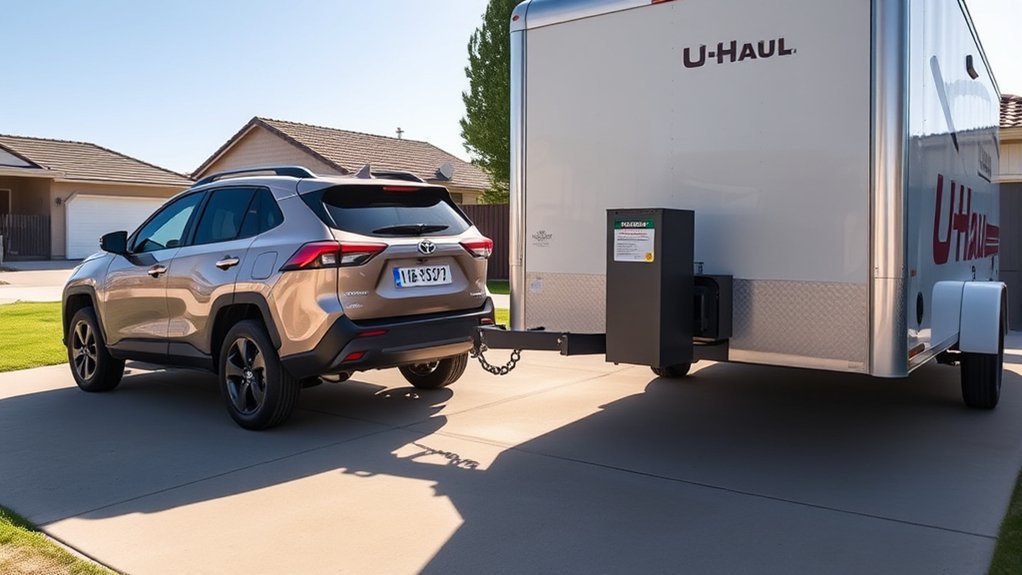
Inspect the RAV4, hitch, trailer, tires, lights, brakes, and cargo before every trip and again at each fuel or rest stop.
Pre-Towing Vehicle Inspection
- Set the RAV4’s cold tire pressures to the values on its tire-and-loading label unless Toyota gives a different towing instruction.
- Inspect tread, sidewalls, wheel condition, and visible fasteners.
- Check engine coolant, warning lights, and brake operation.
- Confirm that the mirrors provide a clear view along both sides of the trailer.
- Read the owner’s manual section covering driver-assistance systems while towing.
- Do not tow with a compact temporary spare installed if the owner’s manual prohibits it.
Trailer and Hitch Inspection
U-Haul lists several requirements for the 4′ x 8′ cargo trailer:
- A 1 7/8-inch or 2-inch hitch ball.
- A hitch-ball rating of at least 2,000 lbs.
- A maximum allowable hitch-ball height of 25 inches.
- Working tow-vehicle and trailer lighting.
- External mirrors on both sides of the tow vehicle.
- A hard top when the tow vehicle is an SUV.
- A tow vehicle curb weight greater than the loaded trailer weight.
Warning: U-Haul’s 2,000-lb hitch-ball specification is a minimum, not permission to tow 2,500 lbs with a 2,000-lb-rated component. The receiver, ball mount, hitch ball, pin, and every other component must meet or exceed the trailer’s actual loaded weight.
Ask the rental representative to confirm the trailer’s service-brake equipment. If brakes are fitted, confirm that they operate as intended and that the required connections are complete.
Proper Load Distribution
Load about 60% of the cargo weight in the front half of the trailer. Keep heavy items low, balanced from side to side, and secured. After loading, look at the complete combination from the side. The trailer should be level, and the RAV4 should not show severe rear suspension sag.
Severe sag can indicate excessive tongue weight, an overloaded vehicle, an unsuitable ball height, or improperly positioned cargo. Do not attempt to correct it by moving heavy cargo behind the trailer axle.
Safety Chain Requirements
Cross the safety chains under the trailer tongue before attaching them to permanent structural attachment points on the tow vehicle. Do not attach the chains to the hitch ball or another removable part.
Leave enough slack for full turns without allowing the chains to drag. Attach any separate emergency-brake or breakaway cable according to the trailer instructions.
What Towing Techniques Ensure Safety on the Road?
Safe towing requires lower speed, longer stopping distance, wider turns, smooth steering, and early planning. U-Haul recommends towing at 55 mph or less and reducing speed further for curves, crosswinds, construction, rough pavement, and poor weather.
Keep at least four seconds between your RAV4 and the vehicle ahead. Increase the gap to at least five seconds in rain, snow, or fog.
| Driving Situation | What to Do |
|---|---|
| Normal cruising | Stay at 55 mph or below with a U-Haul trailer and obey any lower posted towing limit. |
| Following traffic | Keep at least four seconds of space, or five seconds in adverse weather. |
| Turning | Turn wider and watch the trailer wheels so they do not strike a curb or cut across another lane. |
| Descending a hill | Reduce speed before the grade and select an appropriate lower range as described in the Toyota manual. |
| Passing | Allow substantially more time and distance for the longer, heavier combination. |
| Trailer sway | Release the accelerator gradually, hold the wheel straight, avoid abrupt steering or vehicle braking, and stop safely after the sway ends. |
What to Do If the Trailer Sways
- Hold the steering wheel firmly in a straight-ahead position.
- Release the accelerator gradually.
- Do not speed up.
- Do not make sudden steering corrections.
- Avoid applying the tow vehicle’s brakes while the combination is actively swaying, unless needed to avoid an immediate collision.
- After the sway stops, pull completely off the roadway in a safe location.
- Inspect the load, tongue weight, tire condition, hitch connection, and cargo inside the RAV4.
- Reload the trailer heavier in front and continue at a lower speed only after correcting the cause.
Parking on a Slope
Avoid parking the combination on a slope. When it cannot be avoided, keep the brake pedal applied while another adult places suitable wheel chocks under the RAV4 and trailer wheels. Let the chocks take the load before setting the parking brake firmly and shifting to Park. Follow the exact sequence in your owner’s manual.
How to Prepare Your RAV4 for Towing
Prepare the RAV4 before the rental date instead of assuming the rental location can correct every problem.
- Read the trailer-towing section of the owner’s manual for your exact model year and powertrain.
- Check the vehicle’s main TWR and unbraked TWR.
- Read the door-jamb payload label and record the occupant-and-cargo allowance.
- Confirm that the receiver, ball mount, ball, pin, and wiring are installed correctly and have adequate ratings.
- Measure the hitch-ball height and confirm that the trailer will sit level.
- Enter the exact RAV4 information into U-Haul’s reservation system.
- Estimate the trailer cargo, vehicle cargo, passengers, and tongue weight.
- Plan to weigh the loaded setup before beginning a long trip.
- Choose a route with suitable fuel stops, parking areas, and fewer steep grades when practical.
New-Vehicle Break-In Rules
Toyota’s 2023 RAV4 manuals say not to tow during the first 500 miles of vehicle operation. For the following 500 miles of towing, Toyota recommends staying below 45 mph and avoiding full-throttle acceleration. Check the manual for your model year because instructions may change.
Maintenance When Towing
Towing places extra load on the engine, hybrid system, transmission, brakes, tires, suspension, and cooling system. Toyota notes that a vehicle used for towing may require more frequent maintenance. The 2023 manuals also instruct owners to recheck the towing-ball and bracket fasteners after approximately 600 miles of trailer towing.
Note: Some Toyota driver-assistance and parking systems may need to be disabled or may operate differently while towing. Follow the instructions for the exact RAV4 rather than relying on a list written for another trim or model year.
Top 5 Mistakes When Towing With a RAV4
- Using only the advertised towing capacity: Check the main TWR, unbraked TWR, payload, GVWR, GAWR, and GCWR for your exact RAV4.
- Counting only the empty trailer: Include boxes, furniture, appliances, tie-down equipment, and everything else carried by the trailer.
- Ignoring tongue weight and vehicle payload: Passengers, luggage, accessories, and tongue weight all use the RAV4’s occupant-and-cargo allowance.
- Using underrated or incorrectly installed hardware: The receiver, ball mount, hitch ball, pin, chains, wiring, and coupler must suit the actual loaded trailer.
- Driving as though the trailer is not there: Slow down, leave more space, turn wider, avoid cruise control, and inspect the combination at every stop.
What Real-World RAV4 Towing Reports Can Tell You
Owner reports can help explain how a RAV4 feels while towing, but they cannot establish a safe weight limit. Two drivers with the same trailer may have different results because of cargo weight, tongue weight, tires, elevation, wind, temperature, traffic, and driving technique.
Treat statements such as “it pulled fine” as one person’s experience, not proof that the combination complied with Toyota’s or U-Haul’s requirements.
| Common Real-World Observation | How to Use That Information |
|---|---|
| A lightly loaded small trailer feels stable | Confirm that the measured weight, tongue weight, and all ratings were actually within their limits. |
| The trailer sways after loading | Stop and inspect cargo placement, tongue weight, tires, hitch height, and vehicle cargo instead of trying to drive through it. |
| Fuel economy drops | Plan additional fuel or charging stops and allow more travel time. |
| The combination feels better at lower speed | Follow U-Haul’s 55-mph recommendation and reduce speed further when conditions require it. |
| The rear of the RAV4 sags | Check payload, tongue weight, ball height, and cargo placement before driving. |
Frequently Asked Questions
Can I tow a U-Haul trailer with my Toyota RAV4?
Yes, when U-Haul approves the exact combination and the loaded trailer stays below the RAV4’s applicable braked or unbraked limit. You must also remain below payload, GVWR, GAWR, GCWR, trailer, hitch, and rental-contract limits.
Can a RAV4 tow a fully loaded 4′ x 8′ U-Haul trailer?
Only a RAV4 with a TWR of at least 2,500 lbs could qualify by trailer weight, and that is not automatic approval. The trailer needs service brakes when required by the vehicle manual, all hardware must be rated correctly, payload and combination weights must fit, and U-Haul must approve the setup. A measured load below the maximum provides more room for scale error.
How much cargo can I put in a 4′ x 8′ U-Haul behind a RAV4?
The 850-lb trailer leaves about 650 lbs under a 1,500-lb main TWR, 900 lbs under a 1,750-lb TWR, and 1,650 lbs under a 2,500-lb TWR. However, the 2023 RAV4 examples have a 1,000-lb unbraked limit, which may reduce the allowance to about 150 lbs when the trailer has no service brakes. Payload and other limits can reduce it further.
Can a Toyota RAV4 tow a 5′ x 8′ U-Haul trailer?
The 5′ x 8′ trailer weighs about 900 lbs empty and has a 2,700-lb maximum gross weight. It may be approved with a limited load for some RAV4 configurations, but it cannot be fully loaded behind a RAV4 rated at 2,500 lbs or less. Brake status and U-Haul’s vehicle-specific validation are essential.
Does a U-Haul trailer need brakes behind a RAV4?
Toyota’s 2023 RAV4 manuals require trailer service brakes when gross trailer weight exceeds the 1,000-lb unbraked TWR. State or provincial law may impose an additional requirement. Confirm the assigned trailer’s brake system with U-Haul before loading.
What should I do if the trailer starts to sway?
Release the accelerator gradually, hold the steering wheel straight, and avoid abrupt steering or vehicle braking while the sway is active. After it stops, pull over safely and inspect the cargo, tongue weight, tires, hitch, and vehicle load before continuing at a lower speed.
Can I use cruise control while towing a U-Haul trailer?
U-Haul does not recommend cruise control while towing. Control the speed manually so you can react earlier to grades, traffic, curves, crosswinds, and trailer movement. Follow the Toyota manual for transmission-range and driver-assistance instructions.
Safety Disclaimer: This article provides general towing information. Always follow the owner’s manual and labels for your exact Toyota RAV4, the trailer and hitch instructions, U-Haul’s rental contract, and all applicable laws. Do not tow when any required weight, brake, equipment, or operating condition is not satisfied.
Conclusion
A Toyota RAV4 can tow an approved U-Haul trailer, but the safe cargo allowance may be much lower than the advertised towing capacity suggests. The 4′ x 8′ trailer weighs 850 lbs empty, and the 2023 RAV4 examples have a 1,000-lb unbraked limit. That can leave only about 150 lbs for cargo when the assigned trailer has no service brakes.
Identify the exact vehicle rating, confirm the trailer’s brake equipment, calculate payload and tongue weight, inspect every hitch component, and obtain U-Haul’s approval. Load the trailer heavier in front, secure the cargo, stay at 55 mph or less, and stop immediately if the combination becomes unstable.
Sources
- 2023 Toyota RAV4 eBrochure — 2023 trim towing capacities, curb weights, payload, GVWR, and model specifications
- 2026 Toyota RAV4 Specifications — current maximum advertised towing capacity
- Toyota Owner’s Manuals and Warranties — model-specific TWR, unbraked TWR, payload, tongue-weight, break-in, and towing instructions
- U-Haul 4′ x 8′ Cargo Trailer Rental — trailer weight, cargo capacity, hitch-ball, lighting, mirror, speed, and tow-vehicle requirements
- U-Haul Trailer User Instructions — loading, safety chains, following distance, speed, inspection, and sway response
- U-Haul Cargo Trailer Size Guide — 4′ x 8′, 5′ x 8′, and 6′ x 12′ trailer weights and cargo limits