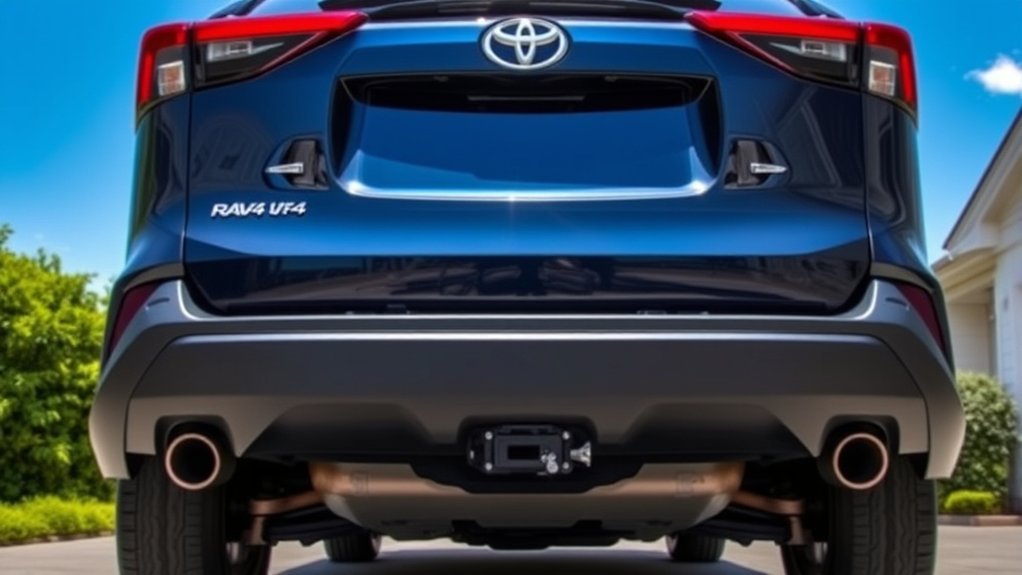
Yes, you can install a hitch receiver on a Toyota RAV4 Hybrid for a bike rack, cargo carrier, or trailer. The important part is matching the hitch and equipment to your exact model year, trim, and drivetrain. This became especially important for 2026, when Toyota increased the towing capacity of several AWD Hybrid grades.
Quick Answer
A Toyota RAV4 Hybrid can use a frame-mounted hitch receiver. The 2025 Hybrid is rated to tow up to 1,750 pounds, while certain 2026 AWD Hybrid grades are rated up to 3,500 pounds. Most trims need an accessory hitch, but the 2026 Woodland includes a standard 2-inch receiver.
Key Takeaways
- A hitch can be added to most RAV4 Hybrid model years, but fitment must match the exact year and trim.
- The 2019–2025 RAV4 Hybrid is generally rated at 1,750 pounds in the U.S.; several 2026 AWD grades are rated at 3,500 pounds.
- A hitch with a higher rating does not increase the vehicle’s towing capacity.
- A bike rack normally needs only the receiver, while trailer towing also requires suitable wiring, a ball mount, safety chains, and possibly trailer brakes.
- A hitch can affect the hands-free liftgate sensor, so confirm compatibility before installation and test the sensor afterward.
At a Glance
| Time Required | About 1–3 hours for many bolt-on installations; longer when fascia trimming, sensor work, or trailer wiring is required. |
| Difficulty | Moderate. Some aftermarket receivers are no-drill, but safely lifting and torquing the hitch can require two people or professional equipment. |
| Tools Needed | Safety glasses, sockets, ratchet, extensions, torque wrench, exhaust support, trim tools, and the tools listed by the hitch or wiring-kit manufacturer. |
| Cost | As a dated example, Toyota listed its 2025 receiver at $555, the towing harness at $240, and a 2-inch trailer ball at $24 before labor. Current pricing varies by model year, hitch, dealer, and installer. |
What Is a Hitch Receiver and Why Does It Matter?
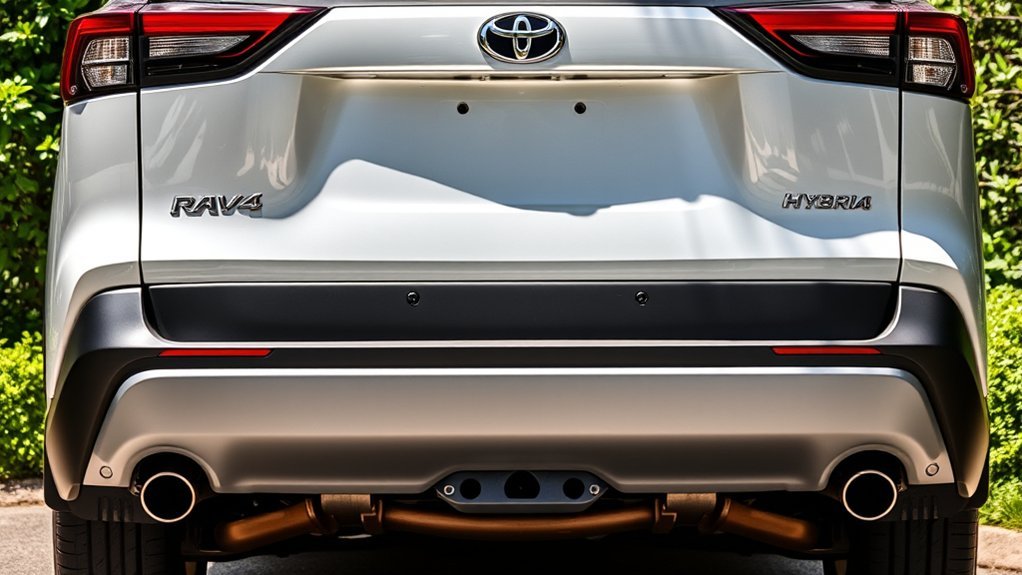
A hitch receiver is a frame-mounted steel assembly with a square opening that accepts a bike rack, cargo carrier, ball mount, or other compatible accessory. It gives the RAV4 Hybrid more carrying flexibility without placing equipment on the roof.
Two receiver sizes are common:
- 1.25-inch receiver: Usually suitable for lighter bike racks and cargo accessories. Accessory selection and load capacity can be more limited.
- 2-inch receiver: Offers a wider range of racks, cargo carriers, ball mounts, and anti-rattle devices. Most current Class III RAV4 hitches use this size.
A hitch manufacturer may rate its receiver for more weight than the RAV4 can tow. That does not increase the vehicle’s rating. The usable limit is always the lowest rating among the vehicle, receiver, ball mount, hitch ball, trailer, rack, and other installed components.
Installing a stronger hitch does not turn a 1,750-pound RAV4 Hybrid into a 3,500-pound tow vehicle. The vehicle’s model-year, trim, and drivetrain rating still controls.
Can You Install a Hitch on a RAV4 Hybrid?
Yes. Toyota offers genuine towing components, and several established hitch manufacturers offer receivers for specific RAV4 Hybrid model years. Some aftermarket products attach to existing frame weld nuts without drilling, while other installations may require lowering the exhaust, trimming a small section of fascia, relocating sensor wiring, or removing rear bumper panels.
What to Check Before Buying
- Confirm the model year. A hitch made for a 2019–2025 RAV4 may not fit the redesigned 2026 body.
- Confirm Hybrid fitment. Do not assume a hitch listed for a gasoline RAV4 automatically fits the Hybrid or Plug-in Hybrid.
- Check the receiver size. Match the opening to the rack, carrier, or ball mount you intend to use.
- Read the installation instructions. Check for drilling, fascia trimming, exhaust lowering, sensor relocation, and required torque values.
- Check kick-sensor notes. Confirm whether the hands-free liftgate remains functional, requires a replacement sensor, or must be switched off.
- Plan the wiring. Trailer towing requires a compatible lighting converter and connector. A basic bike rack may not.
Pro Tip: Search using the vehicle’s exact year, trim, drivetrain, and powertrain. Confirm fitment again with the hitch manufacturer or Toyota dealer before ordering.
What Is the Towing Capacity of the RAV4 Hybrid?
The towing capacity depends on the model year and, beginning in 2026, the drivetrain and trim. Toyota’s current 2026 information lists a maximum of 3,500 pounds for specific AWD Hybrid grades. The 2025 RAV4 Hybrid owner’s manual lists a 1,750-pound trailer weight rating.
Check the current Toyota RAV4 specifications and the owner’s manual supplied with your exact vehicle before towing.
RAV4 Hybrid Tow Ratings by Model Year and Trim
| Model | Drivetrain | Maximum Trailer Rating | Important Note |
|---|---|---|---|
| 2019–2025 RAV4 Hybrid | Electronic On-Demand AWD | Up to 1,750 lbs | Confirm the exact year in its owner’s manual. |
| 2026 LE | FWD or AWD | Up to 1,750 lbs | The LE AWD does not receive the higher 3,500-pound rating. |
| 2026 XLE Premium | FWD | Up to 1,750 lbs | FWD models retain the lower rating. |
| 2026 XLE Premium | AWD | Up to 3,500 lbs | Requires appropriate towing equipment. |
| 2026 SE | FWD | Up to 1,750 lbs | FWD rating differs from the SE AWD. |
| 2026 SE | AWD | Up to 3,500 lbs | Verify the exact vehicle configuration. |
| 2026 Woodland | AWD | Up to 3,500 lbs | Includes a standard 2-inch tow hitch receiver. |
| 2026 XSE | AWD | Up to 3,500 lbs | Use the exact manual and door labels when loading. |
| 2026 Limited | AWD | Up to 3,500 lbs | The complete towing setup must support the load. |
The previous-generation RAV4 Hybrid produced 219 combined horsepower and came with electronic AWD. The redesigned 2026 model offers 226 combined horsepower with FWD and 236 horsepower with AWD, so older specifications should not be applied to the new generation.
Factors That Affect Safe Towing Capacity
The published trailer rating is only one part of the calculation. You must also remain within the vehicle and component limits shown in the owner’s manual and on the certification and tire-loading labels.
- TWR: The gross weight of the trailer and everything loaded inside it.
- GCWR: The maximum combined weight of the loaded vehicle and loaded trailer.
- GVWR: The maximum permitted weight of the loaded RAV4 itself.
- GAWR: The maximum weight permitted on each axle.
- Payload: Passengers, luggage, installed accessories, and trailer tongue weight all use available payload.
- Tongue weight: The downward load applied to the hitch ball or receiver.
For the 2025 RAV4 Hybrid, Toyota specifies a 1,000-pound unbraked trailer limit and recommends that tongue weight equal 9%–11% of the loaded trailer weight. A 1,750-pound trailer would therefore place approximately 158–193 pounds on the hitch when loaded within that range. Requirements may differ for 2026, so use the manual for the exact vehicle.
Warning: Never use the hitch’s advertised rating as the vehicle’s towing rating. Stay below every applicable TWR, GCWR, GVWR, GAWR, payload, tongue-weight, tire, hitch, ball-mount, and trailer limit. The lowest limit controls.
OEM vs. Aftermarket RAV4 Hitches
Both Toyota genuine and reputable aftermarket hitches can work well when they are designed for the exact RAV4 Hybrid. The better choice depends on receiver position, installation requirements, sensor compatibility, cost, and how you plan to use it.
| Feature | Toyota Genuine Hitch | Aftermarket Hitch |
|---|---|---|
| Fitment | Designed around specified Toyota models and factory mounting locations. | Varies by manufacturer and part number; exact Hybrid fitment must be confirmed. |
| Receiver position | Often integrated higher into the bumper for a factory appearance and ground clearance. | Can sit below or partly behind the fascia, depending on design. |
| Installation | May require bumper-panel removal, cutting, wiring, and sensor-related parts. | Some products are simple bolt-on installations; others require trimming or exhaust lowering. |
| Kick sensor | May require a hitch-compatible sensor, relocation, reconfiguration, or deactivation. | Some designs preserve operation, but performance is not guaranteed across every trim and installation. |
| Warranty | Covered under applicable Toyota genuine-parts terms when purchased and installed as required. | Covered by the hitch manufacturer’s warranty; damage caused by a faulty part or improper installation may not be covered by Toyota. |
| Best for | Owners prioritizing factory integration and Toyota-supported components. | Owners prioritizing receiver choice, easier installation, or a lower-profile design. |
Common Kick-Sensor Challenges During Hitch Installation
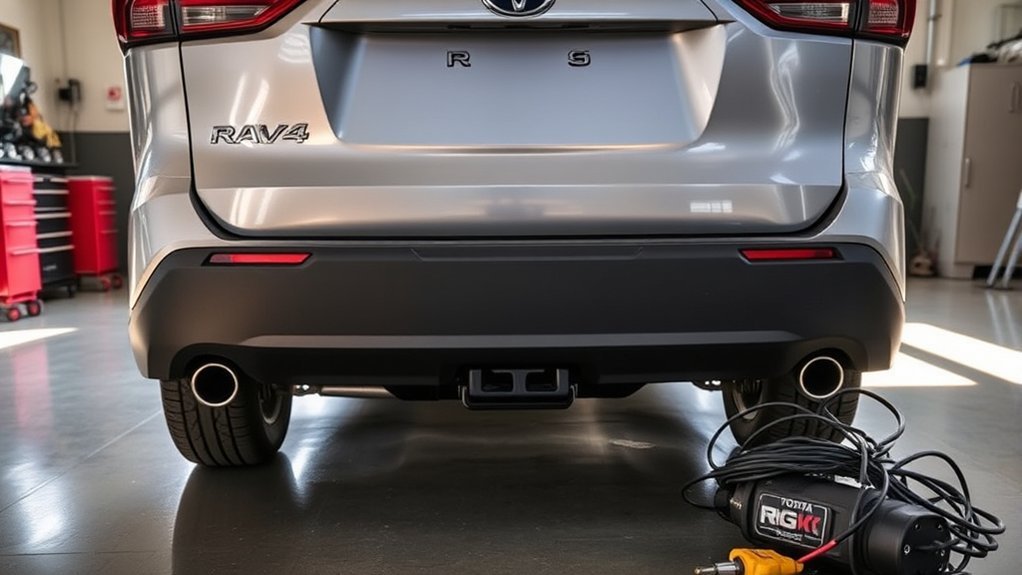
The hands-free liftgate sensor is mounted near the rear bumper, which is also where the hitch receiver and wiring must pass. Toyota warns that a hitch or another rear-bumper accessory may require the sensor to be disabled, removed, relocated, or replaced.
Toyota also sells a genuine tow-hitch kick sensor for applicable vehicles. Fitment must be checked by VIN because sensor parts differ by model and equipment package.
| Challenge | Possible Effect | Best Response |
|---|---|---|
| Receiver crosses the sensor’s detection area | Sensor works only in a smaller area or stops responding | Follow the hitch and Toyota sensor instructions; do not improvise sensor placement. |
| Sensor wiring conflicts with fascia cutting | Wiring can be pinched, stretched, or damaged | Unclip and protect the wiring before cutting or moving fascia components. |
| Wrong sensor or hitch combination | Intermittent or completely lost hands-free operation | Confirm the parts by VIN and model year before installation. |
| Sensor is intentionally disabled | Power liftgate still works from the button or key, but not by foot motion | Confirm the vehicle setting and explain the change to every regular driver. |
Note: Test the kick sensor, parking sensors, backup camera, liftgate, trailer lights, and nearby wiring before accepting the completed installation.
What Do Users Say About Installing Hitches on RAV4 Hybrids?
Owner reports can help identify common fitment issues, but they should not replace product instructions or official vehicle limits. Installation experiences differ because RAV4 model years, bumper designs, kick sensors, hitch brands, tools, and installer skill all vary.
Successful Installations Reported Online
Many product-specific installation reports describe successful bolt-on installations. Common themes include:
- Existing mounting points: Several aftermarket hitches use factory frame weld nuts without drilling.
- Exhaust access: Lowering or supporting part of the exhaust may be required to reach the mounting points.
- Second-person assistance: A hitch is heavy and awkward to hold while starting the bolts.
- Fascia trimming: Some hidden or higher-mounted receivers require a small, accurately measured cut.
- Torque control: Mounting bolts must be tightened to the manufacturer’s specified value.
- Sensor testing: Kick-sensor performance should be checked after the receiver and fascia are in their final positions.
For example, CURT’s installation instructions for a compatible RAV4 hitch describe an easy, no-drill installation using existing weld nuts, common sockets, and a torque wrench. That procedure applies only to the listed hitch and compatible model years, not every RAV4 receiver.
Complications With Wiring and Kick Sensors
A receiver used only for a basic bike rack or cargo carrier may not need a trailer-light harness. Trailer towing is different. The trailer must have functioning lights, and Toyota’s genuine receiver documentation states that the appropriate towing wire harness is required and sold separately.
Do not directly splice trailer lighting into the RAV4’s wiring unless an approved installation procedure specifically calls for it. Use a vehicle-specific powered converter or Toyota towing converter designed to protect the vehicle’s electrical system.
What Equipment Do You Need?
For a Bike Rack
- Receiver hitch that fits the exact RAV4 Hybrid
- Compatible rack shank size
- Hitch pin or locking pin
- Anti-rattle device if recommended
- Rack and bicycle weight below the allowed tongue and accessory limits
Check liftgate clearance before opening the hatch. If bicycles or the rack cover the license plate or taillights, additional lighting or a different rack position may be required under local law.
For a Cargo Carrier
- Compatible receiver and carrier
- Hitch pin and anti-rattle device
- Secure straps or tie-downs
- Weatherproof cargo protection when needed
- Enough rear-axle and payload capacity for the carrier and its load
The carrier’s entire weight acts behind the vehicle and adds to rear-axle load. Hitch extensions also increase leverage and may reduce the usable capacity stated by the hitch or accessory manufacturer.
For Trailer Towing
- Vehicle-specific receiver hitch
- Correct-rise or correct-drop ball mount
- Properly sized and rated hitch ball
- Rated hitch pin and clip
- Vehicle-specific trailer-light converter and connector
- Crossed safety chains
- Trailer brakes and a compatible brake-control arrangement when required
- Breakaway equipment where required
- Proper mirrors if the trailer blocks the normal rearward view
The Toyota genuine tow hitch receiver documentation states that its towing wire harness is required and sold separately. Toyota’s RAV4 towing converter integrates trailer lighting with the vehicle electrical system.
How Much Does It Cost to Add a Hitch?
The total cost depends on the model year, receiver design, wiring, kick-sensor requirements, shop rate, and whether bumper panels must be removed or trimmed. A simple rack-only installation normally needs fewer parts than a complete trailer-towing setup.
As a verified 2025 example, Toyota listed:
- Tow hitch receiver: $555 MSRP
- Towing wire harness: $240 MSRP
- 2-inch trailer ball: $24 MSRP
Those figures did not include taxes, shipping, dealer charges, installation, a possible kick-sensor part, or other towing equipment. Current Toyota, 2026, aftermarket, and local labor prices may be different.
Get a written quote that identifies:
- The exact hitch manufacturer and part number
- Receiver size
- Wiring kit or converter
- Fascia cutting or bumper removal
- Kick-sensor work
- Labor
- Warranty coverage
- Post-installation testing
Tips for Choosing the Right Hitch
- Start with the intended use. A two-bike rack has different needs from a 3,000-pound trailer.
- Confirm exact fitment. Check the year, Hybrid powertrain, drivetrain, trim, and any hands-free liftgate equipment.
- Choose the receiver size. A 2-inch receiver usually provides the broadest accessory selection.
- Check ground clearance. A low receiver can scrape on steep driveways or trails.
- Check accessory clearance. Confirm the rack or carrier clears the bumper, exhaust, liftgate, and spare-access area.
- Compare installation procedures. Look for drilling, trimming, exhaust work, panel removal, and sensor relocation.
- Use the lowest rating. Never exceed the weakest component or vehicle limit.
Safe Towing Practices With a Toyota RAV4 Hybrid
Towing changes acceleration, braking distance, steering response, fuel consumption, and vehicle stability. Read the trailer-towing section of the owner’s manual before the first trip, even if you have towed with another vehicle.
Pre-Trip Checklist
- Confirm the loaded trailer weight and tongue weight.
- Confirm vehicle payload, GVWR, GAWR, and GCWR limits.
- Check the receiver, ball mount, ball, pin, and fasteners.
- Cross the safety chains beneath the trailer coupler.
- Connect the breakaway cable separately from the safety chains when equipped.
- Test brake lights, turn signals, running lights, and electric trailer brakes.
- Check vehicle and trailer tire pressure while the tires are cold.
- Confirm the coupler is locked and the jack is fully raised.
- Secure all trailer and vehicle cargo.
- Make sure the trailer sits level or close to level.
Driving With a Trailer
- Accelerate, steer, and brake gradually.
- Allow substantially more stopping distance.
- Take wider turns so the trailer wheels do not strike curbs.
- Reduce speed in rain, crosswinds, rough pavement, and downhill sections.
- Do not use cruise or driver-assistance systems when the owner’s manual says they are unsuitable for towing.
- Stop after a short distance to recheck the coupler, lights, chains, cargo, and hitch.
- Recheck the hitch and trailer at fuel and rest stops.
The 2025 RAV4 Hybrid manual says not to exceed 65 mph, the posted towing limit, or the trailer manufacturer’s limit, whichever is lower. It also warns against sudden braking, abrupt steering, towing with a compact spare tire, and exceeding the unbraked trailer limit. Follow the exact instructions for your model year because the 2026 vehicle uses a different platform and safety system.
Warning: A trailer over the applicable unbraked limit needs service brakes. Brake, safety-chain, breakaway, lighting, mirror, and speed requirements can also vary by state or province.
Post-Installation Maintenance
- Inspect the receiver and mounting hardware periodically.
- Look for loose bolts, corrosion, cracked coating, bent parts, and wiring damage.
- Keep the receiver opening clean and use a protective plug when practical.
- Check the rack, carrier, or ball mount for movement before every trip.
- Have the installation inspected after any collision, hard impact, or severe scraping event.
Where Can You Get a RAV4 Hybrid Hitch Installed?
You can use a Toyota dealer, independent hitch specialist, qualified repair shop, or a national hitch-installation service. The installer matters as much as the hitch because correct torque, wiring protection, fascia cutting, and sensor handling affect safety and long-term reliability.
Authorized Dealer Options
A Toyota dealer is a practical choice when you want Toyota genuine parts, factory-style integration, or a hitch-compatible kick-sensor solution. Ask the dealer:
- Which hitch and sensor part numbers fit the VIN?
- Is a wiring converter included?
- Will the kick sensor continue to operate?
- Is fascia cutting required?
- What parts and labor warranties apply?
- Will all liftgate, camera, parking, and lighting functions be tested?
Local Garage and Hitch Services
Independent hitch specialists and services such as U-Haul may offer aftermarket receivers and installation. Before booking, confirm that the shop has worked on the same RAV4 Hybrid generation and understands its electrical and kick-sensor layout.
Ask the shop to list the hitch part number, receiver size, wiring kit, expected fascia changes, sensor effects, labor cost, and warranty in writing. Do not select an installer only because it offers the lowest labor quote.
Frequently Asked Questions
Does the RAV4 Hybrid come with a hitch?
Most RAV4 Hybrid trims do not include a receiver as standard equipment, so one must be added. An important exception is the 2026 Woodland Hybrid, which Toyota equips with a standard 2-inch tow hitch receiver.
What year of RAV4 should you stay away from?
No RAV4 Hybrid model year should be rejected solely because of its year. Check the vehicle’s VIN for open recalls, review maintenance and repair records, confirm that recall work was completed, inspect the hybrid and cooling systems, and arrange an independent pre-purchase inspection. Current recall information is available through the NHTSA recall lookup.
What are the disadvantages of towing with a RAV4 Hybrid?
Towing reduces fuel economy and acceleration, increases braking distance, uses available payload, and places more load on the tires, cooling system, brakes, and rear axle. Models rated at 1,750 pounds also have less trailer capacity than larger SUVs. The 2026 AWD Hybrid lineup improves capacity on selected grades, but it still requires careful loading and the correct equipment.
Can you tow a trailer with a Toyota RAV4 Hybrid?
Yes. The 2025 RAV4 Hybrid is rated up to 1,750 pounds, and selected 2026 AWD Hybrid grades are rated up to 3,500 pounds. Use a compatible receiver, wiring, ball mount, safety chains, and trailer brakes when required. Confirm the exact rating and instructions in the owner’s manual for the vehicle.
Conclusion
A Toyota RAV4 Hybrid can be equipped with a useful hitch receiver for bicycles, cargo, or trailer towing. The correct setup depends on the exact model year and trim. The 2025 Hybrid is rated at 1,750 pounds, while selected 2026 AWD grades reach 3,500 pounds and the 2026 Woodland includes a standard 2-inch receiver.
Choose a receiver that fits the vehicle, account for the kick sensor and wiring, and stay below every vehicle and component limit. A careful installation, accurate weight calculation, and complete pre-trip inspection are more important than choosing between an OEM and aftermarket label.
Sources
- Toyota: The Next Adventure Begins—2026 RAV4 Arrives This Winter — 2026 Hybrid trims, drivetrains, horsepower, towing capacities, and Woodland equipment.
- Toyota 2025 RAV4 Hybrid Owner’s Manual — towing limits, tongue weight, trailer brakes, speed guidance, safety chains, and loading precautions.
- Toyota Genuine Tow Hitch Receiver With Ball Mount — genuine receiver description and separate wiring-harness requirement.
- Toyota RAV4 Tow Hitch Converter — trailer-light integration and kick-sensor accessory warning.
- Toyota Kick Sensor Guide — hands-free liftgate operation for applicable RAV4 model years.
- CURT RAV4 Hitch Installation Manual — example of a no-drill, bolt-on aftermarket installation and required tools.