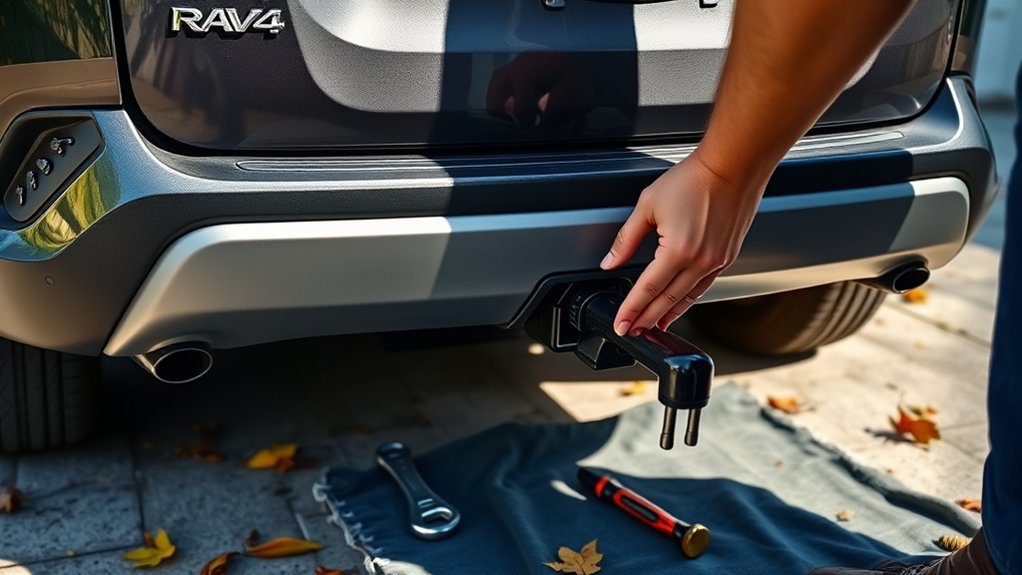
Installing a trailer hitch on a Toyota RAV4 can be a simple factory-weld-nut job or a more involved bumper-removal project, depending on the vehicle year and hitch design. Many 2019–2025 fifth-generation hitches share similar mounting points, but the redesigned sixth-generation 2026 RAV4 requires a hitch specifically approved for that model. Always match the receiver and instructions to your exact year, trim, powertrain, and intended use.
Quick Answer
Buy a hitch listed for your exact RAV4. Some receivers bolt directly to factory weld nuts with no cutting, while OEM or hidden designs may require exhaust lowering, bumper removal, or fascia trimming. Hand-start every fastener, torque it to the kit specification, and inspect the hitch, exhaust, sensors, and wiring before towing.
Key Takeaways
- Confirm the model year, trim, powertrain, production details, and hitch part number before buying.
- Do not copy fascia dimensions or torque values from another RAV4 hitch kit.
- Support the exhaust if the instructions tell you to lower it, and hand-start all bolts to prevent cross-threading.
- A receiver’s rating does not increase the towing or tongue-weight limit of the RAV4.
- Install and test the correct wiring system if you will tow a trailer with lights or electric brakes.
- Check hands-free liftgate kick-sensor compatibility on equipped trims.
At a Glance
| Time Required | About 1–2 hours for a simple bolt-on receiver; several hours for a bumper-integrated or high-clearance installation |
| Difficulty | Easy to advanced, depending on bumper removal, fascia trimming, wiring, and sensor work |
| Tools Needed | Metric sockets, ratchet, torque wrench, eye protection, exhaust support, trim tools, and any kit-specific adapter or cutting tool |
| Cost | Varies widely by receiver style, wiring system, sensor changes, and local labor rates |
Step-by-Step Guide to Installing a Trailer Hitch on Your RAV4
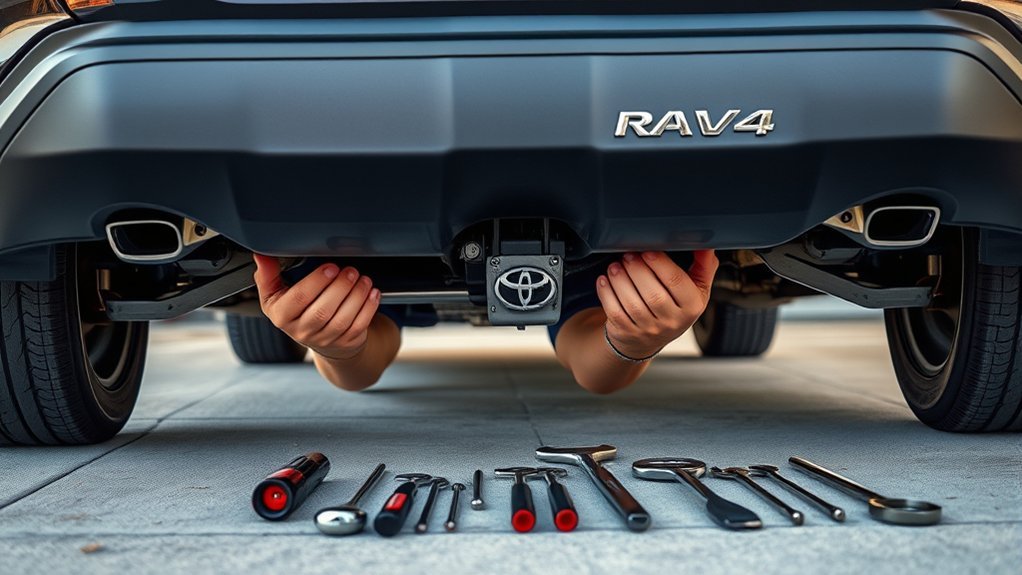
A Toyota RAV4 trailer hitch installation usually starts with checking the kit contents, exposing the frame mounting points, raising the receiver into position, hand-starting the hardware, and applying the specified torque. The exact work around those steps depends on the receiver design.
A basic below-bumper aftermarket hitch may use four existing weld nuts and require little disassembly. A hidden or high-clearance hitch may require exhaust lowering and a small fascia opening. A bumper-integrated OEM-style receiver can require removal of the bumper cover, additional brackets, and a larger trim operation.
Warning: Do not begin cutting, drilling, or torquing hardware until you have confirmed that the instruction manual and hitch part number match your exact RAV4. Instructions for a 2019–2025 model should not be assumed to fit the redesigned 2026 RAV4.
Confirm Your RAV4 Year, Fitment, and Towing Limits
Before ordering a receiver, use the hitch manufacturer’s vehicle lookup and compare the result with your registration, VIN, trim, drivetrain, and powertrain. Gas, Hybrid, Plug-in Hybrid, hands-free liftgate, and production-location differences can affect fitment or installation steps.
- Model year and generation: Verify whether you have a 2019–2025 fifth-generation RAV4 or a redesigned 2026 model.
- Trim and powertrain: Check gas, Hybrid, or Plug-in Hybrid compatibility and whether the vehicle is front-wheel drive or all-wheel drive.
- Receiver size: Confirm whether your rack, ball mount, or cargo carrier uses a 1-1/4-inch or 2-inch shank.
- Intended use: Towing, bike racks, mobility carriers, and cargo trays can have different receiver and tongue-load needs.
- Liftgate equipment: Check whether a hands-free kick sensor must be moved, disabled, or removed.
- Vehicle limits: Read the towing and payload sections of the Toyota owner’s manual for your exact vehicle.
Toyota’s published 2026 specifications show why exact trim verification matters: some 2026 configurations have a 1,750-pound towing limit, while several AWD grades are rated up to 3,500 pounds. The receiver installed under the bumper does not override the vehicle’s grade-specific limit.
Your usable limit is the lowest rating among the RAV4, receiver hitch, ball mount, hitch ball, trailer, rack, carrier, and any adapter.
OEM vs. Aftermarket Hitches: Which Is Best for Your RAV4?
Choosing between an original equipment manufacturer hitch and an aftermarket hitch depends on appearance, clearance, installation complexity, receiver size, accessory compatibility, and budget. Neither category is automatically best for every RAV4 owner.
Toyota’s bumper-integrated receiver typically gives a factory-style appearance and keeps the receiver higher, but installation may require more rear-bumper disassembly and trimming. Toyota currently lists the PK960-42R10 receiver as a replacement for PK960-42K10, but fitment still needs to be checked for the exact vehicle.
Aftermarket receivers from companies such as CURT, Draw-Tite, EcoHitch, and U-Haul may offer simpler below-bumper mounting or concealed high-clearance designs. A basic receiver may sit lower than the factory-style hitch, while a hidden design may require fascia trimming.
| Hitch Type | Typical Installation | Best For | Main Tradeoff |
|---|---|---|---|
| OEM bumper-integrated hitch | May require bumper-cover removal, brackets, fascia trimming, and kick-sensor changes | Factory appearance and higher receiver placement | More labor and disassembly |
| Basic below-bumper aftermarket hitch | Often bolts to factory weld nuts with little or no fascia cutting | Faster installation and broad availability | Lower receiver can reduce rear clearance |
| Hidden or high-clearance aftermarket hitch | May require exhaust lowering and a measured fascia opening | Cleaner appearance and improved clearance | More cutting and a longer installation |
Note: Manufacturer instructions can differ even when two hitches fit the same RAV4. For example, the current CURT 13615 manual uses existing weld nuts and specifies 86 ft-lbs for its M12 hardware, while the EcoHitch X7396 guide specifies 70 ft-lbs for its M12 hardware and includes fascia trimming.
What You’ll Need Before Installing a RAV4 Trailer Hitch
A successful trailer hitch installation requires the instructions and hardware supplied with the exact receiver, enough room to work safely, and tools that can reach the frame fasteners.
- Metric sockets and ratchet: Many fifth-generation kits use 17mm or 19mm sockets, but verify every size in your manual.
- Torque wrench: Use a range that covers the hitch maker’s published torque.
- Specified torque adapter or extension: Some passenger-side bolts have limited wrench clearance.
- Impact wrench, if desired: Use it only after the bolt has been started by hand for several turns. Never use it for final torque.
- Exhaust hanger pliers: These make rubber hanger removal easier when exhaust lowering is required.
- Exhaust support: Use a support strap, suitable stand, or stable block so the exhaust does not hang by unsupported joints.
- Trim-removal tools: Required for bumper covers, cargo panels, wiring, or kick-sensor access.
- Cutting and finishing tools: Use only when the manual provides a fascia template or dimensions.
- Safety glasses and gloves: Protect against falling debris, sharp fascia edges, and metal hardware.
- Helper or lifting support: A receiver can be heavy and awkward to hold under the bumper.
Plan on roughly one to two hours for a straightforward bolt-on receiver. A bumper-integrated or hidden hitch can take several hours because of bumper removal, measuring, trimming, wiring, and sensor work.
Preparing Your RAV4 for Hitch Installation
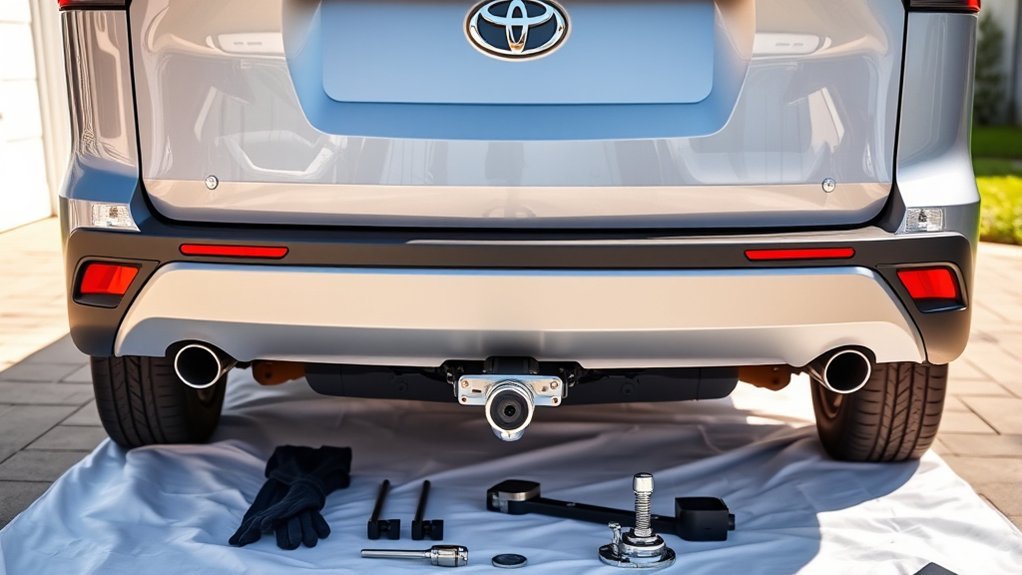
Park the RAV4 on a flat, solid surface, set the parking brake, let the exhaust cool fully, and chock the wheels. If the vehicle must be raised, use Toyota-approved lifting points and properly rated jack stands. Never work under a vehicle supported only by a jack.
Inspect the hitch, hardware, and instructions before removing vehicle parts. Compare every bolt, washer, nut, bracket, spacer, and trim piece with the kit’s parts list.
Remove stickers or plugs from the factory mounting holes. If the weld nuts contain dirt, corrosion, or undercoating, use the cleaning method recommended by the hitch maker. A small wire brush, suitable lubricant, or compressed air may be used, but do not damage the threads.
If the instructions require exhaust lowering, support the exhaust first. Use the hanger lubricant specified by the manual, then remove only the hangers needed to create working space.
| Preparation Task | What to Check |
|---|---|
| Secure the vehicle | Flat surface, parking brake, wheel chocks, cool exhaust, and safe lifting equipment |
| Verify the parts | Correct hitch number, complete hardware, undamaged side plates, and matching instructions |
| Prepare mounting points | Remove stickers and clean existing weld nuts without harming their threads |
| Support the exhaust | Lower it only when required and prevent stress on joints, wiring, or hangers |
| Mark the fascia | Use the exact template, centerline, and dimensions supplied with the hitch |
| Check sensors | Identify hands-free liftgate wiring or other rear-bumper equipment before cutting |
Trailer Hitch Installation: A Step-by-Step Walkthrough
Read the full hitch manual before starting. The following sequence explains the common workflow, but your kit may add bumper-cover removal, brackets, spacers, sensor changes, or other part-specific steps.
Required Tools and Equipment
Lay out the sockets, torque wrench, washers, bolts, brackets, and trim tools in the order they will be used. Keep the manual within reach and confirm whether any torque adapter changes the wrench setup recommended by the manufacturer.
- Secure the RAV4. Park on a level surface, set the parking brake, chock the wheels, and let the exhaust cool.
- Inspect the hitch and hardware. Stop if the receiver is damaged, the side plates do not match the vehicle, or supplied parts are missing.
- Remove required vehicle parts. Depending on the kit, this may include a tie-down bracket, lower fascia pieces, the bumper cover, or liftgate-sensor components.
- Support and lower the exhaust if required. Do not let the exhaust hang unsupported from pipes or joints.
- Expose and clean the mounting points. Remove stickers and debris from the factory weld nuts.
- Measure and trim only when required. Mark the centerline and follow the exact template or dimensions in the hitch instructions.
- Raise the hitch into place. Use a helper or suitable lifting support and keep wiring, exhaust parts, and body panels out of the way.
- Install the supplied fasteners. Place washers in the specified orientation and hand-start every bolt before tightening one side.
- Align and torque the receiver. Center the hitch, snug the fasteners evenly, and torque them in the sequence and to the value listed in the manual.
- Reinstall removed parts. Reattach the exhaust, bumper components, sensors, underbody panels, and wiring brackets.
- Inspect the finished installation. Check receiver alignment, fascia clearance, heat shields, exhaust movement, wiring, and sensor operation.
How to Secure the Hitch to the Frame
Raise the receiver slowly and align both side plates with the factory mounting points. Start every fastener by hand. A bolt that will not turn several complete threads by hand may be misaligned or entering a dirty weld nut.
Once all bolts are engaged, snug them gradually from side to side. Do not fully tighten one side while the other side is loose because this can pull the receiver out of alignment.
| Step | Action |
|---|---|
| 1. Align | Position the side plates against the correct frame mounting points |
| 2. Insert | Install only the supplied bolts, washers, spacers, and brackets |
| 3. Hand-start | Turn every bolt several full threads before using a powered tool |
| 4. Snug evenly | Draw the hitch against the frame gradually from side to side |
| 5. Torque | Apply the exact part-number-specific torque with a calibrated torque wrench |
| 6. Reinstall | Restore the exhaust, bumper parts, panels, and sensors |
Final Installation Checks Before You Tow
- Check every fastener. Confirm the correct washer orientation and final torque.
- Check the receiver. It should be centered, firmly mounted, and free from visible frame or fascia gaps.
- Check the exhaust and heat shields. Shake the exhaust gently and listen for contact with the receiver or shields.
- Check the bumper opening. Trimmed fascia should not press against or distort around the receiver.
- Check rear sensors. Test the liftgate and turn off a kick sensor that was removed or disabled according to Toyota’s instructions.
- Check the hitch accessory. Insert the ball mount, rack, or carrier and verify that the pin passes through without binding.
- Check the wiring. Test running lights, turn signals, brake lights, hazards, and any brake-controller functions.
- Check ground clearance. Make sure the receiver and accessory will not strike the pavement during normal driveway or ramp transitions.
Final Steps: Torque and Reattach Your Hitch
Torque is part-number-specific. Do not rely on a general RAV4 number or the bolt diameter alone because bolt grade, washer design, thread engagement, and receiver construction can differ.
For example, the EcoHitch X7396 installation guide specifies 70 ft-lbs for its M12 hardware and 96 in-lbs for its 1/4-inch bracket hardware. The current CURT 13615 installation manual specifies 86 ft-lbs for its M12 fasteners. Use only the value supplied for your receiver.
After tightening the hardware, reinstall the exhaust onto its rubber hangers and inspect the heat shields. If a manufacturer’s instructions allow a shield to be repositioned to prevent rattling, make only the adjustment described in that manual.
Pro Tip: Keep the installation manual and torque specification with your vehicle records. Reinspect the receiver after the first towing trip and at the interval recommended by the hitch manufacturer.
Do You Need Wiring for Towing With Your RAV4?
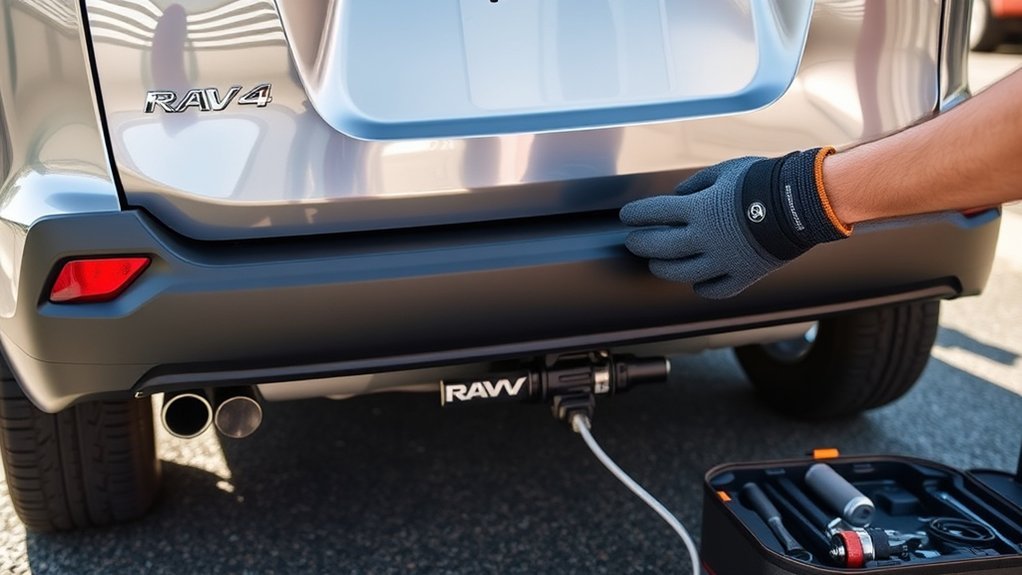
You need trailer wiring when the trailer has running lights, brake lights, turn signals, electric brakes, charging circuits, or another powered function. A receiver hitch supplies only the physical connection point.
A vehicle-specific 4-pin flat harness normally supports basic trailer running lights, brake lights, and turn signals. Toyota’s current RAV4 receiver listing states that its required towing wire harness is sold separately.
A trailer with electric brakes may require a 7-way connector, suitable power and ground circuits, and a compatible brake controller. Installing a 7-way socket by itself does not automatically provide controlled trailer braking. Follow the wiring-kit, brake-controller, trailer, and vehicle instructions, and check the laws that apply where you drive.
A bike rack or cargo carrier normally does not require trailer wiring unless it includes lamps or blocks the RAV4’s brake lights, turn signals, or license-plate visibility.
After installation, test the connector with a properly wired trailer or approved tester. The National Highway Traffic Safety Administration recommends checking trailer brake lights and turn signals before travel.
Hands-Free Liftgate and Kick-Sensor Considerations
A receiver mounted near the rear bumper can interfere with the hands-free power-liftgate kick sensor on equipped RAV4 trims. Toyota notes that installing a hitch may require the sensor to be disabled or removed and its operation setting turned off.
Before purchasing a hitch, check whether the manufacturer provides a relocation bracket, revised sensor layout, or trim-specific restriction. During installation, keep sensor wiring away from sharp fascia edges, hot exhaust parts, and receiver hardware.
After installation, test the liftgate from a safe position. If the sensor was removed or disabled, confirm that its vehicle setting matches Toyota’s instructions so the liftgate does not open unexpectedly.
Match the Ball Mount, Tongue Weight, and Trailer Setup
Completing the receiver installation does not finish the towing setup. You also need a ball mount with the correct shank size, rise or drop, capacity, hitch-ball diameter, and hitch pin.
- Keep the trailer level: Choose a ball-mount rise or drop that keeps the loaded trailer close to level according to its manufacturer.
- Use the correct ball: The hitch-ball diameter must match the coupler marking, and its shank must fit the ball mount.
- Install the pin and retainer: Confirm that the hitch pin passes fully through the receiver and accessory.
- Attach safety chains correctly: Follow the trailer and local requirements, and keep the chains clear of the road.
- Respect tongue weight: Trailer tongue weight, racks, carriers, and cargo placed behind the vehicle count against applicable receiver, vehicle, axle, and payload limits.
- Account for passengers and cargo: Occupants, luggage, accessories, and trailer tongue weight can reduce the remaining vehicle capacity.
Warning: A hitch labeled for more weight than your RAV4 can tow does not raise the vehicle’s rating. Follow the lowest applicable limit and every towing instruction in the owner’s manual.
Avoid These Common Mistakes When Installing Your Hitch
- Ordering by appearance alone: Verify exact vehicle and part-number fitment before buying.
- Using 2019–2025 instructions on a 2026 RAV4: The redesigned model requires explicitly approved parts.
- Skipping the manual: Hardware, trim dimensions, brackets, and torque values vary by hitch.
- Cutting too soon: Measure from the specified reference points and use the supplied template.
- Forcing bolts: Clean the weld nuts, realign the receiver, and hand-start every fastener.
- Using an impact wrench for final torque: Finish with a calibrated torque wrench.
- Letting the exhaust hang unsupported: Support it before removing rubber hangers.
- Ignoring heat-shield contact: Check for rattles before the first drive.
- Overlooking the kick sensor: Verify sensor compatibility and final operation.
- Assuming hitch capacity equals vehicle capacity: Use the lowest-rated component.
- Skipping wiring tests: Test all trailer lights and brake-controller functions before entering public roads.
Troubleshooting RAV4 Hitch Installation Problems
| Problem | Likely Cause | Safe Next Step |
|---|---|---|
| Bolt will not start | Dirty weld nut, hitch misalignment, or wrong bolt | Lower the hitch slightly, verify the hardware, and clean the threads without forcing the bolt |
| Receiver sits off-center | One side was tightened before all bolts were installed | Loosen the hardware, center the receiver, snug evenly, and retorque |
| Exhaust or heat shield rattles | Insufficient clearance around the hitch | Confirm the hangers are seated and follow the hitch manual’s approved clearance adjustment |
| Fascia presses against receiver | Opening is misplaced or too small | Recheck the template before carefully finishing the edge; do not make an uncontrolled larger cut |
| Trailer lights do not work | Poor ground, blown fuse, loose connector, or incorrect harness connection | Follow the wiring manual’s test sequence and repair the fault before towing |
| Liftgate opens unexpectedly or kick function fails | Receiver interference or incorrect sensor setting | Check Toyota’s sensor instructions and disable or reposition only as approved |
When to Get Professional Installation
Hire a qualified installer if you do not have a suitable torque wrench, safe lifting equipment, trim tools, electrical-testing equipment, or confidence cutting the bumper fascia. Professional help is also appropriate when frame threads are damaged, the hitch does not align, sensor wiring is involved, or a 7-way and brake controller must be installed.
Installation prices vary by receiver design, vehicle trim, wiring system, local labor rate, and the amount of bumper or sensor work required. Ask for an itemized quote that identifies the hitch part number, wiring type, sensor work, installation labor, and final testing.
Before leaving the shop, ask the installer to confirm the receiver rating, vehicle limit, fastener torque, exhaust clearance, kick-sensor status, connector operation, and whether a follow-up inspection is recommended.
Frequently Asked Questions
Can I add a trailer hitch to my RAV4?
Yes. Vehicle-specific receivers are available for many RAV4 model years and configurations. Confirm the exact year, generation, trim, powertrain, receiver size, and kick-sensor compatibility before ordering.
Can I install a trailer hitch myself?
Many basic bolt-on RAV4 receivers are manageable DIY projects for someone with safe lifting equipment, metric tools, and a suitable torque wrench. OEM and hidden designs can be harder because they may require bumper removal, fascia trimming, wiring, or sensor changes.
Can I use a 2019–2025 hitch on a 2026 RAV4?
Do not assume it will fit. The 2026 RAV4 is a redesigned sixth-generation model. Use only a receiver whose manufacturer explicitly lists your 2026 trim and powertrain as compatible.
What is the weakness of the Toyota RAV4 for towing?
The RAV4 is a compact crossover rather than a heavy-duty tow vehicle. Towing capacity, tongue weight, payload, cooling capability, and braking needs vary by model and grade, so the exact owner’s manual limit must control trailer selection.
How much does professional hitch installation cost?
There is no reliable nationwide price. A simple four-bolt receiver is usually less labor-intensive than an OEM bumper-integrated hitch, while wiring, brake-controller installation, fascia trimming, and kick-sensor work increase the total. Request an itemized local quote.
Do I need to cut the bumper to install a RAV4 hitch?
It depends on the receiver. Some below-bumper hitches require no fascia cut, while OEM and concealed high-clearance designs may require a measured opening. Use only the template or dimensions supplied for your exact hitch.
Do I need trailer wiring for a bike rack?
Usually not. Wiring is needed when the rack has its own lamps or blocks legally required vehicle lights. Check brake-light, turn-signal, license-plate, and rear-camera visibility after mounting the rack.
Can I tow up to the rating printed on the hitch?
Only when that rating does not exceed any lower vehicle or component limit. The RAV4’s owner’s manual, payload, axle ratings, receiver, ball mount, hitch ball, trailer, and accessories must all be considered.
Conclusion
A safe Toyota RAV4 trailer hitch installation starts with exact fitment, not a generic set of bolt sizes or torque values. Determine whether your receiver is a basic below-bumper, concealed, or OEM bumper-integrated design, then follow its manual from the first removed panel to the final torque check.
Before towing, verify the RAV4’s vehicle rating, receiver and ball-mount limits, exhaust clearance, kick-sensor status, wiring operation, hitch pin, safety chains, and trailer setup. Get professional help when frame threads, electrical brakes, bumper trimming, or sensor work are beyond your tools or experience.
Sources
- Toyota Owner’s Manuals and Warranties — model-specific towing, payload, and operating instructions
- Toyota: The Next Adventure Begins, 2026 RAV4 — sixth-generation changes, grade-specific towing limits, and factory receiver information
- Toyota Genuine RAV4 Tow Hitch Receiver PK960-42R10 — wiring-harness separation, vehicle-rating disclaimer, and kick-sensor warning
- CURT 13615 Installation Manual — current bolt-on procedure, hardware, weld-nut preparation, exhaust note, and torque specification
- Torklift EcoHitch X7396 Installation Guide — exhaust lowering, fascia dimensions, hardware, and kit-specific torque values
- NHTSA Summer Driving and Road-Trip Tips — pre-trip trailer brake-light and turn-signal checks