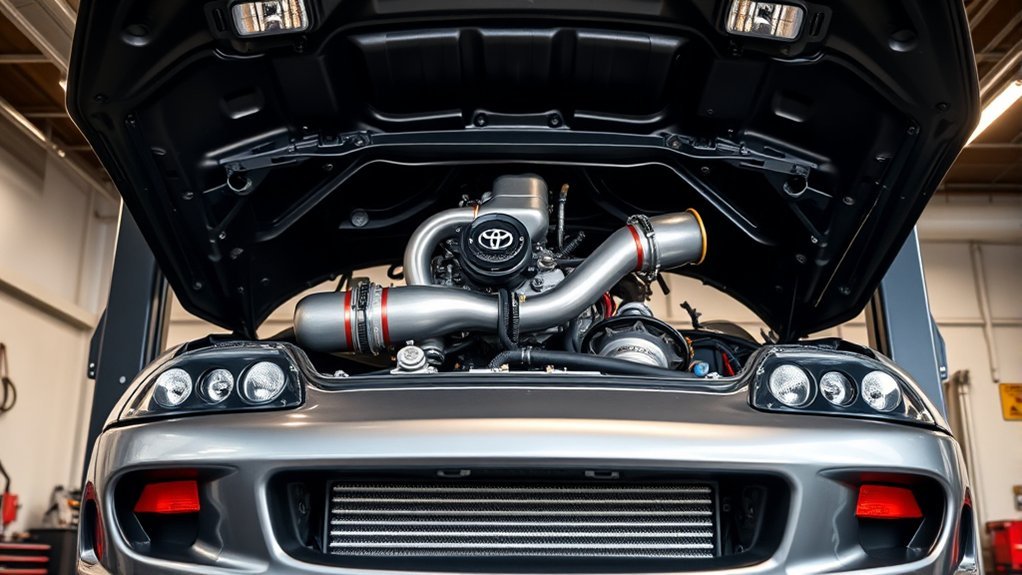
A single turbo conversion can elevate your Toyota Supra’s performance dramatically. You’ll need essential components like a high-quality turbo kit, an efficient intercooler, and upgraded fuel systems. Choosing the right turbo is key—consider your power goals and turbo characteristics for the best fit. Don’t underestimate the importance of engine management and tuning to maximize performance. With common challenges in installation, proper planning is crucial. Stick around, and you’ll discover even more about achieving your dream setup!
How to Begin Your Single Turbo Conversion: Essential Components
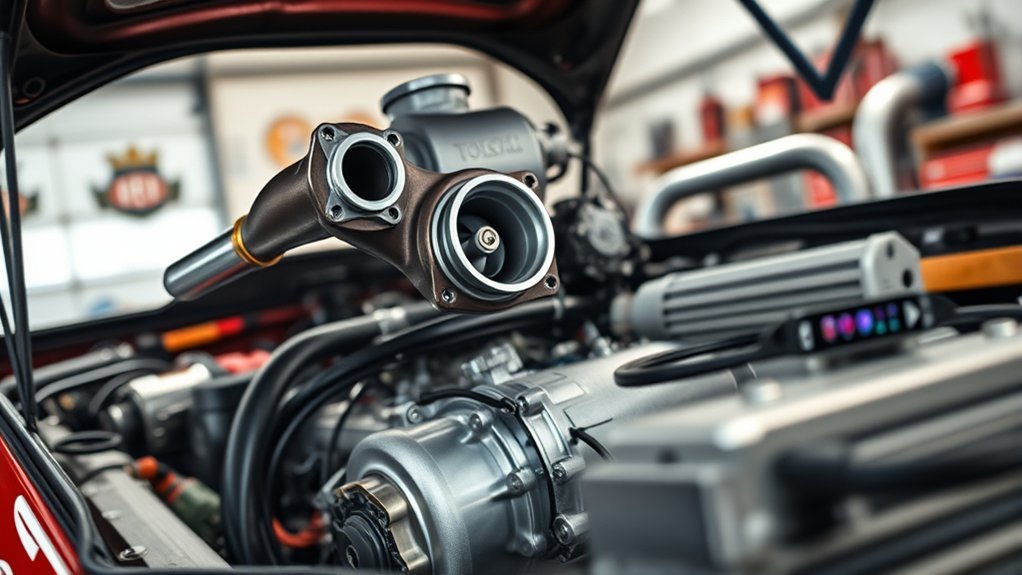
When you’re ready to kick off your single turbo conversion for your Toyota Supra, gathering the essential components is crucial to guarantee a smooth and successful upgrade. Start with a high-quality single turbo kit, like those from FSR or PHR, to confirm compatibility. Pair it with an HKS GT S/S exhaust manifold for maximum flow and performance.
Next, you’ll need a quality intercooler, such as the ETS 4 FMIC, to enhance cooling efficiency under boost. Don’t overlook the importance of oil lines and fittings for proper turbo lubrication, along with a suitable downpipe to match your setup.
Lastly, consider your engine management solutions. A standalone ECU will allow precise tuning and monitoring, ensuring your Supra reaches its full capability. With all these components in place, you’ll be well on your way to releasing the power of your single turbo conversion.
Upgrading Your Fuel System for Single Turbo Conversion: Essential Parts
When upgrading your fuel system for a single turbo conversion, choosing the right fuel pump and injectors is essential. You’ll want to install larger fuel injectors, ideally around 1000cc, to meet the increased demands of your setup. Additionally, selecting a high-flow fuel pump, like the Walbro 450, guarantees your engine gets the fuel it needs to perform at its best under boost.
Fuel Pump Options
Upgrading your fuel system is an essential step in ensuring your Toyota Supra can handle the demands of a single turbo conversion. Choosing the right fuel pump options is vital for supporting increased fuel demands. Aim for a high-flow fuel pump rated for at least 800 horsepower on E85. Here are some popular choices:
- Walbro 450LPH: Known for reliability and performance.
- AEM 340LPH: Excellent for high-horsepower applications.
- Compatible Fuel Lines: Upgrade to larger diameter hoses to avoid starvation.
- Adjustable Fuel Pressure Regulator: Fine-tune fuel delivery and maintain ideal air-fuel ratios.
Injector Size Selection
Choosing the right fuel injectors is essential for maximizing your single turbo conversion’s performance. When targeting 450-500 rwhp, upgrading to 1000cc injectors is recommended. If you aim for peak power around 700-750 rwhp, larger injectors like 1200cc are necessary, especially when using E85 fuel. To determine the correct injector size, you can use the formula:
| Desired HP | Injector Size (cc/min) |
|---|---|
| 450 | 1000 |
| 500 | 1000 |
| 700 | 1200 |
| 750 | 1200+ |
Pair your upgraded injectors with a high-flow fuel pump and guarantee proper tuning for an ideal air-fuel ratio (AFR). This way, you’ll achieve safe and efficient engine operation post-conversion.
Steps to Choose the Right Turbocharger for Your Goals
How do you find the perfect turbocharger for your single turbo conversion? Start by defining your power goals. Are you aiming for 450-500 rwhp on 93 octane or pushing for 700-750 rwhp on E85? Next, consider the efficiency ratings and spool characteristics of various models. Popular choices like the Precision PT62 to PT76 can handle outputs from 400whp to 2000whp.
Define your power goals and consider turbo efficiency to find the ideal turbocharger for your single turbo conversion.
- Opt for a ball bearing turbo for quicker spool times.
- Verify compatibility with your chosen manifold; modifications might be necessary.
- Factor in your fuel injectors and supporting fuel system upgrades; larger turbos demand more fuel flow.
- Research turbo options that align with your performance needs.
Why Engine Management and Tuning Matter
While a single turbo conversion can dramatically enhance your Toyota Supra’s performance, effective engine management and tuning are essential to release its full potential and maintain reliability. With increased power levels, proper engine management becomes vital. Tuning adjustments, like air-fuel ratio and ignition timing, help prevent engine knock and potential damage from higher boost levels.
A standalone ECU offers precise control over fuel delivery and timing, allowing you to tailor your setup for maximum horsepower and torque. Regularly monitoring parameters such as boost levels and exhaust gas temperatures during tuning can help you identify issues before they escalate into severe engine failures.
For the best results, consider dyno tuning. This process provides accurate power output measurements and fine-tuning, ensuring your modified Supra runs efficiently and reliably. By prioritizing engine management, you’re not just boosting performance; you’re safeguarding your investment and ensuring an exhilarating driving experience.
Common Installation Challenges: Overcoming Common Issues
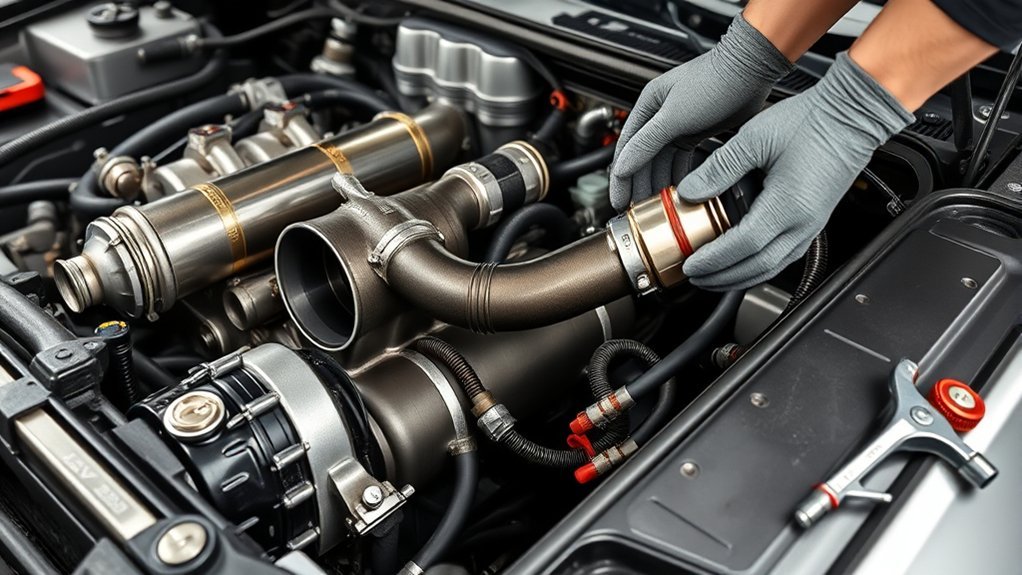
Successfully completing a single turbo conversion for your Toyota Supra involves maneuvering several common installation challenges that can arise throughout the process. Addressing these issues proactively will help you achieve a smoother installation experience.
- Guarantee proper clearance for the turbo and components, which might require modifications to engine mounts or the engine bay.
- Optimize wastegate placement to prevent boost creep, necessitating careful planning and possible adjustments to the exhaust manifold.
- Route oil feed and return lines correctly to avoid leaks and guarantee proper lubrication, even in tight engine bay spaces.
- Be prepared to custom fabricate intake and exhaust piping, as pre-made options often don’t fit well with your new turbo setup.
Thorough research on compatible parts and insights from the community can greatly ease these common installation challenges, empowering you to enjoy the performance gains of your new turbo setup.
Essential Maintenance Tips for Turbocharged Engines
To keep your turbocharged Toyota Supra running smoothly, regular maintenance is vital. Start by checking and changing the engine oil frequently; synthetic oil is your best bet for high-performance applications, guaranteeing optimal lubrication for the turbo kit. Monitor the air-fuel ratio (AFR) closely—maintaining the right AFR is key to preventing engine knock and achieving efficient combustion. Don’t overlook the air filter; inspect and replace it regularly to keep debris from damaging your turbocharger.
Routine maintenance on the turbo system is important. Schedule checks for boost leaks, inspect oil lines for blockages, and confirm the wastegate functions properly. Finally, always keep an eye on coolant levels and engine temperature. Overheating can spell disaster for your turbo, so consider using high-quality coolant and monitoring conditions closely. By following these essential tips, you’ll help your turbocharged Supra reach its full potential.
How Much Horsepower Can You Achieve With a Single Turbo?
When considering a single turbo conversion for your Toyota Supra, it’s essential to assess your power goals and choose the right turbo. Depending on the turbo size and other modifications, you can achieve anywhere from 400 to over 750 rwhp. The turbo model you select will directly impact your performance, so understanding these factors will help you hit your desired horsepower target.
Power Goals Assessment
Achieving impressive horsepower with a single turbo conversion on a Toyota Supra hinges on several key factors, including turbo selection and supporting modifications. Your power goals dictate how far you can push the limits, with outputs ranging from 400whp to over 750whp. Enthusiasts often aim for:
- 450-500whp on 93 octane
- 700-750whp on E85 fuel
- Boost levels around 1.0 bar for safety
- Upgraded fuel systems and tuning for reliability
To achieve these goals, you’ll need effective upgrades like high-flow fuel pumps, larger injectors (like 1000cc), and aftermarket engine management systems. By carefully evaluating your power goals, you can reveal the true potential of your Supra and enjoy exhilarating performance on the road.
Turbo Selection Impact
Choosing the right single turbocharger can make or break your horsepower goals for a Toyota Supra. Depending on the turbo model and size, you could achieve anywhere from 400whp to an astonishing 2000whp. For instance, the Precision Turbocharger is a versatile option that supports a wide range of power needs. Many enthusiasts opt for turbos like the BW 6266, 6466, and 6766 to hit targets between 450-750 rwhp. Remember, pairing your turbo with a high-flow fuel system and proper engine management is vital, especially for those lofty horsepower aspirations. Plus, if you choose a ball bearing turbo, you’ll enjoy quicker spool times and improved throttle response, key for maximizing your Supra’s performance on the street or track.
Frequently Asked Questions
Can a 6’5″ Guy Fit in a Supra?
Yes, a 6’5″ guy can fit in a Supra. With proper adjustments, you’ll find driver comfort is achievable. Consider aftermarket seats for enhanced support, ensuring every drive feels liberating and enjoyable, regardless of distance.
Can I Convert a Normal Engine to a Turbo?
Sure, you can convert a normal engine to a turbo! Just remember, it’s like fitting a lion in a shoebox—turbo compatibility is key. You’ll need upgrades, tuning, and a bit of engineering magic to release that power!
What Size Turbo Is Best for the N54?
For the N54, consider a BorgWarner EFR 7163 for balanced spool and power, or a Precision 6266 for more aggressive setups. Turbo sizing depends on your goals, so choose wisely for your driving needs.
Can a Supra Have 1000 HP?
Absolutely, your Supra can soar to 1000 horsepower! Achieving these power goals means embracing high-capacity turbos, upgraded fueling systems, and expert tuning, releasing exhilarating performance that’ll leave everyone in awe. Immerse yourself in the thrill!
Conclusion
So, you’ve transformed your Toyota Supra into a single turbo beast—congratulations! Now, just remember, with great horsepower comes great responsibility (and possibly a slightly lighter wallet). It’s all fun and games until you’re explaining to your friends why your car sounds like a jet engine. But hey, at least you’ll be the life of the party! Just keep up with that maintenance, and you’ll be racing into the sunset while others are still figuring out how to change their oil.