Check your tire pressure at least once a month, and before long trips, when the tires are cold. Compare each reading with the pressure on the driver’s door-jamb placard or in the owner’s manual, add or release air until it matches, and refit the valve caps. This page covers the routine, the tools, and the conditions that change pressure between checks.
Where to Find Your Target Pressure
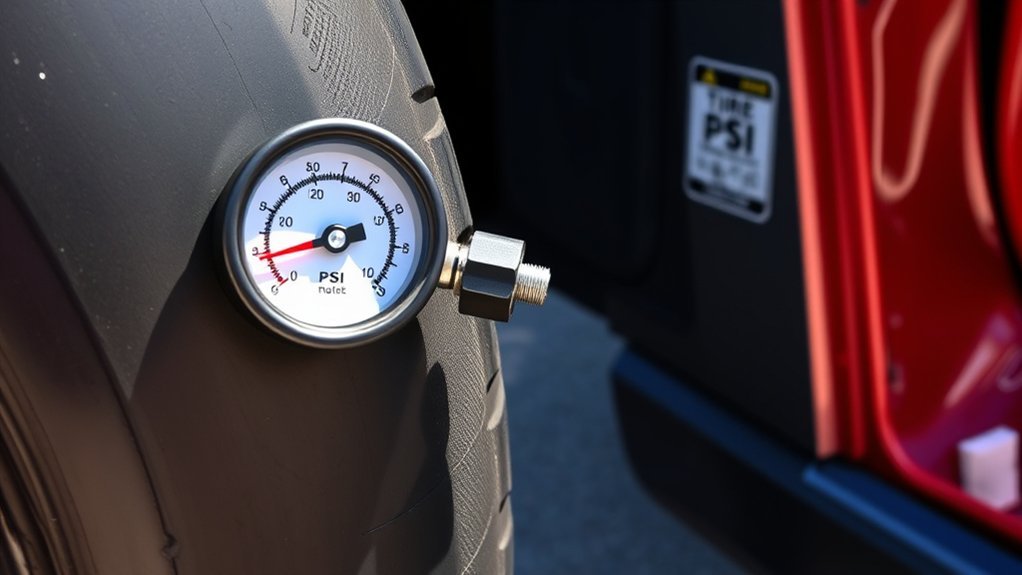
The tire information placard on the driver’s door jamb lists the vehicle maker’s recommended cold pressure for the original tire size, often separately for front and rear. The owner’s manual repeats it and may add notes for heavy loads. Do not use the “Max Press” number on the tire sidewall as your everyday target. It is the most the tire is built to hold, not the pressure chosen for your vehicle.
If you have changed to a different tire size, the placard may no longer apply. Ask the tire shop or the tire maker for the right pressure for your size and load.
What Wrong Pressure Does to a Tire
The U.S. Tire Manufacturers Association (USTMA) says underinflation causes excessive heat build-up and internal structural damage that may lead to tire failure, including tread or belt separation, even at a later date. It also says tires inflated above the maximum molded on the sidewall are more likely to be cut, punctured or damaged by an impact such as a pothole.
| Condition | What changes | Result |
|---|---|---|
| Underinflated | More flex and heat in the tire | Internal damage risk, faster shoulder wear, lower fuel economy |
| Overinflated | Stiffer tire, smaller contact patch | Harsher ride, faster center wear, more impact damage if far too high |
| At placard pressure | Tire keeps its designed shape | Intended balance of grip, wear and ride |
For fuel use, FuelEconomy.gov says you can improve gas mileage by 0.6% on average, and up to 3% in some cases, by keeping your tires inflated to the proper pressure, and that underinflated tires can lower mileage by about 0.2% for every 1 psi drop in the average pressure of all tires.
Tools You Need
- A tire pressure gauge. USTMA says a gauge calibrated in 1 psi increments up to 60 psi is sufficient for most passenger tires, and a dual-head gauge calibrated in 2 psi increments up to 100 psi is sufficient for light truck tires. A gauge you own and keep in the car is more consistent than a worn station gauge.
- An air source. A portable 12-volt compressor or a station pump.
- Valve caps. Spares in the glove box help, since they keep dirt and moisture out of the valve.
How to Check and Set Pressure
- Start cold. Check before driving, or after the car has been parked at least three hours. USTMA and NHTSA both define cold this way; USTMA also accepts a vehicle driven less than one mile at moderate speed.
- Read the target from the placard.
- Remove the valve cap and press the gauge straight onto the stem until the hiss stops.
- Write down the reading for each tire, including the spare if it has its own listed pressure.
- Add air in short bursts if low, rechecking after each burst and stopping at the placard value.
- Release air if high by briefly pressing the pin in the center of the valve, then recheck.
- Refit the caps.
USTMA warns never to bleed air from tires that are hot from driving, because a rise above the cold value is normal. If you must add air to warm tires, add a small amount and recheck when they are cold.
Tire Pressure Monitoring Systems Are Not Enough
A tire pressure monitoring system (TPMS) is a warning device, not a gauge. USTMA points out it may give no warning until one or more tires are as much as 25% below the vehicle manufacturer’s recommendation. On a 35 PSI placard that is a tire near 26 PSI. Use your own gauge for the monthly check even if the dash shows no warning. If the warning light comes on, stop in a safe place and check all four tires.
Conditions That Change Pressure Between Checks
Temperature
USTMA says tire pressure falls by about 1 to 2 psi for every 10°F drop in temperature. After a cold snap, or after a move from a warm garage to a cold morning, expect your readings to be lower and top up to the placard value.
Time
USTMA says passenger and light truck tires may lose 1 to 2 psi per month under normal conditions. That is why a monthly check matters even when nothing looks wrong. A tire that loses much more than the others may have a slow leak from a nail, a bad valve stem or a rim leak.
Altitude
Gauges read pressure relative to the air around them. Because atmospheric pressure is lower at elevation, a tire inflated at sea level will read higher after a drive to the mountains. USTMA says significant changes in altitude or temperature change inflation pressure and require an adjustment. For a short trip, temperature matters more, and you should recheck cold pressure near where you will be driving.
Cargo and towing
If your placard or manual lists a separate pressure for a full load, use it only when the vehicle is loaded. Never exceed the tire’s maximum sidewall pressure, and do not guess. For a trailer, see our guide on tire pressure for heavy loads and towing.
A Simple Maintenance Schedule
| When | What to do |
|---|---|
| Monthly | Measure cold pressure on all tires, spare included (NHTSA recommendation) |
| Before long trips | Check pressure and look over each tire for cuts, bulges and nails |
| After a big temperature change | Recheck and top up to the placard value |
| After each check | Refit the valve caps |
| Before heavy loads or towing | Confirm the loaded pressure in the manual, if listed |
NHTSA’s tire safety checklist (PDF) summarizes these checks, and FuelEconomy.gov covers the fuel economy side.
Frequently Asked Questions
Should I use the PSI on the tire sidewall?
No. The sidewall number is the tire’s maximum. Use the placard or owner’s manual for everyday driving.
How often should I check tire pressure?
At least once a month, and before long trips, with the tires cold.
What does cold tire pressure mean?
The car has been parked at least three hours, or driven less than one mile at moderate speed. That reading is the one the placard number refers to.
Does tire pressure change with the weather?
Yes. About 1 to 2 psi per 10°F according to USTMA, so a large seasonal swing can move your tires several PSI.
Does proper pressure save fuel?
FuelEconomy.gov says 0.6% on average and up to 3% in some cases, and about 0.2% for every 1 psi drop across all tires.
Why does my tire lose air every week?
Normal loss is a pound or two per month. Losing more than that points to a leak. Check the valve stem and core with soapy water, look for a nail in the tread and have a shop inspect the tire if the loss continues.