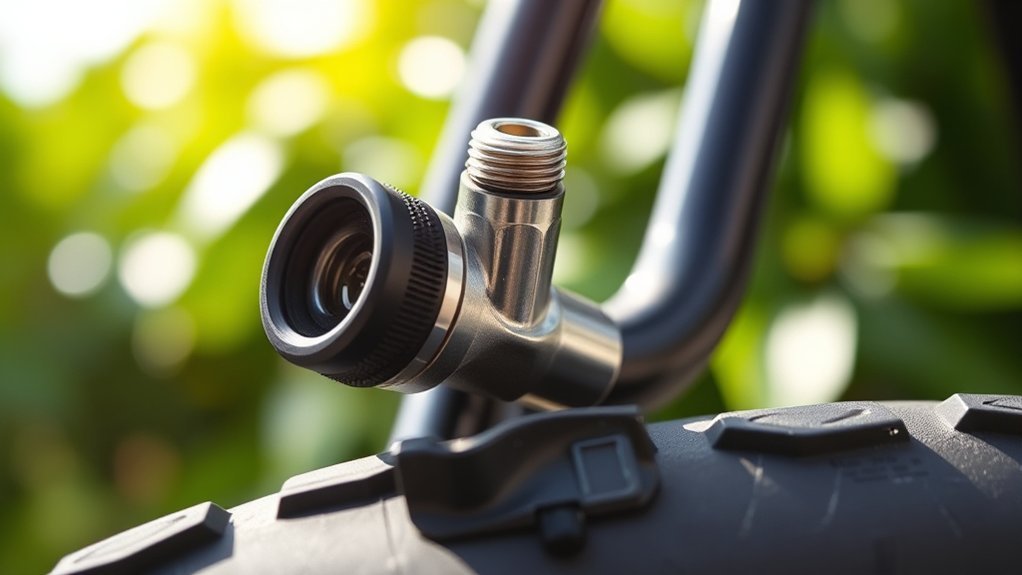
A Schrader valve is the wide, spring-loaded valve used on most car and motorcycle tires and on many bicycles. Its replaceable center core opens when a pump, gauge, or tool presses the pin, then closes when the pin is released. Knowing how to check, inflate, and test this valve can help you prevent slow pressure loss.
Quick Answer
A Schrader valve is a wide tire valve with a spring-loaded pin and replaceable core. Pressing the pin allows air to enter or escape, while releasing it closes the seal. It fits standard automotive air chucks, but its pressure rating and replacement parts must match the specific tire or pressurized system.
Key Takeaways
- Schrader valves are wider than Presta valves and fit most automotive pumps and pressure gauges.
- Use the vehicle placard or owner’s manual for the correct cold tire pressure, not the maximum pressure printed on the tire.
- A bubbling soapy-water test can reveal a leaking core, stem base, bead, wheel, or puncture.
- Fully deflate an ordinary tire before removing its valve core, and use a proper valve-core tool.
- High-pressure, refrigerant, aircraft, hydraulic, fire-suppression, and breathing-gas systems require application-specific parts and trained service.
At a Glance
| Time Required | 2–5 minutes to check or adjust pressure; about 10 minutes to replace a tire-valve core |
| Difficulty | Easy for an ordinary car, motorcycle, utility, or bicycle tire |
| Tools Needed | Pressure gauge, compatible pump or inflator, soapy water, valve-core tool, and a compatible replacement core when needed |
| Cost | No parts are needed for a pressure check; replacement cores and basic core tools are generally inexpensive |
What a Schrader Valve Is and Why It Matters
A Schrader valve is a hollow stem containing a removable, spring-loaded valve core. The small pin visible in the center opens the core when it is pressed by an air chuck, pressure gauge, or suitable deflation tool.
When the pin is released, the spring moves the sealing part of the core back against its seat. Pressure inside the tire also helps hold the core closed. This design allows the same opening to be used for inflation, pressure measurement, and controlled deflation.
Schrader valves are common on passenger vehicles, trucks, motorcycles, trailers, wheelbarrows, lawn equipment, children’s bicycles, utility bicycles, and some mountain bikes. Related Schrader-style service valves are also made for industrial equipment, but those products may use different seals, materials, dimensions, and pressure ratings.
Note: The stem, core, and cap are separate parts. The stem passes through the wheel or connects to the tube, the core controls airflow, and the cap protects the opening. On some tire and TPMS assemblies, a sealing cap also provides a secondary barrier against leakage.
How a Schrader Valve Works: Parts and Mechanism
The core inside a Schrader stem works as a small spring-loaded poppet valve. Pressing the center pin moves the sealing element away from its seat and creates a path for air or another approved medium. Removing that pressure allows the spring and internal system pressure to close the valve again.
| Part | What It Does | Common Problem |
|---|---|---|
| Stem | Holds the core and connects the valve to the tube, wheel, or system | Cracking, bending, corrosion, or leakage at the rim |
| Core | Contains the moving seal, spring, bridge, and pin | Loose installation, worn seal, corrosion, or debris |
| Center pin | Opens the core when pressed | Bent, stuck, or contaminated |
| Spring | Returns the seal to its closed position | Weakness, corrosion, or incompatible material |
| Cap | Blocks dirt and moisture and may provide a secondary seal | Missing, cracked, loose, or damaged seal |
A Schrader valve is self-closing, but the cap still matters because contamination around the core can prevent a reliable seal.
How to Inflate, Check, and Deflate a Schrader Valve
Ordinary Schrader tire valves are designed to work with common automotive pressure gauges and inflator chucks. The chuck presses the center pin while its rubber seal closes around the valve mouth.
Warning: For a vehicle tire, use the recommended cold pressure on the driver-door placard or in the owner’s manual. Do not use the maximum pressure printed on the tire sidewall as the normal operating target. Never deliberately bleed a hot tire down to its cold-pressure specification.
Preparing the Valve
- Park safely and allow a vehicle tire to cool before making a precise pressure adjustment.
- Remove the valve cap and place it where it will not be lost.
- Inspect the stem for cracks, bending, corrosion, or movement at the wheel.
- Wipe dirt or moisture away from the valve opening.
- Briefly inspect the center pin. It should sit close to the center and should not appear bent.
Using the Air Chuck
- Place the chuck squarely over the valve.
- Push it firmly enough to create a seal. A brief hiss while attaching it is normal.
- Add air in short bursts and recheck the pressure often.
- Stop at the manufacturer’s recommended cold pressure.
- Remove the chuck straight off the valve to reduce stress on the stem.
Pro Tip: A filling-station compressor can add air to a small bicycle tire very quickly. Use short bursts, check the pressure after each burst, and never exceed the tire or rim manufacturer’s limits.
Checking and Releasing Pressure
Press a compatible gauge firmly and squarely onto the valve until the hissing stops. Read the pressure and compare it with the recommended specification.
If the pressure is too high, use the bleed button on the gauge or press the center pin gently with a suitable blunt tool. Release air in short bursts, then measure again. Avoid sharp objects that could damage the pin or seal.
After the adjustment, install a clean, undamaged cap. Tighten it with your fingers until it is secure; it does not need heavy force.
Maintenance, Troubleshooting, and Replacing the Core
A core leak is only one possible cause of pressure loss. The leak may also come from the stem base, a TPMS grommet, the tire bead, the wheel, or a puncture in the tire itself.
Regular Valve Core Checks
Check the valve whenever you measure tire pressure. Look for a missing cap, bent stem, cracked rubber, corrosion, or dirt around the core.
To test for a leak, apply a small amount of soapy water to the valve opening. Growing bubbles indicate escaping air. Also apply the solution around the base of the stem and any visible TPMS retaining hardware.
- Continuous bubbles at the opening usually point to the core or its seal.
- Bubbles at the stem base may indicate a damaged stem, seal, or TPMS grommet.
- No bubbles at the valve means the leak may be in the tread, bead, wheel, or another part of the tire assembly.
Common Seal Problems and Leak Diagnosis
| Symptom | Likely Area | Next Step |
|---|---|---|
| Bubbles at the valve opening | Loose, dirty, worn, or damaged core | Deflate the tire, inspect the core, and replace it if needed |
| Bubbles at the stem base | Stem, rim seal, TPMS grommet, or corrosion | Have the tire removed and the valve assembly serviced |
| Stem cracks when gently moved | Aged rubber snap-in stem | Replace the complete stem |
| Pressure falls but the valve does not bubble | Puncture, bead leak, porous wheel, or hidden damage | Inspect the complete tire and wheel assembly |
| Corrosion on a metal TPMS stem | Incompatible core, cap, nut, or service hardware | Use the sensor manufacturer’s complete service kit |
How to Replace a Schrader Valve Core
Warning: These steps apply only to an ordinary tire that can be safely and completely deflated. Do not remove a core from a refrigerant, hydraulic, aircraft, fire-suppression, industrial-gas, SCUBA, or other high-pressure system. Those systems require approved recovery or service equipment and trained personnel.
- Confirm the leak. Apply soapy water to the valve opening and look for growing bubbles.
- Support the vehicle or bicycle safely. A completely deflated tire may not support its normal load without damage.
- Deflate the tire fully. Press the center pin until no pressure remains.
- Remove the old core. Insert a proper valve-core tool, turn it counterclockwise, and keep control of the core as it comes free.
- Inspect the stem. Check the internal threads and opening for corrosion, dirt, or damage.
- Select a compatible core. Match the valve type, stem material, operating medium, temperature, and pressure specification. Aluminum TPMS stems normally require the sensor manufacturer’s approved nickel-plated core.
- Install the new core. Turn it clockwise with the core tool until it is seated. Use the manufacturer’s torque value where one is provided. Do not force or over-tighten it.
- Reinflate the tire. Restore the manufacturer’s recommended cold pressure.
- Retest for leakage. Apply soapy water to the core and stem base. No growing bubbles should appear.
- Replace the cap. Use a clean cap with an undamaged seal when the assembly requires one.
When to Replace the Whole Valve Stem
A new core will not repair a cracked rubber stem, damaged stem-to-rim seal, corroded TPMS body, leaking grommet, bent metal stem, or stripped core threads. Those problems require replacement or professional servicing of the complete valve assembly.
When a tire is removed from a wheel, replacing an aged rubber snap-in stem is usually sensible. For a direct TPMS sensor, use the correct service kit for that exact sensor and wheel application rather than mixing cores, caps, nuts, or grommets.
Sizes, Threads, and Materials: Standards to Know
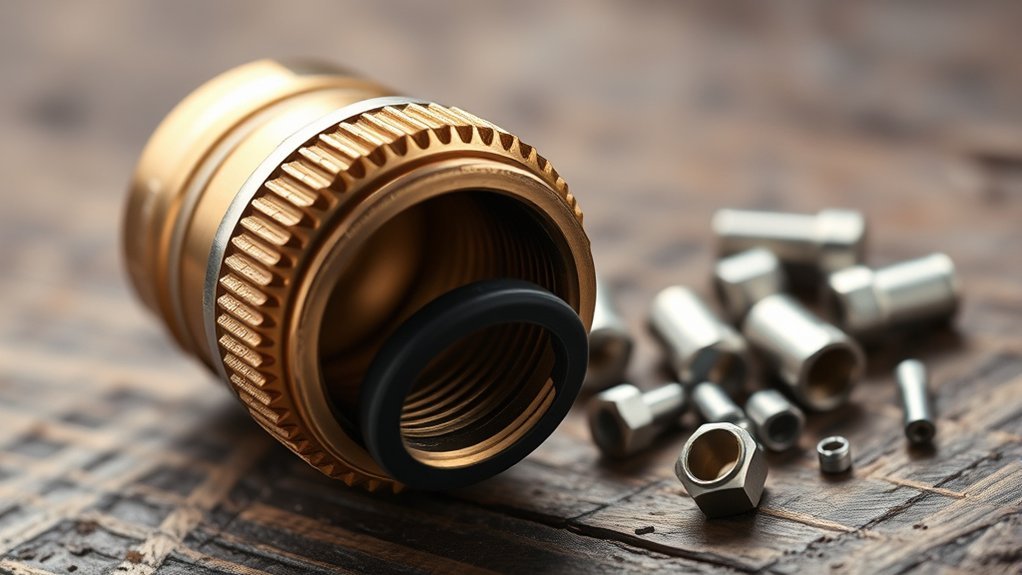
Common tire Schrader valves use standardized thread families covered by ISO 4570. The familiar external cap thread is commonly described as approximately 0.305 inch with 32 threads per inch and corresponds to the widely used 8V1 tire-valve family.
A standard-bore replacement core uses a smaller internal thread commonly sold at approximately 0.206 to 0.209 inch with 36 threads per inch. Because nominal descriptions and valve families vary, the safest approach is to choose a core specifically listed for the stem or system rather than relying only on a measured diameter.
| Component | Common Materials | Compatibility Concern |
|---|---|---|
| Valve core | Brass or nickel-plated brass with application-specific seals | Seal material, pressure, temperature, medium, and stem metal |
| Rubber snap-in stem | Rubber covering over a metal core or tube | Rim-hole size, maximum application pressure, speed, and age |
| Clamp-in or TPMS stem | Commonly aluminum or another corrosion-resistant metal | Correct nut, grommet, cap, core plating, and installation torque |
| Cap | Plastic or compatible metal, sometimes with a rubber seal | Metal compatibility and presence of the required sealing insert |
The visible diameter of a bicycle Schrader stem is roughly 8 mm, while a Presta stem is roughly 6 mm. Actual bicycle rim holes are commonly about 8.5 mm for Schrader and 6.5 mm for Presta, so rim compatibility must be checked before changing valve types.
Common Schrader Valve Applications and Pressure Ratings
Schrader-style valves are produced for many systems, but there is no single pressure rating that applies to all of them. Each core must be matched with an approved housing, seal material, operating medium, temperature range, and maximum working pressure.
Standard replacement tire cores are commonly designed for ordinary automotive tire pressures and may carry maximum ratings around 200 PSI. By contrast, specialized Schrader Pacific industrial products include assemblies for much higher pressures. That does not make an ordinary tire valve safe for industrial service.
| Application | How the Valve Is Used | Service Guidance |
|---|---|---|
| Cars, motorcycles, trailers, and utility tires | Inflation, pressure checking, and controlled deflation | Routine owner maintenance is normally appropriate |
| Bicycle tires and tubes | Inflation with a Schrader-compatible bicycle or automotive chuck | Check tire, tube, rim, and pump limits |
| Direct TPMS assemblies | The stem supports both inflation and the wheel-mounted sensor | Use the correct sensor service kit and torque values |
| Refrigeration and air-conditioning equipment | Purpose-built service ports may use Schrader-style cores | Qualified refrigerant service is required; do not vent refrigerant |
| Aircraft, hydraulic, fuel, and industrial systems | Application-specific testing, charging, or pressure access | Use only approved parts, procedures, tools, and trained personnel |
| SCUBA and breathing-gas equipment | Some ancillary components may contain service fittings, but standard cylinder outlets use dedicated DIN or yoke connections | Never fill a breathing-gas cylinder through an ordinary tire valve or air chuck |
Schrader vs Presta: Key Differences for Cyclists
Schrader and Presta valves perform the same basic job, but their shape, rim requirements, and pump connections differ. Neither valve is automatically better for every bicycle.
| Feature | Schrader | Presta |
|---|---|---|
| Approximate stem width | About 8 mm | About 6 mm |
| Opening method | Pump or gauge presses a spring-loaded center pin | User loosens the tip nut before attaching the pump |
| Typical bicycles | Children’s, city, utility, hybrid, and some mountain bikes | Road, gravel, performance, and many modern mountain bikes |
| Rim requirement | Larger valve hole | Smaller valve hole that removes less rim material |
| Pump availability | Compatible with automotive chucks and many bicycle pumps | Needs a Presta pump head or a suitable pump adapter |
| Tubeless use | Less common in modern bicycle tubeless systems | The most common conventional bicycle tubeless-valve format |
Pump Adapters and Rim Reducers Are Different
A pump adapter changes the connection between the valve and pump. For example, a small threaded adapter can let a Schrader-only pump inflate a Presta valve.
A rim-hole reducer supports a narrow Presta stem inside a rim drilled for a wider Schrader valve. Without a suitable reducer, the smaller stem can move in the hole and may become damaged near its base.
A Schrader tube normally will not fit a rim drilled only for Presta because the Schrader stem is too wide. Do not drill or enlarge a bicycle rim unless the rim manufacturer specifically approves the modification. Removing material can weaken the rim or void its warranty.
Safety Tips for High-Pressure Schrader Systems
The simple appearance of a Schrader-style valve does not mean every version can be serviced like a tire valve. High-pressure and non-air systems may contain hazardous gases, refrigerants, fuel, oil, hot fluid, or oxygen-enriched media.
Warning: Never install a tire core merely because it fits the threads. The replacement must be approved for the system’s pressure, temperature, housing, seal material, and operating medium.
- Refrigeration and HVAC: Follow applicable environmental and technician-certification requirements. In the United States, EPA Section 608 regulates stationary refrigerant service and generally prohibits intentional venting.
- Aircraft and industrial equipment: Use the maintenance manual, approved parts, pressure-control equipment, and required personal protective equipment.
- Hydraulic and fuel systems: Confirm chemical compatibility and fully isolate stored pressure before service.
- SCUBA and breathing-gas cylinders: Have valves and cylinders inspected, filled, and maintained by trained personnel using dedicated breathing-gas equipment.
- Oxygen or oxygen-enriched systems: Use only components, lubricants, and procedures specifically approved for oxygen service.
When to Choose a Schrader Valve and Compatibility Tips
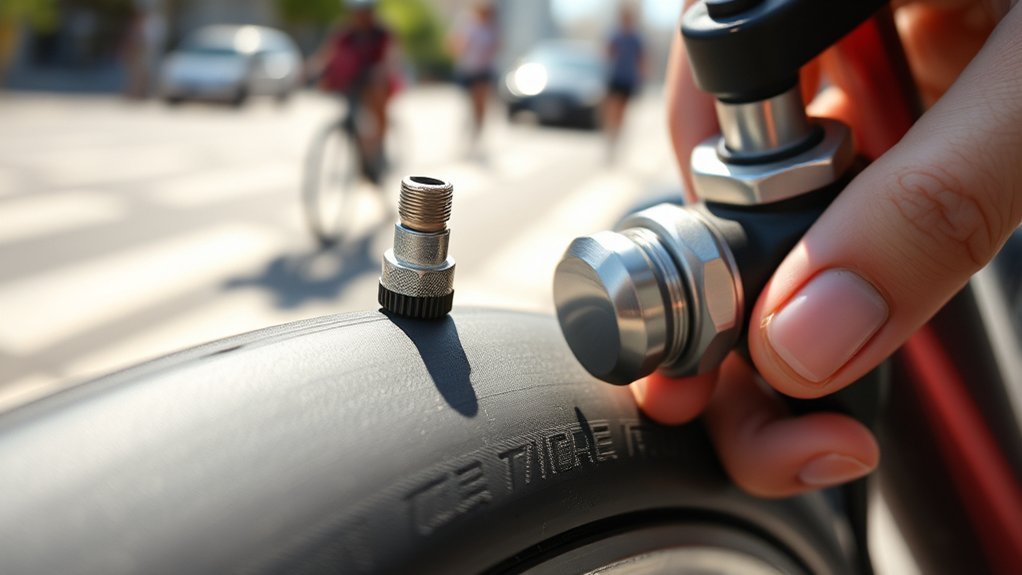
Choose a Schrader valve when the wheel, tube, or equipment was designed for it and easy access to automotive-style pumps is important. It is a practical choice for motor vehicles, utility equipment, trailers, children’s bikes, city bikes, and many general-purpose wheels.
- Match the valve to the wheel or rim-hole specification.
- Use a pump head designed for Schrader valves or a dual-purpose bicycle pump.
- Check that a replacement tube has the correct tire size, width range, valve type, and valve length.
- Use a suitable rim reducer when a manufacturer permits a Presta tube in a Schrader-drilled bicycle rim.
- Do not force a Schrader stem through a smaller Presta rim hole.
- Keep a clean cap installed after every pressure check.
- Use manufacturer-approved TPMS service parts on sensor-equipped wheels.
For automotive tires, maintain the pressure shown on the vehicle placard or in the owner’s manual. The National Highway Traffic Safety Administration recommends checking all tires, including the spare, at least monthly while they are cold.
Frequently Asked Questions
What is the difference between a Schrader valve and a regular valve?
“Regular valve” is not a specific technical type. Most car tire valves are Schrader valves. Bicycles may use Schrader, Presta, Dunlop or Woods, Regina, or newer proprietary valve systems.
What is a Schrader valve used for?
Its most familiar use is inflating, checking, and releasing pressure from car, motorcycle, trailer, utility, and bicycle tires. Application-specific Schrader-style cores are also used in some air-conditioning, fuel, hydraulic, aircraft, and industrial service ports.
How do I know whether I have a Schrader or Presta valve?
A Schrader valve is wider and has a recessed spring-loaded pin in the center. A Presta valve is narrower and has a small threaded nut at the tip that must be loosened before inflation.
Is an air-conditioning Schrader valve the same as a tire valve?
It uses a related operating principle, but the core, housing, seal material, pressure rating, refrigerant compatibility, and service procedure may be different. Never substitute a tire core unless the equipment manufacturer specifically approves it.
Can a leaking Schrader valve core be replaced?
Yes, an ordinary tire-valve core can usually be replaced with a compatible core after the tire has been safely and completely deflated. A new core will not fix a cracked stem, damaged rim seal, corroded TPMS assembly, bead leak, wheel damage, or tire puncture.
Can I use a car tire pump on a bicycle Schrader valve?
Yes, provided the chuck fits and the gauge can accurately read the bicycle tire’s pressure range. Add air in very short bursts because a powerful station compressor can overinflate a small bicycle tire quickly.
Does the valve cap stop a tire from leaking?
The core is the primary seal, but the cap keeps dirt and moisture away from it. A cap with a sealing insert may also slow leakage from a faulty core, but the damaged core or stem should still be repaired.
Conclusion
A Schrader valve is a simple, durable way to inflate and check many tires, but the familiar shape is used across a much larger family of application-specific products. For ordinary tires, keep the cap installed, check cold pressure regularly, and use soapy water to locate leaks.
A replaceable core can solve a leak at the valve opening, provided the tire is fully deflated and the new core matches the stem. Cracked stems, TPMS corrosion, rim-seal leaks, punctures, and high-pressure system faults need different repairs. Never assume a tire core is suitable for refrigerant, hydraulic, aircraft, industrial-gas, or breathing-gas equipment merely because its threads appear to fit.
Sources
- National Highway Traffic Safety Administration: TireWise — correct cold tire-pressure checks and use of the vehicle placard.
- ISO 4570:2002, Tyre Valve Threads — standardized tire-valve thread families and current standard status.
- Schrader Pacific Valve Cores — application-specific valve-core materials, testing, and pressure capabilities.
- Schrader TPMS Service Kits — valve-core, cap, grommet, material, and corrosion guidance.
- Michelin Bicycle Valve Guide — Schrader and Presta dimensions, rim-hole compatibility, and valve selection.
- U.S. EPA Section 608 — refrigerant-handling, recovery, certification, and venting requirements.