
You’ll use a manual tire inflator when you need a compact, non‑electric way to restore pressure without power. Manual inflators—hand pumps, foot pumps, and mini bellows—force air via a piston or bellows through a one‑way valve into the tyre; you’ll monitor pressure with a gauge as you pump. Expect 5–20 minutes per tyre and 30–50 PSI max depending on model. They’re slower but reliable backups; keep valves and seals checked, and continue for practical tips and comparisons.
What Is a Manual Tire Inflator and When to Use One
A manual tire inflator is a compact, non‑electrical pump that you operate by hand to add air to a tire, making it an essential emergency tool when power sources aren’t available. You’ll rely on a manual tire inflator in emergency situations or remote locations where electricity’s absent and you need control over mobility. The device’s compact, lightweight construction lets you store it in a trunk or carry it onfoot without burden. Operation demands physical effort: you pump a handle or lever to move air into the tire, so plan for sustained motion until you reach the desired pressure. These pumps can fully inflate a car tire, though they’re slower than electric units and often require 10–20 minutes depending on tire size and starting pressure. For someone who values autonomy, a manual inflator gives dependable, low‑tech redundancy—simple mechanics, no power dependency, predictable performance—so you can maintain safe tire pressure and keep moving on your terms.
Quick: Inflate a Tire Now (Hand‑Pump Steps)
First, check the tire pressure with a gauge to confirm the required PSI. Remove the valve cap and firmly secure the pump nozzle to the valve to guarantee an airtight seal. Use steady strokes and monitor the gauge, stopping when the tire reaches the target PSI, then quickly remove the nozzle and replace the cap.
Check Tire Pressure
1 simple check before pumping guarantees you don’t over- or under-inflate: verify the tire’s current PSI with a gauge and compare it to the vehicle’s recommended PSI (typically 30–35 PSI for passenger cars). When you check my tire, use a calibrated tire pressure gauge for accurate inflation readings. If the gauge shows underinflated tires, prepare your manual inflator. Remove the valve cap and attach the pump nozzle securely to avoid leaks. Pump with steady, consistent strokes, pausing to read the gauge frequently so you stop at the recommended tire pressure. Once reached, detach the pump swiftly and replace the valve cap to preserve pressure. Maintain your manual inflator—regular checks keep it reliable for emergencies and independent mobility.
Secure Pump To Valve
Start by removing the valve cap and press the pump nozzle onto the valve stem so it seats firmly; push down and twist the nozzle if needed to create a tight seal that prevents air leaks. Secure the manual pump to the valve with a positive, immobile connection so each stroke transfers pressure into the tire without loss. Check the coupling visually and by feeling for hissing; any leak undermines efficient inflation and wastes effort. Maintain alignment between pump and valve to prevent bending or damage. Keep your gauge accessible so you can monitor pressure throughout the process. When the connection is solid, you’ll convert manual effort into predictable inflation. After finishing, detach carefully and restore the valve cap to preserve pressure.
Pump Until Target
With the pump firmly sealed to the valve, check the pressure gauge to confirm the target PSI and begin using smooth, consistent strokes to introduce air; watch the gauge after every few pumps to track progress and avoid overshooting the target. You’ll pump until target PSI is reached, keeping tire pressure at least at the recommended PSI for safe, ideal tire performance. Maintain a tight connection to secure the valve and prevent leaks. Practice monitoring the gauge to detect rapid rises and avoid over-inflation.
- Pump consistently: steady strokes, observe gauge frequently, stop at recommended PSI.
- Verify: confirm tire pressure at least equals the vehicle’s spec; adjust if low.
- Finish: secure the valve, replace cap, confirm ideal tire pressure.
Quick: Inflate a Tire Now (Foot Pump / Bellows Steps)
Place the foot pump on a stable surface, remove the valve cap, and securely attach the pump nozzle to the valve to prevent leaks; then pump the lever with your foot while monitoring tire pressure and stop when the recommended PSI is reached. Position the pump so you can apply steady, controlled force without slipping. Use rhythmic, full strokes on the bellows or foot lever to move air efficiently; each stroke should be complete to maximize volume per pump. Keep a pressure gauge in-line or check the tire periodically to monitor the pressure and prevent over-inflation. Know your tire’s recommended PSI before you begin and set a target—the desired pressure—so you don’t overshoot. When the target’s reached, detach the nozzle quickly and cleanly to minimize air loss, then replace the valve cap firmly. Practice this routine to gain speed and confidence; it’s a small act of independence that keeps you mobile and self-reliant.
Hand Pump vs Foot Pump vs Mini Bellows : Pros and Cons
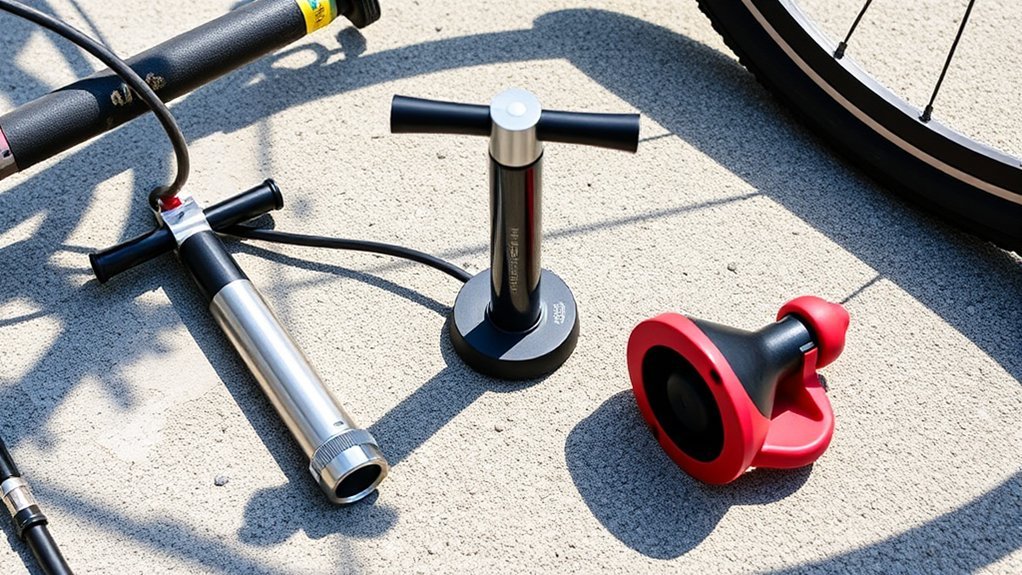
Compare pumping effort, inflation speed, and portability to pick the right manual inflator for your needs. You’ll find hand pumps are lightweight and cheap but demand the most physical effort and inflate large tires slowly, while foot pumps deliver faster fills and lower exertion at the cost of bulk. Mini bellows maximize portability for small tires or gear but have limited air output and are inefficient on larger tires.
[Products Worth Considering]
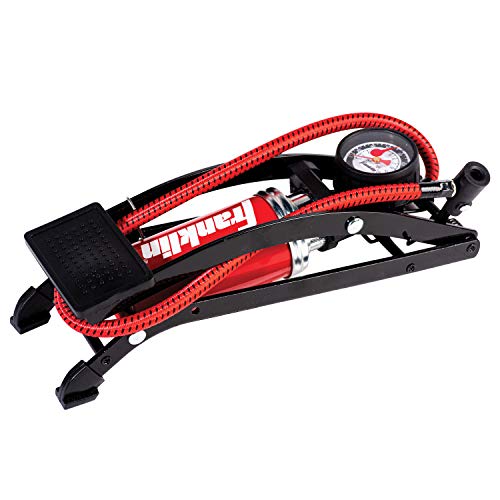
MULTI-USE: This pump is perfect for inflating sports ball, bike tires, car tires, and other inflatables with ease
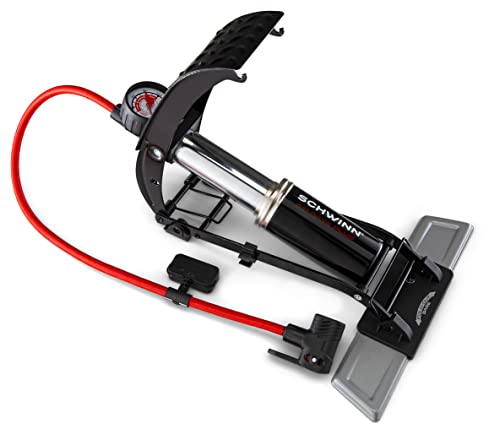
MANUAL AIR PUMP: Keep your bike ready for the trails with the Schwinn Air Base Plus Foot Pump. The universal fit dual head works with both Schrader and Presta valves, and uses a red/green color indicator to show when you're ready to inflate.
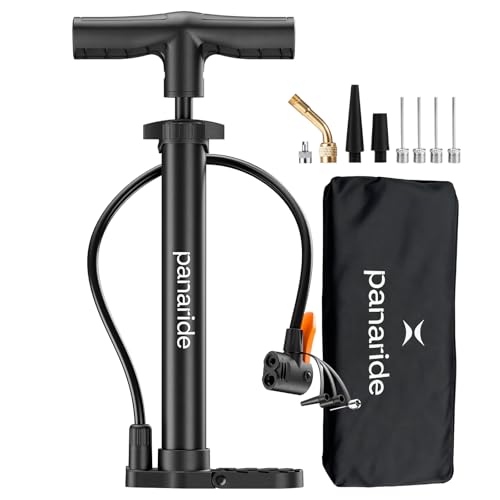
EXCELLENT COMPATIBILITY: Our versatile bike air pump seamlessly accommodates both Presta and Schrader valves, making it a perfect choice for various tasks including bicycles, baby stroller tires sports equipment, or inflatables. Ideal for use with BOB, Bumbleride, Joggers, Thule, Graco, Bugaboo, Trend strollers, and more.
Pumping Effort Required
Although all three manual inflators can get a tire to pressure, they differ sharply in the physical effort you’ll need: hand pumps demand repeated upper-body exertion and suit small tires or emergencies, foot pumps let you leverage body weight for faster, less fatiguing inflation on larger tires, and mini bellows prioritize portability at the cost of many more strokes and slower progress on big jobs. For liberation-focused users who value independence, choose the tool that matches duty cycle and physique.
- Hand pumps — High pumping effort required; effective for small tire size and emergencies; depends on your arm strength and stamina; low bulk.
- Foot pumps — Lower user exertion; use body weight for sustained pressure; better user comfort and suitable for larger tires.
- Mini bellows — Minimal carry weight; many strokes, lower inflation speed; ideal backup among manual inflators.
Inflation Speed Comparison
When you need to refill a tire, inflation speed becomes a practical trade-off between pump type, user effort, and tire volume: hand pumps are the slowest in practice (often 10–20 minutes for a car tire) but cost least and stay compact; foot pumps speed the job (typically 5–15 minutes) by letting you use body weight for higher repeatable compression; mini bellows prioritize portability but deliver the lowest airflow, so larger tires can take 20+ minutes. You’ll choose by matching speed needs and stamina. In an inflation speed comparison, hand pumps require sustained strokes and lower air output, so they’re economical but slow. Foot pumps raise air output and reduce inflation times with less fatigue. Mini bellows pumps trade speed for carry weight, useful when liberation demands minimal load.
Portability And Storage
Inflation speed matters, but portability and storage often decide which manual inflator you actually carry. You’ll choose by balancing portability, storage space, and expected use in emergencies. Manual inflators are power-free tools that grant independence; pick what fits your routine and escape plans.
- Hand pumps: lightweight and compact for trunk storage, you can stow them easily, but they demand sustained physical effort and get tiring on larger tires.
- Foot pumps: ergonomic with steady pumping and less bending, better for larger tires, but bulkier and harder to carry for long trips.
- Mini bellows pumps: ultra-portable, fit backpacks or glove compartments, ideal for short fixes, but low volume limits use on high-pressure or heavy-duty tires.
How Manual Inflators Work (Simple Explanation)
A manual tire inflator uses a hand-operated pump that you compress and pull to force air through a hose into the tire valve. You grip the handle, drive the piston in the pump body, and create pressure that pushes air through the nozzle into the tire. Manual inflators use a simple one-way valve system so air moves only into the tire; you’ll attach the nozzle securely to prevent leaks. Because most units lack a built-in pressure gauge, you monitor tire pressure with a separate pressure gauge as you inflate tires. Inflation time depends on tire volume and your pumping speed; expect several minutes for larger tires. The devices are lightweight and portable, so you can carry them for emergency situations or remote travel where electricity’s absent. Operating one requires steady physical effort and attention to measured pressure. Using a hand pump gives you control and independence—practical, reliable, and aligned with a liberated approach to vehicle maintenance.
Pick the Right Manual Inflator for Car, SUV, Truck, or Bike
Decide based on vehicle tire compatibility: confirm the inflator’s PSI capacity exceeds your tire’s recommended pressure (cars ~30–35 PSI, bikes 40–100 PSI, trucks higher). Match pump size and portability to your storage needs—compact for bikes and trunks, heavy-duty for trucks. Prioritize pressure range needs and robust construction to guarantee effective inflation and long-term reliability.
[Products Worth Considering]

【More Time-Saving】: Under the condition of high pressure of 260 PSI, our Compact Hand Pump can also ensure sufficient air volume (about 44 ml per pump) to make your inflation faster, which can save you 50% of your time. The volume of the air intake determines the time required for air pumping. Tiakia separate hose design achieves a balance between air intake volume and high-pressure design, and for the first time realizes a high degree of unification that saves time and effort for air pumping.

ADVANCED TRUEGAUGE SCREEN: This battery tire inflator includes updated sensor technology, capable of collecting pressure data from tire inflators at a frequency of 200 times per second. Its valid data rate is higher than 80%, which is 60% better than the market average. Wherever you go, accurate readings help you drive safely.

Dual Mode Bike Pump: The bike tire pump being able to pump manually as well as using co2 inflator. You can do most of the filling with the hand pump then switch to the CO2 cartridges to get a high pressure ( can up to 110 PSI).(NOT include CO2 cartridges )
Vehicle Tire Compatibility
When choosing a manual tire inflator for your vehicle, match its maximum pressure and gauge range to your tire type—passenger cars typically need 30–35 PSI, SUVs and trucks 35–45 PSI, and many bikes require 40–100 PSI—so pick a pump that can reliably reach those pressures. You’ll assess tire sizes and pressure requirements, verify valve compatibility, and select a manual inflator that serves your vehicle types without compromise. Prioritize robust gauges, clear markings, and adaptable fittings so you stay independent on the road.
- Check valve type compatibility (Schrader vs Presta) and use appropriate adapters.
- Match pump max PSI to vehicle pressure requirements and tire sizes.
- Confirm gauge accuracy across the needed PSI range.
Pump Size And Portability
Portability and pump size directly affect which manual inflator you should carry for cars, SUVs, trucks, or bikes, so match pump volume and construction to tire type and storage constraints. You’ll prioritize pump size and portability: compact models with a lightweight design (1–3 lb) suit bikes and standard cars; larger pumps with greater inflation capacity fit SUVs and trucks. Choose collapsible or foldable units to remain easy to carry and store. Look for multiple nozzle attachments to cover valves across vehicles. Table shows quick guidance.
| Vehicle type | Recommended feature |
|---|---|
| Bike | Compact models, lightweight design |
| Car/SUV | Mid‑size pump, multiple nozzle attachments |
| Truck | Larger pumps, high inflation capacity |
Pressure Range Needs
How high should your inflator go to safely top off different tires? You need a manual inflator matched to your pressure range needs and vehicle type. Choose one that reaches the maximum recommended PSI for safe, ideal tire performance and freedom on the road.
- Cars/SUVs: select an inflator capable of 40 PSI+ (cars 30–35 PSI, SUVs 30–40 PSI) and with a reliable pressure gauge to hit setpoints precisely.
- Trucks: require higher capacity—pick an inflator that reaches 80 PSI to cover truck needs (50–80 PSI) and sustain load conditions.
- Bikes: use compact inflators rated to 100 PSI for accurate cycling pressures (40–100 PSI); prioritize lightweight design for portability.
Match PSI specs, use the pressure gauge, and confidently inflate tires by vehicle type.
What to Expect: Inflation Time and Max Pressure
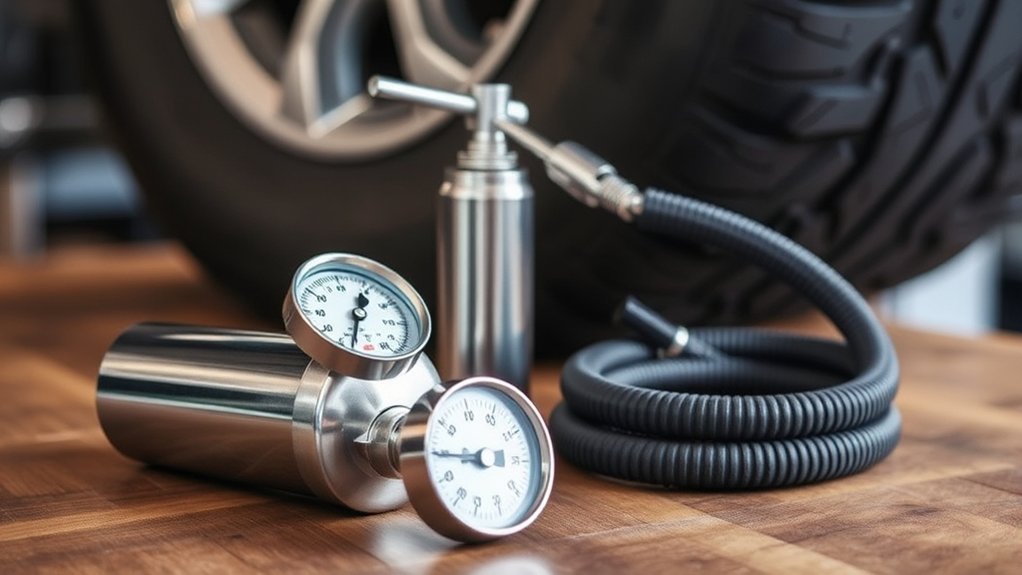
Although manual inflators demand physical effort, you can generally expect 10–20 minutes to fully inflate a standard passenger tire, with actual time varying by tire size and your pumping speed. In practice, inflation time depends on your strength, stamina, and the inflator’s displacement per stroke. Most manual inflators reach a max pressure between about 30 and 50 PSI, so they suit standard car tire service within the recommended PSI range but aren’t ideal for high-pressure or large SUV/truck tires. Before pumping, verify current pressure with a gauge; then pump deliberately and monitor pressure to avoid overinflation. In emergency situations, manual inflators provide reliable, low-tech support: they’re portable, mechanically simple, and don’t need power. Expect longer sessions if the tire is severely underinflated or colder. If you need faster fills or pressures above the inflator’s max pressure, plan to use a compressor or roadside service to secure freedom of movement and minimize time spent at the roadside.
Common Problems and Fast Fixes (Leaks, Seals, Hard Pumping)
Once you’ve finished pumping and checked the pressure, inspect the pump and valve connections for common faults that prevent efficient inflation. You’ll diagnose leaks by listening for hissing and watching pressure readings; apply soapy water at connections to reveal bubbling. Confirm a tight seal by seating the nozzle firmly, removing debris, and verifying the rubber gasket isn’t cracked. If you encounter hard pumping, check hoses and handle for kinks or obstructions that restrict airflow. Lubricate moving parts to restore smooth action, especially in cold conditions.
After pumping, check pressure, listen for hisses, use soapy water for leaks, seat the nozzle, and lubricate moving parts.
- Replace rubber gasket: persistent seal failures often resolve with a new gasket, restoring inflation efficiency and a reliable tight seal.
- Trace and stop leaks: prioritize the valve stem, hose fittings, and nozzle; stop bubbling sites and re-test pressure readings.
- Fix hard pumping: straighten hoses, clear obstructions, and lubricate the mechanism to reduce effort and maintain consistent inflation efficiency.
[Products Worth Considering]
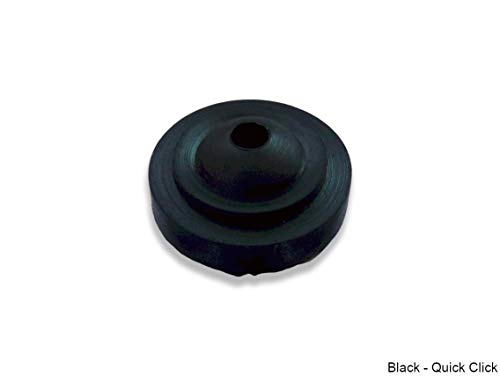
Universal Fit for Prestaflator & Silca Heads – Compatible with all current and past Prestaflator BIG push/pull Presta heads and Silca pump heads that use the 24.1 or 24.2 gasket design, ensuring reliable performance and easy replacement.

Universal Fit for Prestaflator & Silca Heads – Compatible with all current and past Prestaflator BIG push/pull Presta heads and Silca pump heads that use the 24.1 or 24.2 gasket design, ensuring reliable performance and easy replacement.

JMCHstore Gas Cap Gasket for Coleman CT200U CT200U-EX BT200X Mini Bike; Baja MB165 MB200 Doodlebug Mini Bike; TrailMaster MB200-2 Minibike, Realtree RT200 196cc Mini Bike.
Roadside Safety and Best Practices When Inflating
Before you start inflating at the roadside, park on firm, level ground, engage the parking brake, and put the vehicle in gear or “Park” so it can’t roll. Keep visibility and escape routes clear; use hazard lights and reflective triangles. Confirm recommended tire pressure first so you target peak performance, then begin the inflation process with intent.
Attach your manual inflator nozzle firmly to the valve stem to prevent leaks. Pump steadily and read the gauge frequently; pause to verify pressure and avoid over-inflating. Work efficiently but deliberately—every action should reduce risk and reclaim mobility. After reaching the specified tire pressure, remove the inflator, replace the valve cap securely, and recheck the pressure once more.
If conditions feel unsafe—traffic, poor footing, or inadequate lighting—prioritize personal safety and seek professional help. Your goal is resilient, self-reliant operation: control the environment, control the inflation process, and refuse unnecessary hazard.
When to Use a Manual Inflator : and When to Switch to Electric
You’ve secured the vehicle and confirmed target pressure; now decide whether to use your manual pump or switch to an electric unit. You’ll choose based on location, urgency, and physical capacity. Manual inflator suits emergency situations, remote stops, and when you want a low-tech, reliable portable tire inflators option that needs no power. Use it for small corrections or as a deliberate act of self-reliance.
- Evaluate urgency and inflation time: if you need rapid restoration (1–3 minutes per tire), pick an electric inflator; for slow, controlled topping-up (10–20 minutes), the manual inflator is acceptable.
- Consider frequency and effort: frequent checks or large tires favor an electric inflator to preserve your energy and time; occasional use rewards the simplicity of a manual unit.
- Maintain both: keep a manual inflator as backup even if you rely on a portable electric inflator for convenience, ensuring preparedness and autonomy.
Frequently Asked Questions
What Are the Different Types of Tire Inflators?
You’ll choose among electric tire inflators, portable air compressors, foot pump mechanics, bicycle tire inflators, dual action pumps, CO2 inflators, and hybrid inflator options, each offering tradeoffs in speed, portability, power, and autonomy.
How to Use a Manual Tire Inflator?
You check tire pressure, attach nozzle securely, pump with proper technique using steady strokes, monitor gauge; follow safety precautions, note inflator features, avoid common mistakes, perform maintenance tips regularly, and set usage frequency to prevent wear.
How Do I Choose the Right Inflator?
Choose one that matches tire PSI and inflator sizes—then check portability features, inflation speed, durability factors, inflation accuracy, user reviews, and maintenance tips; you’ll gain freedom from roadside delays with a reliable, compact, well-reviewed unit.
Which Is Better, 150 PSI or 300 PSI?
150 psi suits most drivers for portability and consistent pressure accuracy factors; 300 psi benefits high-load use with faster inflation speed comparison and greater durability considerations, though portability issues arise; weigh user experience feedback for liberation.
Conclusion
You’ve got the basics: manual inflators are simple, reliable tools for modest roadside repairs and cautious upkeep when electronics aren’t convenient. Use a hand pump for precision, a foot pump for less upper‑body effort, and bellows for compact convenience; switch to an electric compressor when speed or high pressure matters. Keep seals tidy, watch pressure gauges, and err on the side of caution — slow, steady top‑ups beat hurried improvisation every time.







Leave a Reply