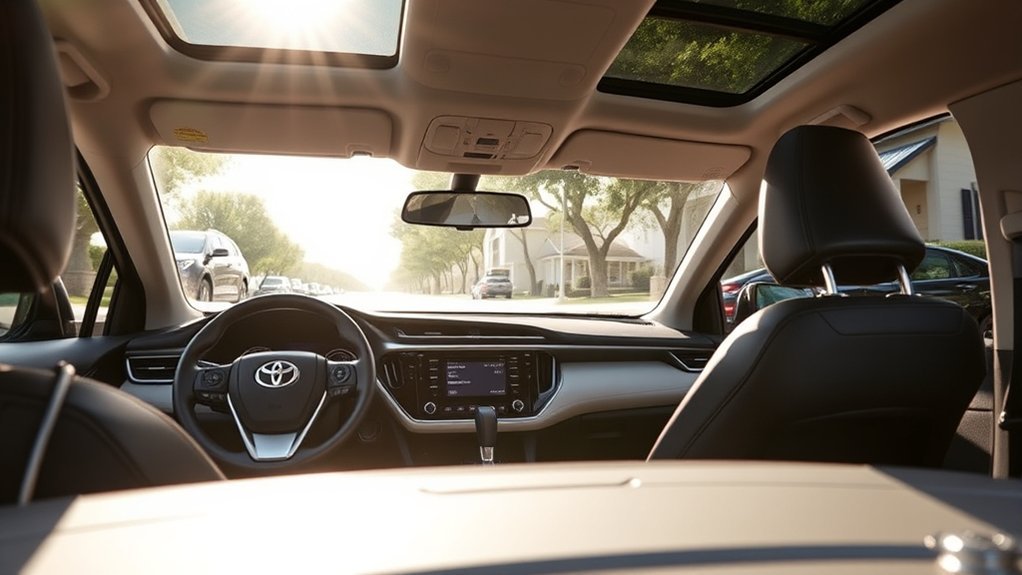
To drive an automatic Toyota RAV4, sit with your foot on the brake pedal, start the vehicle, move the shift lever from P to D, release the parking brake if it does not release itself, and ease off the brake. The details of starting, the parking brake and manual shifting differ between the 2013-2018 and 2019-2025 generations and on hybrids, so this guide covers each one.
Before you drive
- Adjust the seat so you can press the brake pedal fully with a slight bend in your knee, and set the seatback so your shoulders rest against it.
- Set the steering wheel height and reach using the adjustment lever under the column, then lock it back in place.
- Adjust the inside and outside mirrors.
- Fasten your seat belt. The vehicle warns you if the driver’s belt is not fastened.
- Confirm the shift lever is in P (Park).
How to start the RAV4
Gas models with Smart Key
Keep the key fob with you, press the brake pedal, and push the ENGINE START STOP switch. Toyota’s guide states that the shift lever must be in Park with the brake pedal depressed. If you push the switch without pressing the brake, it cycles through Accessory, On and Off instead of starting the engine.
Gas models with a standard key (some 2013-2018 trims)
Some 2013-2018 RAV4s use a conventional ignition switch instead of a push button. Insert the key with the lever in Park and turn it to start.
Hybrid models
With the shift lever in Park and your foot on the brake, press the POWER switch firmly. The vehicle is ready to drive when the READY indicator stays lit, usually with a beep. The engine may not run at that point, because a hybrid can move on the electric motor alone. Silent does not mean off.
Shift lever positions
| Position | What it does |
|---|---|
| P (Park) | Locks the transmission. Required for starting. You must press the brake pedal to shift out of it. |
| R (Reverse) | Backs the vehicle up. Come to a complete stop before selecting it. |
| N (Neutral) | Disconnects the drive. Use it only briefly, for example in a car wash that requires it. |
| D (Drive) | Normal forward driving. The transmission shifts gears for you. |
| S (Sequential or Sport manual mode) | Move the lever from D to S, then use + to upshift and – to downshift. Toyota notes that downshifting increases power uphill or gives engine braking downhill. |
Older articles, including earlier versions of this page, mention an “L” position. The 2013 and later RAV4 guides reviewed here show P, R, N, D and S, not L, so use S and downshift for engine braking on steep descents. If your vehicle is from an earlier generation, check the gear selector markings and the owner’s manual.
Driving step by step

- Start the vehicle with your foot on the brake.
- Release the parking brake if needed (see below).
- Hold the brake, move the lever to D, and check mirrors and blind spots.
- Release the brake slowly. The RAV4 creeps forward on its own, like most automatics.
- Press the accelerator gently. Let the transmission select gears.
- To stop, press the brake progressively and come to a stop before changing direction.
- To reverse, stop fully, press the brake, select R, and check behind you and on the camera or display.
Parking brake by generation
- 2013-2018: Toyota’s 2014 guide shows a lever-type parking brake. Press the brake pedal, pull the lever up to set it. To release it, pull slightly and then lower it, as shown in the guide; your manual gives the exact release steps.
- 2019 and later: An electric parking brake with a switch. Pull the switch while stopped with the brake pedal pressed to apply it, and press the switch with the brake pedal pressed to release it. It also has an automatic mode, so check your owner’s manual for how it behaves with the shift lever.
Brake Hold
On vehicles with the electric parking brake, the Brake Hold function keeps the brakes applied when you stop with the shift lever in D, S or N, and releases automatically when you accelerate. It is convenient in stop and go traffic and can be switched on or off with its button.
Drive modes
| Mode | Best used for |
|---|---|
| Normal | Everyday driving. |
| ECO | Toyota describes it as helping to achieve low fuel consumption. Throttle response is softer. |
| SPORT | More acceleration and sharper response, at the cost of fuel economy. |
| Snow (AWD models, 2019 onward) | Slippery roads. Available on AWD vehicles, per Toyota’s 2019 guide. |
Driver assistance and warning features
Features vary by model year and trim, so check that your vehicle has each one before relying on it.
- Rear cross-traffic alert: Warns of vehicles approaching from the side when you reverse, on equipped trims. It supplements your mirrors and the camera.
- Road sign assist and adaptive cruise control: Part of the driver assistance package on newer models. They help, but you stay responsible for speed and following distance.
- Tire pressure warning: A light appears when a tire is under-inflated. Check pressure with a gauge and use the figures on the driver’s door jamb label.
Common mistakes to avoid
- Shifting before stopping: Always stop completely before moving between D and R, or into P.
- Leaving a hybrid in READY without noticing: Because it is quiet, check for the READY light before you get out, and switch it off.
- Driving with the parking brake set: A dashboard brake warning stays lit. Release it fully, and on lever models check that the lever is fully down.
- Ignoring warning lights: A red brake or charging light means stop safely and check the manual. Do not keep driving.
- Relying on driver assists in place of looking: Sensors can miss objects, particularly in rain, snow or when dirty. Turn your head and use the mirrors.
Parking and leaving the vehicle
- Stop completely with your foot on the brake.
- Apply the parking brake.
- Shift to P.
- Switch off the engine or hybrid system with the ENGINE START STOP or POWER switch.
- When parking on a hill, turn the front wheels toward the curb if facing downhill, and away from it if facing uphill with a curb.
- Take your key fob with you and lock the doors.
Note: Switch names and features differ by model year and trim. The owner’s manual for your vehicle at toyota.com/owners is the authority for your RAV4.
Frequently asked questions
Why will my RAV4 not shift out of Park?
Press the brake pedal firmly first. The transmission requires it. If the brake is pressed and it still will not shift, check the owner’s manual for the shift lock override procedure for your model year and have the brake light switch checked.
Which drive mode should I use every day?
Normal is the standard setting. ECO favors fuel economy, and Sport sharpens throttle response.
Is it OK to use S mode on hills?
Yes. Downshifting in S gives engine braking on long descents, which reduces brake use, and more power on climbs.
Does a hybrid RAV4 drive differently?
The controls are the same. It starts silently, may pull away on the electric motor, and the READY light tells you it is on.
Is the RAV4 easy to drive?
The controls are the same as most automatic crossovers. Spend a few minutes in an empty lot to learn the size and sight lines before driving in traffic.