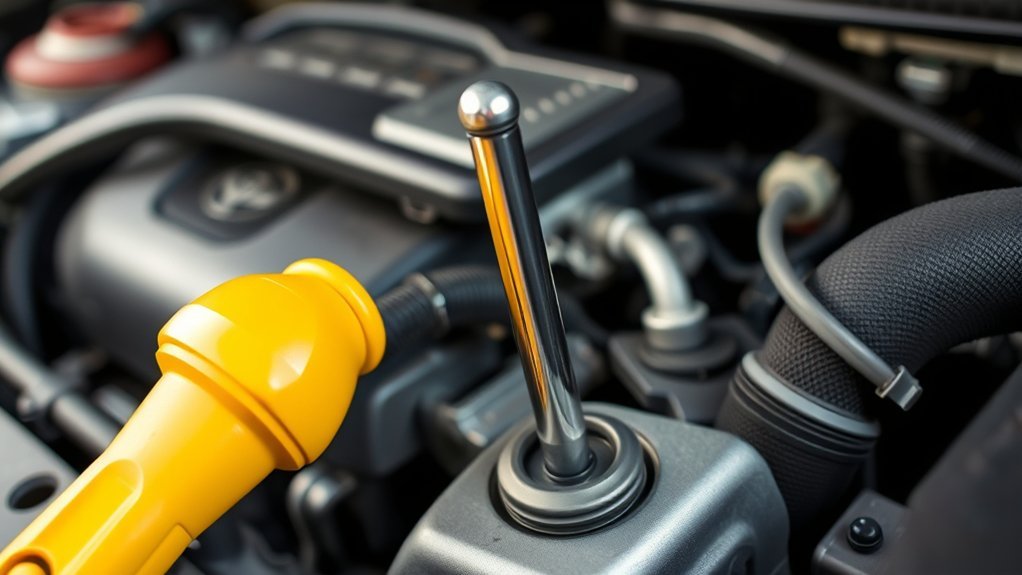
Checking the transmission fluid in a Toyota RAV4 depends on the model year, transmission, and market. Most U.S.-market RAV4s through 2012 use a conventional automatic transmission with a dipstick, while 2013 and newer models generally use a no-dipstick level-checking system. The correct fluid also changes across generations, so confirm the specification before opening a bottle or removing a plug.
Quick Answer
Most U.S.-market RAV4s through 2012 have a transmission dipstick; 2013 and newer models generally do not. For a dipstick model, warm the fluid, park level, leave the engine idling, cycle the gears, then read the HOT range. No-dipstick models require a level lift, model-specific temperature window, and overflow-plug procedure.
Key Takeaways
- Most 1996–2012 U.S. RAV4 automatics have a dipstick. The exact location, markings, and checking temperature vary by engine and transmission.
- Most 2013 and newer RAV4s have no transmission dipstick. Their fluid level is set through a refill and overflow system at a specified temperature.
- There is no single fluid for every RAV4. Early models may use Dexron II/III, 2001–2005 examples commonly use Type T-IV, many 2006–2025 models use ATF WS, and newer 2026-generation models may specify e-Transaxle Fluid TE.
- Do not use color alone to diagnose a transmission. Leaks, delayed engagement, slipping, warning lights, contamination, debris, and service history matter more.
At a Glance
| Time Required | About 10–15 minutes for a dipstick check; shop time varies for a no-dipstick level inspection. |
| Difficulty | Easy for an equipped dipstick model; advanced or professional for a no-dipstick transmission. |
| Tools Needed | Owner’s manual, gloves, lint-free rag, and flashlight. A no-dipstick procedure may require a level lift, scan tool, fluid pump, sockets, torque wrench, and new plug gaskets. |
| Cost | No cost for a basic dipstick or leak inspection. Professional diagnosis and fluid-level service prices vary by location and transmission. |
Which RAV4 Years Have a Transmission Dipstick?
The following table is a general guide for U.S.-market vehicles. Imported models, manual transmissions, engine options, production changes, and previous transmission replacements can create exceptions. Confirm the vehicle through its VIN and the correct Toyota owner’s manual.
| Model years | Typical setup | How the level is checked |
|---|---|---|
| 1996–2000 | Conventional automatic, generally with a dipstick | Dipstick procedure; verify the fluid and markings in the exact manual. |
| 2001–2005 | Conventional automatic with a dipstick | Warm-fluid dipstick procedure, usually with the engine idling. |
| 2006–2012 | Conventional automatic with a dipstick on most U.S. models | Warm-fluid dipstick procedure; four-cylinder and V6 layouts differ. |
| 2013–2018 gasoline | No owner-accessible transmission dipstick | Temperature-controlled refill and overflow-plug procedure. |
| 2016–2025 hybrid or plug-in hybrid | Power-split hybrid transaxle or eCVT without a dipstick | Model-specific fill and level procedure; not checked with an engine-bay dipstick. |
| 2019–2025 gasoline | Eight-speed automatic without a dipstick | Temperature-controlled overflow procedure on a level lift. |
| 2026-generation hybrid or plug-in hybrid | Newer hybrid transaxle without a dipstick | Use the current manual and Toyota service procedure; do not assume the 2019–2025 fluid or method applies. |
Note: A “sealed transmission” is not permanently sealed or automatically maintenance-free. The term usually means there is no owner-accessible dipstick and the level is set through service plugs at a controlled temperature.
Why Transmission Maintenance Matters
Transmission or transaxle fluid lubricates internal components, carries heat, and supports the hydraulic operation of a conventional automatic transmission. A correct fluid level is important because both underfilling and overfilling can interfere with lubrication, pressure control, and shifting.
Routine checks can also reveal a leaking pan, axle seal, cooler line, case joint, drain plug, or refill plug before the level becomes dangerously low. Hybrid RAV4 transaxles operate differently from conventional automatics, but they still require the exact specified fluid and a leak-free housing.
Transmission fluid is separate from power-steering fluid. For models equipped with a hydraulic steering system, see this guide to checking Toyota RAV4 power-steering fluid.
Before Checking the Fluid
Warning: Keep hands, clothing, jewelry, and tools away from belts, pulleys, cooling fans, and other moving parts while the engine is running. Transmission fluid and nearby exhaust components may be hot. Never work beneath a vehicle supported only by a jack.
Tools for a Dipstick Check
- Correct Toyota owner’s manual or service information
- Clean, lint-free white rag or shop towel
- Gloves and eye protection
- Flashlight
- The exact specified fluid, only if topping off is permitted and necessary
- A clean narrow funnel that fits the dipstick tube, if applicable
Basic Preparation
- Work outdoors or in a well-ventilated area.
- Park on a level, solid surface.
- Apply the parking brake.
- Confirm whether the manual requires Park or Neutral.
- Check that you are holding the transmission dipstick, not the engine-oil dipstick.
- Do not rely only on handle color because colors and locations vary.
How to Check RAV4 Transmission Fluid With a Dipstick
This method generally applies to U.S.-market RAV4 automatic transmissions through 2012. Follow the markings and instructions on your vehicle because the required temperature and selector position can vary.
1. Warm the Transmission
Drive normally until the transmission reaches its specified checking temperature. A 2005 RAV4 service procedure, for example, uses 158–176°F (70–80°C), but that range should not be assumed for every year. The COLD marks, when provided, are normally a rough reference rather than the final level check.
2. Park Level and Cycle the Gears
Keep your foot firmly on the brake. With the engine idling, move the selector slowly through each gear position and pause briefly in each one. Return it to the position specified by the manual, commonly Park. This circulates fluid through the transmission’s hydraulic passages.
3. Remove and Clean the Dipstick
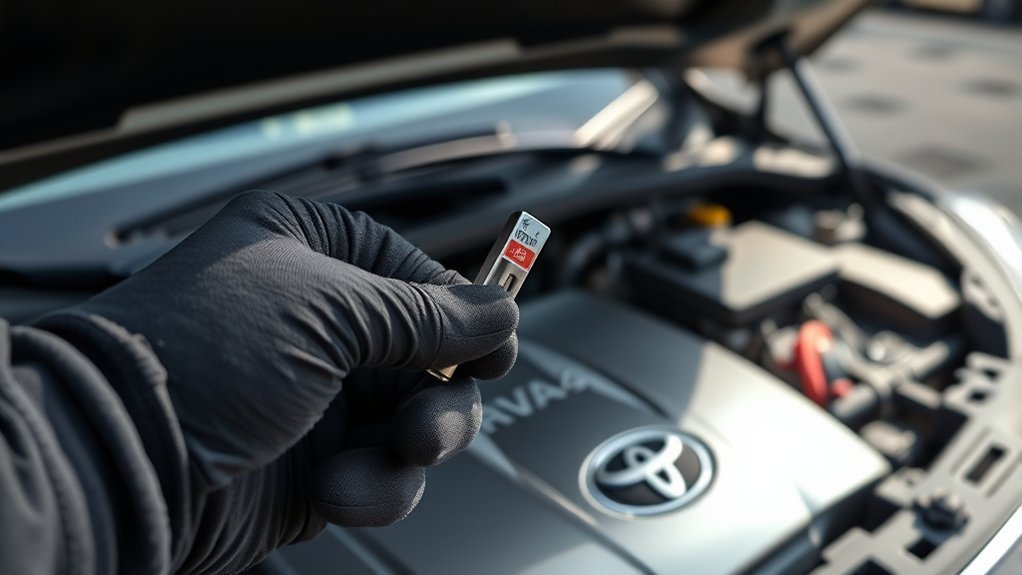
Locate the transmission dipstick, pull it out, and wipe it completely clean with a lint-free rag. Inspect the dipstick for labels such as ATF, TRANS, HOT, COLD, or the required fluid specification.
4. Reinsert and Read the Level
Insert the dipstick fully, remove it again, and hold it level. Read both sides because fluid can smear inside the tube. Repeat the check if the line is unclear. When the transmission is at the specified temperature, the fluid should fall within the HOT range rather than above or below it.
5. Inspect the Fluid
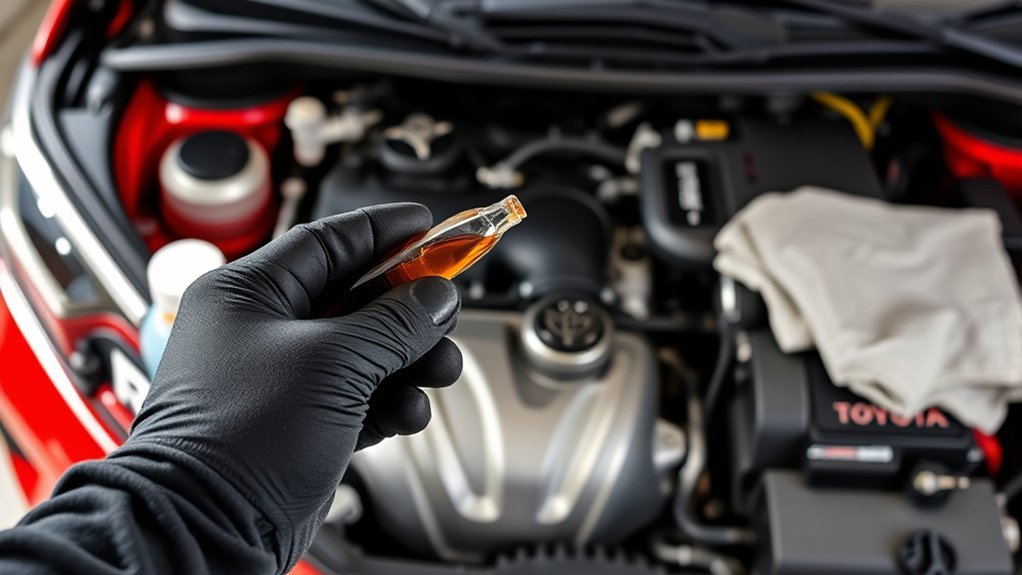
Place a drop on a clean white towel. Look for obvious metal particles, foam, milkiness, or an unusually strong burnt odor. Color alone is not a reliable pass-or-fail test.
6. Correct a Low Level Carefully
A low level usually warrants a leak inspection before adding fluid. If the manual permits topping off through the dipstick tube, add only the exact specified fluid in small amounts. Recheck after each addition. The distance between dipstick marks may represent much less than a full quart.
Pro Tip: Record the level, fluid appearance, mileage, fluid specification, and date. A photo of the dipstick can make future comparisons easier and help a technician understand the vehicle’s service history.
7. Avoid Overfilling
Too much fluid can be aerated by rotating components. Foamed fluid may cause erratic pressure, leakage, overheating, or poor shifting. If the level is clearly above the HOT range, have the excess removed using the correct procedure rather than continuing to drive and hoping it settles.
How to Check a RAV4 With No Transmission Dipstick
Most 2013 and newer RAV4s do not provide an under-hood transmission dipstick. Owners can still check for evidence of a problem, but an accurate fluid-level measurement normally requires a model-specific service procedure.
Safe Checks an Owner Can Perform
- Look for spots after parking: Check the ground beneath the engine and transmission after the vehicle has sat overnight.
- Inspect visible areas: From above or beside the vehicle, use a flashlight to look for wet residue around accessible hoses, case joints, axle areas, and undercovers.
- Watch for warning messages: A transmission, hybrid-system, check-engine, or overheating warning requires diagnosis.
- Notice engagement: Delayed movement after selecting Drive or Reverse can indicate a fluid, control, or mechanical problem.
- Notice shifting behavior: Slipping, engine-speed flares, repeated harsh shifts, or new shuddering should not be ignored.
- Review service records: Confirm whether the transmission was opened, drained, repaired, or refilled recently.
On a no-dipstick RAV4, the safest DIY inspection is for leaks, warnings, and abnormal operation. Opening the overflow plug without the correct procedure can create a low-fluid condition.
What the Professional Level Procedure Involves
The exact steps vary by transmission. A typical Toyota conventional automatic procedure may include:
- Identifying the transmission by VIN, model code, and repair manual.
- Confirming that the correct fluid and new sealing gaskets are available.
- Placing the vehicle on a lift and keeping it level front-to-rear and side-to-side.
- Checking the starting fluid quantity when service or leakage has occurred.
- Monitoring transmission-fluid temperature with Toyota Techstream, a compatible scan tool, or the specified temperature-detection mode.
- Starting the engine and circulating fluid through the required selector positions.
- Removing the overflow plug only within the specified temperature window.
- Adding fluid through the refill opening if no valid overflow is present, or allowing excess fluid to drain until the specified drip condition is reached.
- Installing new gaskets and tightening the plugs to the model-specific torque.
- Cleaning the area and checking for leaks after the procedure.
For the 2022–2025 UB80F gasoline transmission, Toyota service information uses a fluid-level adjustment range of 95–113°F (35–45°C). That temperature is not a universal value for every RAV4 transmission or hybrid transaxle. Technicians should use the applicable procedure from the Toyota Technical Information System.
Warning: Do not remove a drain or overflow plug merely to “see whether fluid comes out.” At the wrong temperature, angle, or engine state, a normal transmission may appear underfilled or may lose fluid that must then be replaced accurately.
Toyota RAV4 Transmission Fluid Type by Year
The label on the dipstick, owner’s manual, repair manual, or VIN-specific Toyota parts information is the final authority. The following ranges are general U.S.-market guidance, not substitutes for the exact manual.
| Model years | Common specification | Important qualification |
|---|---|---|
| 1996–2000 | Some U.S. manuals specify Dexron II or III; specifications vary | Verify the exact year and transmission. Do not assume Type T-IV. |
| 2001–2005 | Toyota Genuine ATF Type T-IV on common U.S. automatic models | Confirm the dipstick label and manual before adding fluid. |
| 2006–2012 | Toyota Genuine ATF WS on many U.S. conventional automatics | Engine and transmission options affect capacity and procedure. |
| 2013–2025 gasoline | Toyota Genuine ATF WS on most U.S. models | These are generally no-dipstick transmissions requiring an overflow procedure. |
| 2016–2025 hybrid and plug-in hybrid | Toyota Genuine ATF WS on many front and rear hybrid transaxle applications | Do not use generic belt-CVT fluid unless the exact manual specifies it. |
| 2026-generation hybrid and plug-in hybrid | Toyota Genuine e-Transaxle Fluid TE may be specified | Check the current 2026 Toyota RAV4 manual; do not automatically use ATF WS. |
Toyota Genuine ATF WS, Type T-IV, Dexron-type fluids, and e-Transaxle Fluid TE have different specifications. Do not mix or substitute them based only on a bottle’s “multi-vehicle” wording. Confirm compatibility for the exact transmission before use.
What to Look for in the Fluid
Fluid appearance can provide clues, but it cannot confirm transmission health by itself.
- Clear reddish or amber fluid: Often consistent with usable fluid, depending on the product and service age.
- Darker red or brown fluid: May reflect normal aging, heat exposure, or accumulated wear material. Review mileage, odor, symptoms, and service history.
- Strong burnt odor: Can indicate overheating or clutch-material deterioration and should prompt professional inspection.
- Milky, cloudy, or pink emulsion: May indicate water or coolant contamination. Avoid driving until the source is diagnosed.
- Visible metallic glitter or fragments: Requires prompt diagnosis because it may indicate abnormal internal wear.
- Foamy fluid: May result from overfilling, aeration, an incorrect fluid, or air entering the system.
Note: Fluid that has darkened is not automatically failed, and bright fluid does not prove that the level, pressure, or transmission condition is correct.
How Often Should RAV4 Transmission Fluid Be Changed?
There is no single replacement interval that applies to every RAV4. Use the warranty and maintenance guide for the exact model year, powertrain, and market.
For example, Toyota’s 2022 RAV4 Warranty & Maintenance Guide lists automatic transmission fluid replacement at 60,000 miles or 72 months for specified special operating conditions. Those conditions include primarily driving while towing, using a car-top carrier, carrying heavy loads, or performing extensive idling and low-speed operation such as taxi or delivery work.
Under normal use, Toyota maintenance guides commonly emphasize inspection for leakage rather than a universal replacement at 60,000 miles. A shop may recommend a preventive interval based on operating conditions, fluid history, age, or local conditions, but that recommendation should be clearly distinguished from Toyota’s published schedule.
Drain-and-Fill vs. Fluid Exchange
- Drain-and-fill: Removes the fluid that drains from the pan or case and replaces a portion of the total capacity. Some fluid remains in internal passages, the torque converter, or cooler circuit.
- Fluid exchange: Replaces a larger percentage of the fluid, sometimes using specialized equipment and a model-specific process.
- Repair-related refill: Uses a specified initial quantity followed by a temperature-controlled level adjustment after a leak repair or component removal.
Do not choose a service method solely because the fluid looks dark. A transmission that is already slipping, shuddering, overheating, or storing fault codes should be diagnosed before any fluid service. The technician should also confirm the correct fluid, service history, refill procedure, and plug torques.
Signs the Transmission Needs Inspection
- A fresh fluid puddle or wet underbody area
- Repeatedly low fluid on a properly performed dipstick check
- Delayed engagement after selecting Drive or Reverse
- Engine-speed flare or slipping during acceleration
- New harsh, erratic, or repeated shifting
- Shuddering that occurs at consistent speeds or loads
- A burning smell or smoke
- A transmission, hybrid-system, overheating, or check-engine warning
- Milky fluid, metal debris, or severe foaming
- Recent transmission, axle, cooler-line, or seal work followed by symptoms
When You Should Not Keep Driving
Park the RAV4 and arrange an inspection or tow if it will not move normally, slips severely, loses a large amount of fluid, produces smoke, displays an overheating warning, or makes new grinding or mechanical noises. Continuing to drive with a significant leak or loss of drive can increase damage and create a road-safety risk.
Common Mistakes When Checking RAV4 Transmission Fluid
- Assuming every model has a dipstick: Most 2013 and newer RAV4s do not.
- Checking on a slope: Vehicle angle affects both dipstick and overflow readings.
- Using the COLD range as the final result: On many dipstick models, COLD is only a rough reference.
- Turning the engine off when the procedure requires idling: This can change the fluid distribution and reading.
- Using a universal temperature: The correct overflow window is transmission-specific.
- Adding the wrong fluid: ATF WS, Type T-IV, Dexron-type fluid, CVT fluid, and e-Transaxle Fluid TE are not automatically interchangeable.
- Adding too much at once: Small increments reduce the chance of overfilling.
- Opening the overflow plug without a refill plan: Fluid may be lost even when the transmission was initially correct.
- Working under jack-only support: A level-check procedure requires safe lifting equipment and stable support.
- Ignoring a recurring low level: A properly serviced transmission should not require routine top-offs; repeated loss requires leak diagnosis.
Frequently Asked Questions
Does a 2012 Toyota RAV4 have a transmission dipstick?
Most U.S.-market 2012 RAV4 gasoline models with conventional automatic transmissions have an ATF dipstick. Four-cylinder and V6 layouts differ, so use the owner’s or repair manual to locate it and confirm the checking procedure.
Does a 2016 Toyota RAV4 have a transmission dipstick?
Generally, no. Both gasoline and hybrid 2016 RAV4 models use no-dipstick fluid-level systems. An accurate level check requires the procedure for the exact automatic transmission or hybrid transaxle.
Where is the transmission dipstick on a 2019 RAV4?
The 2019 RAV4 does not normally have an under-hood transmission dipstick. Gasoline models use an eight-speed automatic, while hybrid models use a power-split eCVT transaxle. Both require model-specific service procedures for an accurate fluid-level check.
What transmission fluid should I use in my RAV4?
Use only the specification listed for the exact model, transmission, and production date. Early models may use Dexron II or III, many 2001–2005 models use Type T-IV, many 2006–2025 models use ATF WS, and some 2026-generation hybrid models specify e-Transaxle Fluid TE.
Can I use ATF WS in a 2026 RAV4 Hybrid?
Do not assume ATF WS is correct. Newer 2026-generation hybrid transaxles may specify Toyota Genuine e-Transaxle Fluid TE. Check the current manual or VIN-specific Toyota service information before adding or replacing fluid.
How often should RAV4 transmission fluid be changed?
Follow the maintenance guide for the exact model. Toyota lists replacement at 60,000 miles or 72 months for certain RAV4s used primarily for towing, heavy loading, car-top carrying, or extensive idling and low-speed operation. That is not a universal normal-driving interval.
Can I check RAV4 transmission fluid when it is cold?
A COLD mark on an older dipstick may provide a rough reference, but the final check generally requires the fluid to be within the specified warm or HOT range. No-dipstick transmissions must also be checked inside a model-specific temperature window.
Can I top off a sealed RAV4 transmission myself?
It is possible with the correct repair information, lifting equipment, fluid pump, temperature-monitoring method, tools, and torque specifications. However, an inaccurate refill can leave the transmission underfilled or overfilled, so most owners should use a qualified Toyota or transmission technician.
Conclusion
First determine whether your RAV4 has a transmission dipstick. On most U.S.-market models through 2012, warm the transmission, park level, keep the engine in the state specified by the manual, cycle the gears, and read the HOT range carefully. On most 2013 and newer models, limit DIY work to checking for leaks, warnings, and abnormal operation unless you have the exact Toyota service procedure and safe lifting equipment.
Always verify the fluid by model year, powertrain, production date, and VIN. Do not assume every modern RAV4 uses ATF WS, and do not diagnose the transmission from fluid color alone. Promptly investigate slipping, delayed engagement, heavy leakage, overheating, contamination, or warning lights.
Sources
- Toyota 2005 RAV4 Owner’s Manual — Type T-IV specification and older-model reference information.
- Toyota 2012 RAV4 Manuals and Warranties — official model-year owner resources.
- Toyota 2013 RAV4 Owner’s Manual — fourth-generation owner information and ATF WS specifications.
- Toyota 2022 RAV4 Warranty & Maintenance Guide — transmission inspection and special-operating-condition replacement guidance.
- Toyota 2026 RAV4 Manuals and Warranties — current-generation owner and maintenance documentation.
- Toyota Technical Information System — model-specific repair procedures, fluid-level methods, temperatures, and torque specifications.