
A passenger seat that is too far forward, too reclined, or poorly matched to the passenger can make a Toyota RAV4 uncomfortable and reduce proper seat-belt fit. The correct method depends on whether the vehicle has a manual or power passenger seat. This guide explains the controls, safe adjustment order, trim differences, common problems, and safer accessibility options.
Quick Answer
Park the RAV4, locate the bar, lever, or power switches beside the passenger seat, then set the fore-aft position, seatback angle, and height if equipped. Confirm that a manual seat locks, the passenger sits upright, and the lap and shoulder belts fit correctly. Controls vary by model year, trim, package, and market.
Key Takeaways
- Manual seats usually use a front slide bar and a side recline lever; power seats use switches on the outer side of the seat.
- Passenger-seat adjustment changed between RAV4 generations, trims, packages, and countries, so confirm the equipment for your VIN.
- After adjustment, make sure the seat is locked and the belt lies low across the hips and across the center of the shoulder.
- Do not place loose cushions or seat covers on the front passenger seat unless Toyota confirms compatibility with the occupant-detection system.
- Do not alter seat rails, wiring, airbags, upholstery, or occupant sensors without a qualified mobility or vehicle-modification specialist.
At a Glance
| Time Required | 2 to 5 minutes |
| Difficulty | Easy for normal adjustment; professional help required for repairs or modifications |
| Tools Needed | None; owner manual and flashlight are helpful for troubleshooting |
| Cost | $0 for adjustment; repair or adaptive-equipment costs vary |
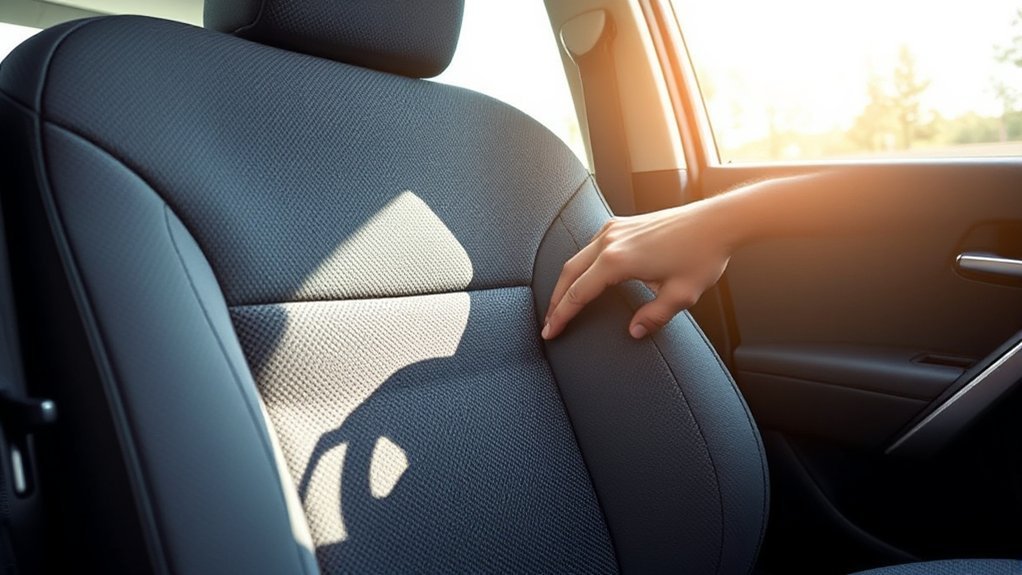
How to Adjust the Passenger Seat in a Toyota RAV4
Before You Begin
Park on level ground, apply the parking brake, and shift into Park. Make adjustments before the vehicle moves. Ask the passenger to sit fully back against the seatback with both feet supported on the floor.
Check the exact Toyota owner manual for the vehicle. Seat controls and power-seat operating conditions can differ by production year, trim, powertrain, and country.
Warning: Keep hands, fingers, feet, loose clothing, floor mats, and objects away from the seat tracks while the seat is moving. Never adjust the seat while the vehicle is being driven.
Manual vs. Power Passenger Seat Controls
| Control | Typical Location | What It Does |
|---|---|---|
| Slide bar | Under the front edge of a manual seat | Moves the seat forward or backward |
| Recline lever | Outer side of a manual seat | Changes the seatback angle |
| Height lever | Outer side, if equipped | Raises or lowers the seat cushion |
| Power switches | Outer side of a power seat | Controls slide, recline, height, and tilt functions included on that seat |
Steps to Adjust the Passenger Seat
- Find the controls. Look under the front edge and along the outer side of the passenger seat.
- Set the fore-aft position. Lift the manual slide bar or operate the horizontal power switch. Move the seat until the passenger has comfortable knee clearance without pressing against the dashboard or rear seat.
- Set the seatback. Pull the recline lever or operate the recline switch. Keep the seatback as upright as comfort allows; excessive recline can weaken seat-belt protection.
- Adjust height or cushion angle if equipped. Use only the lever or switch provided by Toyota. Do not place blocks, spacers, or hardware under the seat rails.
- Confirm the seat is locked. Release a manual control, then rock the seat gently forward and backward. It should not slide.
- Check belt fit. The lap belt should sit low and snug across the hips, and the shoulder belt should cross the center of the shoulder without touching the neck or falling off the shoulder.
- Check the passenger-airbag indicator. With an adult seated correctly, follow the owner manual if the “AIR BAG OFF” indicator remains illuminated.
Pro Tip: Make one adjustment at a time. Start with slide position, then seatback angle, then height or tilt. This makes it easier to identify which change improves comfort and belt fit.
Common Toyota RAV4 Passenger Seat Adjustment Problems
RAV4 passenger-seat complaints usually involve limited height adjustment, a seat that will not slide, a manual seat that does not lock, a power seat that stops moving, or an “AIR BAG OFF” indicator that stays on with an adult passenger.
Before assuming the seat is defective, confirm the exact equipment. Toyota’s official feature lists show major differences between model years and grades. For example, the 2025 U.S. RAV4 used a 4-way adjustable passenger seat on lower grades and a 4-way power passenger seat on the gas Limited. The 2026 U.S. RAV4 moved to manual 6-way passenger adjustment on several grades and power 8-way passenger adjustment on Limited and XSE.
Height Adjustment Limitations
Passenger height adjustment is not universal across every RAV4. A 4-way passenger seat generally provides fewer functions than a 6-way or 8-way seat, but the exact movements must be confirmed in the owner manual. Toyota Canada’s 2026 RAV4 specifications list multiple arrangements, including 6-way manual driver and passenger seats, an 8-way power driver seat with a 6-way manual passenger seat, and 8-way power seats for both front occupants.
| What to Check | Why It Matters | Best Next Step |
|---|---|---|
| Owner manual | Shows the controls and safety warnings for the exact vehicle | Read the front-seats and occupant-classification sections |
| Window sticker or build sheet | Lists factory-installed equipment | Look for manual or power passenger-seat wording |
| VIN and production market | Features can differ by country and production run | Ask a Toyota dealer to verify the VIN |
| Physical controls | Confirms which adjustments are actually installed | Inspect the front and outer side of the seat |
A model-year change can alter the answer: Toyota listed 4-way passenger adjustment on many 2025 U.S. RAV4 grades, while several 2026 U.S. grades use 6-way manual adjustment and select grades use 8-way power adjustment.
Why Passenger Seat Comfort Varies by RAV4 Model
Comfort changes with seat height, cushion shape, upholstery, available adjustments, passenger height, mobility, and posture. Two vehicles with the RAV4 name may feel different because they belong to different generations, grades, or markets.
- Check the seat height. A fixed or limited height may feel too high or too low for a particular passenger.
- Check entry space. Sliding the seat rearward before entry can create more room, but reset it for correct belt fit before driving.
- Check the seatback angle. A modest change can improve headroom and hip comfort; excessive recline is unsafe.
- Check the exact model. Advice from another owner only applies when the year, trim, market, and seat equipment match.
Safe Solutions for RAV4 Passenger Seat Comfort Issues
Start with factory adjustments and simple access changes. Major seat work can affect seat strength, airbags, the seat-belt system, and front-passenger occupant detection.
Height Adjustment Options
- Confirm the installed seat. Use the VIN, manual, window sticker, or dealer build record.
- Use the full factory adjustment range. Set slide, recline, height, and tilt only through the original controls.
- Improve entry access. Properly installed running boards or side steps may reduce the climb into the cabin.
- Use the grab handle correctly. A passenger may use the interior assist grip while entering or exiting, but it is not a substitute for a secure mobility aid.
- Ask about adaptive equipment. Toyota’s Mobility program describes professionally installed passenger-access equipment and recommends working with mobility specialists.
Seat Modification Considerations
A seat from another trim may bolt into the floor yet still be incompatible with wiring, airbag modules, seat-belt buckles, occupant sensors, upholstery-mounted airbags, or vehicle software. Physical fit alone does not prove that a swap is safe.
Warning: Do not drill, cut, space, weld, or relocate seat rails. Do not bypass or probe airbag wiring, occupant sensors, or seat-belt circuits. Toyota warns that seat and SRS modifications can cause incorrect operation or accidental deployment.
For a lower, higher, swiveling, or more adjustable seat, consult a Toyota dealer and a qualified mobility-equipment installer. Ask for written confirmation that the proposed equipment is compatible with the exact VIN and retains normal airbag, seat-belt, and occupant-classification operation.
How to Make the RAV4 Passenger Seat More Comfortable for Shorter Passengers
Shorter passengers may need easier entry, better foot support, and a belt path that stays away from the neck. Use the vehicle’s built-in adjustments first.
- Raise the seat if the factory control allows it. Stop when the passenger has comfortable headroom and correct belt fit.
- Slide the seat to balance legroom and belt position. Move it rearward for entry, then set a safe riding position before driving.
- Keep the seatback upright. The passenger should sit fully back rather than leaning forward or slouching.
- Use a properly installed step or mobility aid. This can help with entry without changing the seat cushion or rails.
- Avoid loose booster, wedge, and swivel cushions. Toyota RAV4 manuals warn that items placed on the front passenger seat can interfere with weight sensing and airbag operation. Use only equipment specifically approved for the vehicle and installed or evaluated by a qualified specialist.
Note: If an adult is seated upright with the belt fastened and the “AIR BAG OFF” light remains on, follow the owner-manual procedure. If the indicator does not change, move the passenger to a rear seat when practical and have the system checked.
Modifying Non-Adjustable Seats
If the passenger seat has limited adjustment, a replacement seat may seem like the quickest solution. Treat it as a safety-system modification, not a simple comfort upgrade.
| Option | Possible Benefit | Main Risk or Requirement |
|---|---|---|
| Factory seat from another trim | More adjustment range | Must match rails, wiring, airbags, buckle, sensors, modules, and programming |
| Loose seat cushion | Changes apparent sitting height | Not recommended without Toyota-approved compatibility because it may affect occupant detection and belt fit |
| Side steps or running boards | Easier entry and exit | Requires secure installation and a non-slip stepping surface |
| Professionally installed mobility seat | Can improve transfer height or provide swivel/lift movement | Requires vehicle-specific evaluation, qualified installation, and confirmation of safety-system compatibility |
Do not approve a modification unless the installer can document that the airbag system, seat-belt anchorage, occupant sensor, seat strength, and warning lights will continue to work correctly.
How to Troubleshoot Seat Adjustment Problems

If the passenger seat will not move or lock, begin with checks that do not disturb the restraint-system wiring.
- Check for track obstructions. Remove coins, toys, bottles, floor-mat edges, and other loose items without putting fingers into the mechanism.
- Check a manual seat lock. Lift the slide bar, move the seat, release the bar, and verify that both rails lock. Stop using the seat if it slides after release.
- Test each power function separately. Listen for a motor and note whether only one direction or one switch fails.
- Check the correct fuse only through the owner manual. Use the specified fuse rating. Never install a higher-amperage fuse, and arrange service if a replacement fuse blows again.
- Look under the seat without touching connectors. Do not unplug, probe, pull, or repair yellow SRS connectors or other seat wiring.
- Check warning indicators. An SRS warning light or abnormal passenger-airbag indicator requires professional diagnosis.
Warning: Do not continue using a seat that will not lock, has damaged rails, moves unexpectedly, smells hot, repeatedly blows a fuse, or triggers an SRS warning light.
If the problem remains, book service with a Toyota dealer or qualified technician. Power-seat motors, switches, modules, rails, and restraint-system wiring need model-specific testing.
Other Ways to Improve Passenger Access and Comfort
You can improve access without altering the original seat. Properly installed running boards, a stable exterior step designed for the vehicle, and professional transfer aids may help passengers who have difficulty climbing into the RAV4.
Do not place a loose swivel cushion on the front passenger seat simply because it is marketed as an accessibility product. A safer option is a professionally evaluated swivel or lift seat that is designed for vehicle use and installed through a qualified mobility-equipment provider.
Owner communities can help identify comfort concerns, but forum posts cannot prove that a seat, bracket, cushion, or wiring adapter is safe for a specific VIN. Confirm any part or modification through Toyota documentation, a dealer, or a qualified adaptive-equipment specialist.
Frequently Asked Questions
Does the RAV4 have an adjustable passenger seat?
Yes. RAV4 passenger seats generally provide at least fore-aft and recline adjustment, but the number of manual or power adjustments varies by model year, trim, package, and market. Check the owner manual and build sheet for the exact VIN.
How do you adjust the passenger seat in a RAV4?
Use the slide bar, recline lever, height lever, or power switches fitted to the seat. Adjust the slide position first, then the seatback and height if equipped. Confirm that the seat locks and that the seat belt fits correctly.
How do you manually adjust a RAV4 passenger seat?
Lift the bar under the front of the seat, slide the seat, and release the bar. Rock the seat gently to confirm that it locked. Use the side lever for recline and the height lever only when the seat includes one.
Can you add height adjustment to a RAV4 passenger seat?
Do not add spacers or alter the rails. A factory seat or mobility seat may be possible in some vehicles, but only after a Toyota dealer or qualified modifier confirms compatibility with the rails, wiring, airbags, seat belt, occupant sensor, and vehicle electronics.
Why does the “AIR BAG OFF” light stay on with an adult passenger?
Posture, objects under or on the seat, contact with the rear seat, or a system fault can affect occupant classification. Ask the passenger to sit upright and fully back with feet on the floor, remove unapproved seat accessories, and follow the owner manual. Arrange service if the indicator remains abnormal.
What is the lawsuit against the Toyota RAV4?
There is no single lawsuit identified by that broad phrase, and this article does not verify a passenger-seat-height case. For a safety concern, search the vehicle’s VIN through the NHTSA recall database, review Toyota notices, and consult a qualified lawyer for case-specific legal advice.
Safety Disclaimer: This article provides general information. Follow the owner manual for the exact VIN and consult a Toyota dealer or qualified vehicle or mobility technician before repairing or modifying seats, rails, seat belts, airbags, wiring, upholstery, or occupant sensors.
Conclusion
The safest way to improve a Toyota RAV4 passenger seat is to use the controls already installed, confirm the equipment for the exact year and trim, and check the final belt fit and seat lock. Avoid loose cushions and unverified seat swaps. For persistent comfort, access, electrical, or warning-light problems, use a Toyota dealer or qualified mobility specialist rather than changing the restraint system yourself.
Sources
- Toyota Manuals and Warranties — model-specific seat controls, warnings, fuses, seat belts, and occupant-classification guidance
- Toyota USA: 2026 RAV4 grade features — current U.S. manual 6-way and power 8-way passenger-seat availability
- Toyota Canada: 2026 RAV4 specifications — Canadian seat configurations by grade
- Toyota Mobility: Adaptive equipment solutions — professional passenger-access and mobility options
- NHTSA Recalls — VIN-based recall, investigation, complaint, and manufacturer-communication lookup