The correct highway tire pressure is not a universal 32, 35, or 40 PSI. It is the cold pressure selected by your vehicle manufacturer for the tire size and load on your vehicle. Using that placard value supports stable handling, lower heat buildup, predictable braking, and even tire wear during long, high-speed trips.
Quick Answer
For highway driving, use the vehicle manufacturer’s recommended cold tire pressure shown on the driver-side door placard or in the owner’s manual. Do not add extra air just because you will drive faster or farther. Use a different full-load or towing value only when the manufacturer specifically provides one.
Key Takeaways
- Use the door-jamb placard cold PSI, not a generic chart or the maximum pressure on the tire sidewall.
- Check pressure before driving or after the vehicle has been parked for at least three hours.
- Highway driving does not automatically require extra pressure.
- A temperature drop of about 10°F commonly lowers measured tire pressure by about 1 PSI.
- Check pressure monthly, before long trips, and whenever weather changes sharply or the TPMS light appears.
At a Glance
| Time Required | About 5–10 minutes |
| Difficulty | Easy |
| Tools Needed | Accurate tire-pressure gauge and an air source if adjustment is needed |
| Cost | No service cost if you already have a gauge and air source; equipment prices vary |
Recommended Highway Tire Pressure and Where to Find It
Your best highway tire pressure is the same vehicle-specific pressure used for normal road driving: the recommended cold PSI on the Tire and Loading Information label or in the owner’s manual. The front and rear values may be different, so read both entries instead of assuming all four tires use the same number.
NHTSA’s TireWise guidance directs drivers to the vehicle manufacturer’s label and recommends checking all tires, including the spare, at least once a month when cold.
Do not use the maximum PSI molded into the tire sidewall as your everyday target. That marking relates to the tire’s maximum load and corresponding cold inflation information. It is not the vehicle manufacturer’s optimized setting for ride, braking, steering response, load distribution, and tread wear.
Warning: Do not add extra pressure simply because you plan to drive at highway speed. Excess pressure can change handling and ride quality, while insufficient pressure increases flex and heat. Use only the pressure specified for your vehicle, tire size, and load condition.
What “Cold Tire Pressure” Means
For the most consistent reading, measure pressure before driving or after the vehicle has been parked for at least three hours. A very short drive at moderate speed may have little effect, but checking before the trip is the safer and more repeatable routine.
Tire pressure normally rises as the tire warms during driving. Do not bleed a properly inflated warm tire down to the cold placard number. It may become underinflated after cooling.
What to Do If the Tires Are Already Warm
If a warm tire appears significantly low, add enough air to reach at least the vehicle’s recommended cold pressure as a temporary safety measure. Then check and correct all pressures again after the vehicle has been parked long enough for the tires to become cold.
Note: A warm reading above the placard number is usually normal. The placard specifies a cold setting, not the pressure you should expect after sustained driving.
Why Highway Tire Pressure Matters for Safety, Wear, and Fuel Economy
Handling, Heat, and Tire Wear
Correct pressure helps each tire support its share of the vehicle’s load and maintain the contact shape intended by the manufacturer. This is especially important during long highway trips, where speed, cargo, hot pavement, and continuous flex can increase tire temperature.
Underinflation causes extra sidewall flex and heat. It may also reduce steering precision and increase the chance of tire damage. Excess pressure can make the ride harsher and reduce the tire’s ability to absorb bumps. Either condition may contribute to irregular wear, although tread patterns alone do not prove that pressure is the only cause.
Effects on Fuel Economy
Underinflated tires have more rolling resistance. FuelEconomy.gov estimates that gas mileage can fall by about 0.2% for every 1 PSI drop in the average pressure of all tires.
FuelEconomy.gov estimates that properly inflated tires improve gas mileage by about 0.6% on average and by up to 3% in some underinflated cases.
These figures are estimates, not a promise for every vehicle. Speed, temperature, tire construction, alignment, cargo, road surface, and driving style also affect fuel use.
Set Highway PSI for Cars, SUVs, Light Trucks, and Towing
There is no dependable PSI range that applies to every passenger car, crossover, SUV, or light truck. Vehicle weight, axle loading, tire size, load index, wheel specification, and suspension design all affect the manufacturer’s chosen pressure.
| Vehicle or Tire Situation | Pressure to Use | Where to Verify It |
|---|---|---|
| Original-size tires, normal or highway driving | Vehicle placard cold PSI | Driver-side door label or owner’s manual |
| Different front and rear values | Use the listed value for each axle | Tire and Loading Information label |
| Heavy cargo or towing | Use a full-load value only if the manufacturer lists one | Owner’s manual, placard, or certification label |
| Different tire size or load range | A verified pressure that preserves the required load capacity | Vehicle manufacturer or qualified tire manufacturer |
| Temporary spare tire | The spare-specific cold pressure | Spare sidewall, storage label, or owner’s manual |
Adjustments for Towing and Heavy Loads
Towing does not automatically mean you should add air above the placard value. Some vehicles provide a separate full-load pressure, while others use the normal placard pressure for all permitted loads. Follow the exact instruction for your model.
Tire pressure also cannot make an overloaded vehicle safe. Stay within the vehicle’s payload, gross vehicle weight rating, gross axle weight ratings, tire load ratings, wheel ratings, hitch rating, and trailer limits.
Warning: Never exceed the tire’s marked maximum cold pressure, the wheel’s pressure rating, or any vehicle load limit. If the trailer or cargo substantially changes rear-axle load, confirm the correct setup in the owner’s manual before traveling.
Replacement and Non-Original Tires
The door placard was developed for the original tire specification. If the replacement tires have a different size, construction, or load range, do not assume the same pressure is automatically correct. Ask the vehicle manufacturer or a qualified tire manufacturer for a pressure that provides at least the original required load capacity without exceeding any tire or wheel limit.
How to Check and Set Tire Pressure Step by Step
- Park and let the tires cool: Check before driving or after the vehicle has been parked for at least three hours.
- Find the correct target: Read the Tire and Loading Information label on the driver-side door edge, door jamb, or nearby pillar. Check whether front and rear pressures differ.
- Remove the valve cap: Keep it clean and place it somewhere safe.
- Measure the pressure: Press an accurate gauge squarely onto the valve stem until the hissing stops and the reading stabilizes.
- Add or release air: Add air in short bursts if pressure is low. If it is high while the tire is cold, release a small amount and measure again.
- Check every road tire: Keep tires on the same axle at their specified matching pressure unless the manufacturer states otherwise.
- Check the spare: A temporary spare may use a substantially different pressure from the road tires.
- Replace the valve caps: Caps help keep dirt and moisture away from the valve core.
- Recheck before a long trip: Confirm pressure again after major weather changes or before carrying a heavy load.
Pro Tip: Keep one dependable gauge in the vehicle and use the same gauge for routine checks. Small differences between gauges are common, so consistency makes gradual pressure loss easier to spot.
Change PSI for Temperature, Altitude, and Seasonal Conditions
Cold-Weather Pressure Changes
Measured tire pressure commonly changes by about 1 PSI for each 10°F change in air temperature. When temperatures fall, check the tires cold and add air as needed to return them to the placard value. Do not intentionally run below the listed pressure for winter traction.
Michelin’s tire guidance uses the same approximate 1 PSI per 10°F rule and recommends monthly checks.
Hot Weather and Highway Travel
Hot weather and sustained driving raise tire temperature and pressure. This increase is expected when the cold pressure was set correctly. Do not release air from a hot tire merely because its reading is above the cold placard number.
Before a summer road trip, check the tires cold, inspect for cuts, bulges, cracking, punctures, and unusual wear, and confirm that the vehicle is not overloaded.
Altitude Changes
Changes in elevation can affect a gauge reading because the surrounding atmospheric pressure changes. Temperature normally causes the more noticeable day-to-day variation. Do not use an unsupported altitude correction formula. Recheck the tires cold at your destination and maintain the vehicle manufacturer’s recommended pressure.
Common Pressure Mistakes and Signs of a Problem
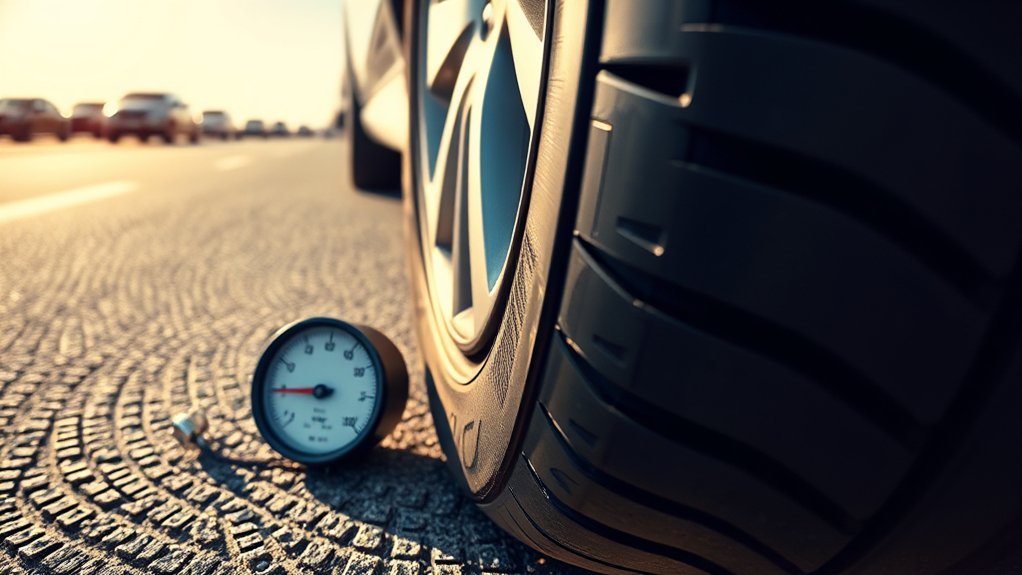
- Using the sidewall maximum: The sidewall value is not the normal pressure target for the vehicle.
- Adding extra air for highway speed: Use the placard value unless the manufacturer provides a different load-specific setting.
- Bleeding warm tires: A warm tire naturally reads higher and may become low after cooling if air is released.
- Trusting appearance: A radial tire can be significantly underinflated without looking flat.
- Relying only on TPMS: The system is designed to warn of significant underinflation, not every small pressure loss.
- Ignoring the spare: Spare tires also lose air and may require a different pressure.
- Repeatedly topping up one tire: Frequent pressure loss may indicate a puncture, valve leak, wheel damage, or bead-sealing problem.
What the TPMS Light Means
Under the U.S. federal standard, a compliant system must detect a tire at approximately 25% below the recommended cold placard pressure under specified test conditions, although some vehicles warn sooner. That means the tire can be meaningfully low before the light appears.
If the TPMS symbol flashes for roughly a minute and then remains on, the system may have a fault rather than a simple low-pressure condition. Check the owner’s manual and arrange an inspection.
NHTSA’s FMVSS No. 138 interpretation explains the 25% threshold and detection requirements.
Tread-Wear Clues
Wear on both shoulders can be associated with underinflation, while concentrated center wear can sometimes be associated with excessive pressure. However, these patterns are only clues. Alignment, worn suspension parts, wheel balance, tire rotation, cornering, load, and tire design can also cause uneven wear.
When Not to Continue Driving
Stop in a safe place if a tire is rapidly losing pressure, visibly flat, bulging, split, exposing cords, vibrating severely, or producing unusual noise. Do not continue highway driving on a damaged conventional tire. Install a usable spare or arrange roadside assistance and have the tire inspected by a qualified professional.
Quick Reference for Highway Tire Pressure
- Normal highway trip: Use the vehicle placard cold PSI.
- Front and rear values differ: Follow the number shown for each axle.
- Heavy cargo or towing: Use a different pressure only if the manufacturer lists a full-load setting.
- Cold weather: Measure cold and add air to restore the placard pressure.
- Warm tires: Do not bleed them down to the cold number; recheck after cooling.
- Non-original tire size: Obtain a verified recommendation from the vehicle or tire manufacturer.
- Temporary spare: Use the spare-specific pressure and observe its speed and distance limits.
- Nitrogen-filled tires: Use the same placard target and continue checking pressure monthly.
- Repeated pressure loss: Have the tire, valve, bead, and wheel inspected.
Frequently Asked Questions
What is the best tire pressure for highway driving?
Use the vehicle manufacturer’s recommended cold PSI on the driver-side door placard or in the owner’s manual. Highway driving normally uses the same cold setting as everyday road driving.
Should I add extra PSI before a highway trip?
No, not simply because the trip involves highway speeds. Set the tires to the placard cold PSI. Use a different full-load value only when your vehicle manufacturer specifically lists one.
Should I use the maximum PSI printed on the tire sidewall?
No. The sidewall marking is not the vehicle’s normal pressure recommendation. Use the Tire and Loading Information label or owner’s manual for everyday and highway driving.
How often should I check tire pressure?
Check all tires, including the spare, at least once a month and before long trips. Check again after a major temperature change, after striking a pothole, or when the TPMS light appears.
Should I release air when the tires are hot?
Not when the tires were correctly set while cold. Pressure normally rises during driving. Recheck after the tires have cooled instead of bleeding them to the cold placard number while hot.
Do I need different PSI when towing?
Only when the vehicle manufacturer provides a separate full-load or towing pressure. Do not increase pressure by guesswork, and never exceed tire, wheel, axle, payload, hitch, or vehicle limits.
Does nitrogen change the recommended tire pressure?
No. Tires filled with nitrogen use the same recommended cold PSI. Nitrogen does not eliminate the need for monthly checks, and compressed air may be added when needed.
Can I use the door-placard PSI with larger or LT tires?
Not automatically. A different size, construction, or load range may require another pressure to carry the intended load. Obtain a recommendation from the vehicle manufacturer or a qualified tire manufacturer.
Conclusion
For highway driving, set each tire to the vehicle manufacturer’s recommended cold PSI. Check the door placard or owner’s manual, measure before driving, and do not add extra air merely because the trip is long or fast. Use a separate full-load pressure only when it is specifically listed, and recheck the tires after major temperature changes.
Monthly pressure checks, proper load management, and prompt inspection of leaks or damage help protect handling, tire life, and fuel economy. TPMS is a useful warning system, but it does not replace an accurate gauge.
Sources
- NHTSA TireWise — vehicle placard pressure, monthly cold checks, tire safety, warm-tire guidance, and TPMS information.
- FuelEconomy.gov: Keeping Your Vehicle in Shape — fuel-economy estimates and the instruction not to use the sidewall maximum as the vehicle target.
- Michelin: How to Check Tire Pressure — cold-pressure procedure, monthly checks, sidewall-versus-placard guidance, and nitrogen information.
- Michelin Tire FAQs — highway pressure, temperature effects, replacement tire sizing, wear, and inspection guidance.
- NHTSA FMVSS No. 138 Interpretation — TPMS detection timing and the 25%-below-placard threshold.