
In hot weather your tire pressure rises about 1 PSI for every 10°F increase, so check cold pressures and keep them at the vehicle’s recommended PSI, not the tire’s max. Use a reliable gauge, inspect tread and sidewalls, and recheck during big day/night swings. Overinflation reduces contact patch and traction; underinflation increases heat, wear, and blowout risk. If you want step‑by‑step checks, adjustments, and an inspection checklist, keep going.
Quick Answer and Immediate Safety Actions
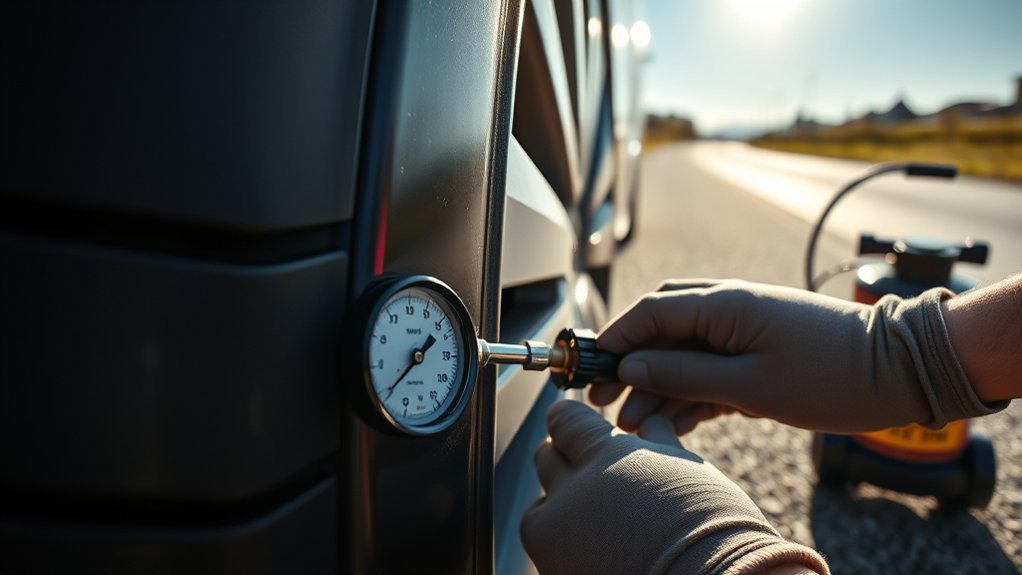
Because air expands with heat, expect roughly a 1 PSI rise for every 10°F increase and check your tires accordingly: inspect pressure each morning when tires are cold, compare readings to the manufacturer’s recommended PSI, and adjust as needed to avoid overinflation that reduces traction and raises blowout risk on hot pavement. You should verify tire pressure before long drives in hot weather and after parked periods in direct sun. Use a calibrated gauge, record deviations from spec, and bleed air in small increments until you hit the target PSI. Visually inspect tread and sidewalls for bulges, cracking, or uneven wear that indicate impending failure. If you find overinflated tires or structural damage, don’t drive aggressively; call roadside support or change to a spare in a safe location. These disciplined practices protect you, maximize control, and preserve mobility—practical steps toward autonomy, not passive risk.
Why Tire Temperature : Not Just Air Temp : Matters
While ambient air sets a baseline, tire temperature — which can run far hotter than the surrounding air — directly drives internal pressure and structural stress, so you must account for it when evaluating tire condition. You’ll see tire temperature commonly exceed 120°F on an 85°F day; that heat forces the air to expand, raising tire pressure and altering contact patch geometry. The ideal gas law quantifies this: temperature shifts translate to measurable PSI changes, so monitoring temperature is a practical safety step in hot weather.
You must treat temperature as an active variable: elevated tire temperature not only overinflates but also softens rubber compounds, accelerating wear and reducing grip. Overheated tires stress sidewalls and increase blowout risk, threatening control and freedom on the road. To preserve performance and liberation, incorporate routine temperature checks alongside pressure readings, interpret both together, and respond proactively to deviations that compromise traction, stability, or tire life.
Rule of Thumb: How Much PSI Changes With Temperature
Remember that air expands roughly 1 PSI for every 10°F increase, so you should expect higher hot-day readings than your morning cold check. Compare morning vs. hot readings to determine whether the pressure change pushes you above the vehicle’s recommended PSI. Regularly correcting for those temperature-driven shifts helps prevent overinflation-related blowouts and uneven wear.
Temperature-to-PSI Conversion
When ambient temperature rises about 10°F, expect roughly a 1 PSI increase in tire pressure as the air expands, and conversely a 10°F drop will lower pressure by about 1 PSI; this rule of thumb helps you predict pressure shifts and plan checks to keep inflation within the manufacturer’s safe range. Use temperature-to-psi conversion to translate weather forecasts into actionable checks: a 30°F swing can change tire pressure roughly 3 PSI. In hot weather conditions, higher tire temperatures from road and ambient heat amplify this effect, so you’ll see actual pressures exceed static predictions. You should monitor tire pressure regularly, adjust to the manufacturer’s recommended cold PSI, and relieve excess only when safe. Accurate conversion empowers you to maintain safety, control, and freedom on the road.
Morning Vs. Hot Readings
Because air expands predictably with heat, you’ll typically see about a 1 PSI rise for every 10°F increase, so morning (cold) readings can be several PSI lower than measurements taken after driving on hot pavement. You should check your tire pressure when tires are cold—haven’t been driven for at least three hours—to get a baseline. On a hot day a 30°F swing can add ≈3 PSI, which matters: uncorrected hot readings may mask underinflation or create overinflation if you adjust without accounting for temperature. For safe control and freedom on the road, measure cold, compare against manufacturer recommendations, and adjust accordingly. If you must measure hot, note ambient and surface heat and reduce the reading by the expected PSI uplift before making changes.
Risks of Overinflated Tires in Hot Weather
Although hot air expands and raises tire pressure by roughly 1 PSI for every 10°F, that increase can push your tires past the manufacturer’s safe limit and create several hazards. You’ll face clear risks with overinflated tires in hot weather: the contact patch shrinks, reducing traction and increasing the chance of loss of control. Braking distances lengthen because less rubber meets the road, degrading your stopping performance. Overinflation concentrates wear in the tire center, shortening service life and forcing more frequent replacements. Elevated internal pressure also stresses sidewalls; on hot asphalt at speed, that stress raises blowout probability, which threatens your freedom to travel safely. You should monitor and adjust pressures to the vehicle-specified cold PSI, account for ambient temperature rises, and avoid adding excess air during heat. These measured steps preserve handling, longevity, and your autonomy on the road while minimizing the acute safety hazards created by overinflated tires.
Risks of Underinflated Tires in Hot Weather
If you drive on underinflated tires in hot weather, the increased sidewall flexing produces excess heat that dramatically raises the risk of tire failure at highway speeds. You’ll face higher chances of sudden blowouts: roughly 80% of blowouts link to under-inflated tires. Heat affects structural integrity, accelerating cord and rubber degradation and causing uneven wear—outer edges wear faster—shortening tire life. Underinflation by 10 PSI can cut fuel efficiency up to 15%, increasing costs and dependence. Handling and braking distance degrade as contact patch distorts, compromising your ability to maneuver and escape hazards. Act with principled urgency: inspect, correct, and replace damaged tires to reclaim control and safety.
| Condition | Effect | Safety Concern |
|---|---|---|
| Under-inflated tires | Increased flexing | Overheating |
| High ambient heat | Accelerated degradation | Higher failure rate |
| 10 PSI low | ↓ Fuel efficiency | Higher operating cost |
| Uneven wear | Reduced lifespan | Compromised traction |
Check Tire Pressure the Right Way (When, Tools, Target PSI)
Check tire pressure at least once a month and before long trips, using a reliable gauge on cold tires (haven’t been driven for three hours) to get accurate readings. You’ll check tire pressure to preserve safety, efficiency, and control in hot weather. Use a reliable tire pressure gauge—digital or quality dial—and confirm readings on each cold tire. Rely on the vehicle’s manufacturer-recommended tire pressure, found on the driver’s door jamb, not the tire’s max PSI.
- Use: carry a calibrated reliable tire pressure gauge; remove valve caps; press firmly; read quickly.
- When: measure cold tires (≥3 hours stationary) and monthly; record values to detect trends.
- Target PSI: inflate to the manufacturer-recommended pressure; inspect tread and sidewalls simultaneously.
This precise routine liberates you from preventable failures. You’ll maintain traction, optimize fuel use, and reduce blowout risk by disciplined checks and strict adherence to specified recommended tire pressure.
[Products Worth Considering]

PROCESS LEVEL ACCURACY: Each ETENWOLF’s digital tire pressure gauge is calibrated manually to ANSI B40.7 Grade 2A(plus-minus 1 PSI).Presta valve adapter not included, if used for bicycles, it must be purchased separately
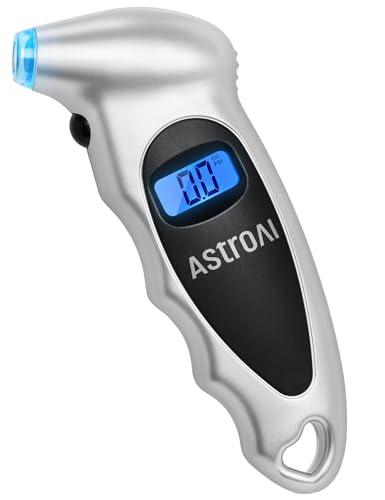
EXPERT-GRADE CALIBRATION: Each AstroAI Tire Pressure Gauge is calibrated with professional-grade tools, ensuring quick and accurate measurement results within plus-minus 1PSI. Stay prepared for any roadside emergency and travel with peace of mind.

Digital Tire Pressure Gauge 2 Pack, Industrial Tire Gauge 3-200 PSI, Calibrated to ANSI B40.7 Grade 2A(plus-minus 0.5%), Air Pressure Gauge with Replaceable AAA Batteries
Adjust PSI for Big Day/Night Temperature Swings
When you expect large day/night temperature swings, check your tire pressure both morning and night to capture the cold and hot states. Adjust PSI to compensate for the expected differential (about ±1 PSI per 10°F) while keeping to the vehicle’s recommended PSI, not the tire’s maximum. Monitor pressures daily during extreme weather and readjust as temperatures stabilize to maintain safe handling and tire longevity.
Check Pressure Morning And Night
Although tires warm up as you drive, you should measure and set inflation with cold tires in the morning for the most accurate PSI readings; air pressure rises roughly 1 PSI per 10°F, so daytime heat can mask underinflation and nighttime cooling can leave you overinflated. You need routine checks morning and night when temperature changes are large to preserve tire pressure, reduce wear, and protect safety on the road. Check measurements against the vehicle placard, not the tire sidewall.
- Check tires each morning when ambient temps are lowest; correct low readings to recommended PSI.
- Recheck after long, hot days if temperatures drop considerably at night; bleed or add air as needed.
- Log readings during seasonal shifts to anticipate adjustments and avoid sudden failures.
Adjust For Temperature Differential
Because tire pressure changes about 1 PSI for every 10°F, you should adjust target inflation to account for large day/night swings to keep pressures within the vehicle’s recommended range. When you expect cooler nights, set cold inflation slightly higher so overnight cooling doesn’t drop you below the recommended PSI; if heat builds during the day, start closer to the lower bound to avoid overinflation. Use Tire Pressure Monitoring as a safety tool, not a substitute for proactive adjustment—it notifies you but won’t prevent damage from predictable thermal shifts. Before setting pressures, calculate expected temperature differential and adjust your tire pressure accordingly. This disciplined approach preserves traction, reduces uneven wear, and protects your mobility and freedom on the road.
Monitor And Readjust Regularly
After you set your cold inflation to account for expected day/night swings, monitor pressures each morning and readjust as needed—air expands roughly 1 PSI per 10°F, so a large overnight drop can leave you underinflated by several PSI. You’ll perform regular checks to preserve safety, traction, and tire life. Check when tires are cool for accurate tire pressure readings, before long trips, and after extreme temperature shifts. When adjusting your tire pressure, use a calibrated gauge and add or release air in small increments to reach the target.
- Check each morning when tires are cool; note deviations versus target PSI.
- Record readings to detect trends and plan adjustments.
- Reassess before long drives or after major temperature swings; act immediately if PSI is off.
Inspect Tires for Heat-Related Damage and Wear
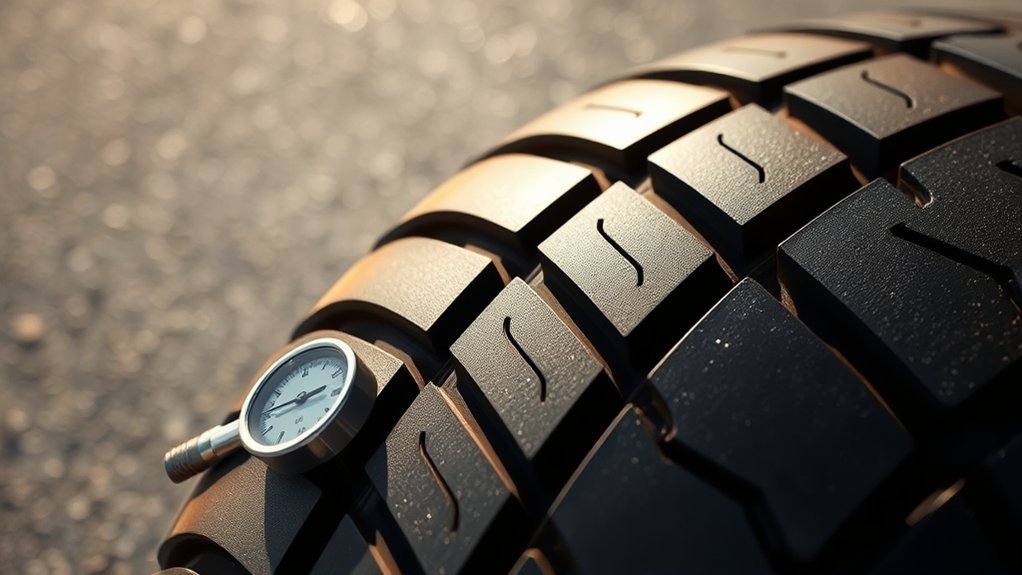
When temperatures climb, inspect your tires for heat-related damage like cracks, bulges, and uneven tread that can signal increased risk of tread separation or blowout. You should inspect your tires at least weekly during heat waves, looking for sidewall stress, localized soft spots, or bead damage. Heat can soften rubber and accelerate failure modes; catching defects early preserves control and autonomy on the road. Measure tread depth with the penny test and compare all four corners for uneven wear patterns that often reflect incorrect tire pressure or alignment. If one tire shows accelerated degradation relative to others, remove the wheel for a close inspection of inner shoulder and bead areas. Document findings and avoid driving at high speeds if you detect bulges, deep cracks, or tread delamination. Prioritize prompt professional evaluation for structural damage, but use these checks to reclaim responsibility for your safety and prevent heat-driven failures before they become catastrophic.
[Products Worth Considering]
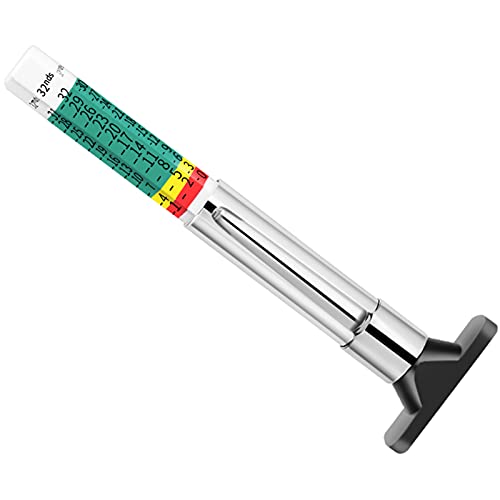
1. Accurately measures tire tread depth gauge tool, Calibrated from 0 to 1 inch in 1/32 inch

Accurate and precise tire tread depth readings in 1/32 inch increments (1/128 inch resolution)

ACCURACY TIRE THREAD TREAD DEPTH GAUGE, Reads in 1/32 inch increments.Stuffers for Men and Women
Monthly Summer Checklist : When to Visit a Pro or Replace Tires
If summer heat has you checking pressures more often, make a monthly visit to assess whether professional service or replacement is needed: measure tire pressure (noting that pressure rises about 1 PSI per 10°F), inspect for uneven wear, bulges, cracks, or tread delamination, and compare all four tires for discrepancies that signal alignment or inflation issues. You’ll act deliberately: record PSI versus the vehicle placard, note tread depth and damage, and decide when to consult a technician. Overinflation above manufacturer PSI requires a professional adjustment to avoid blowouts and reduced traction. Excessive uneven wear or structural damage means it’s time to replace tires.
In summer, check and log tire PSI, inspect for bulges, uneven wear, or delamination — consult a pro or replace as needed.
- Check monthly: log tire pressure, tread depth, and visual defects.
- Visit a pro when PSI deviates, you see bulges, or tread delaminates.
- Replace tires immediately if wear exceeds limits or damage compromises integrity.
This routine frees you from avoidable risk while keeping mobility safe and sovereign.
[Products Worth Considering]

1.Accurate and Efficient: Different colors on the bar represents different scopes, the red range on bar: 0 – 3/ 32; Yellow range on bar: 3/ 32 – 6/ 32; Green range on bar: 6/ 32 – 32/ 32, allowing you easy and fast to read and calibrated

1. Accurately measures tire tread depth gauge tool, Calibrated from 0 to 1 inch in 1/32 inch

Accurate measures tire tread depth gauge tool
Frequently Asked Questions
How Does Tire Pressure Affect Fuel Economy in Hot Weather?
You’ll see reduced fuel efficiency if tire pressure rises or falls from recommended values; incorrect tire pressure increases rolling resistance and uneven wear, harming summer driving economy and safety—so monitor pressures regularly to preserve performance and freedom.
Can TPMS Sensors Give False Readings When It’s Hot?
Yes — you can get false TPMS readings when it’s hot. You’ll face TPMS calibration issues and heat related inaccuracies; sensor performance variability can produce misleading pressures, so you should verify manually and recalibrate for safety and freedom.
Do Different Tire Brands Respond Differently to Heat?
Like differing sails, yes — you’ll see tire material differences, tread design effects, and brand performance variations: manufacturers use compounds and patterns that heat, flex, and wear uniquely, so you’ll choose brands that free you safely.
Is Nitrogen Inflation Better for Summer Driving?
Yes — you’ll gain modest nitrogen benefits: steadier pressure with reduced temperature impact, lowering inflation frequency needs and enhancing safety. You’ll still check pressures regularly, though nitrogen doesn’t eliminate heat-driven expansion entirely.
How Does Parking on Hot Asphalt Impact Tire Lifespan?
Parking on hot asphalt accelerates tire wear by increasing rubber degradation and sidewall stress; you’ll need to monitor tire wear, limit parking duration, maintain proper pressure, and rotate tires regularly to preserve safety and autonomy.
Conclusion
You’re in control: check cold tire pressure before driving, carry a reliable gauge, and don’t let heat-driven PSI gains catch you off guard. Remember, “a stitch in time saves nine” — a quick pressure check and visual tire inspection prevent bigger failures. Keep inflation within the vehicle manufacturer’s cold PSI range, adjust for large day‑to‑night swings, and replace tires showing heat cracking, bulges, or abnormal wear. Safety-first, consistent, and deliberate.







Leave a Reply