
·
Reviewed for accuracy
·
Last updated April 2026
·
4 min read
Driving on improperly inflated tires ruins your fuel economy and puts your safety at risk. You often need to convert pounds per square inch (PSI) to bar when using European air compressors or reading metric gauges. This guide shows you exactly how to calculate this pressure conversion quickly and accurately.
Quick Answer
To convert PSI to bar, divide your PSI measurement by 14.5038. For a fast mental estimate, divide the PSI by 15. For example, 30 PSI equals about 2.07 bar.
Key Takeaways
- Divide PSI by 14.5038 to get an exact bar measurement.
- Divide PSI by 15 for a quick mental estimate in the field.
- Remember that 30 PSI equals roughly 2.07 bar, which covers most passenger tires.
- Check whether your gauge measures absolute or relative pressure to avoid critical errors.
How to Use the PSI to Bar Conversion Formula
Start with the exact formula: BAR = PSI / 14.5038. You should use this formula for precise conversions. When speed matters more than perfect accuracy, divide by 15 for a quick estimate. This mental math usually gets you within a few percent of the true value. Plug PSI values directly into the formula to get your bar reading and avoid dangerous guesswork.
When accuracy counts, use a digital calculator to eliminate human rounding errors. Enter the PSI, confirm your units, and record the bar output. Repeatable inputs always yield repeatable results. For field work, carry a compact conversion chart or a simple smartphone app. Set your app to store your preferred precision of two or three decimal places.
Rely on the exact formula for final equipment settings. Use the approximate divide-by-15 method for fast system checks. Calculators guarantee consistency across all your pressure measurements.
Common PSI to Bar Conversion Values
Apply the exact conversion formula to common reference points so you can act decisively. For 10 PSI, the conversion gives about 0.69 bar. You use this low pressure for simple benchmarks and light equipment. At 30 PSI, you get roughly 2.07 bar. You will recognize this as a typical passenger tire range. For 50 PSI, the result is approximately 3.45 bar. Heavy duty vehicles and performance tires require this higher stiffness. At 100 PSI, the conversion equals about 6.89 bar. You will see this high level mostly in industrial contexts.
Pro tip: Memorize the 30 PSI to 2.07 bar conversion, as you will use this most frequently for standard car maintenance.
Keep these anchors in mind to save time. Use them to verify gauges, set systems, or cross-check equipment specifications quickly. Precision protects your components and gives you complete control over pressure settings.
Converting Tire Pressure for Cars and Bikes
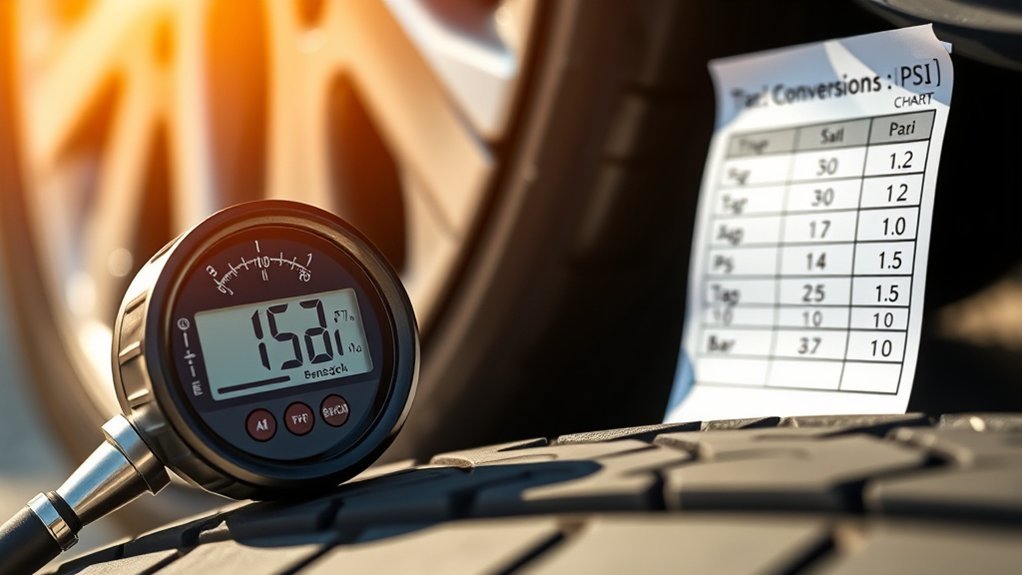
For most passenger cars and bikes, divide the PSI reading by 14.5038 to get bar. A typical car range of 30 to 35 PSI becomes about 2.07 to 2.41 bar. Common truck and SUV settings of 35 to 40 PSI convert to roughly 2.41 to 2.76 bar. You use a pressure gauge to read PSI. Then, you convert to bar for consistent documentation or European equipment. Always check your tires cold for accurate readings. Note the manufacturer recommendations inside your driver door jamb. High-performance vehicles frequently call for pressures above 40 PSI.
Maintain proper tire pressure for safety, fuel efficiency, and handling. Underinflated tires cost you money through reduced range and poor control. Use a reliable digital gauge that toggles between units. Regular checks and decisive adjustments maximize your vehicle’s performance.
How Temperature Affects Pressure Readings
Temperature changes directly impact your pressure readings in both PSI and bar. For every 10 degrees Fahrenheit drop in temperature, your tires lose about 1 PSI. This equals a drop of roughly 0.07 bar. Always measure pressure in the morning before driving. Driving heats up the tires and artificially inflates the gauge reading. Compensate for extreme weather conditions when setting your baseline pressure.
Two Fast PSI to Bar Approximations
Two quick approximations let you convert PSI to bar in your head. First, divide your PSI by 15 for a close estimate. Using this method, 30 PSI equals 2 bar, and 100 PSI equals roughly 6.7 bar. Second, use the 2:3 ratio to check your math backward. Multiply your bar reading by 1.5 to get your PSI. For example, 2 bar multiplied by 1.5 equals 3 PSI. Both methods trade a little accuracy for speed. They work well for everyday tire checks and standard workshop ranges.
Both tricks free you from complex calculators in the field. You can act confidently in the moment. Use rounding conscientiously. For critical industrial systems, always revert to the exact mathematical formula. These approximations focus on practicality for common vehicles and tools.
Avoid These PSI to Bar Conversion Errors
Watch out for rounding shortcuts. Treating 1 bar exactly as 15 PSI shifts your final results. Also, confirm whether your gauge reads absolute pressure or relative pressure. Mixing the two produces entirely incorrect outputs. Use the 14.5038 factor to avoid systematic errors in your shop.
Wrong Rounding Shortcuts
Rough shortcuts introduce measurable error into your work. Always divide by 14.5038 for critical tasks. Avoid excessive rounding because errors grow larger at higher pressures. Shortcuts produce errors up to 4 percent. Convert with clear intent. Apply the exact formula, keep your significant digits, and never truncate intermediate numbers. Rounding down early compounds your error over time. Use a calculator to preserve precision, then round only your final result.
Mixing Gauge and Absolute Pressure
Gauge and absolute pressures use entirely different zero points. You cannot treat 30 PSI gauge and 30 PSI absolute as equivalent. You must check whether your reading is gauge pressure or absolute pressure before doing math. Gauge pressure is relative to the atmosphere. Absolute pressure is relative to a complete vacuum.
Warning: Mixing absolute and gauge pressure readings can lead to catastrophic equipment failure in sealed hydraulic or pneumatic systems.
Gauge zero equals standard atmospheric pressure. According to standard reference data, atmospheric pressure equals about 14.7 PSI. Absolute pressure includes that atmospheric offset. A blind conversion will understate or overstate the true force. Label your inputs clearly. Add or subtract atmospheric pressure when switching between types. This discipline prevents faulty designs and unsafe outcomes.
Why PSI and Bar Are Different
PSI and bar originate from entirely different measurement systems. PSI comes from the United States customary system. Bar comes from the metric system. They reference physical force differently. PSI measures force per square inch. Bar equals exactly 100,000 pascals. Their numerical values and scales do not match natively. That difference creates consequences for equipment specs and international communication.
Different Unit Systems
PSI and bar measure pressure but lack direct interchangeability. PSI stands for pounds per square inch. Bar acts as a metric-derived unit used internationally. One bar equals roughly 14.5038 PSI. You depend on a conversion table or multiplier to switch contexts. Taking this step preserves safety and ensures accurate cross-border collaboration.
Measurement Reference Differences
You encounter PSI in imperial contexts and bar where metric norms hold. Each system ties to distinct reference areas. Numeric values shift because the base units differ, not because the physical force changes. Misreading units undermines safety. Learn both units, verify labels before acting, and insist on clear conversions.
Practical Impact on Daily Use
You must convert values carefully to avoid expensive mistakes. Reading a tire at “30” without checking the unit could mean severe underinflation. Treat PSI and bar as distinct inputs. Convert your numbers, and then take action. Misreading units skews handling and tire wear. High-performance settings demand exact PSI. Passenger ranges differ from truck ranges. Always convert to the unit your specific gauge uses.
Frequently Asked Questions
What is the formula for converting PSI to bar?
The exact formula is BAR = PSI / 14.5038. You divide your PSI measurement by 14.5038 to find the correct bar value. For a quick mental estimate, you can divide your PSI by 15.
What is 40 to 60 PSI in bar?
A range of 40 to 60 PSI equals approximately 2.76 to 4.14 bar. You calculate this by dividing 40 by 14.5038, and then dividing 60 by 14.5038.
What is 32 PSI in bar?
32 PSI equals exactly 2.206 bar. You will commonly use this conversion since 32 PSI is a standard manufacturer recommendation for many compact and mid-size sedans.
Is 2.4 bar equal to 35 PSI?
No, 2.4 bar does not equal 35 PSI. Multiplying 2.4 by 14.5038 equals roughly 34.8 PSI. While very close, it is not an exact match for highly sensitive equipment.
Conclusion
You now have the exact formula and the quick mental shortcuts to convert PSI to bar. Divide your PSI by 14.5038 for perfect accuracy, or divide by 15 when you need a fast estimate in the garage. Always check whether your gauge measures absolute or relative pressure before doing the math. Grab your tire gauge and test the formula on your own vehicle today to ensure you are driving safely.
References
- SI Units and Conversion Factors — National Institute of Standards and Technology (NIST)
- Atmospheric Pressure Guidelines — National Weather Service
- Tire Safety and Pressure Ratings — National Highway Traffic Safety Administration (NHTSA)