
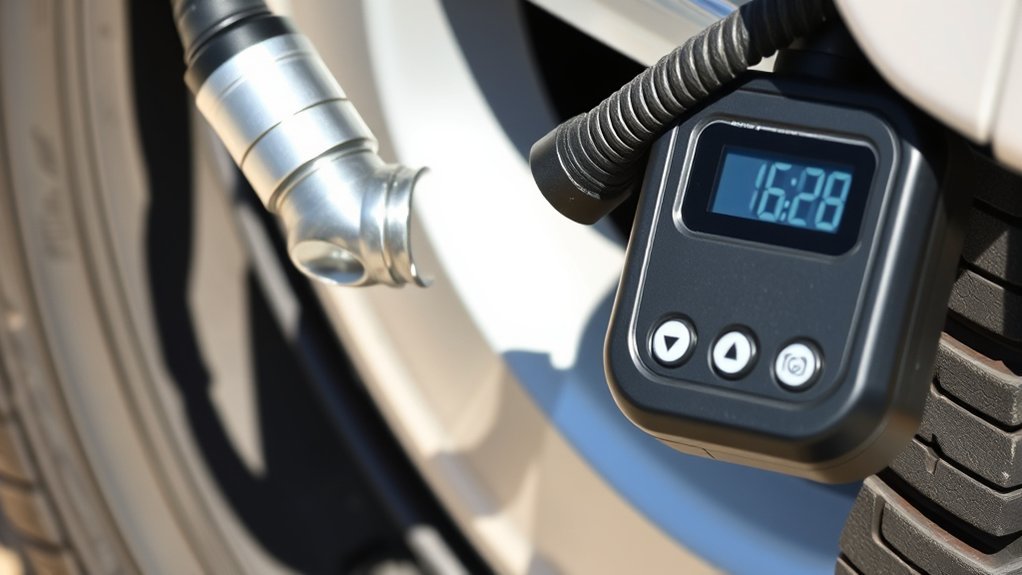
You use a small electric pump that draws in air, compresses it with a motor-driven piston, and forces that compressed air through a hose into the tire until the gauge reaches your set pressure. Plug into 12V, 110V, or use a battery pack, attach the valve head tightly, monitor the pressure, and stop when done. Units often have auto-shutoff and need cooling after long runs. Keep going to learn setup, safety, and troubleshooting.
Quick Answer: How Portable Tire Inflators Work and When to Use Them
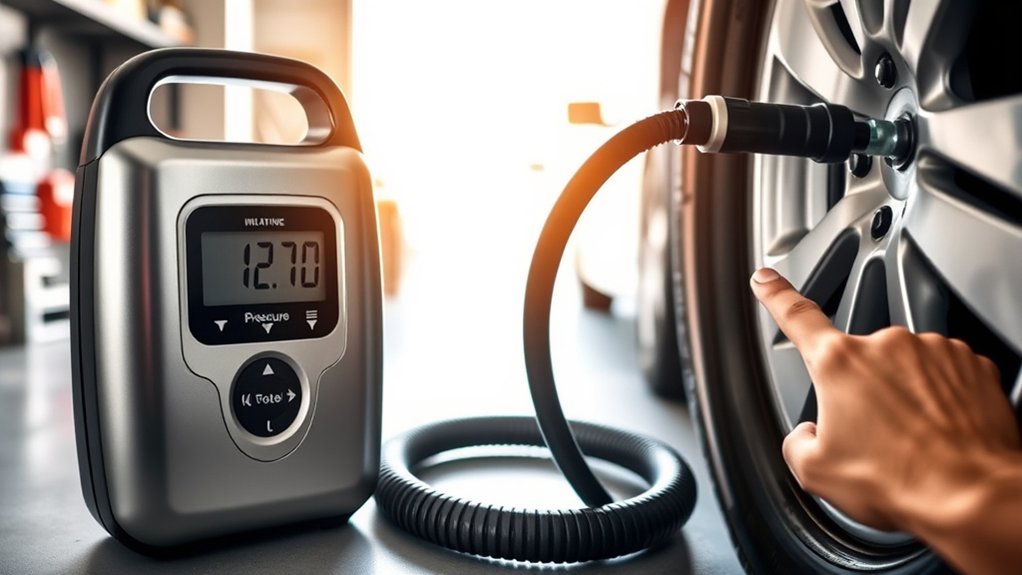
Portable tire inflators act like compact air compressors: an electric motor draws in air, compresses it, and pushes it through a hose into your tire, typically powered from a 12V vehicle outlet, wall plug, or internal battery for roadside or home use. You’ll use these portable tire inflators to restore pressure quickly when you detect low tire pressure, topping off rather than fully inflating a flat. The unit’s pump runs for 5–10 minutes before thermal limits force a cooldown, so plan short bursts and monitor progress. Most models include a tire pressure gauge; check pressure with the inflator off to avoid misleading readings. Technically, they convert electrical energy to compressed air via a piston or rotary mechanism, delivering PSI through the valve connection. For independent travel and resilience, keep an inflator, a calibrated gauge, and a basic pressure chart in your vehicle. That setup gives you autonomy, safer mileage, and reduced blowout risk without relying on external help.
How a Portable Tire Inflator Connects to a Valve
Start by unscrewing the small valve cap to expose the valve stem, then firmly twist the inflator’s hose onto the stem until it seats tightly — this creates the airtight connection you need to prevent leaks while you read and set PSI. You’ll see the current air pressure on the inflator’s gauge immediately; that lets you confirm baseline pressure before you start pumping air.
- Confirm the valve stem is clean and debris-free to guarantee a proper seal.
- Align the portable tire inflator hose, then twist or clamp per the connector type until you feel resistance and no hissing.
- Watch the gauge as you set the desired PSI; the inflator will start pumping air into the tire once activated.
- When the target pressure’s reached, shut off the inflator, detach the hose, and replace the valve cap to protect the stem.
This connection process is direct, technical, and liberating — it puts control of tire pressure squarely in your hands.
Step-by-Step: Using a Tire Inflator Safely and Effectively
Start by prepping the inflator: remove the valve cap, confirm the hose and fittings are clean, and attach the hose to the stem with a secure twist to prevent leaks. Turn the inflator on and watch the pressure gauge until it matches the vehicle’s recommended PSI. When you reach the target, switch the unit off, detach the hose carefully, replace the valve cap, and store the inflator in good working condition.
Prepare The Inflator
Before you begin, place the inflator on a flat, stable surface within easy reach of the tire valve and confirm your power source — wall outlet, 12V vehicle socket, or a fully charged battery. You’ll prepare the inflator methodically so you stay free from delay and dependency.
- Inspect and secure the unit; confirm connections and that the power source matches the inflator’s rating.
- Remove the valve stem cap, align the hose, and attach the chuck firmly to avoid leaks.
- If the inflator has a pressure setting, set desired tire pressure and verify the gauge calibration.
- Keep tools and replacement caps nearby; maintain clear access to the valve stem and controls.
Act deliberately — this preflight frees you to handle inflation confidently.
Inflate And Check Pressure
1. Remove the valve stem cap and clear debris so your seal stays clean. Attach the portable air compressor hose to the valve stem, twisting until you get an airtight connection. Power on the inflator and watch the pressure gauge closely. Adjust until the gauge reads the recommended tire pressure for your vehicle — don’t guess.
When you reach the target PSI, turn off the inflator, then carefully detach the hose to avoid a sudden hiss that can lose air. Replace the valve cap to protect the valve from dirt and damage. Check tire pressure regularly, especially before long trips, to maintain ideal safety and fuel efficiency. Proper, disciplined inflation keeps you free on the road and in control of your vehicle.
Power Options: 12V, 110V, and Cordless Batteries
While all tire inflators compress air to restore pressure, the power source you choose dictates speed, portability, and where you can use it. 12V models plug into your vehicle’s cigarette lighter and are ideal for roadside emergencies because they’re compact and convenient; many also include built-in rechargeable batteries for short off-vehicle use. 110V AC units need a wall outlet but deliver faster, more efficient inflation for regular home maintenance.
You’ll pick a power source based on need: emergency mobility vs. speed and efficiency. 12V and cordless battery options free you from fixed locations, so you can reclaim control on the road. 110V gives steady power for repeated use at home. Remember cordless battery inflators may slow down with large volume fills and struggle to inflate completely flat tires quickly. Use 12V for quick roadside top-ups, cordless for lightweight freedom, and 110V for sustained, fast work to get inflated tires reliably.
- 12V — vehicle hookup, portable, emergency-ready
- Cordless battery — most portable, variable speed
- 110V — fastest, best for home maintenance
- Hybrid models — built-in batteries plus AC/12V options
[Products Worth Considering]

AC/DC OUTLET & MULTI-PURPOSE:CARSUN portable air compressor’s multifunctional AC/DC dual power supply design can draw power from both vehicle and wall outlets. Its DC plug is designed for a 12V cigarette lighter socket while its AC plug is designed for a 110V/120V wall outlet. Come with 3 additional adaptors which makes it perfect for cars, motorcycles, bikes tires, air mattress, inflatable boats, balls and other inflatables.(NOTICE: NOT SUPPORT FOR ANY TRUCK OR TRACTOR TIRES)

12 V DC/120 V AC Dual Power: The AstroAI Tire Inflator features dual power supplies, compatible with 12 V car cigarette lighters and 120 V household outlets, convenient for both home and travel use. The AstroAI Tire Inflator can easily switch between high-pressure and high-current inflation modes. High-pressure mode inflates car, bicycle and motorcycle tires along with sports equipment and other small inflatables. Large-volume mode inflates bigger low-pressure objects like air mattresses
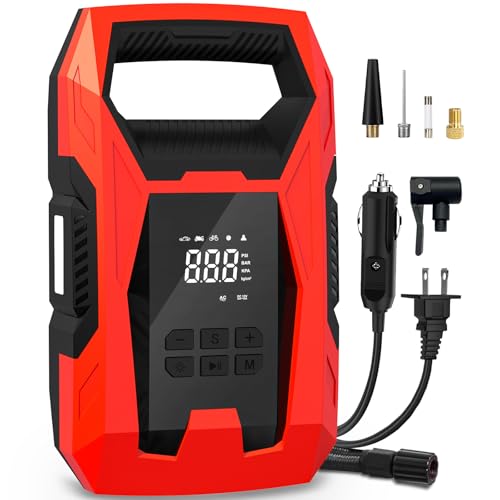
AC/DC OUTLET & MULTI-PURPOSE:CARSUN portable air compressor’s multifunctional AC/DC dual power supply design can draw power from both vehicle and wall outlets. Its DC plug is designed for a 12V cigarette lighter socket while its AC plug is designed for a 110V/120V wall outlet. Come with 3 additional adaptors which makes it perfect for cars, motorcycles, bikes tires, air mattress, inflatable boats, balls and other inflatables.(NOTICE: NOT SUPPORT FOR ANY TRUCK OR TRACTOR TIRES)
Inside a Portable Inflator: Motor, Piston, Valves
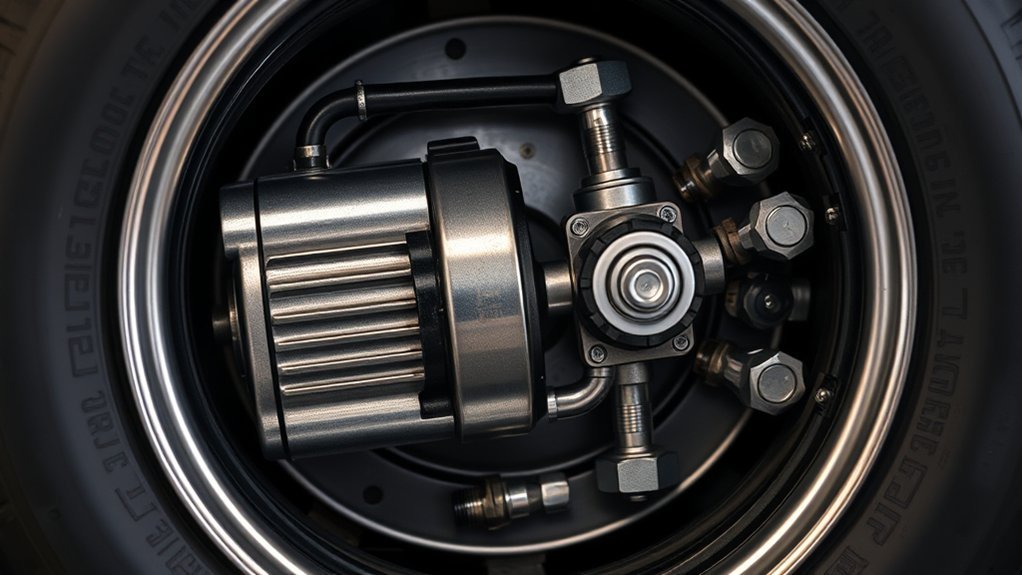
When you hook up a portable inflator, an electric motor drives a geared linkage that converts rotary motion into the piston’s linear stroke, compressing air inside a small cylinder; valves then direct that compressed air into the tire and stop it from flowing back. You control freedom on the road by knowing how the motor, piston, and valves cooperate. The motor spins; gears translate that spin into a reciprocating piston that pressurizes air to act as a compact compressor. Intake and discharge valves time the airflow: one admits ambient air on the piston’s intake stroke, the other opens on compression to push compressed air out. Check valves prevent backflow when you disconnect. The assembly is compact, rugged, and meant for quick deployment so you stay mobile. Maintenance is simple: keep the motor vents clean, inspect the piston seal for wear, and verify valve seats are free of debris. Below is a concise component reference.
| Component | Role |
|---|---|
| Motor | Power source |
| Piston | Compresses air |
| Gears | Convert motion |
| Valves | Control flow |
| Seals | Prevent leaks |
How Pressure Sensing and Auto-Shutoff Keep You Safe
Pressure sensors continuously read the tire’s PSI and feed real‑time data to the inflator’s control system so you get accurate pressure monitoring during inflation. The auto‑shutoff mechanism uses that sensor input to stop the compressor automatically when the preset target PSI is reached, preventing over‑inflation. Together they let you inflate tires reliably without constant supervision, reducing human error and the risk of excessive pressure.
Pressure Sensors Explained
Because the sensor constantly reads tire pressure, you get real‑time feedback and can set the inflator to stop at the exact PSI you want. You rely on pressure sensors to monitor levels, prevent overinflation, and reduce safety risks from incorrect inflation.
- Digital sensors measure pressure precisely, giving you tighter control than analog gauges.
- Accurate readings prevent under‑inflation and overinflation, both of which degrade handling and increase risk.
- Sensors interface with the inflator’s controls so you can work efficiently and confidently, freeing you from guesswork.
- Regular calibration and inspection keep sensors reliable; neglect creates false readings and undermines safety.
Use and maintain sensors deliberately—precision liberates you from uncertainty and protects your tires and safety.
Auto‑Shutoff Mechanisms
A reliable auto‑shutoff combines a real‑time pressure sensor with control logic so the inflator stops precisely at the PSI you set, preventing over‑inflation and reducing blowout risk. You rely on integrated pressure sensors that monitor tire pressure continuously; when the programmed PSI is reached the control unit cuts power to the pump. That automated action removes guesswork and minimizes improper inflation caused by human error or distraction. You’ll set the target PSI once, then let the device finish and shut off automatically, which speeds maintenance and preserves tire integrity. Regular use keeps tire pressure within ideal range, improving fuel efficiency and safety. Choose inflators with proven auto-shutoff reliability to protect your mobility and freedom.
Limitations of Portable Tire Inflators (What They Can’t Do)
While portable inflators handle quick top-ups well, they have clear limits you should know:
- limitations of portable tire inflators — They lack storage tanks, so they supply air only while running. That means you won’t get sustained flow for heavy jobs or pneumatic tools.
- flat tires — Most units can’t restore a fully flat tire. They’re built for topping up, not building pressure from zero; you’ll need a larger compressor or roadside service.
- improperly inflated — If a tire is severely under-inflated, the inflator may overheat or shut down after 5–10 minutes. PSI gauges can read inaccurately during operation, so check pressure with the unit off to confirm.
- battery power — Portable models often rely on vehicle power or small batteries, limiting run time and output. They’re oilless and lower-power by design, so don’t expect the performance of shop compressors when you want true freedom from constraints.
Common Problems and Quick Troubleshooting Tips
1 simple checklist will solve most inflator hiccups: confirm solid power connections or a charged battery, inspect the hose and valve head for kinks or loose fittings, and let the unit cool 10–15 minutes if it shuts off from overheating. If the unit won’t start, verify power: for corded models, ascertain clamps or plug contact clean metal; for battery models, confirm the battery charged indicator and swap or recharge if weak. If it runs but doesn’t fill, stop and check the hose for blockages or sharp bends and reseat the valve attachment; inflators use positive sealing at the valve to move air. For erratic PSI readings, turn the inflator off and check your tire pressure with a separate gauge—readings stabilize when the pump is idle. If overheating recurs, limit run cycles to manufacturer duty ratings and allow full cool-down. These steps free you from roadside uncertainty and get you back in control quickly.
[Products Worth Considering]

ADVANCED TRUEGAUGE SCREEN: This battery tire inflator includes updated sensor technology, capable of collecting pressure data from tire inflators at a frequency of 200 times per second. Its valid data rate is higher than 80%, which is 60% better than the market average. Wherever you go, accurate readings help you drive safely.

Please Note: This product must be powered by a 12V DC Cigarette Lighter to function properly, and ensure the vehicle is in a running state. And it equipped with a 9.8-foot cord, which can meet the usage needs of most regular-sized vehicles.
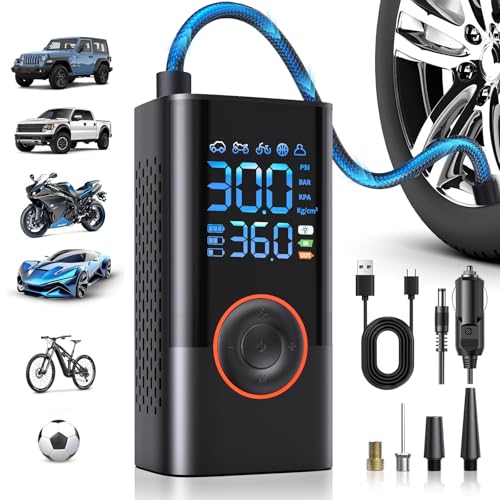
👍【𝗗𝘂𝗮𝗹 𝗜𝗻𝗳𝗹𝗮𝘁𝗶𝗼𝗻 𝗠𝗼𝗱𝗲𝘀 – 𝗔𝗹𝘄𝗮𝘆𝘀 𝗣𝗼𝘄𝗲𝗿𝗲𝗱】This portable air compressor has a built-in high-capacity rechargeable battery and can also be powered via a 12V DC car power cord, ensuring the inflator always has a sufficient power supply. It inflates up to three times faster than other ordinary cordless inflators on the market, with 35% more power. Can inflate 7 car tires or 21 bicycle tires, away from the problem of insufficient battery power
Which Inflator Is Right for You: Use Cases and Buying Pointers
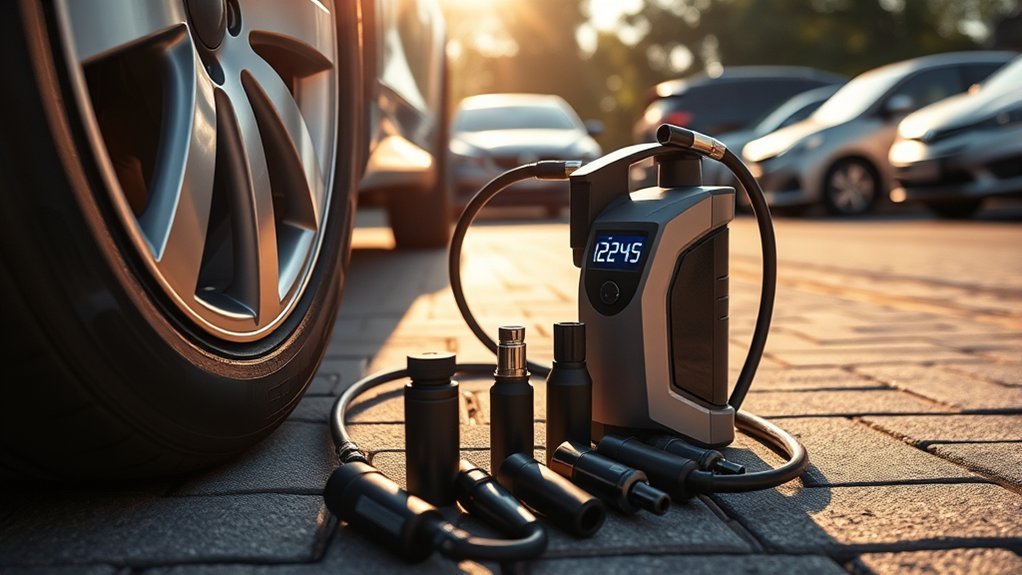
Looking for the right tire inflator depends on how and where you’ll use it: choose 110V AC units for regular home garage work, 12‑V plug models for on‑road emergencies and frequent travel, and cordless/battery inflators for lightweight portability or quick top‑offs. You’ll match types of portable tire inflators to real needs: 110V for full re-inflation powered by a stronger electric motor, 12‑V for travelers who need to take one in the car, and cordless for nimble, occasional top-offs. Prioritize automatic shut-off to hit your target pounds per square inch without babysitting. Built-in PSI gauges are essential, but confirm accuracy when the unit is idle. Consider duty cycle and airflow (CFM) if you routinely restore very low tires.
- Home garage — 110V, robust electric motor, full inflations.
- Roadside — 12‑V plug, compact, always in the trunk.
- Travel/hiking — cordless, light, quick top‑offs.
- Fleet/professional — high‑flow, calibrated gauges, durable.
[Products Worth Considering]

Fast-Inflation & Compact: Our compact and lightning-fast upgrade to the popular R7 air compressor portable. With a powerful 40L/Min cylinder, this air pump for car can inflate a tire (215/50 R17) in under a minute (26-35PSI) and even Tesla tires (235/40 R19) in just 1.5 minutes (28-36PSI). Say goodbye to slow and cumbersome inflation processes – This 150PSI tire inflator portable air compressor offers a smoother, faster solution for all your inflation needs.

Fast Inflation & Easy Operation: The air pump’s high-quality cylinder delivers 25L/Min inflation, filling a tire from 29 PSI to 36 PSI in just one minute. Easy operation, quick inflation. Please note that you should allow the air compressor to cool off for a while after 15 minutes of continuous operation. (NOTE: This tire inflator can only be used if connected to a 12 V DC, 15 A cigarette lighter). NO AC!

[Fast & Efficient Inflation] The OlarHike tire inflator features a high-performance motor that delivers rapid airflow—inflate a standard car tire (195/65 R15) from 30 to 35 PSI(+5 PSI) in just 55 seconds, or a larger SUV tire (235/65 R17) from 30 to 35 PSI(+5 PSI) in only 2.2 minutes. Ideal for cars, SUVs, light Pickup(Within 51 PSI), motorcycles, bicycles, and sports balls. Important Note: The unit can only inflate car/pickup truck tires up to 51 PSI
Frequently Asked Questions
How Does the Tire Inflator Work?
You compress air via an electric motor-driven piston, monitor tire pressure with sensors, and choose inflator types by power source; follow maintenance tips, observe safety precautions, and you’ll quickly regain control and mobility.
Does a Car Need to Be Running to Use a Tire Inflator?
No, your car doesn’t need to be running to use a tire inflator; you can rely on battery, 12V outlet, or wall power. Prioritize tire inflator safety, manual tire inflation skills, tire pressure monitoring, and inflator maintenance tips.
Do Cordless Tire Inflators Really Work?
Yes — they work, freeing you like a compact lifeline: expect limited battery performance and slower inflation speed versus corded units; enjoy portability benefits, follow maintenance tips, and don’t expect full-flat recovery without patience.
What Are the Disadvantages of Tire Inflators?
You’ll face tire inflator limitations: limited run time, inaccurate gauges, noise level concerns, portability issues, and power source dependency that restricts speed and capacity, so you’ll plan backups and choose models that maximize reliability and freedom.
Conclusion
Like a pocket-sized blacksmith, a portable tire inflator shapes pressure to purpose: you connect the chuck, energize the pump, watch the gauge, and it stops when the set PSI’s reached. You’ll choose power type and flow rate for the job, heed duty cycle limits, and troubleshoot leaks or false readings. Use it for routine topping, roadside emergencies, and bike tires — not sustained heavy-duty inflation — and keep a separate pressure gauge for accuracy.







Leave a Reply