Does The Toyota RAV4 Have Tow Package? (explained)
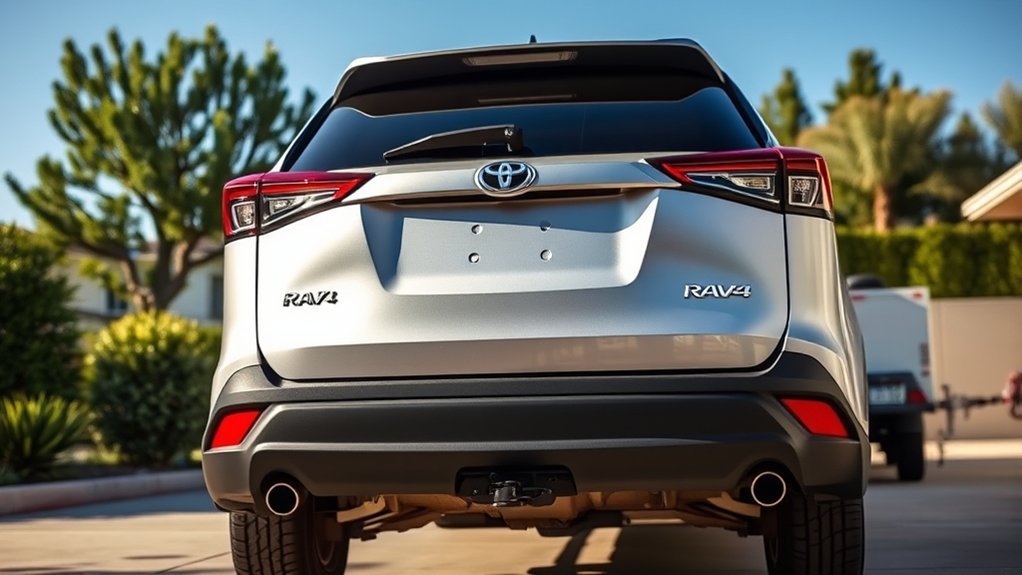
Your Toyota RAV4 can tow a lightweight utility trailer, sport trailer, or small camper, but the correct limit depends on the model year, grade, powertrain, drivetrain, payload, and towing equipment. The biggest source of confusion is that the redesigned 2026 RAV4 has different ratings from the 2025 model. Some 2026 AWD grades can tow up to 3,500 pounds, while other configurations remain limited to 1,750 pounds.
Quick Answer
The 2026 Toyota RAV4 does not have one universal tow package across every grade. The Woodland includes a factory 2-inch rear hitch receiver and wiring harness. Other eligible grades may need a compatible receiver and harness. Depending on drivetrain and grade, the 2026 RAV4 is rated to tow up to 1,750 or 3,500 pounds.
Key Takeaways
- Toyota lists a maximum towing capacity of 3,500 pounds for specified 2026 AWD RAV4 grades.
- The 2026 Woodland includes a 2-inch rear tow-hitch receiver and wiring harness as standard equipment.
- All 2026 RAV4 FWD configurations and the LE AWD have a lower 1,750-pound rating.
- Use loaded trailer weight, not advertised dry weight, when comparing a trailer with your limit.
- Passengers, cargo, accessories, hitch equipment, and trailer tongue weight can consume the RAV4’s payload capacity.
- Never assume that a higher-rated receiver, suspension upgrade, or transmission cooler increases Toyota’s official vehicle rating.
Does the Toyota RAV4 Have a Tow Package Option?
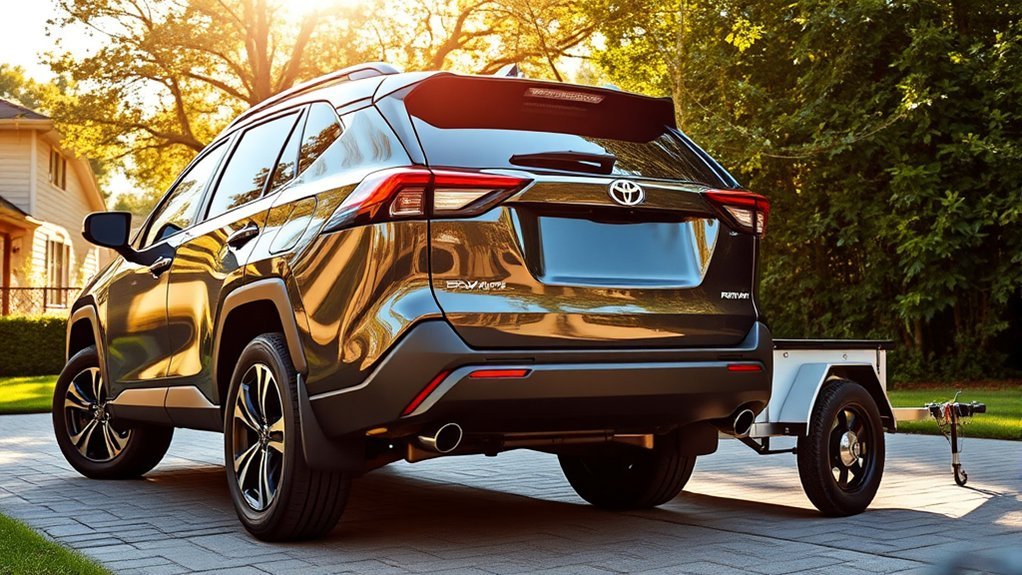
The answer depends on the model year and grade. Toyota does not advertise one universal tow package that is included with every 2026 RAV4. However, the 2026 RAV4 Woodland is a major exception. Toyota lists a standard 2-inch rear tow-hitch receiver with a wiring harness on both the Hybrid and Plug-in Hybrid Woodland versions.
Other eligible RAV4 grades may require separately installed equipment. Toyota offers a genuine RAV4 tow-hitch receiver with a ball mount, while the required Toyota towing wire harness is listed separately. Confirm part fitment by vehicle identification number before ordering because parts can differ by model year, powertrain, bumper design, and market.
Warning: A hitch rated for 3,500 pounds does not turn a 1,750-pound RAV4 into a 3,500-pound tow vehicle. The lowest applicable vehicle, hitch, ball mount, hitch ball, tire, axle, trailer, or brake-system rating always controls.
What Is the Towing Capacity of the Toyota RAV4?
The current U.S.-market 2026 RAV4 is available with Hybrid and Plug-in Hybrid powertrains. Toyota lists an overall maximum of 3,500 pounds, but that number does not apply to every grade or drivetrain.
| 2026 RAV4 configuration | Maximum advertised towing capacity | Important note |
|---|---|---|
| Hybrid FWD grades | Up to 1,750 lbs | Do not apply the AWD rating to an FWD vehicle. |
| Hybrid LE AWD | Up to 1,750 lbs | The LE AWD does not share the higher rating of specified AWD grades. |
| Hybrid XLE Premium, SE, Woodland, XSE, and Limited AWD | Up to 3,500 lbs | Verify the exact grade and equipment in the owner’s manual. |
| Plug-in Hybrid SE, Woodland, and XSE AWD | Up to 3,500 lbs | Toyota’s consumer towing information specifically names these grades. |
| Plug-in Hybrid GR SPORT | Check the exact manual and specification sheet | Do not transfer another Plug-in Hybrid grade’s rating without confirmation. |
These figures refer to gross loaded trailer weight. The trailer, batteries, propane cylinders, water, food, tools, bikes, camping equipment, and all other trailer cargo must fit within the applicable rating.
The number on the brochure is only one limit. Your safe towing limit is the lowest result after you check the RAV4, its payload, both axles, every hitch component, the loaded trailer, its tires, and its braking equipment.
How Does 2025 RAV4 Towing Capacity Differ?
The previous-generation 2025 RAV4 used different towing ratings. Keep these figures separate from the redesigned 2026 model:
| 2025 U.S. model | Maximum towing capacity |
|---|---|
| RAV4 gas | Up to 1,500 lbs |
| RAV4 Hybrid | Up to 1,750 lbs |
| RAV4 Plug-in Hybrid | Up to 2,500 lbs |
Note: Toyota did not offer the gas-powered Adventure or TRD Off-Road grades for the 2025 U.S. model year. Do not copy a 3,500-pound rating from an older Adventure or TRD Off-Road model and apply it to a 2025 LE, XLE, XLE Premium, or Limited.
How Do You Find Your Exact RAV4 Towing Limit?
Do not rely on a search-result snippet or a hitch advertisement. Use the following process before choosing a trailer:
- Identify the exact vehicle: Record the model year, grade, powertrain, drivetrain, and sales market. An LE AWD, XLE Premium AWD, and XLE Premium FWD may not share the same rating.
- Read the owner’s manual: Find Trailer Weight Rating, unbraked Trailer Weight Rating, Gross Combination Weight Rating, tongue-weight instructions, towing restrictions, and required equipment.
- Read the door-jamb labels: Record the combined occupant-and-cargo limit, GVWR, front GAWR, and rear GAWR.
- Check every towing component: Confirm the receiver, ball mount, hitch ball, coupler, chains, tires, wheels, and trailer axle ratings.
- Weigh the loaded setup: Use a certified vehicle scale and a suitable tongue-weight scale when practical.
You can locate Toyota manuals through the Toyota Manuals and Warranties portal. The manual for your exact RAV4 is more authoritative than a generic model-year article.
What Equipment Do You Need to Tow With a RAV4?
A complete towing setup normally needs more than a hitch ball. Each component must fit the RAV4 and the trailer.
- Hitch receiver: Use a receiver approved for the exact RAV4 configuration and installed at the specified mounting points.
- Ball mount: Choose the correct rise or drop so the loaded trailer sits level.
- Hitch ball: Match the ball diameter and shank rating to the trailer coupler and ball mount.
- Wiring harness: A four-pin flat connector normally powers basic brake lights, turn signals, and taillights.
- Trailer-brake connection: A trailer with electric brakes may need a compatible seven-way connector, brake controller, and breakaway system. A four-pin lighting connector does not provide electric-brake output by itself.
- Safety chains: Attach the chains to the approved points and follow the hitch and trailer manufacturers’ routing instructions.
- Hitch pin and clip: Use the correct size and verify that both are fully secured.
- Mirrors: Add compliant towing mirrors when the trailer blocks the required rearward view.
- Weight-measuring equipment: Use a scale rather than guessing loaded trailer or tongue weight.
Ask a Toyota dealer or qualified towing-equipment installer to confirm wiring compatibility, brake-controller requirements, bumper clearance, hitch height, and whether the installation affects hands-free liftgate operation or other rear sensors.
Which RAV4 Weight Limits Must You Check?
| Term | What it means | Why it matters |
|---|---|---|
| Trailer Weight Rating | The maximum permitted gross loaded trailer weight for the specified RAV4 configuration. | The trailer and everything loaded in it must remain below this limit. |
| Unbraked Trailer Weight Rating | The maximum trailer weight permitted without the trailer service brakes specified by Toyota. | A trailer can be below the main tow rating but still require brakes. |
| Payload or occupant-and-cargo limit | The weight available for occupants, cargo, applicable accessories, and trailer tongue load. | A trailer may fit the tow rating but overload the vehicle’s payload. |
| GVWR | The maximum permitted loaded weight of the RAV4. | The loaded vehicle, including tongue weight, cannot exceed it. |
| GAWR | The maximum load allowed on the front or rear axle. | Tongue weight can overload the rear axle before GVWR is reached. |
| GCWR | The maximum combined loaded weight of the RAV4 and trailer. | Passengers and cargo can reduce the trailer weight that fits within this limit. |
| Trailer GVWR | The maximum weight the trailer itself is designed to carry. | It is more useful for screening trailers than an optimistic dry-weight advertisement. |
| Tongue weight | The vertical load the trailer places on the hitch ball. | Too little can increase sway; too much can overload payload, the hitch, or the rear axle. |
How Does Tongue Weight Affect RAV4 Payload?
Tongue weight is carried by the RAV4, so it uses part of the occupant-and-cargo capacity shown on the vehicle’s label. Use this calculation:
Remaining payload = door-jamb occupant-and-cargo limit − occupants − vehicle cargo − applicable added equipment − measured trailer tongue weight
For example, a 2,500-pound loaded trailer would create about 250 pounds of tongue weight at an illustrative 10%. That 250 pounds is carried by the RAV4 and must fit within its payload and rear-axle limits. Use the tongue-weight range stated in the owner’s manual for your exact RAV4 rather than automatically applying a generic 10% to 15% rule.
Pro Tip: Load the trailer exactly as it will travel before weighing it. Water, batteries, propane, coolers, bikes, and cargo can change both gross trailer weight and tongue weight.
Lightweight Trailers Suitable for RAV4 Towing
The RAV4 works best with trailers that leave useful room below every applicable limit. A trailer that appears small can still be unsuitable after cargo, water, batteries, accessories, and tongue weight are included.
Start with the trailer’s data plate. Compare its GVWR and actual loaded weight with the rating for your exact RAV4. Then calculate whether the tongue load fits within the vehicle’s remaining payload and rear GAWR.
Micro Campers and Teardrops
A RAV4 can tow some micro campers and teardrop trailers, but the word “micro” does not guarantee compatibility. Compare the road-ready camper weight with the RAV4’s Trailer Weight Rating and unbraked limit.
- Check the data plate: Record the trailer GVWR and axle rating.
- Add travel equipment: Include batteries, propane, water, food, bedding, awnings, air conditioners, and installed accessories.
- Measure tongue weight: Confirm that it follows Toyota’s manual and fits the remaining payload.
- Check brake requirements: The trailer may need brakes even when it remains below the RAV4’s maximum tow rating.
A 1,500-pound dry camper is generally not a suitable match for a RAV4 rated to tow only 1,500 pounds because the dry number excludes normal travel cargo and leaves no practical weight margin.
Utility and Cargo Trailers
Utility and cargo trailers can carry lawn equipment, building supplies, tools, furniture, bikes, and household loads. The cargo often weighs more than expected, so weigh the completed load rather than estimating it by appearance.
| Trailer type | Common use | Main RAV4 concern |
|---|---|---|
| Small utility trailer | Yard waste, tools, furniture, and small equipment | Dense cargo can exceed the trailer or vehicle limit quickly. |
| Small enclosed trailer | Weather-protected cargo | The trailer body uses more of the available capacity and presents more wind resistance. |
| Sport-gear trailer | Bikes, kayaks, paddleboards, and outdoor equipment | Tall or poorly secured gear can shift or create aerodynamic instability. |
| Micro camper | Basic camping and sleeping space | Installed equipment, batteries, water, and propane raise loaded weight. |
| Teardrop trailer | Weekend camping | Dry weight can be far below the actual road-ready weight. |
Lightweight Sport Trailers
A lightweight sport trailer may carry kayaks, bikes, paddleboards, or camping equipment while leaving more capacity available than an enclosed camper. The loading still needs careful attention.
- Keep heavy equipment low: Follow the trailer manufacturer’s loading instructions and keep weight near the designed load area.
- Balance the load: Do not place heavy cargo at the rear merely to reduce tongue weight.
- Use rated tie-down points: Secure each bike, boat, container, or tool independently.
- Recheck after driving: Stop safely after the first few miles and inspect straps, racks, tires, lights, and the coupler.
NHTSA advises drivers to tie down large objects directly, avoid excessive cargo, and double-check that the load cannot fall, shift, leak, or escape.
How to Tow Safely With Your RAV4
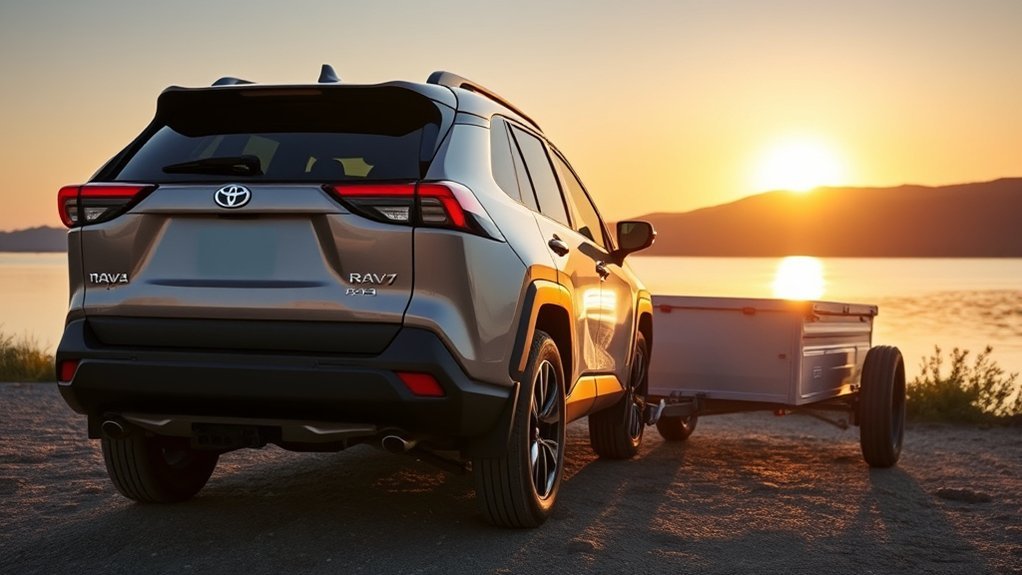
Safe towing starts before the RAV4 moves. Inspect the vehicle, receiver, coupler, wiring, brakes, tires, and cargo before every trip.
| Pre-trip check | What to verify | Why it matters |
|---|---|---|
| Ratings | Trailer weight, payload, GVWR, GAWR, GCWR, hitch, ball, and tire limits | Prevents overloading the vehicle or a single component |
| Coupler and ball | Correct ball size, fully seated coupler, closed latch, and installed lock or pin | Keeps the trailer connected |
| Receiver connection | Ball mount fully inserted, hitch pin installed, and clip secured | Prevents the ball mount from leaving the receiver |
| Safety chains | Correct attachment, adequate turning clearance, and no dragging | Provides a secondary connection |
| Breakaway cable | Connected independently where the trailer-brake system requires it | Can activate trailer brakes if separation occurs |
| Lights and brakes | Turn signals, brake lights, running lights, brake controller, and trailer brakes | Improves visibility and stopping control |
| Tires and wheels | Cold pressure, tread, sidewalls, lug nuts, age, and load rating | Reduces tire-failure risk |
| Cargo | Correct balance and secure tie-downs | Prevents load shift, sway, and road debris |
| Visibility | Mirrors provide the rearward view required by local law | Helps with lane changes, turns, and reversing |
Practice reversing, turning, and stopping in an open area before your first road trip. A trailer tracks inside the RAV4’s path during a turn and increases the distance needed to stop.
Drive smoothly and leave more following distance. Follow the lowest applicable limit from the owner’s manual, trailer manufacturer, and posted road signs. Slow down before curves, crosswinds, rough roads, wet pavement, and long downhill grades.
What Should You Do If the Trailer Starts to Sway?
- Hold the steering wheel firmly and keep the RAV4 pointed straight ahead.
- Ease off the accelerator gradually. Do not accelerate to pull out of the sway.
- Avoid abrupt steering or hard braking while the combination is unstable.
- Allow the combination to slow and stabilize.
- Pull over safely and inspect cargo position, tongue weight, tires, hitch connections, and vehicle loading before continuing.
Warning: Do not continue at the speed where sway began. Trailer instability generally becomes more severe as speed increases. Stop and correct the cause rather than relying only on electronic Trailer Sway Control.
Pro Tip: Keep a printed towing checklist in the glove box. Use it for the coupler, hitch pin, chains, breakaway cable, lights, brakes, tires, mirrors, cargo straps, and weight limits before every trip.
Improving RAV4 Towing Control and Reliability
You can improve connection quality, lighting, braking, and control with the right equipment, but you cannot raise Toyota’s official towing capacity.
- Install the correct receiver: Use approved mounting positions and hardware for the exact RAV4.
- Install proper wiring: Use a vehicle-specific harness rather than cutting directly into factory lighting wires.
- Add trailer-brake equipment when required: Use a compatible connector, controller, trailer brakes, and breakaway system.
- Use the correct ball height: A level trailer normally handles more predictably than one that points sharply up or down.
- Maintain the vehicle and trailer: Towing adds heat and load, so follow the severe-use or towing maintenance instructions in both manuals.
Suspension helpers, heavier springs, aftermarket coolers, upgraded brakes, or a stronger receiver may change how a vehicle carries or manages a load. They do not change Toyota’s published Trailer Weight Rating, GVWR, GAWR, GCWR, payload label, or tire limits.
What Should You Check Before Towing?
Complete this final check with the RAV4 and trailer loaded for travel:
- Confirm that the exact RAV4 configuration is approved to tow the loaded trailer.
- Verify that the loaded trailer is below the Trailer Weight Rating and its own GVWR.
- Confirm that passengers, cargo, equipment, and tongue weight fit within the RAV4’s payload.
- Check GVWR, front GAWR, rear GAWR, GCWR, and tire limits.
- Lock the coupler onto the correct hitch ball.
- Install the hitch pin, clip, safety chains, and breakaway cable correctly.
- Test brake lights, turn signals, running lights, trailer brakes, and the brake controller.
- Check cold tire pressure on the RAV4 and trailer.
- Secure all cargo so it cannot shift during a turn or hard stop.
- Confirm that the trailer is reasonably level when connected.
- Make sure the rearward view meets local mirror requirements.
- Do not tow with a temporary spare tire unless the exact owner’s manual expressly permits it.
Stop in a safe place after the first few miles. Inspect the coupler, hitch pin, chains, cable, electrical plug, tires, wheel hubs, and tie-downs. Correct unusual heat, movement, noise, looseness, or tire wear before continuing.
Alternatives for Heavy-Duty Towing Needs
A RAV4 is designed for light-duty towing. Choose a vehicle with more capacity when the loaded trailer exceeds the rating for your exact RAV4, when tongue weight overwhelms payload, or when you expect to tow close to the limit frequently.
| Vehicle type | Why it may work better |
|---|---|
| Midsize SUV | May provide more towing capacity, payload, cooling, and braking while remaining easier to drive than a full-size truck. |
| Full-size SUV | Offers more room for passengers and cargo while towing a heavier trailer. |
| Midsize pickup | Provides a separate cargo bed and often higher tow and payload ratings. |
| Full-size pickup | Better suited to large campers, boats, equipment trailers, and frequent heavy towing when correctly configured. |
Do not choose a replacement vehicle by its advertised maximum alone. Cab style, engine, axle ratio, drivetrain, installed equipment, payload label, hitch, and trailer package can change the rating within the same model line.
Frequently Asked Questions
Does the 2026 Toyota RAV4 come with a tow package?
There is no single universal tow package on every 2026 RAV4. The Woodland includes a standard 2-inch rear tow-hitch receiver and wiring harness. Other eligible grades may require separately installed towing accessories.
Do all Toyota RAV4s have a tow hitch?
No. Do not expect every RAV4 to have a receiver. Inspect the vehicle and confirm whether the hitch and wiring are factory-installed, dealer-installed, or aftermarket.
Which 2026 Toyota RAV4 can tow the most?
Specified 2026 AWD grades can tow up to 3,500 pounds, including eligible Hybrid XLE Premium, SE, Woodland, XSE, and Limited configurations and Plug-in Hybrid SE, Woodland, and XSE configurations. Verify the exact owner’s manual before towing.
Can a 2025 RAV4 tow 3,500 pounds?
The U.S.-market 2025 lineup generally does not have a 3,500-pound rating. The 2025 gas RAV4 is rated up to 1,500 pounds, the Hybrid up to 1,750 pounds, and the Plug-in Hybrid up to 2,500 pounds. Older Adventure or TRD Off-Road ratings should not be transferred to a 2025 vehicle.
Can a Toyota RAV4 tow a camper?
A RAV4 can tow some lightweight campers and teardrops. Compare the camper’s actual loaded weight, tongue weight, brake requirements, and GVWR with the limits for the exact RAV4. Do not make the decision from dry weight alone.
Does a stronger hitch increase RAV4 towing capacity?
No. A stronger receiver, ball mount, or hitch ball cannot increase Toyota’s vehicle rating, payload, GVWR, GAWR, GCWR, tire limits, or brake requirements. The lowest applicable rating remains the limit.
Does a RAV4 trailer need brakes?
Check the unbraked Trailer Weight Rating and brake instructions in the exact RAV4 owner’s manual. If the trailer exceeds that limit, use the braking equipment Toyota requires. You must also follow the trailer-brake laws in every state or province where you drive.
What is the main RAV4 weakness for towing?
Payload and weight margin can become limiting even when the trailer fits the advertised tow rating. Passengers, cargo, installed equipment, and tongue weight may overload the vehicle or rear axle before the maximum trailer number is reached.
Conclusion
The Toyota RAV4 can be a practical tow vehicle for a lightweight trailer when you match the trailer to the exact model year, grade, drivetrain, and equipment. For 2026, specified AWD grades can tow up to 3,500 pounds, while FWD configurations and the LE AWD have a lower 1,750-pound rating. The Woodland also stands out because it includes a factory 2-inch receiver and wiring harness.
Before towing, verify the owner’s manual, payload label, GVWR, axle ratings, GCWR, unbraked limit, hitch components, loaded trailer weight, and measured tongue weight. Use proper lighting and brake equipment, secure every load, and choose a larger tow vehicle when the combination exceeds any limit or regularly operates close to the maximum.
Sources
- 2026 Toyota RAV4 — current model lineup and maximum advertised towing capacity.
- Toyota: The Next Adventure Begins, 2026 RAV4 — grade, drivetrain, towing, and Woodland hitch specifications.
- 2026 Toyota RAV4 Plug-in Hybrid — Plug-in Hybrid towing information.
- Toyota Genuine Tow Hitch Receiver With Ball Mount — receiver and separate-harness requirements.
- Toyota Genuine Towing Wire Harness Kit — four-pin trailer-light connection information.
- NHTSA: Drive Safe, Secure Your Load — cargo-securing and overloading guidance.