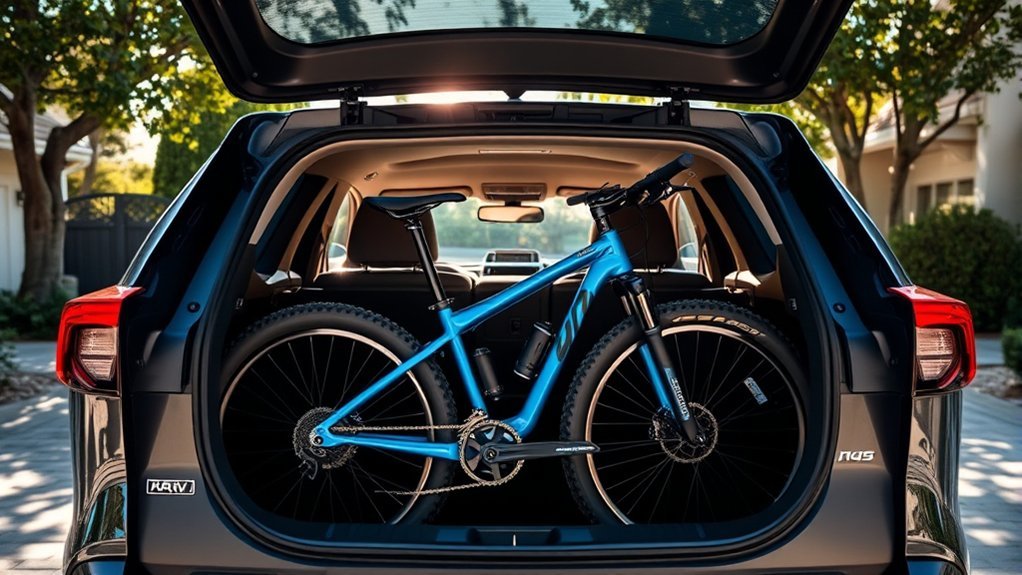
Yes, an adult bike can usually fit inside a Toyota RAV4 when the rear seats are folded down. The exact setup depends on the RAV4 model year and the bike’s total length, wheel size, handlebar width, saddle height, and accessories. Some bikes fit with both wheels installed, but removing the front wheel is the most dependable way to create clearance and protect the interior.
Quick Answer
Most road, gravel, hybrid, and mountain bikes can fit inside a Toyota RAV4 with the rear seats folded. A compact bike may fit with both wheels attached, while a large 29er, tri-bike, fat-tire bike, or e-bike is more likely to need its front wheel removed. Measure first and secure the bike before driving.
Key Takeaways
- A RAV4 can carry at least one adult bike in many common configurations, but no single fit answer applies to every bike or model year.
- A 2025 RAV4 is listed with up to 69.8 cubic feet behind the front seats, while Toyota lists 70.4 cubic feet for the redesigned 2026 RAV4.
- Removing the front wheel is the easiest way to shorten the bike and lower the handlebars.
- Use designated cargo hooks and several soft straps so the bike cannot move forward, backward, or sideways.
- Protect hydraulic disc brakes with a pad spacer whenever a wheel is removed.
- Measure the actual bike and vehicle rather than relying only on frame size or cargo volume.
At a Glance
| Time Required | About 5–15 minutes for one bike |
| Difficulty | Easy for a standard bike; moderate for a heavy e-bike or two-bike load |
| Tools Needed | Cargo mat or blanket, two or more cam straps, wheel-removal tool if required, and a brake-pad spacer for hydraulic disc brakes |
| Cost | No added cost if you already own suitable protection and straps; otherwise the cost depends on the supplies selected |
Warning: Never drive with an unsecured bicycle in the passenger compartment. Keep the bike below the driver’s rearward sightline when possible, close the liftgate fully, keep all occupied seats and seat belts usable, and secure the frame at several points so it cannot become a projectile during hard braking or a collision.
Can You Fit a Mountain Bike Inside a RAV4?
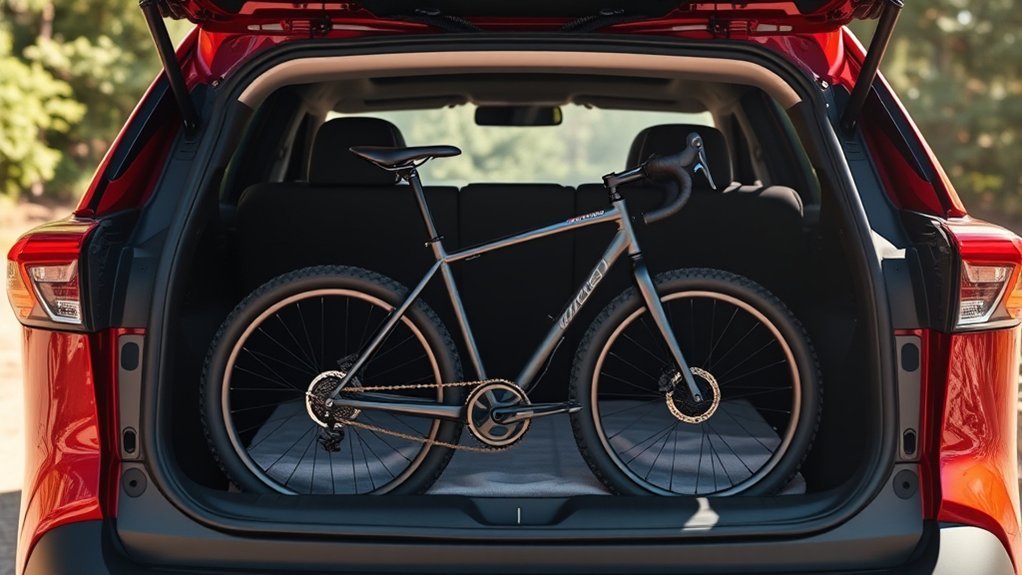
Many mountain bikes fit inside a RAV4 with the rear seats folded, but you should not assume that every bike will stand upright or fit with both wheels installed. Modern mountain bikes can have 29-inch wheels, long wheelbases, wide handlebars, high saddles, and slack front-end geometry. Those features make them harder to load than a compact road or hybrid bike.
Toyota stated that the fifth-generation RAV4 introduced for 2019 could accommodate a 29-inch mountain bike with its wheels installed. That shows an intact 29er can fit in at least some configurations, but it is not a guarantee for every frame size, saddle position, trim, cargo-floor setting, or newer RAV4 generation.
Try loading a mountain bike diagonally or on its non-drive side first. Turn the handlebars so the front wheel follows the side of the cargo area. If the hatch, saddle, pedals, or bars interfere, remove the front wheel. Lowering a dropper post can also reduce the bike’s height without changing its riding adjustment permanently.
Note: “29-inch bike” describes the approximate wheel category, not the bike’s total length or height. A small 29er may fit intact while a large or extra-large model with the same wheel size may not.
Mountain Bike Fit by Configuration
| Bike Configuration | Likely Loading Approach |
|---|---|
| Small or medium hardtail | May fit on its side or diagonally with both wheels installed |
| Large 29er | Plan to remove the front wheel and lower the dropper post |
| Full-suspension mountain bike | Protect the shock, derailleur, rotors, and frame contact points |
| Fat-tire bike | Front-wheel removal is commonly needed because of width and tire volume |
How to Fit Road Bikes and Tri-Bikes Inside a RAV4
A road bike may fit flat or diagonally with both wheels installed, especially if it has a compact frame and narrow drop handlebars. However, a label such as “56 cm” does not prove that it will fit. Two 56 cm bikes can have different wheelbases, stem lengths, saddle heights, and overall lengths.
Triathlon bikes often take more space because of their aero extensions, saddle position, and long front end. Removing the front wheel usually gives a tri-bike a more manageable shape, but you should still check whether the aero bars, pedals, or rear wheel contact the hatch or side trim.
| Bike Type | Can It Fit With Both Wheels? | Safer Planning Assumption |
|---|---|---|
| Road bike | Often possible, depending on frame and seat position | Remove the front wheel if the hatch or bars are close |
| Gravel or hybrid bike | Possible for many medium-size bikes | Check wider bars, fenders, and racks |
| Triathlon bike | Possible in some cases but less predictable | Plan to remove the front wheel and protect the aero bars |
Measure Before Loading
Cargo volume is useful for comparing vehicles, but it does not tell you whether a particular bike will pass through the hatch. Record these measurements before a long trip:
- Bike length: Measure from the rear tire to the farthest front point with the wheel straight. Measure again with the front wheel removed.
- Bike height: Measure from the floor to the top of the saddle or handlebar, whichever is higher. Lower a dropper post before measuring if you plan to transport it that way.
- Handlebar width: Measure the full tip-to-tip width, including bar-end accessories.
- Vehicle opening: Measure the narrowest hatch width and height, not only the larger space farther inside.
- Usable floor: Measure from the closed hatch position to the front-seat backs in their normal driving positions.
- Narrowest interior width: Measure between wheel-well trim and any protruding cargo panels.
Leave a small clearance margin for the liftgate, rear glass, interior trim, pedals, and straps. Do not force the power liftgate against a tire or handlebar.
Step-by-Step Loading Method
- Prepare the RAV4. Park on level ground, open the liftgate, remove loose cargo, and fold only the rear seats you do not need for passengers.
- Protect the interior. Cover the cargo floor and seatbacks with a fitted cargo liner, moving blanket, or thick washable cover.
- Clean the bike. Brush off loose mud and wipe the chain area if it may touch the interior.
- Remove accessories. Take off loose bottles, pumps, lights, computers, bags, and other parts that could detach.
- Shorten the bike if necessary. Remove the front wheel, lower a dropper post, and turn the handlebars. Store the axle with the wheel or reinstall it in the fork so it is not lost.
- Protect hydraulic brakes. Insert the correct brake-pad spacer and do not squeeze the brake lever while the wheel is removed.
- Load the bike carefully. Place it on its non-drive side when practical so the derailleur faces upward. Keep disc rotors away from hard objects and oily surfaces.
- Pad contact points. Add towels or foam around pedals, bars, fork ends, frame tubes, rotors, and any point touching the vehicle.
- Secure the frame. Use designated cargo hooks and at least two soft cam straps. Restrain movement forward, backward, and sideways without crushing frame tubes.
- Secure the wheel and gear. Strap the removed wheel separately so its rotor, cassette, or axle cannot strike the bike or occupants.
- Test the load. Push and pull the bike firmly. It should not slide, tip, or contact the liftgate.
- Close the hatch slowly. Watch every contact point and stop immediately if the liftgate meets resistance.
Pro Tip: When a front wheel with a hydraulic disc brake is removed, install the correct pad spacer and keep hands away from the brake lever. Shimano warns that pressing the lever without a spacer can push the caliper pistons outward.
Key Dimensions of the RAV4 Interior
The RAV4’s official cargo volume depends on model year and configuration. The figures below are useful for comparing generations, but they do not replace direct hatch-opening and floor measurements.
| RAV4 Reference | Behind Second Row | Second Row Folded |
|---|---|---|
| 2025 RAV4 reference configuration | 37.6 cubic feet | 69.8 cubic feet |
| 2026 RAV4 | 37.8 cubic feet | 70.4 cubic feet |
Those totals show that the RAV4 has useful cargo capacity, but they do not establish a universal cargo height or width between the wheel wells. The usable opening can also be smaller than the widest or tallest point inside the cargo area. Measure your exact RAV4 if clearance will be close.
Generation and trim differences matter. A cargo floor in a raised position, a subwoofer, a tonneau cover, seat position, interior accessories, or a different powertrain can change usable space. Remove or properly store the cargo cover before loading a tall bicycle, and never leave it loose in the cabin.
Cargo volume tells you how much space exists in total. Your bike’s length, handlebar width, saddle height, and the hatch opening determine whether it will actually fit.
Best Practices for Securing Your Bike Inside a RAV4
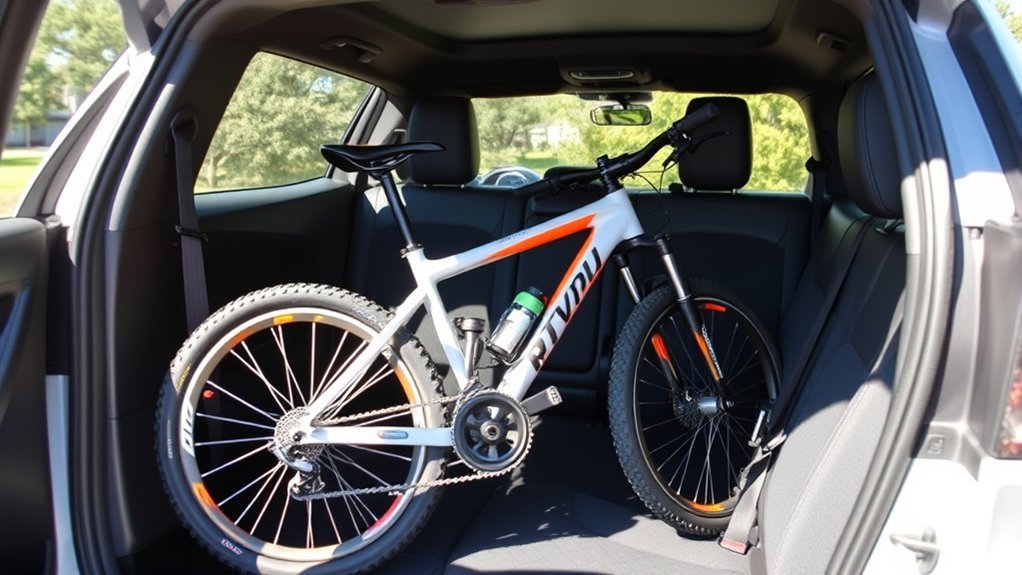
Getting the bike inside is only half the job. A bicycle contains hard metal parts and enough mass to injure an occupant or damage the vehicle if it moves during sudden braking. The National Highway Traffic Safety Administration advises drivers to tie down large objects and confirm that a load cannot shift, leak, fall, or escape.
Use only the vehicle’s designated cargo hooks or an interior bike mount designed for the exact installation. Do not substitute grocery-bag hooks, child-seat tether anchors, head-restraint posts, seat-latch hardware, grab handles, or plastic trim pieces.
| Best Practice | What to Do |
|---|---|
| Fold the required seats | Keep any seat needed by a passenger upright, locked, and fully usable with its seat belt |
| Keep weight low | Place the bike on or close to the cargo floor rather than balancing it high against glass or trim |
| Use multiple straps | Control forward, rearward, and side-to-side movement with separate restraint points |
| Protect the frame | Use soft loops and moderate strap tension, especially on carbon or thin-wall frame tubes |
| Protect the drivetrain | Keep the derailleur facing upward and prevent the chain or cassette from touching upholstery |
| Check the hatch | Close it slowly and confirm that the bike does not touch the glass, latch, or power-liftgate path |
A fitted cargo mat or tray helps protect the floor from dirt and moisture, but it is not a restraint system. The bike still needs to be strapped securely.
Keeping Your RAV4 Clean After Bike Transport
Bikes carry dirt, chain lubricant, tubeless sealant, water, and trail debris into the cargo area. A fitted cargo liner, washable mat, or moving blanket protects the floor and folded seatbacks. Add a separate rag around the drivetrain so chain oil cannot stain fabric or interior panels.
Before loading, brush off heavy mud and check the tires for sharp stones. After the trip, remove loose debris, wipe hard surfaces with an interior-safe cleaner, and let damp mats dry outside the vehicle. Do not use a cleaning product on the bike’s brake rotors unless the brake manufacturer approves it.
Store muddy shoes, helmets, and tools in closed bins or washable bags. This keeps small objects from rolling under the bike and makes it easier to confirm that every item is secured before driving.
What RAV4 Owners Are Saying About Bike Transport
Real-world owner reports are generally positive, but they also show why one universal answer is unreliable. Some owners load a medium mountain or road bike with both wheels installed. Others remove the front wheel from a large 29er, lower the saddle, or turn the handlebars to clear the hatch.
The most consistent practical advice is to bring the actual bike when test-driving or measuring a RAV4. A test fit reveals issues that cargo-volume figures cannot show, including handlebar contact, liftgate clearance, pedal position, saddle height, and whether the driver’s seat must move too far forward.
Interior transport can reduce the bike’s exposure to road spray and casual visibility, but it does not make the bike theft-proof. Lock the vehicle, keep valuable accessories out of sight, and do not leave a high-value bike unattended longer than necessary.
Alternatives for Transporting Bikes: Racks vs. Inside
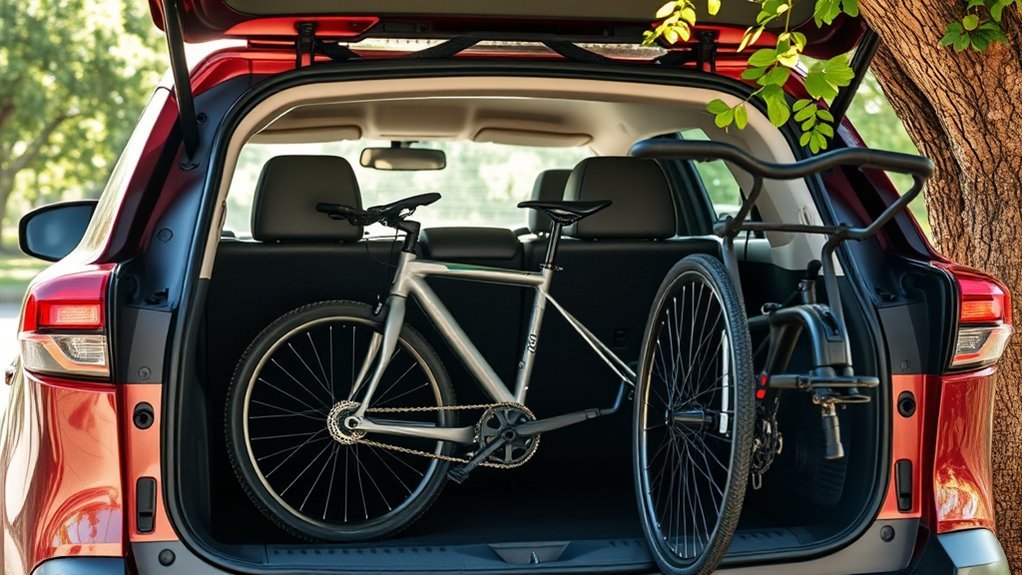
Carrying a bike inside protects it from direct weather and does not require an external rack. It also uses passenger and cargo space, brings dirt indoors, and requires careful restraint. A hitch or roof rack may be more practical when you frequently carry several bikes or need the rear seats for passengers.
| Transport Method | Advantages | Trade-Offs |
|---|---|---|
| Inside the RAV4 | Sheltered from weather and road spray; no external rack required | Uses seats and cargo room; requires interior protection and securement |
| Hitch-mounted rack | Easy loading height; useful for multiple bikes; preserves cabin space | Requires a compatible hitch and rack; may affect rear access and parking length |
| Roof-mounted rack | Keeps the liftgate and cargo area available | Requires overhead lifting and careful attention to garages, branches, and height limits |
Use a rack that is approved for the vehicle, bike weight, tire width, wheelbase, and frame type. E-bikes can exceed the capacity of racks designed for conventional bicycles.
Tips for Fitting Multiple Bikes Inside
Two bikes may fit inside some RAV4 configurations, but front-wheel removal is the safer starting plan. The goal is not simply to close the hatch. Both bikes must remain stable without one frame, pedal, rotor, or derailleur carrying the weight of the other.
- Remove both front wheels and install brake-pad spacers where required.
- Remove bottles, computers, pumps, and loose bags.
- Load the first bike with its drivetrain facing upward.
- Cover the frame, pedals, bars, rotors, and derailleur with thick padding.
- Position the second bike so its drivetrain and disc rotors do not contact the first bike.
- Strap each bike independently rather than relying on the upper bike to hold the lower one.
- Secure both removed wheels separately with padding between cassettes, rotors, frames, and interior trim.
- Confirm that no part of either bike can strike the rear glass or liftgate.
Road bikes are usually easier to combine because they have narrower tires and handlebars. Two full-suspension mountain bikes, fat-tire bikes, or e-bikes take more room and may exceed what can be loaded safely without an interior fork mount or external rack.
Special Cases: E-Bikes, Carbon Frames, and Accessories
Fitting an E-Bike Inside a RAV4
An e-bike can fit, but its weight may be the main problem. Use two people or a suitable loading aid if you cannot lift it while keeping your back straight and the bike under control. Do not lift it by the display, cables, fenders, battery handle, or other parts that the bicycle manufacturer does not identify as lifting points.
Follow the e-bike manufacturer’s instructions for its battery and display. Bosch advises removing the detachable display and, when possible, the battery and storing them securely inside the vehicle during transport. Keep the battery protected from movement, moisture, metal objects, impact, and excessive cabin heat.
Removing a detachable battery can reduce the bike’s lifting weight, but it does not make an ordinary rack suitable for a heavy e-bike. Check every rack and vehicle limit separately.
Protecting Carbon Frames
Do not overtighten a narrow strap directly against a carbon tube. Use broad soft loops, pad every contact point, and restrain the bike without crushing the frame. Keep pedals, axles, handlebars, and the second bike away from exposed carbon surfaces.
Bikes With Fenders, Baskets, or Child Seats
Fenders, baskets, racks, and child seats increase the bike’s height and width. Remove detachable accessories before loading when their manufacturer permits it. Never close the liftgate against a flexible fender or basket and assume it will remain clear while driving.
Comparing the RAV4 With Similar SUVs for Bike Transport
The RAV4 is practical for one-bike transport, but cargo volume alone should not decide which SUV is best for a cyclist. Hatch shape, floor length, usable height, wheel-well intrusion, seat-folding design, and the ability to secure a bike matter just as much.
RAV4 Versus Honda Element
The Honda Element’s tall, box-shaped cabin and flexible rear-seat arrangement can make upright or fork-mounted bike loading easier. The RAV4 has a more conventional compact-SUV interior, so a long bike may need to lie diagonally or have its front wheel removed.
The comparison also involves different ownership situations. The Element is no longer sold new in the United States, while current RAV4 models offer newer technology, safety systems, and powertrain choices. Inspect the exact used Element or test-fit the exact RAV4 rather than choosing from body shape alone.
Comparing Bike Capacity Options
- Honda Element: Its tall and square cargo area is well suited to bulky recreational gear, but available examples are used vehicles.
- Subaru Forester or Outback: These may suit cyclists who also prioritize all-wheel drive, but their roofline and floor shape differ, so direct measurements are still required.
- Jeep Grand Cherokee: Its larger exterior class may provide more room in some dimensions, but cargo shape, trim, and bike geometry still determine whether wheel removal is necessary.
- Toyota RAV4: Works well for many one-bike loads and can sometimes carry two bikes with wheels removed, padding, and careful securement.
Bring the largest bike you expect to carry when comparing vehicles. Test that the hatch closes, the driver’s seat remains comfortable, required passenger seats stay usable, and the bike can be attached to suitable cargo points.
Is the RAV4 Right for Your Cycling Needs?
Cargo Space Considerations
The RAV4 balances everyday usability with enough cargo room for many cyclists. It is a strong option when you normally carry one road, gravel, hybrid, or mountain bike and are willing to fold the rear seats. It becomes less convenient when you regularly carry several riders, multiple large bikes, or a heavy e-bike.
- Older and newer RAV4 generations have different cargo shapes and specifications.
- A large modern bike may need front-wheel removal even when a smaller bike fits intact.
- The front seats must remain in a safe and comfortable driving position.
- Every occupied seating position must retain a usable seat belt.
- A cargo mat protects the interior but does not replace straps or a bike mount.
Bike Size Compatibility
Many standard road bikes fit inside with both wheels installed when placed flat or diagonally, but that is not guaranteed. Triathlon bikes, large 29ers, fat-tire bikes, and e-bikes are more likely to need the front wheel removed. Wide handlebars, tall saddles, racks, fenders, and baskets can create clearance problems even on a short frame.
Measure the bike in its intended transport configuration, compare it with the narrowest usable vehicle dimensions, and leave clearance around the liftgate and rear glass. A physical test fit remains the most reliable answer.
Frequently Asked Questions
Can you fit an adult bike in a Toyota RAV4?
Yes. Most adult road, gravel, hybrid, and mountain bikes can fit with the rear seats folded. Small bikes may fit with both wheels installed, while larger bikes usually fit more easily after the front wheel is removed.
How big is the back of a RAV4 with the seats down?
Toyota lists up to 69.8 cubic feet behind the front seats for the referenced 2025 RAV4 configuration and 70.4 cubic feet for the 2026 RAV4. Cargo volume does not provide the hatch opening or narrowest interior dimensions, so measure the exact vehicle for a close fit.
Will a 29-inch mountain bike fit inside a RAV4?
It can. Toyota specifically described the fifth-generation RAV4 as able to hold a 29-inch mountain bike with its wheels installed. Large frames, wide handlebars, high saddles, and the redesigned 2026 cargo area can produce different results, so plan to remove the front wheel unless you have confirmed an intact fit.
Can two bikes fit inside a RAV4?
Two road or compact bikes may fit with both front wheels removed and the rear seats folded. Use padding between the bikes, keep derailleurs and rotors protected, secure each bike separately, and make sure the hatch closes without touching either bike.
Can an e-bike fit inside a Toyota RAV4?
Many e-bikes can fit, but their weight and bulky tires make loading harder. Follow the bicycle manufacturer’s instructions, remove a detachable battery or display when recommended, protect those components from impact and heat, and use help if the bike is too heavy to lift safely.
What should I do after removing a hydraulic disc-brake wheel?
Install the correct brake-pad spacer and do not press the brake lever while the wheel is removed. After reinstalling the wheel, confirm that the axle is secured correctly and test both brakes before riding.
What is the main RAV4 weakness for cyclists?
The main limitation is that useful cargo volume does not always provide enough straight-line length or vertical clearance for a large bike with both wheels attached. Folding the seats and removing the front wheel solves the problem for many bikes but reduces passenger space.
Can you fit a bike inside most SUVs?
Most compact and midsize SUVs can hold at least one adult bike with the rear seats folded, especially after the front wheel is removed. The bike still needs padding and secure restraint, and the liftgate must close completely without pressure against the load.
Final Verdict
The Toyota RAV4 is a practical choice for carrying one adult bicycle inside. Road, gravel, hybrid, and smaller mountain bikes may fit with both wheels installed, while a large 29er, triathlon bike, fat-tire bike, or e-bike is more likely to need its front wheel removed.
For the most reliable result, measure the bike and the exact RAV4, protect the interior, use a brake-pad spacer when required, and secure every part of the load before driving. A hitch rack becomes more convenient when you frequently need the rear seats, carry several bikes, or transport a bike that is too heavy or bulky to load safely inside.
Sources
- Toyota 2026 RAV4 Sales Consultant Guide — 2026 cargo-volume and interior specifications
- Toyota 2025 RAV4 Comparison — referenced 2025 cargo-volume figures
- Toyota UK: The New Toyota RAV4 — manufacturer statement about accommodating a 29-inch mountain bike
- National Highway Traffic Safety Administration: Secure Your Load — cargo-restraint safety guidance
- Shimano Disc Brake Dealer’s Manual — pad-spacer and brake-lever precautions when a wheel is removed
- Bosch eBike Systems: Transporting the eBike — detachable battery and display transport guidance