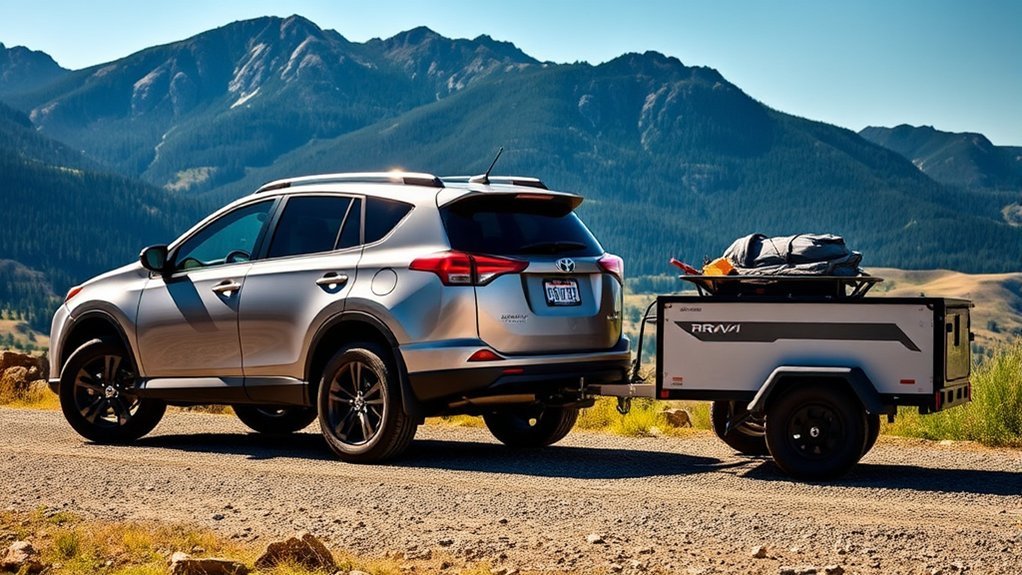
The U.S.-market 2025 Toyota RAV4 is designed for light-duty towing, but its limit depends on the powertrain. Gas models are rated to tow up to 1,500 pounds, RAV4 Hybrid models up to 1,750 pounds, and RAV4 Plug-In Hybrid models up to 2,500 pounds when properly equipped. Those figures are maximum loaded-trailer ratings, not targets, and passengers, cargo, hitch equipment, tongue weight, and trailer brakes must also stay within Toyota’s limits.
Quick Answer
A 2025 Toyota RAV4 can tow up to 1,500 pounds with the gas powertrain, 1,750 pounds as a Hybrid, or 2,500 pounds as a Plug-In Hybrid. All three have a 1,000-pound unbraked trailer limit. Confirm the exact rating in your owner’s manual and weigh the trailer fully loaded.
Key Takeaways
- U.S.-market 2025 RAV4 gas models have a maximum 1,500-pound Trailer Weight Rating.
- The 2025 RAV4 Hybrid is rated for up to 1,750 pounds and includes standard electronic all-wheel drive.
- The 2025 RAV4 Plug-In Hybrid has the highest rating at 2,500 pounds and produces 302 combined horsepower.
- Toyota lists a 1,000-pound unbraked Trailer Weight Rating for all three powertrains.
- Toyota specifies tongue weight equal to 9%–11% of the loaded trailer weight.
- Use actual loaded weight, not a trailer’s advertised dry weight, when deciding whether a trailer fits your RAV4.
What’s in This Article
Model-year note: This guide covers U.S.-market 2025 RAV4 models. Toyota changed the lineup and towing ratings for the redesigned 2026 RAV4, so do not apply the figures below to a 2026 or another model year. See Toyota’s 2026 RAV4 announcement for the newer rating structure.
2025 RAV4 Towing Capacity by Model
The maximum loaded-trailer rating is 1,500 pounds for 2025 RAV4 gas models, 1,750 pounds for every 2025 RAV4 Hybrid grade, and 2,500 pounds for the 2025 RAV4 Plug-In Hybrid SE and XSE. Toyota identifies these ratings as meeting SAE J2807 trailering requirements.
| 2025 Model Type | Maximum TWR | Unbraked TWR | Toyota Tongue-Weight Range | Practical Use |
|---|---|---|---|---|
| RAV4 Gas: LE, XLE, XLE Premium, Limited | 1,500 lbs | 1,000 lbs | 135–165 lbs at maximum TWR | Light utility, cargo, kayak, and small equipment trailers |
| RAV4 Hybrid: all 2025 grades | 1,750 lbs | 1,000 lbs | About 158–193 lbs at maximum TWR | Light utility trailers, small boats, and selected ultra-light campers |
| RAV4 Plug-In Hybrid: SE and XSE | 2,500 lbs | 1,000 lbs | 225–275 lbs at maximum TWR | Some compact campers, personal watercraft, and lightweight boats |
Warning: A trailer can be below the maximum towing rating and still overload the RAV4. Tongue weight, occupants, luggage, pets, roof cargo, accessories, and hitch equipment all use part of the vehicle’s load capacity.
Important RAV4 Weight Ratings
Do not rely on towing capacity alone. Confirm every applicable limit in the Toyota owner’s manual for your VIN and model.
- TWR, or Trailer Weight Rating: The maximum combined weight of the trailer and everything loaded in or on it.
- Unbraked TWR: The maximum trailer weight allowed without a trailer service-brake system. Toyota lists 1,000 pounds for the 2025 RAV4 models covered here.
- GCWR: The maximum combined weight of the loaded RAV4 and loaded trailer.
- GVWR: The maximum permitted weight of the RAV4 itself, including occupants, cargo, accessories, and tongue weight.
- GAWR: The maximum permitted weight on the front or rear axle.
- Payload: The weight the vehicle can carry. Tongue weight and hitch-mounted equipment count against it.
- Tongue weight: The downward load the trailer applies to the hitch ball. Toyota specifies 9%–11% of gross trailer weight.
Toyota calculates TWR using a base vehicle with limited occupants and equipment. Extra passengers, cargo, accessories, and vehicle-mounted equipment can reduce how much trailer weight you can safely tow without exceeding GCWR, GVWR, or GAWR.
Note: The trailer’s brochure “dry,” “curb,” or “unloaded” weight normally excludes some or all cargo, water, propane, batteries, dealer-installed equipment, food, tools, and camping supplies. Use the trailer’s actual loaded weight from a suitable scale.
Key Differences Between 2025 RAV4 Gas, Hybrid, and Plug-In Hybrid Models
The three powertrains have different outputs and tow ratings. The gas RAV4 uses a 203-horsepower engine and an eight-speed automatic transmission. The RAV4 Hybrid produces 219 combined horsepower and uses an electronically controlled continuously variable transmission. The Plug-In Hybrid produces 302 combined horsepower and has the highest 2025 RAV4 tow rating.
| Model Type | Maximum TWR | Power | All-Wheel Drive |
|---|---|---|---|
| RAV4 Gas | 1,500 lbs | 203 hp and 184 lb-ft | Optional |
| RAV4 Hybrid | 1,750 lbs | 219 combined hp | Standard electronic AWD |
| RAV4 Plug-In Hybrid | 2,500 lbs | 302 combined hp | Standard electronic AWD |
All-wheel drive can improve traction when starting on a wet ramp, loose surface, or incline. It does not allow you to exceed the published TWR, GCWR, GVWR, GAWR, hitch rating, or trailer-equipment limits.
How Towing Performance Is Affected by RAV4 Features
Your RAV4’s powertrain, transmission, drivetrain, payload, hitch equipment, and stability systems affect how the vehicle behaves with a trailer. The published tow rating is the upper limit, but correct loading and suitable trailer equipment determine whether the combination remains stable and controllable.
Engine Power and Torque
The standard 2.5-liter Dynamic Force gas engine produces 203 horsepower and 184 pound-feet of torque. It is suitable for light utility, cargo, kayak, and equipment trailers that remain within all vehicle and hitch limits.
The 2025 RAV4 Hybrid raises combined output to 219 horsepower. Its electric motors can provide smooth response from a stop, but its maximum TWR remains 1,750 pounds.
The 2025 RAV4 Plug-In Hybrid produces 302 combined horsepower and carries the highest RAV4 rating for this model year at 2,500 pounds. More power can improve acceleration, but it does not shorten the trailer’s stopping distance or remove the need for trailer brakes.
Payload and Tongue Weight
Tongue weight is part of the load carried by the RAV4. Toyota specifies that tongue weight should equal 9%–11% of the trailer’s actual gross weight.
- A 1,000-pound loaded trailer should place about 90–110 pounds on the hitch.
- A 1,500-pound loaded trailer should place about 135–165 pounds on the hitch.
- A 1,750-pound loaded trailer should place about 158–193 pounds on the hitch.
- A 2,500-pound loaded trailer should place about 225–275 pounds on the hitch.
Too little tongue weight can encourage sway. Too much can overload the hitch or rear axle, reduce available payload, raise the front of the vehicle, and weaken steering and braking control.
Transmission and Drivetrain Behavior
The gas RAV4 uses an eight-speed automatic transmission. Hybrid and Plug-In Hybrid models use an electronically controlled hybrid transaxle that may hold the engine at higher revolutions when climbing or accelerating with a trailer.
Higher engine speed under load can be normal, but warning lights, unusual heat, loss of power, abnormal noises, or burning smells require attention. Stop safely and inspect the vehicle rather than continuing to pull a questionable load.
Trailer Sway Control can selectively apply individual brakes and reduce drive torque when sway is detected. Hill-start assist can reduce rollback when starting on an incline. These systems are supplementary and cannot overcome excessive speed, overload, poor tongue weight, unsuitable tires, or defective trailer equipment.
Note: Toyota’s towing instructions direct drivers to disable Lane Tracing Assist while towing because the system may not operate properly with a trailer attached. Follow the instructions for your exact vehicle.
How to Tow Safely and Effectively With Your RAV4
Safe towing starts before the vehicle moves. Verify the loaded weights, use correctly rated hitch equipment, balance the trailer, test the brakes and lights, and inspect both sets of tires.
At a Glance
| Time Required | About 15–30 minutes before each towing trip |
| Difficulty | Easy to moderate; professional installation may be needed for the hitch, wiring, or brake controller |
| Tools Needed | Tire-pressure gauge, scale tickets or weight data, hitch pin, safety chains, wiring connector, wheel chocks, and flashlight |
| Cost | Basic inspections are free; hitch installation, wiring, trailer brakes, mirrors, and public-scale fees cost extra |
Check Your RAV4 Towing Setup
- Confirm the exact rating: Check the model year, powertrain, drivetrain, certification label, and owner’s manual.
- Find the loaded trailer weight: Include the trailer, cargo, water, fuel, propane, batteries, coolers, tools, accessories, and equipment.
- Check all vehicle ratings: Stay within TWR, unbraked TWR, GCWR, GVWR, front GAWR, rear GAWR, payload, and hitch limits.
- Measure tongue weight: Load the trailer so the hitch receives 9%–11% of actual gross trailer weight.
- Inspect the hitch system: Confirm that the receiver, ball mount, hitch ball, coupler, pin, clips, safety chains, and mounting hardware are correctly rated and secure.
- Make sure the trailer is level: An obvious nose-up or nose-down position can signal the wrong ball height, poor weight distribution, overload, or suspension problems.
- Test lights and brakes: Check running lights, brake lights, turn signals, trailer service brakes, and any required breakaway system.
- Inspect tires and cargo: Set vehicle and trailer tire pressures to their specified cold values and secure cargo so it cannot shift.
- Check visibility: Use towing mirrors if the trailer blocks the legally required view behind or beside the vehicle.
- Perform a low-speed test: Check steering, braking, brake-controller response, noise, and trailer tracking before entering faster traffic.
Proper Weight Distribution
Place heavy cargo low and near the trailer axle, with enough weight ahead of the axle to produce Toyota’s 9%–11% tongue-weight range. Do not concentrate heavy items at the rear of the trailer because that can reduce tongue weight and increase sway.
Secure every item against forward, rearward, and side-to-side movement. NHTSA advises drivers to tie down cargo, avoid excessive loading, and double-check that the load cannot shift or escape from the vehicle or trailer.
A weight-distributing hitch is not automatically appropriate for every RAV4 or trailer. Use one only when the Toyota owner’s manual, hitch instructions, and trailer manufacturer permit it. The hitch and every attached part must carry a rating equal to or greater than the actual load.
Trailer Brakes, Wiring, and Hitch Requirements
Toyota lists an unbraked TWR of 1,000 pounds for the 2025 gas, Hybrid, and Plug-In Hybrid RAV4. If gross trailer weight exceeds 1,000 pounds, Toyota requires trailer service brakes. State or provincial law may impose a lower threshold or require additional equipment.
- Use a brake system and controller compatible with the trailer and vehicle.
- Test normal braking and the controller’s manual function before entering traffic.
- Use a properly rated hitch ball that matches the coupler size.
- Cross safety chains beneath the trailer tongue unless the equipment maker instructs otherwise.
- Connect any legally required breakaway cable to a suitable point separate from the safety chains.
- Use a vehicle-specific wiring harness. Do not directly splice trailer lights into the RAV4’s lighting circuits.
Warning: Trailer-brake, safety-chain, lighting, mirror, and breakaway-device rules vary by location. Check every state or province on your route rather than relying only on the law where the trip starts.
RAV4 Towing Break-In and Speed Limits
Toyota gives special instructions for a new RAV4 or a vehicle fitted with new powertrain components:
- Do not tow a trailer during the vehicle’s first 500 miles.
- For the next 500 miles, keep towing speed below 45 mph and avoid full-throttle acceleration.
- After the break-in period, do not exceed 65 mph on a flat, straight, dry road.
- Always obey a lower posted towing limit or lower speed specified by the trailer manufacturer.
Slow down further for curves, descents, crosswinds, rough pavement, rain, snow, loose surfaces, heavy traffic, or restricted visibility. Leave substantially more stopping distance than you would without a trailer.
What to Do if Trailer Sway Starts
- Grip the steering wheel firmly and steer straight ahead. Do not try to cancel sway with sharp steering corrections.
- Release the accelerator immediately but gradually. Do not accelerate to pull out of the sway.
- Avoid sudden vehicle braking. Abrupt braking or steering can make the instability worse.
- Allow the combination to slow and stabilize. Trailer Sway Control may assist when enabled, but the driver must still respond correctly.
- Stop in a safe place after the sway ends. Inspect the vehicle and trailer tires, cargo position, tongue weight, hitch, and vehicle load.
- Resume at a lower speed only after correcting the cause. If no fault is found, the speed at which sway occurred may be too high for that particular vehicle-trailer combination and conditions.
Regular Maintenance Checks
Towing increases the load on the engine, hybrid system, brakes, tires, suspension, cooling system, and hitch hardware. Inspect the combination before every trip and follow any shorter severe-use service intervals listed for your vehicle.
| Maintenance Check | Why It Matters | Recommended Action |
|---|---|---|
| Engine or Hybrid-System Temperature | Towing creates additional heat | Watch gauges and warning messages; stop safely if overheating is indicated |
| Vehicle and Trailer Tires | Pressure, age, damage, and load rating affect stability | Check cold pressure, tread, sidewalls, valve stems, and wheel-lug security |
| Vehicle and Trailer Brakes | The combination needs more distance to stop | Inspect brake condition and verify trailer-brake operation before departure |
| Hitch and Coupler | Loose or mismatched parts can disconnect | Check ratings, fasteners, pin, clips, ball, coupler latch, chains, and wiring |
| Loaded Weight | Brochure dry weight does not show trip-ready weight | Weigh the loaded trailer and vehicle combination when the setup changes |
| Tongue Weight | Incorrect balance can cause sway or axle overload | Maintain 9%–11% of loaded trailer weight without exceeding payload or hitch limits |
Pro Tip: Weigh the trip-ready trailer at a public scale. Weigh again after adding batteries, water, propane, accessories, or major cargo because those changes can alter both total weight and tongue weight.
What RAV4 Owners Say About Towing Their Trailers
Owner comments about RAV4 towing are anecdotal rather than controlled testing, so they should not replace Toyota’s ratings or instructions. Experiences vary with trailer shape, road grade, elevation, wind, temperature, tire condition, cargo placement, and driving speed.
Drivers towing light utility trailers, kayak trailers, small boats, and carefully selected compact campers often describe acceptable performance when the combination remains comfortably within every rating. Hybrid drivers may notice sustained engine speed on hills because the hybrid transaxle chooses the engine speed needed for the load.
Negative experiences are more likely when a trailer is close to the vehicle’s limit, has a large frontal area, is poorly balanced, lacks suitable brakes, or is pulled at excessive speed. A trailer’s aerodynamic drag can make it feel much heavier at highway speed than its scale weight suggests.
The 2025 RAV4 is a light-duty tow vehicle. Its maximum rating is a ceiling, not a reason to choose a trailer that reaches the limit before passengers, cargo, accessories, and tongue weight are checked.
Best Trailers and Loads to Tow With Your Toyota RAV4
The best trailer is one whose actual trip-ready weight, tongue weight, frontal area, brake system, hitch equipment, and cargo distribution fit every limit for your exact RAV4. Do not choose a trailer solely because its advertised dry weight falls below the maximum TWR.
- Small utility trailers can work for yard equipment, home-improvement supplies, and light recreational gear.
- Kayak, bicycle, and small cargo trailers commonly leave more capacity for cargo than enclosed or full-height trailers.
- Some very light teardrop campers may fit Hybrid or Plug-In Hybrid limits after all batteries, propane, water, accessories, and supplies are counted.
- Some personal-watercraft and small-boat packages may fit, but the boat, engine, fuel, battery, trailer, and equipment must be weighed together.
- Full-height travel trailers can create substantial aerodynamic drag even when their scale weight appears acceptable.
Trailer Examples by 2025 RAV4 Model
| RAV4 Model | Potential Matches | Watch Closely |
|---|---|---|
| 2025 Gas RAV4 | Small utility, kayak, bicycle, and light open-cargo trailers | Any camper, boat, enclosed trailer, or equipment load that approaches 1,500 lbs when fully loaded |
| 2025 RAV4 Hybrid | Light utility trailers, selected small boats, and some ultra-light teardrops | Heavy batteries, water tanks, propane, accessories, or tongue weight that consumes too much payload |
| 2025 RAV4 Plug-In Hybrid | Some compact campers, personal watercraft, lightweight boats, and larger utility trailers | Any trailer near 2,500 lbs before occupants, cargo, hitch equipment, and vehicle ratings are checked |
Note: A trailer category is not a guarantee of compatibility. Two trailers that look similar can have very different loaded weights, axle ratings, tongue weights, brake equipment, and frontal areas.
What You Need to Know About RAV4 Maintenance for Towing
Towing adds strain to the engine or hybrid system, brakes, tires, suspension, cooling system, wheel bearings, and hitch hardware. Toyota states that vehicles used for towing may require more frequent maintenance because of the added load.
- Check oil and fluids: Maintain engine oil, coolant, and brake fluid at the correct levels and address leaks before towing.
- Inspect brakes: Verify the RAV4’s brakes, trailer service brakes, controller, and breakaway system where fitted.
- Check tire pressure and condition: Inspect both vehicle and trailer tires while cold, including spare tires.
- Inspect hitch hardware: Check the receiver, ball mount, hitch ball, coupler, pin, chains, wiring, and mounting bolts.
- Retighten initial hardware: Toyota directs owners to retighten the towing-ball and bracket fasteners after approximately 600 miles of trailer towing.
- Watch warning indicators: Stop safely for overheating, brake, stability, tire-pressure, hybrid-system, or powertrain warnings.
- Review severe-use maintenance: Ask a Toyota service department whether repeated towing, mountains, heat, dust, or stop-and-go traffic changes the service schedule for your vehicle.
Frequently Asked Questions
Is the 2025 Toyota RAV4 good for towing?
The 2025 RAV4 is suitable for light towing when the loaded trailer, tongue weight, occupants, cargo, and equipment remain within every Toyota rating. It is best matched with small utility, cargo, kayak, bicycle, boat, personal-watercraft, or carefully selected ultra-light camping trailers.
What is the main towing weakness of the RAV4?
Its main limitation is modest towing and payload capacity compared with a truck or larger SUV. Trailer frontal area, braking distance, tongue weight, passengers, cargo, heat, and road grade can also affect performance even when the trailer is below the maximum rating.
Which 2025 RAV4 can tow 3,000 pounds?
No U.S.-market 2025 RAV4 is rated to tow 3,000 pounds. The 2025 RAV4 Plug-In Hybrid has the highest rating at 2,500 pounds. Do not use ratings from an Adventure, TRD Off-Road, 2026 model, or another market for a 2025 RAV4.
Can a 2025 Toyota RAV4 tow a camper?
It can tow some compact campers if the actual loaded weight, 9%–11% tongue weight, payload, GCWR, GVWR, GAWR, hitch rating, and brake equipment all comply. Check the trip-ready weight rather than relying on the camper’s advertised dry weight.
Does a 2025 RAV4 need trailer brakes?
Toyota lists a 1,000-pound unbraked Trailer Weight Rating. If gross trailer weight exceeds 1,000 pounds, trailer service brakes are required by Toyota. State or provincial laws may require brakes at a lower weight or specify additional equipment.
What tongue weight should a 2025 RAV4 use?
Toyota specifies tongue weight equal to 9%–11% of actual gross trailer weight. That equals about 135–165 pounds for a 1,500-pound trailer and 225–275 pounds for a 2,500-pound trailer, provided the vehicle, hitch, axle, and payload limits are not exceeded.
Is a trailer’s dry weight the number used for towing capacity?
No. Towing capacity applies to gross trailer weight, meaning the trailer plus everything carried in or on it. Water, propane, batteries, fuel, food, tools, accessories, dealer options, and personal cargo can add substantial weight above the advertised dry figure.
What Toyota is better for heavier towing?
A Toyota truck or larger SUV is usually more suitable when the trailer exceeds the 2025 RAV4’s limits or requires more payload and braking capacity. Depending on model year and equipment, options may include the Tacoma, Tundra, 4Runner, Land Cruiser, Grand Highlander, or Sequoia.
The 2025 Toyota RAV4 can handle small towing jobs when the trailer is matched to the correct powertrain and every load rating is respected. Verify the owner’s manual, weigh the trailer in trip-ready condition, keep tongue weight within Toyota’s 9%–11% range, use trailer brakes when required, and leave extra room for acceleration, turns, and stopping.
Sources
- Toyota USA Newsroom: 2025 Toyota RAV4 — supports the 2025 gas and Hybrid lineup, engine output, drivetrains, and model-year changes.
- Toyota USA Newsroom: 2025 RAV4 Plug-In Hybrid — supports its 302-horsepower output, AWD system, grades, and model naming.
- Toyota Owner’s Manuals and Warranties — source for model-specific TWR, unbraked TWR, tongue weight, break-in, speed, equipment, and maintenance instructions.
- Toyota USA Newsroom: redesigned 2026 RAV4 — confirms that 2026 towing ratings differ from the 2025 figures in this guide.
- NHTSA: Secure Your Load — supports cargo-securement and overload precautions.
- SAE International J2807 — explains the performance criteria and methodology used to determine tow-vehicle ratings.