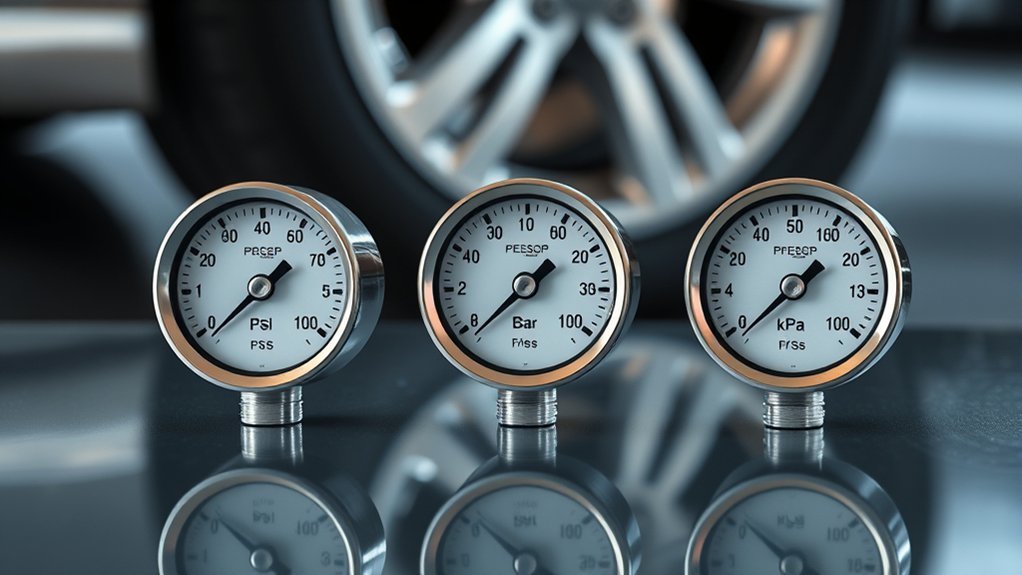
Tire pressure may be shown in PSI, bar, or kPa. These units measure the same pressure, but the number changes with the unit. The safest approach is to use the cold-pressure value on your vehicle’s tire-information placard or in the owner’s manual and set your gauge to the same unit whenever possible.
Quick Answer
Use the unit printed on your vehicle’s tire-information placard. PSI, bar, and kPa measure the same pressure: 1 bar = 100 kPa = 14.5038 psi, and 1 psi = 6.89476 kPa. Match the placard’s cold pressure, not the maximum pressure molded on the tire sidewall.
Key Takeaways
- Use the vehicle manufacturer’s recommended cold tire pressure, which is usually on the driver-side door jamb or in the owner’s manual.
- 1 bar = 100 kPa = 14.5038 psi; for everyday use, 14.5 psi per bar and 6.9 kPa per psi are accurate shortcuts.
- Front and rear pressures may differ, and some vehicles list separate values for normal and fully loaded driving.
- Do not lower a warm tire to the cold placard value. Recheck and make the final adjustment after the tires have cooled.
- Check every tire, including the spare when accessible, at least monthly with a reliable gauge.
Which Tire Pressure Unit Should You Use?
Use whichever unit appears on your vehicle’s placard or owner’s manual. A digital gauge that switches between PSI, bar, and kPa lets you match the listed value directly and avoids conversion or rounding errors.
In the United States, placards commonly show PSI and kPa. Many vehicles sold in metric markets show kPa, bar, or both. The unit itself does not change the correct pressure; only the displayed number changes.
Note: Read the complete placard. It may specify different pressures for the front and rear tires, a different spare-tire pressure, or separate settings for heavier loads.
What PSI Means and Where You’ll See It
PSI means pounds-force per square inch. It is a pressure unit commonly used on tire gauges, air compressors, vehicle placards, and tire sidewalls in the United States. One PSI equals exactly 6.894757 kPa according to the National Institute of Standards and Technology conversion table.
Common Uses and Labels
The location and units vary by manufacturer, model, and market. The following table explains what each label normally means.
| Label location | What you may see | How to use it |
|---|---|---|
| Driver-side door jamb or door edge | Recommended cold pressure in PSI, kPa, bar, or more than one unit | Use this as the main target for the original tire size and listed load condition. |
| Fuel-filler door | Pressure information on some vehicles | Use it if it is the manufacturer’s pressure label for your vehicle. |
| Owner’s manual | Normal-load, full-load, speed, spare, or special-use guidance | Follow the instructions that match your tire size and operating condition. |
| Tire sidewall | Maximum load and maximum cold inflation information | Do not use it as the normal target for a passenger vehicle unless the vehicle or tire manufacturer specifically directs you to do so. |
How to Read PSI
If the placard lists 35 PSI for the front tires and 33 PSI for the rear tires, set your gauge to PSI and adjust each axle to its own value while the tires are cold. Do not assume all four tires need the same pressure.
- Find the target pressure for the correct tire size and load condition.
- Check the tires before driving or after they have been parked for at least three hours.
- Press the gauge squarely onto the valve stem until the hissing stops.
- Add or release air, then measure again.
- Repeat the reading if the result seems unusual.
What Bar Means and How It Maps to Tire Specifications
Bar is a pressure unit widely used on European-market vehicles and equipment. It is not the SI pressure unit, but it is accepted for use with SI. One bar equals exactly 100 kPa and approximately 14.5038 PSI.
A placard value of 2.2 bar converts to about 31.9 PSI, while 2.5 bar converts to about 36.3 PSI. Use the full placard value rather than rounding too aggressively. For example, 2.3 bar is about 33.4 PSI, not simply “around 35.”
Note: A tire gauge reports pressure above the surrounding atmosphere. One bar is close to the magnitude of atmospheric pressure, but 1 bar and 1 standard atmosphere are not the same unit. One standard atmosphere is 101.325 kPa, or about 14.696 PSI.
What kPa Means and Why Some Cars Use It
kPa means kilopascal. The pascal is the SI derived unit of pressure, and one kilopascal equals 1,000 pascals. Vehicle manufacturers often use kPa because it fits international engineering and labeling standards and avoids long numbers in pascals.
Why Manufacturers Use kPa
kPa provides a direct metric expression of pressure. A common placard may show a value such as 230 kPa, often alongside its rounded equivalent of 33 PSI. When both units appear, small rounding differences are normal.
Reading kPa on Vehicles
Set a multi-unit gauge to kPa and match the placard number directly. This is usually more accurate than converting to PSI first. For example, if the placard says 240 kPa, use 240 kPa rather than converting, rounding, and converting back.
Converting kPa to PSI
Multiply kPa by 0.145038 to get PSI, or divide by 6.894757. For quick mental math, dividing by 6.9 is close enough for normal tire checks.
- 220 kPa is about 31.9 PSI.
- 240 kPa is about 34.8 PSI.
- 280 kPa is about 40.6 PSI.
Tire Pressure Conversions: PSI ↔ Bar ↔ kPa
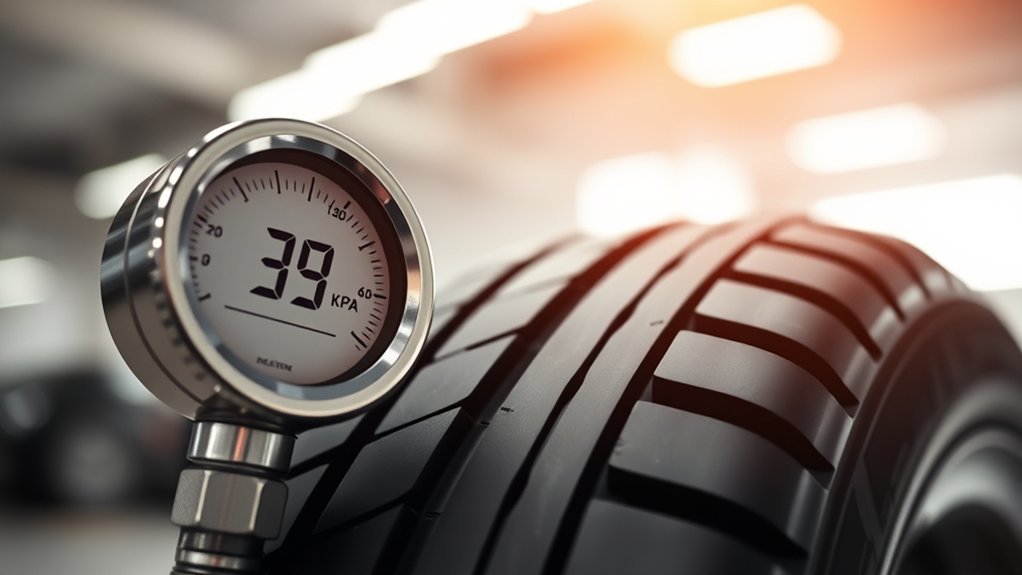
Use these formulas when your gauge and vehicle label show different units:
- Bar to PSI: bar × 14.5038
- PSI to bar: PSI ÷ 14.5038
- PSI to kPa: PSI × 6.89476
- kPa to PSI: kPa ÷ 6.89476, or kPa × 0.145038
- Bar to kPa: bar × 100
- kPa to bar: kPa ÷ 100
Pro Tip: Set a digital gauge to the same unit as the placard. Direct matching is faster and avoids mistakes caused by rounding.
Common Tire Pressure Conversion Chart
The values below are rounded for practical use. Your vehicle placard remains the final authority.
| PSI | Bar | kPa |
|---|---|---|
| 20 | 1.38 | 138 |
| 25 | 1.72 | 172 |
| 30 | 2.07 | 207 |
| 32 | 2.21 | 221 |
| 33 | 2.28 | 228 |
| 35 | 2.41 | 241 |
| 36 | 2.48 | 248 |
| 40 | 2.76 | 276 |
| 45 | 3.10 | 310 |
| 50 | 3.45 | 345 |
Example Pressure Ranges and Why the Placard Still Wins
Many passenger vehicles have placard values near the low-to-mid 30 PSI range, but there is no universal pressure for every car, SUV, EV, or light truck. Tire size, axle load, vehicle design, speed, and cargo can change the required value.
- Passenger cars: Values around 30–36 PSI are common examples, but the placard may be lower or higher.
- Sports and performance cars: Front and rear values may differ, and the manufacturer may publish separate high-speed guidance.
- Light trucks and SUVs: Some use passenger tires, while others use LT tires with very different load-and-pressure requirements.
- Road bicycles: Do not use a passenger-car chart. Bicycle pressure depends on tire width, rider and cargo weight, rim type, surface, and the tire and rim manufacturers’ limits.
A perfectly converted number is still wrong if it did not come from the correct vehicle placard, manual, or manufacturer specification.
Where to Find Your Car’s Recommended Tire Pressure
Check the Tire and Loading Information placard on the driver-side door jamb, door edge, or nearby pillar first. The National Highway Traffic Safety Administration identifies this label and the owner’s manual as the correct sources for the manufacturer’s recommended cold pressure.
Some vehicles also place pressure information inside the fuel-filler door. The manual may include extra instructions for full loads, towing, sustained high speeds, alternative factory tire sizes, winter tires, or a temporary spare.
Warning: Do not inflate a passenger vehicle to the tire sidewall’s maximum-pressure number simply because it is higher. That marking relates to the tire’s maximum load and inflation limits; it is not the vehicle manufacturer’s normal operating target.
How to Check and Set Tire Pressure: Tools and Steps
At a Glance
| Time Required | About 5–10 minutes |
| Difficulty | Easy |
| Tools Needed | Reliable tire-pressure gauge; air compressor or inflator if pressure is low |
| Cost | Usually free with your own equipment; public air-station fees vary |
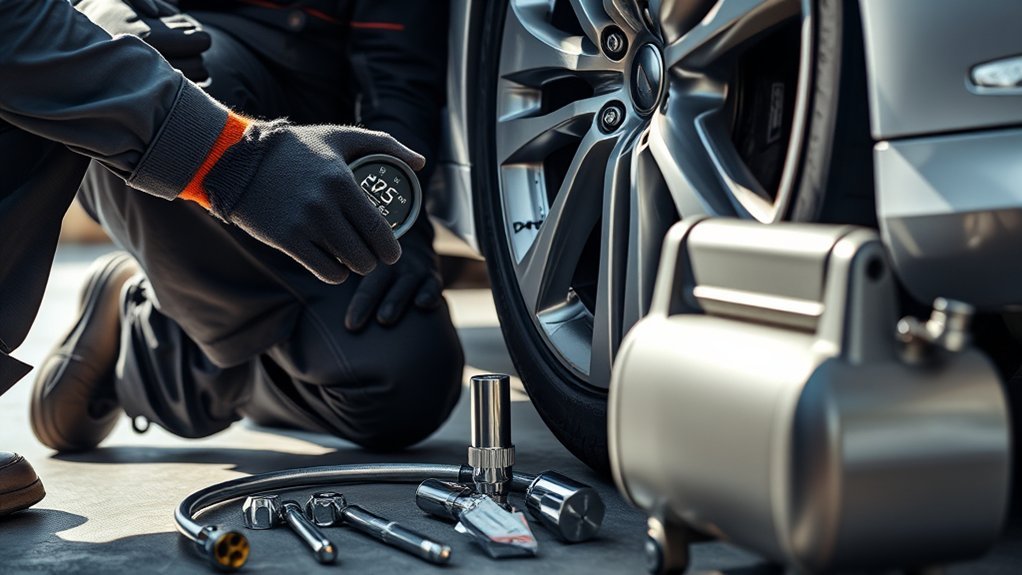
- Let the tires cool. Check before driving or after the vehicle has been parked for at least three hours.
- Find the correct target. Read the placard and note any different front, rear, full-load, or spare pressures.
- Set the gauge unit. Choose PSI, bar, or kPa to match the placard.
- Remove the valve cap. Press the gauge firmly and squarely onto the valve stem.
- Record the reading. Check again if air leaks around the gauge or the number seems inconsistent.
- Adjust the pressure. Add air if low or release small amounts if high, then measure again.
- Finish the check. Replace the valve cap, repeat for every tire and the spare when accessible, and confirm that the TPMS warning clears after following the vehicle manual’s procedure.
What “Cold Tire Pressure” Means
NHTSA defines cold tires for routine checks as tires on a vehicle that has not been driven for at least three hours. Transport Canada also notes that a tire may be treated as cold when the vehicle has been stationary for at least three hours or has traveled no more than 2 km.
Temperature and Seasonal Pressure Changes
Pressure changes with ambient temperature. Transport Canada gives a useful rule of thumb: tire pressure may change by about 7 kPa, or 1 PSI, for each 5°C change in temperature. Check more often during major seasonal temperature swings.
Note: A cold morning can trigger the TPMS light when pressure was already close to the warning threshold. Do not ignore it; verify all tires with a gauge.
What to Do If the Tires Are Warm
Driving heats the tires and normally raises the displayed pressure. Do not release air from a warm tire merely to reach the cold placard number. If a warm tire is clearly low, add enough air to avoid driving significantly underinflated, then recheck and make the final adjustment when the tire is cold.
Troubleshooting and When to Visit a Tire Shop
If the TPMS light appears, the pressure repeatedly falls, or the vehicle’s handling changes, check the tires as soon as it is safe. Pressure is only one possible cause, so avoid diagnosing every vibration or wear pattern as an inflation problem.
| Symptom | What to do |
|---|---|
| TPMS light stays on | Check every tire with a gauge, inspect for visible damage, and inflate to the placard value. Follow the manual if a reset or drive cycle is required. |
| TPMS light flashes, then stays on | This can indicate a TPMS malfunction. Arrange diagnosis if the manual confirms the warning pattern. |
| Uneven tread wear | Verify pressure, then have alignment, suspension, rotation history, and tire condition checked as needed. |
| Repeated pressure loss | Look for a puncture, leaking valve core or stem, bead leak, cracked wheel, or tire damage. Have the assembly inspected instead of repeatedly topping it up. |
| Vibration at speed | Check for low pressure and visible damage. Wheel balance is one possibility, but bent wheels, tire defects, alignment, or suspension problems can also cause vibration. |
| Reduced fuel economy | Confirm cold tire pressure, but also consider driving conditions, load, weather, maintenance, and other mechanical causes. |
When Professional Inspection Is Needed
- A tire loses pressure again after being adjusted.
- You find a bulge, exposed cord, deep cut, cracked wheel, damaged valve, or large puncture.
- The vehicle pulls, shakes, or handles differently after pressure is corrected.
- The gauge reading changes rapidly or will not stabilize.
- The TPMS warning flashes or remains on despite correct verified pressures.
Frequently Asked Questions
Why use kPa instead of PSI?
Use kPa when the vehicle placard or gauge uses kPa. It is a metric multiple of the SI pressure unit, the pascal. It is not inherently safer or more accurate than PSI; matching the manufacturer’s listed unit simply reduces conversion mistakes.
Is 1 bar 14.5 or 14.7 PSI?
One bar equals approximately 14.5038 PSI, usually rounded to 14.5 PSI. The 14.7 PSI figure refers to one standard atmosphere, which equals approximately 14.696 PSI or 101.325 kPa.
What is 30–35 PSI in kPa?
30 PSI is about 207 kPa, and 35 PSI is about 241 kPa. The full range is therefore approximately 207–241 kPa.
How many kPa is 40 PSI?
40 PSI equals approximately 275.8 kPa, normally rounded to 276 kPa. It also equals about 2.76 bar.
Should all four tires have the same pressure?
Not always. Many vehicles specify different front and rear pressures because axle loads differ. Follow each axle’s placard value instead of forcing all four tires to match.
Can I use the maximum pressure on the tire sidewall?
Do not use the sidewall maximum as the routine target for a passenger vehicle. Use the vehicle manufacturer’s cold-pressure recommendation. The sidewall marking describes the tire’s load and inflation limit, not the pressure selected for your vehicle’s ride, handling, and load distribution.
How often should I check tire pressure?
Check all tires at least once a month and before long trips. Check more often when temperatures change sharply or when a tire has recently needed air.
Does TPMS replace a tire-pressure gauge?
No. TPMS is a warning system, not a substitute for monthly checks. A warning may not appear until a tire is significantly underinflated, and some systems do not display an individual pressure for each tire.
Conclusion
PSI, bar, and kPa are interchangeable pressure units once you use the correct conversion: 1 bar = 100 kPa = 14.5038 PSI, and 1 PSI = 6.89476 kPa. The most important number is still the vehicle manufacturer’s recommended cold pressure, not a generic chart or the tire sidewall maximum.
Check the tires cold at least monthly, account for different front and rear settings, and recheck after major temperature changes. Underinflation can increase fuel consumption, reduce tire life, worsen handling, and raise the risk of tire damage. The U.S. Environmental Protection Agency also notes that underinflation increases tire wear and reduces fuel economy.
Sources
- National Highway Traffic Safety Administration: TireWise — recommended cold pressure, placard location, monthly checks, TPMS, and tire-maintenance guidance.
- National Institute of Standards and Technology: SI Conversion Factors — exact PSI, kPa, bar, and atmosphere conversions.
- Transport Canada: Inflating Your Tires — cold-tire checks, gauge guidance, temperature effects, and repeated pressure loss.
- U.S. Environmental Protection Agency: Fuel-Saving Tips — the effect of underinflation on tire wear and fuel economy.