
Keep your tires inflated to the recommended PSI listed on your driver’s door jamb or in your owner’s manual. That number is typically 30-42 psi, depending on vehicle size. Check pressures when the tires are cold, use a quality gauge, and adjust for temperature swings (about 1 psi per 10°F) or extra load when towing. Do not use the sidewall maximum as your target. Simple, consistent checks improve safety, fuel economy, and tire life.
What PSI Should My Tires Be? Quick Answer
The right PSI depends on your vehicle. As a general guide: small cars run around 30 psi, medium cars around 36 psi, and large cars up to 42 psi. These are recommended operating pressures, not the maximum printed on the sidewall.
Always check tire pressure when the tires are cold. Heat from driving raises pressure 4-6 psi and gives a false high reading. Your exact target is on the owner’s manual or the driver’s side door jamb sticker. Check monthly, or every other fill-up, to protect safety, fuel economy, and tire life.
Where to Find Your Car’s Recommended Tire Pressure
Skip the tire sidewall when looking for your target pressure. Check your owner’s manual instead. It lists the model-specific values and any differences by tire type. You’ll also find a sticker on the driver’s side door jamb, glove box door, or fuel door showing the manufacturer’s PSI for front and rear axles. The NHTSA tire safety guide also recommends using these manufacturer sources as your authority.
Check pressures when tires are cold. Driving raises PSI by about 4-6, which skews your reading. Some vehicles need different PSI front-to-rear, so note both values. Keeping pressures at the recommended level improves handling, safety, and fuel economy.
Why the Tire Sidewall Number Isn’t Your PSI
The number stamped on the sidewall is the tire’s maximum inflation limit, not the pressure you should use for everyday driving. That figure (often around 44 PSI) tells you the maximum the tire carcass can handle. It is not calibrated to your vehicle’s load, suspension, or handling.
Your vehicle’s owner’s manual or door placard gives the recommended pressure tuned for ride comfort, fuel efficiency, and safety. Inflating to maximum pressure stiffens the contact patch, reduces grip, and raises blowout risk under stress. Underinflated tires create heat, cause uneven wear, and hurt fuel economy. The recommended pressure is the right operational setting for your car; the sidewall figure is an engineering limit.
How to Check Tire Pressure Correctly (Cold, Tools, Steps)
Check tire pressure when the tires are cold. That means they haven’t been driven for at least three hours, or less than 1.6 km. Press a quality manual gauge firmly on the valve stem without letting air escape, and record the reading. If it differs from the vehicle’s recommended PSI, add or release air and recheck until each tire matches the spec.
[Products Worth Considering]

PROCESS LEVEL ACCURACY: This heavy duty tire pressure gauge is calibrated manually to ANSI B40.1 Grade A (plus-minus 1% of span)
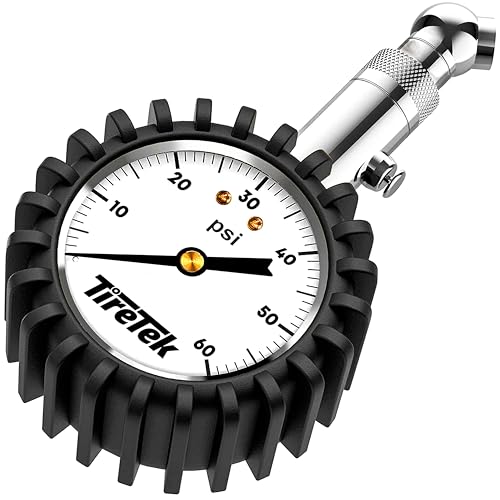
Professional Tire Pressure Gauge for Cars – This heavy duty mechanical tire pressure gauge is calibrated to ANSI B40.1 Grade A (2%) international accuracy standard so you get a precise, accurate pressure reading every time you use it. Makes great car accessories, car stuff, tire deflator, car stuff for men, cool car gadgets, car gifts for men, him, dad

PROCESS LEVEL ACCURACY: Each ETENWOLF’s digital tire pressure gauge is calibrated manually to ANSI B40.7 Grade 2A(plus-minus 1 PSI).Presta valve adapter not included, if used for bicycles, it must be purchased separately
Check When Tires Are Cold
Tire pressure rises with heat, so measure only when tires are cold. Remove the valve cap, press a tire pressure gauge firmly onto the stem, and read the PSI. Check each tire and compare the value to the recommended pressure on your door sticker or owner’s manual.
If pressure is low, add air in short bursts and recheck. If high, bleed small amounts until it matches. Replace valve caps when done to prevent slow leaks.
Use A Quality Gauge
Use a durable, calibrated gauge, digital or high-quality dial, to get reliable readings. Pump-mounted gauges are often inaccurate. Remove the valve cap and press the gauge squarely onto the valve stem. You’ll hear a brief hiss if it isn’t sealed properly.
Read the PSI for each tire and compare it to the recommended tire pressure in your owner’s manual or tire placard. Replace valve caps after checking to prevent leaks.
Inflate And Recheck Pressure
After getting cold readings with a reliable gauge, add air in short bursts and remeasure until each tire hits the manufacturer’s recommended PSI. Remove the valve cap first, press the gauge firmly to avoid leaks, and note the reading. Add air incrementally, don’t blast it in, then recheck each tire against the door placard or owner’s manual.
Use a handheld gauge rather than the pump-mounted display for accuracy. After all tires read correctly, replace valve caps. Remember: heat raises pressure 4-6 PSI, so always measure cold.
Inflate or Release Air Safely to Reach the Recommended PSI
When adding air, seat the compressor chuck securely on the valve stem to avoid leaks and overfilling. If pressure is above the recommended PSI, press the valve core briefly to release small amounts until you reach the target. Always check pressure when tires are cold, re-measure after each adjustment, and replace valve caps when finished.
[Products Worth Considering]
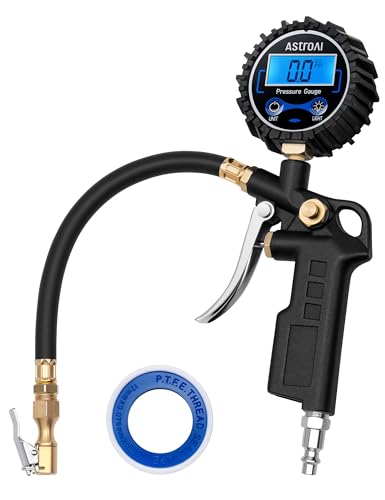
COMPATIBLE WITH both ¼” and ½” NPT air compressors outputs. COMPATIBLE WITH Standard Schrader Valves.

Advanced accuracy: Professionally calibrated tire pressure gauges for cars. Accurately measures from 0-100 PSI with a resolution of +/-1 PSI.
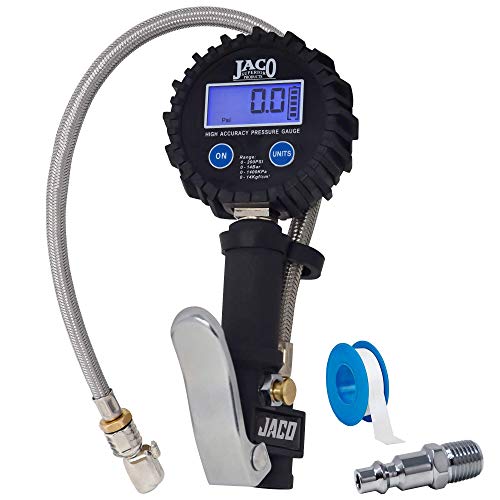
ANSI 1A ACCURACY: Performance tested & calibrated accurate to ±1% full scale with 0.5 PSI resolution for precise tire inflation. Bright 200 PSI LCD display & auto-off feature conserve battery life.
Safely Adding Air
Start by removing the valve cap and checking cold tire pressure with a gauge. Then use an air compressor to add air in short bursts, aiming for the PSI listed in your owner’s manual or door placard. Re-measure between bursts until you hit the target.
| Tool | Action |
|---|---|
| Gauge | Measure cold pressure |
| Compressor | Add air |
| Short bursts | Prevent overfill |
| Re-check | Confirm PSI |
| Valve cap | Replace |
Controlled Air Release
If your gauge shows pressure above the vehicle’s recommended PSI, press the metal pin inside the valve stem in short, controlled bursts while holding the gauge in place. Check the reading after each release and repeat until you reach the target.
Do this when tires are cold. Driving heats the air and raises readings by 4-6 PSI. After each adjustment, re-measure with your gauge rather than trusting the pump display. Screw the valve cap back on when done.
Common PSI Ranges (Compact, Sedan, SUV, Truck) and Exceptions
Most passenger vehicles fall into predictable tire-pressure bands: compacts around 30-32 PSI, sedans about 32-35 PSI, SUVs generally 35-40 PSI, and light trucks often 40-42 PSI when loaded. These ranges give you a useful baseline, but always verify with the sticker or owner’s manual. Manufacturer specs override generic bands.
Note that high-performance models, off-road variants, and some hybrid platforms may call for pressures outside these windows to optimize grip, wear, or efficiency. If you change to aftermarket tires, recheck the contact characteristics and adjust accordingly.
[Products Worth Considering]

PROCESS LEVEL ACCURACY: Each ETENWOLF’s digital tire pressure gauge is calibrated manually to ANSI B40.7 Grade 2A(plus-minus 1 PSI).Presta valve adapter not included, if used for bicycles, it must be purchased separately
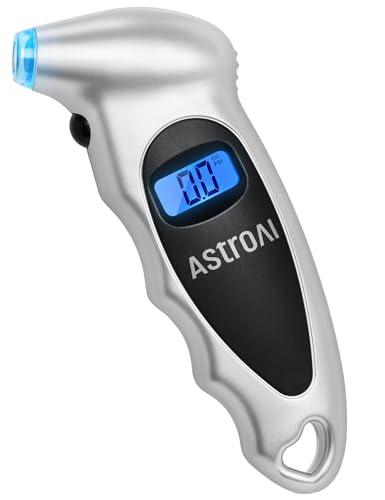
EXPERT-GRADE CALIBRATION: Each AstroAI Tire Pressure Gauge is calibrated with professional-grade tools, ensuring quick and accurate measurement results within plus-minus 1PSI. Stay prepared for any roadside emergency and travel with peace of mind.

Digital Tire Pressure Gauge 2 Pack, Industrial Tire Gauge 3-200 PSI, Calibrated to ANSI B40.7 Grade 2A(plus-minus 0.5%), Air Pressure Gauge with Replaceable AAA Batteries
How Temperature, Cargo, and Towing Change Tire Pressure
Air temperature shifts change tire pressure about 1 PSI for every 10°F. Check inflation when seasons change or temperatures swing. When you add cargo or tow, follow the vehicle manual’s recommended pressure increases rather than guessing. Both under- and over-inflation create safety and wear problems. Monitor pressures before and during heavy loads to prevent heat buildup, uneven tread wear, and reduced fuel efficiency.
Temperature Effects On PSI
Temperature directly affects the air volume inside your tires. Expect about a 1 psi rise for every 10°F increase and a corresponding drop as temperatures fall. Check cold tires (parked 3+ hours or driven less than 1.6 km) to get accurate PSI readings.
Use your tire pressure monitoring system as a backup, but verify with a gauge when temps swing seasonally. Pressure drops in cold weather can cause underinflation, leading to heat buildup once you start driving, reduced fuel efficiency, and higher blowout risk.
Cargo And Towing Adjustments
When you load heavy cargo or tow, raise tire pressures to the vehicle maker’s recommended towing values. Typically this means adding about 3-5 psi over normal, but always follow the owner’s manual for your specific vehicle. Check the correct tire pressure before you depart.
Keep the temperature rule in mind: expect about 1 PSI loss per 10°F drop, so adjust during seasonal shifts. After towing, measure cold pressures rather than readings taken right after a long drive.
How TPMS Works, Lights, and When to Act
The Tire Pressure Monitoring System (TPMS) constantly checks each tire’s pressure via sensors and lights a dashboard warning if pressure drops about 25% below the vehicle’s recommended PSI. You’ll see a TPMS light when at least one tire isn’t properly inflated. A blinking light means a system malfunction. Don’t rely solely on TPMS. Confirm tire pressure with a gauge and correct to the vehicle’s recommended PSI.
| Alert type | Action required |
|---|---|
| Solid light | Stop when safe, inflate low tire(s) |
| Blinking light | Seek immediate service; possible sensor fault |
| Post-inflation | Reset or recheck system as per manual |
| No light | Still check periodically with gauge |
Properly inflated tires preserve control and reduce risk. Inflate to the recommended PSI, use a reliable tire gauge, and act quickly on TPMS warnings. For additional tire care guidance and practical maintenance tips, you can also check TubeTyre’s detailed tire guides and safety tips, where you’ll find helpful information about tire pressure, tube tires, and everyday tire maintenance.
Signs of Underinflation or Overinflation: When to Get Help
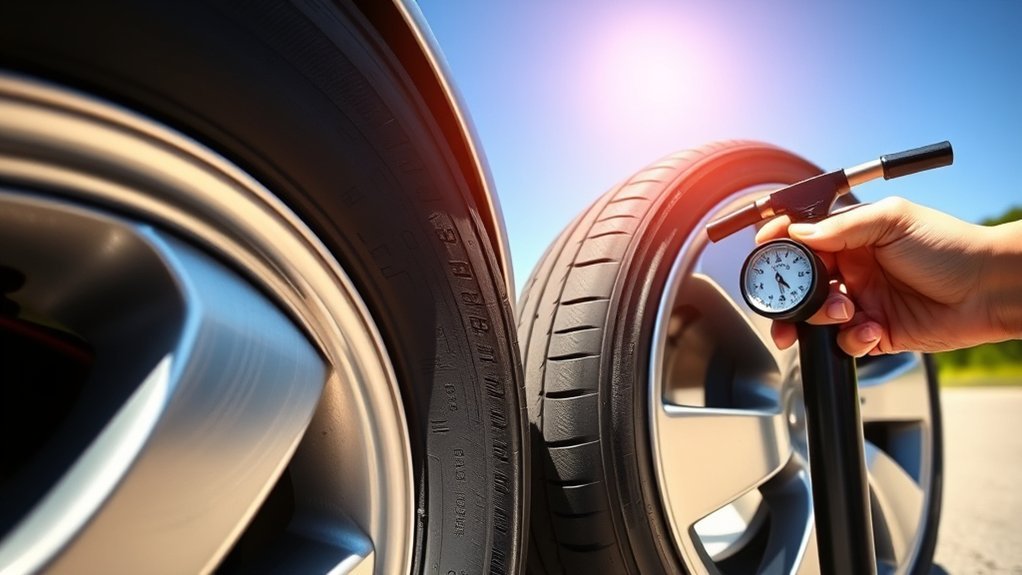
If your car feels vague in corners, rides harsher than usual, or shows uneven tread wear, check tire pressures right away. A soft, squirmy tire usually means pressure is too low. You’ll notice reduced steering responsiveness, higher rolling resistance, and worse fuel economy. As fueleconomy.gov notes, underinflated tires can measurably cut your gas mileage.
If the ride is harsh and road noise increases, pressure is likely too high. Center tread wear may appear, which reduces your contact patch and grip. TPMS alerts give early warning, with a steady light often signaling low pressure and a blinking light pointing to a malfunction.
Don’t ignore unusual wear patterns, persistent TPMS alerts, or changes in handling. Get professional help when you can’t correct the pressure, when alerts persist after inflation, or when wear is uneven.
Monthly Tire-Pressure Checklist and When to Visit a Shop
Check tire pressure at least once a month with a reliable gauge while the tires are cold. Compare the reading to the PSI on your door placard or in the owner’s manual. Most passenger cars fall in the 30-35 PSI range. Record the date and each tire’s reading.
Check both front and rear; flag any deviation greater than 5% from spec. Small drops still hurt fuel economy and safety. Inflate or deflate to match the placard, then recheck. Verify your TPMS shows normal status. A persistent TPMS warning or repeated low readings points to a leak, valve issue, or wheel problem.
Inspect tread and sidewalls for cuts, bulges, or uneven wear. If you see continuing pressure loss, irregular wear, or TPMS faults after correcting air pressure, schedule a professional shop inspection.
Frequently Asked Questions
What Is the Correct PSI for My Car’s Tires?
Check your door-jamb sticker or owner’s manual for the correct tire pressure. Keeping cold pressures at that recommended figure improves safety, fuel efficiency, handling, and tire life.
Is 40 PSI Too High for a Car Tire?
For most standard passenger cars, yes, 40 PSI is too high. Research shows a roughly 3% fuel penalty per 5 PSI of mispressure. Running too high hurts tire longevity, reduces safety, and amplifies the effects of temperature changes. Check the door placard for your vehicle’s actual target.
What Is the 5 PSI Rule?
The 5 PSI rule means you should adjust tire pressure any time it deviates five PSI or more from the recommended level. It’s a practical threshold for when the gap is large enough to affect safety, wear, and fuel efficiency.
What PSI Is Too Low to Drive On?
Below about 20 PSI, a tire is not safe to drive on. At that pressure, you risk handling problems, accelerated tire wear, and potential tire failure. Inflate promptly to restore safe, efficient driving.
Conclusion
Keep your tires at the vehicle’s recommended PSI. Find it on the door placard or in the owner’s manual. Proper pressure improves safety, fuel economy, and tire life. Check cold with a reliable gauge each month and before long trips; adjust slowly and recheck. Account for temperature changes, extra cargo, and towing, and act on TPMS warnings quickly. If you see uneven wear, bulges, or constant pressure loss, get professional help before the problem grows.







Leave a Reply