
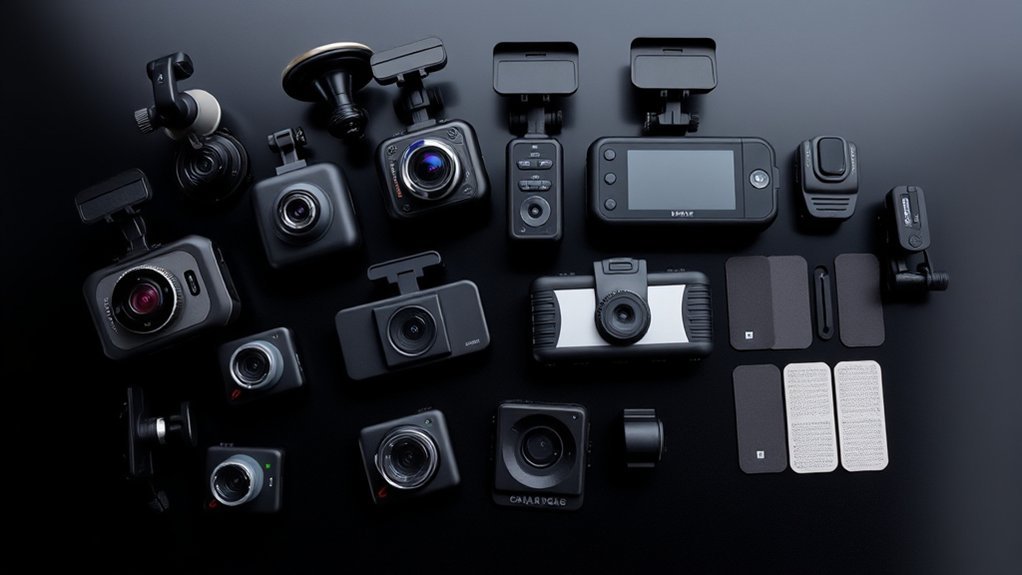
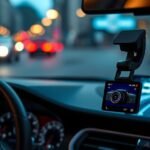
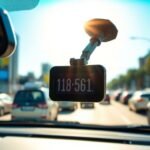
A dash cam typically looks like a compact camera that mounts to your vehicle’s windshield or dashboard. They come in various types, like front, rear, and interior cameras, each serving different purposes. Sizes can range from discreet compact models to larger full-size options with screens. Mounting styles include adhesive, suction, and magnetic mounts, ensuring easy installation and flexibility. If you want to know more about features and installation, keep exploring this topic!
What Are Dash Cams and How Do They Work?
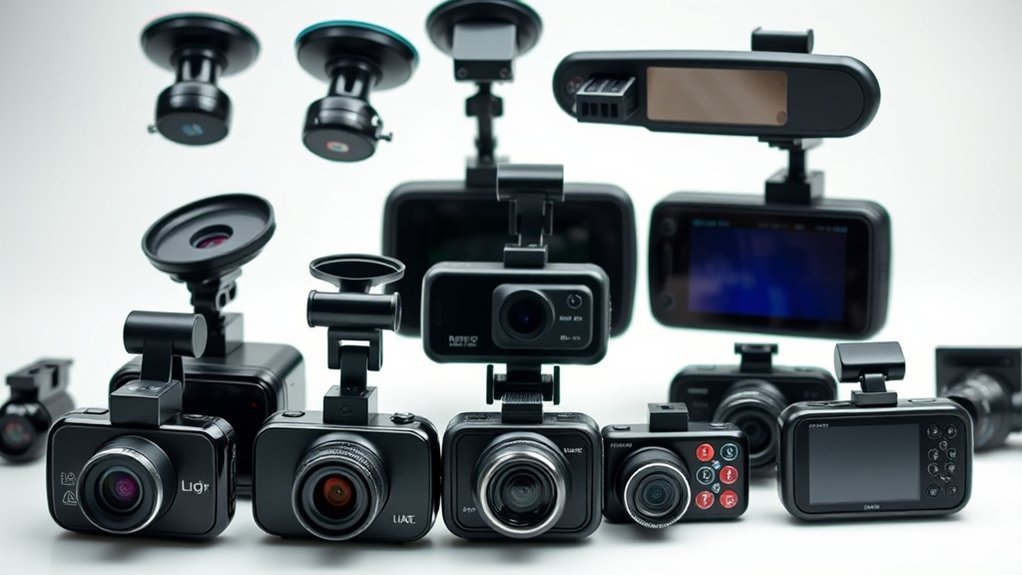
Dash cams are essential tools for modern drivers, acting as vigilant witnesses on the road. These compact cameras, mounted inside or outside your vehicle, continuously record video footage of your surroundings while you drive. With features like loop recording, you don’t have to worry about storage space; the oldest footage gets overwritten automatically, ensuring constant coverage.
Many dash cams come equipped with G-sensors that detect sudden impacts or collisions, locking the recorded video for future reference. This feature can be invaluable if you need to prove your innocence in an accident. Advanced models also offer night vision and HDR technology, optimizing video quality in various lighting conditions.
Installation is a breeze, thanks to plug-and-play designs that let you mount them on your windshield with minimal effort. Overall, dash cams enhance your driving experience, providing peace of mind and an extra layer of protection on the road.
Common Types of Dash Cams: Front, Rear, and Interior
When choosing a dash cam, understanding the benefits of front, rear, and interior cameras is essential. Front cameras capture a wide view of the road ahead, while rear cameras provide vital footage of what’s behind you. Interior cameras, equipped with night vision, are perfect for monitoring passengers or for rideshare drivers, ensuring you have an all-encompassing safety net while on the road.
Front Camera Benefits
While driving, having a front camera can markedly enhance your safety and peace of mind. Here are some key benefits of a front camera:
- Wide-Angle Lens: Most front cameras have a 170° view, capturing more of the road and minimizing blind spots.
- Loop Recording: They often feature loop recording, automatically overwriting older footage to guarantee continuous coverage.
- Night Vision: Equipped with infrared LED lights, front cameras provide clear footage even in low-light conditions.
- Built-in G-Sensors: These sensors detect sudden movements or collisions, locking essential footage for later review.
Investing in a front camera not only helps document your journeys but also protects you against potential disputes on the road.
Rear and Interior Features
Expanding beyond the front camera, rear and interior dash cams provide extensive coverage, augmenting your vehicle’s security. The rear camera typically features a waterproof design and a wide-angle lens (150°), capturing everything behind you and minimizing blind spots. Interior cameras, equipped with infrared LED lights, guarantee clear video in low light, monitoring the cabin effectively.
| Feature | Description |
|---|---|
| Rear Camera | Waterproof, 150° wide-angle lens |
| Interior Camera | Infrared LEDs for low-light recording |
| Dual-View Configuration | Simultaneous recording from front and rear |
| G-Sensor Technology | Locks critical footage upon collision detection |
With easy plug-and-play installation on windshields or rear windows, these cameras offer a straightforward solution to augment your driving experience.
Dash Cam Sizes: Compact vs. Full-Size Models
Choosing the right dash cam size can greatly impact your driving experience and safety. Understanding the differences between compact dash cams and full-size models helps you make an informed choice.
- Compact Dash Cams: These small devices offer easy installation, portability, and discreet use, perfect for vehicles with limited space.
- Full-Size Models: Typically feature advanced capabilities like multiple camera views and larger screens, catering to those who prioritize thorough monitoring.
- Field of View: Compact models generally provide a narrower perspective, while full-size options can encompass wider angles, enhancing your awareness.
- Mounting Styles: Compact dash cams often utilize adhesive mounts or suction cups, while full-size models may require more robust mounting solutions due to their weight and features.
Ultimately, picking the right size aligns with your driving habits and safety needs, ensuring you capture vital moments on the road.
How to Mount Your Dash Cam: Adhesive, Suction, and More
Mounting your dash cam properly is as important as selecting the right size for your vehicle. You have several options for securing your dash cameras, each with its advantages. Adhesive mounts provide a permanent solution, ensuring a low-profile design that won’t obstruct your view. If you prefer flexibility, suction mounts are a popular choice; they allow for easy installation and removal while letting you adjust angles for the best recording perspective. Some models even feature a plug-and-play design, making the setup straightforward and user-friendly. For those who frequently switch vehicles, magnetic mounts offer a convenient way to attach and detach your dash cam quickly, facilitating easy storage. Whatever method you choose, just make sure your dash cam doesn’t obstruct your view, ensuring your safety and compliance with road regulations. Happy driving!
Essential Features to Consider in a Dash Cam
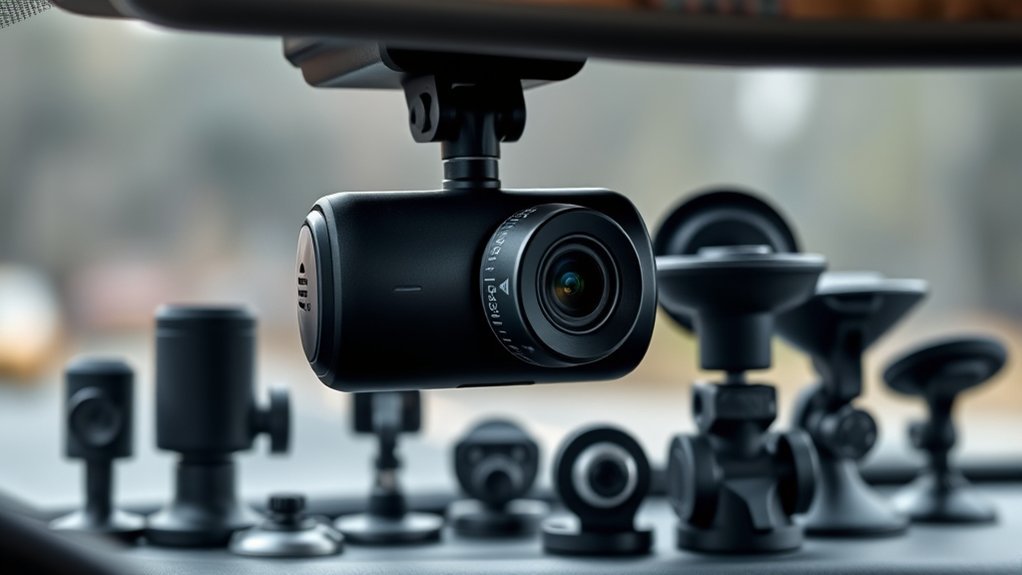
When selecting a dash cam, it’s essential to prioritize important features that enhance your driving experience and guarantee safety. Here are four key features to take into account:
- Multi-channel capabilities: Look for a dash cam with front, cabin, and rear cameras to minimize blind spots and assure full coverage.
- Loop recording: This feature automatically overwrites the oldest footage when storage is full, typically in 1 or 3-minute intervals, guaranteeing you never miss important recordings.
- Built-in G-sensor: A G-sensor activates emergency recording and locks critical videos when sudden movements or collisions are detected, especially when your vehicle is stationary.
- Night vision capabilities: Opt for infrared LED lights and HDR technology for clear footage in low light or varying conditions.
[Products Worth Considering]

[3 Channel Recording Dash Cam] REDTIGER F17 dash camera captures ultra-clear footage with its 4K front camera powered by STARVIS 2 IMX675 sensor, delivering higher light sensitivity, improved dynamic range, plus 1080P inside and rear cameras. With 150° front, 160° cabin, and 155° rear views, this triple dashcam delivers 360° full-protection for daily drivers and family trips.

[ 2026 New 3-Channel Dash Cam & 360°Coverage ] Equipped with triple STARVIS 2-powered sensors, the Vantrue N4S dashcam records in super HD clarity: 2.7K front + 1440P interior + 1440P rear.Its 158° front, 165° cabin, and 160°rear wide-angle lenses eliminate blind spots, while HDR and PlatePix technology deliver sharp details and license plates day or night. This dash cam for cars is perfect for rideshare(Uber/Lyft) drivers and daily commuters.

TRIPLE DASH CAM: This 3 channel dash camera features with a 170 wide-angle front camera + 150°Cabin + 150° waterproof rear camera, reduce visual blind areas. The Screen made by IPS panel, It allows you to see a clear picture at any angle without any blurring.
Choosing the Right Dash Cam for Your Needs
When choosing the right dash cam, think about your driving habits and the environments you frequently encounter. You’ll want a camera that meets your video quality needs, ensuring you capture clear footage in any situation. By considering these factors, you can find a dash cam that truly enhances your safety and peace of mind on the road.
[Products Worth Considering]

4K+1080P Dual Dash Cam: The Gleetour G2 dash cam front and rear setup features a 4K Ultra HD front camera and a 1080P rear camera. With its wide 170° front and 150° rear coverage angles, this dash cam captures a broad view of the road, reducing blind spots and recording essential driving moments such as traffic conditions and surroundings for enhanced safety and peace of mind.

💖💖【New Updated Features Since 17 Aug 2024】This front and rear dash cam has been upgraded to 4K+1080P from its previous 2K+1080P resolution since 17 Aug 2024. Get ready for an ultra-high-definition driving experience that ensures your safety on the road.

ULTRA WIDE ANGLE LENS: Adopting a multi-layer coated wide-angle lens that covers the three lanes in front of the car, reducing blind spots in the field of view; Support WDR wide dynamic technology, automatically optimize brightness contrast in backlit or tunnel scenes
Consider Your Driving Habits
How do your driving habits influence the type of dash cam you need? Your unique driving patterns can help you choose the perfect dash cam for your lifestyle. Consider these factors:
- Urban Driving: If you navigate heavy traffic often, opt for a high-resolution dash cam, like 4K, to capture critical details.
- Parking: For extended parking periods, select a dash cam with a parking monitor to keep an eye on your vehicle.
- Long Trips: Look for models with loop recording to automatically manage storage and guarantee you always have current footage.
- Night Driving: If you drive frequently at night, choose a dash cam equipped with night vision capabilities for clear recordings in low light.
Make your choice based on how you drive!
Evaluate Video Quality Needs
Choosing the right dash cam goes beyond just understanding your driving habits; it also depends on video quality requirements. When evaluating options, consider the resolution. Cameras range from QHD 1440P to true 4K, with models like the Cobra SC 250R excelling in capturing intricate details like license plates. If you often drive at night, look for dash cams with night vision capabilities, featuring infrared LED lights for improved video footage in low light. Additionally, advanced HDR technology can optimize your recordings in varying lighting conditions, guaranteeing clarity. Don’t overlook features like a G-sensor that automatically saves vital footage during sudden movements or collisions—this guarantees you maintain high-quality recordings of critical incidents, granting you peace of mind.
The Benefits of Multi-Channel Dash Cams: Capture Every Angle
Multi-channel dash cams offer a significant advantage by capturing every angle of your driving experience, guaranteeing you’re covered from all sides. With features that enhance safety and evidence collection, these systems are a smart investment for any driver. Here are some key benefits:
Multi-channel dash cams ensure comprehensive coverage of your driving experience, enhancing safety and providing crucial evidence for every driver.
- Comprehensive Coverage: Equipped with a 170° front camera, a 150° cabin camera, and a 150° waterproof rear camera, you minimize blind spots.
- Multiple Perspectives: Capture incidents from up to three simultaneous views, giving you enhanced evidence in case of disputes.
- Continuous Monitoring: Built-in G-sensors and parking monitors guarantee that critical events are recorded, even when your vehicle is stationary.
- Superior Image Quality: HDR technology optimizes footage in various lighting conditions, making details clear in both bright and low-light situations.
With user-friendly installations, multi-channel dash cams empower you to drive with peace of mind.
[Products Worth Considering]

【Dash Cam Front and Rear Inside 4K+1080P+1080P】The Nanoby M1 dash cam captures crisp, high-resolution footage from all angles — 4K front, 1080P interior, and 1080P rear — providing comprehensive protection against accidents and road disputes. With 160° front and 155° cabin and rear views, this triple dash cam offers full coverage—ideal for daily driving, rideshares, taxis, and family trips.

【Dash Cam Front and Rear Inside 1440P+1080P+1080P】 Advanced Sony IMX Sensor & High-Performance Processor – Captures crisp and detailed footage with 2.5K front, 1080P inside, and 1080P rear recording, ensuring reliable evidence for road incidents and disputes. The super night vision and auto IR cabin camera enhance visibility, delivering clear video even in low-light conditions.

⭐ 4K UHD / 3 Channel Dash Cam Front & Rear : Capture UHD footage with this dash cam 4k system, recording front, rear, and cabin views simultaneously. As a practical dash cam front and rear, it reduces blind spots and records important license plate details with high precision. This 3 channel dash cam provides full coverage, making it a dependable car dash cam front and back for daily commuting and rideshare safety
Harnessing Smart Technology in Dash Cams
As technology continues to evolve, smart dash cams are becoming essential tools for modern drivers, offering advanced features that enhance safety and convenience. These devices often come in single-view or dual-view configurations, allowing you to capture multiple perspectives simultaneously, with some models even supporting up to three views. Many smart dash cams integrate seamlessly with mobile apps like Drive Smarter®, enabling you to receive road alerts and manage cloud video effortlessly.
Equipped with high-definition video capabilities, including 4K resolution, these dash cams guarantee you get clear and detailed footage, no matter the lighting conditions. Plus, features like built-in GPS tagging and incident reporting make them perfect for both personal and commercial use. With a plug-and-play design, installing a smart dash cam on your windshield is a breeze, requiring minimal technical expertise. Embrace this technology and drive with confidence!
What to Expect During Dash Cam Installation and Setup?
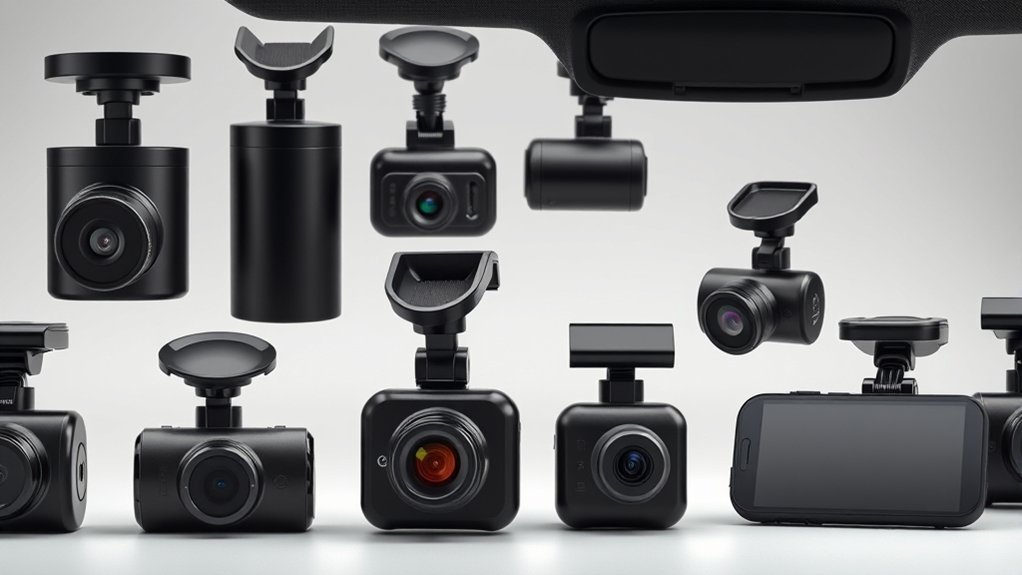
Installing a dash cam is a straightforward process that many drivers can tackle themselves, especially with the user-friendly designs available today. Here’s what to expect during the installation and setup of your car dash cam:
Installing a dash cam is simple, allowing drivers to easily enhance their road safety with user-friendly designs.
- Mounting: Securely attach the camera to your windshield using adhesive or suction cups for stability.
- Powering Up: Simply plug the dash cam into your car’s power outlet, and it’s ready to go.
- Positioning: Adjust the camera for ideal angles—170° for the front view and 150° for the cabin—to minimize blind spots.
- Setup Features: Access the menu to set loop recording intervals and adjust G-sensor sensitivity, tailoring the device to your needs.
With these easy steps, you’ll have your car dash cam up and running in no time, providing peace of mind on the road. Enjoy the freedom of driving while knowing you’re protected!
Frequently Asked Questions
How Do You Know if a Car Has a Dash Cam?
You can spot a dash cam by looking for a small rectangular device mounted on the windshield or rearview mirror. If you notice visible lenses or LED indicators, it’s likely equipped with dash cam features.
What Is the Downside of a Dashcam?
Like a double-edged sword, a dash cam offers benefits but also brings privacy concerns. You might face legal issues for recording others without consent, plus the potential hassle of maintenance and storage limitations.
Is There a Dashcam Without Wires?
Yes, there are wire-free dash cams available. Wireless options often include models powered by rechargeable batteries or solar energy, letting you enjoy hassle-free recording without tangled cables. Embrace the freedom of effortless, hassle-free surveillance.
Do Dashcams Record All the Time?
Dash cams don’t record all the time; instead, they use various recording modes. When you’re driving, they capture everything, but when parked, they only activate with movement or a collision, ensuring efficient storage management.
Conclusion
In summary, when choosing a dash cam, consider compact convenience or full-size features that fit your driving demands. From mounting methods to smart specs, selecting the right device guarantees you’re safeguarded on the road. Multi-channel models can capture every vital corner, providing peace of mind. So, gear up and get going—your dash cam is a dependable defense against unexpected incidents, delivering documentation that drives safety and security. Stay smart, stay safe, and enjoy your journeys!





Leave a Reply