
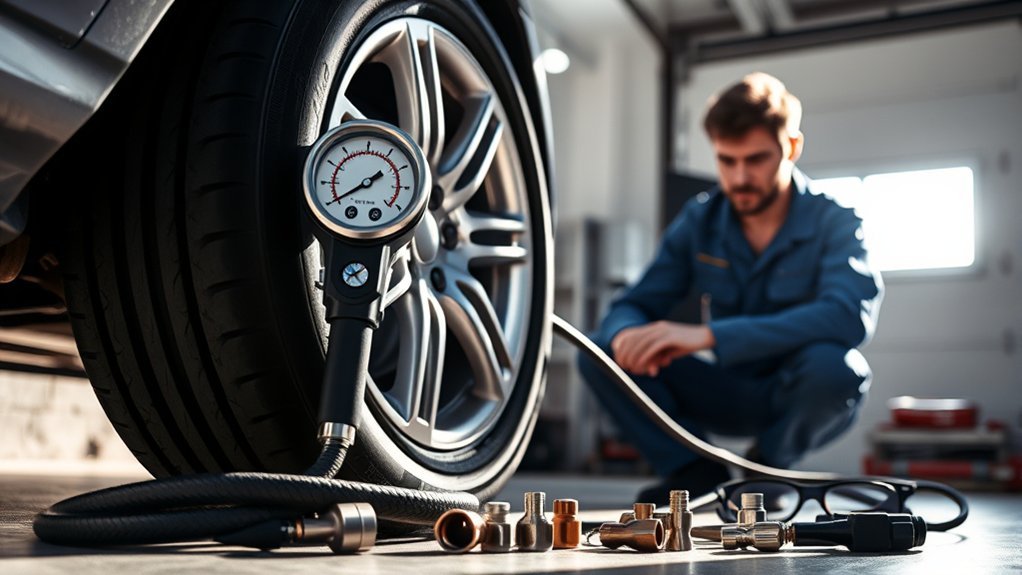
Your inflator’s speed depends mainly on compressor capacity (CFM), power source, tire volume and target PSI, plus hose and nozzle losses. Higher CFM and an AC power supply fill faster; DC or battery units are slower. Bigger tires or higher psi need more air and time. Long, narrow hoses and leaky fittings cut flow and slow you down. Match CFM, duty cycle, and accurate gauge to your tires for best results — keep going to see practical selection tips.
Typical Inflation Time: Quick Rules of Thumb for Car, Bike, and Truck
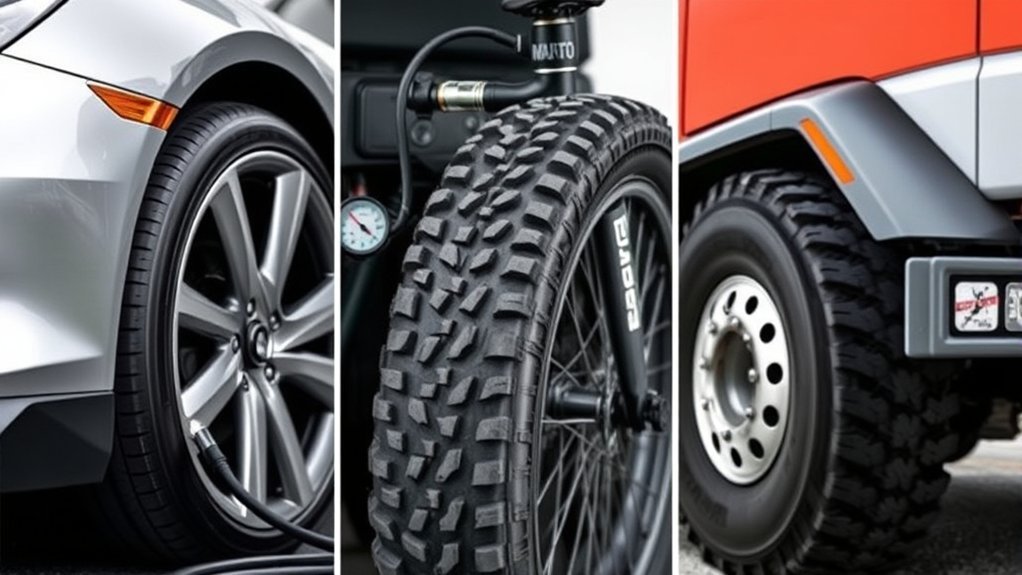
One quick rule of thumb: expect small, low‑volume tires (bikes, motorcycles) to fill fastest, car tires about 3–5 minutes with a high‑wattage AC inflator, and large truck tires 15–20 minutes because of their much greater volume and pressure requirements. You’ll gauge inflation time by volume and required psi: bike tires need little air pressure and low volume, so they reach target psi quickly; car tires at ~35 psi take 3–5 minutes with efficient inflators. Truck tires demand higher psi and much larger volume, so plan 15–20 minutes. The inflator’s cubic feet per minute rating controls throughput; higher CFM cuts time. Your choice of power source affects real-world speed—some options deliver less output and extend inflation time. When you choose equipment, match inflators to tire size and target air pressure, measure psi accurately, and factor CFM into your workflow so you won’t be stalled by slow fills when you need mobility and independence.
Power Source: Why AC, DC, and Battery Affect Inflation Speed
Count on the inflator’s power source to be the biggest single factor in how fast you get back on the road: AC units deliver the highest wattage and CFM, often filling a car tire to ~35 psi in under 5 minutes, while DC (cigarette‑lighter) units and portable battery models produce less output and typically take 8–15 minutes. You’ll choose based on tradeoffs: AC-powered inflators give the fastest inflation speed and best efficiency thanks to higher wattage and sustained air movement, ideal for home use or larger tires. DC-powered inflators plug into your vehicle for roadside convenience but run at lower wattage, so expect slower fills. Battery-operated inflators free you from cords and grant true portability, though they’re the slowest and may struggle with multiple tires. For liberation, prioritize what frees you: raw speed and efficiency (AC), on-the-go utility (DC), or untethered mobility (battery). Match power source to mission for predictable results.
[Products Worth Considering]

AC/DC OUTLET & MULTI-PURPOSE:CARSUN portable air compressor’s multifunctional AC/DC dual power supply design can draw power from both vehicle and wall outlets. Its DC plug is designed for a 12V cigarette lighter socket while its AC plug is designed for a 110V/120V wall outlet. Come with 3 additional adaptors which makes it perfect for cars, motorcycles, bikes tires, air mattress, inflatable boats, balls and other inflatables.(NOTICE: NOT SUPPORT FOR ANY TRUCK OR TRACTOR TIRES)
Compressor Capacity (CFM) and How It Controls Inflation Time
Compressor capacity, measured in cubic feet per minute (CFM), directly controls how quickly air moves into your tire, so higher CFM equals faster inflation. You’ll rely on compressor capacity to determine inflation speed: more CFM moves greater air volume per minute, cutting inflation time and getting you back on the road faster. Choose liberation from slow tools by matching CFM to your needs.
Compressor CFM dictates inflation speed — higher CFM moves more air, cutting fill time and getting you back on the road faster.
- 1 CFM units are compact but slow; expect long inflation times on larger tires.
- 3 CFM and above deliver quick inflation for most car tires, often 3–5 minutes to reach target tire pressure.
- High-capacity inflator models dramatically reduce inflation time for larger tires and emergency use.
- Frequent inflation or servicing larger tires requires higher CFM to avoid wasted time and effort.
You should prioritize a higher CFM tire inflator when you need reliable, rapid inflation speed and sufficient air volume for heavier-duty demands.
Tire Size, Target PSI, and Their Effect on Inflation Speed
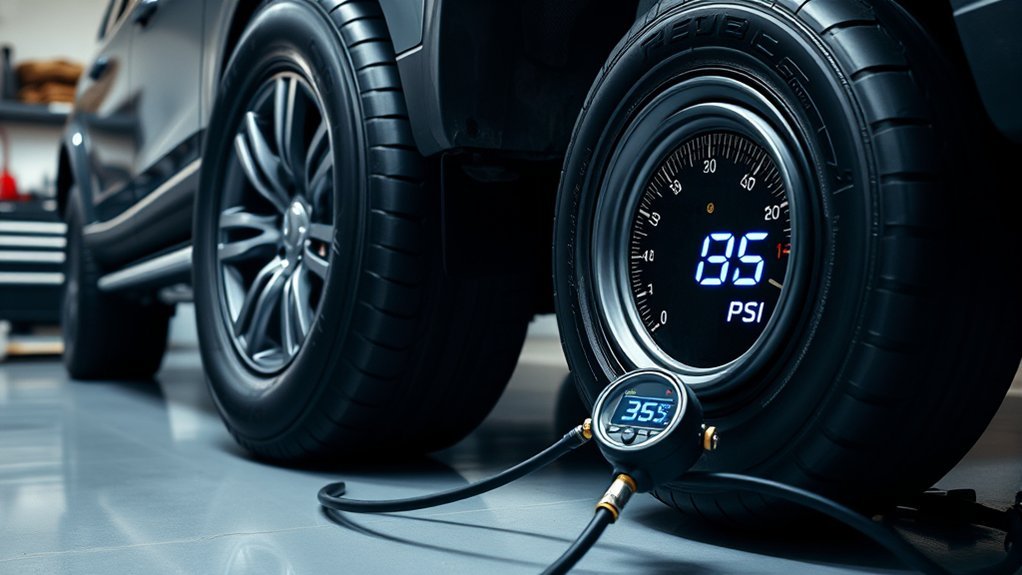
Because tire volume and pressure work together, larger tires and higher target PSI take noticeably longer to fill than small, low‑pressure tires, so you should match your inflator to the job. You’ll see that tire size directly multiplies the volume of air needed during the inflation process: a car tire may reach the desired pressure in minutes, while a truck tire demands much more time. Target psi compounds that — higher target psi means more air mass must be delivered, so inflation speed drops if air flow is limited.
Choose an inflator with sufficient cubic feet per minute to keep inflation times practical for your tires. Pay attention to nozzle design so seals stay tight and leaks don’t waste capacity. For larger tires, minimize resistance with a wider hose to preserve effective air flow; for smaller, low‑psi tires you can trade CFM for portability. Match equipment to tire size and desired pressure to gain freedom from slow, inefficient inflation.
Hose & Nozzle Losses: Reduce Resistance and Prevent Leaks
Hose and nozzle choice directly affects how quickly you’ll get a tire up to pressure: longer, narrower hoses raise resistance and cut airflow, while short, wide hoses preserve CFM and speed inflation. You’ll free yourself from slow fills by prioritizing hose length and internal diameter to reduce air resistance and maximize airflow efficiency. Match a tire inflator with a compact and lightweight hose that keeps losses low.
- Use short, wide hose runs to lower pressure drop and preserve inflation speed.
- Choose nozzle design with a smooth design and tapered nozzle profile to reduce turbulence and improve air entry.
- Inspect connections for air leaks; even minor leakage forces the inflator to work harder and slows fills.
- Favor compact and lightweight assemblies that minimize hose length and permit rapid deployment.
Think technically: minimize resistance, seal precisely, and favor smooth, tapered nozzle geometries to regain time and autonomy during inflation.
How to Choose an Inflator: Match Inflation Speed, Duty Cycle, and Gauge Accuracy
Now that you’ve minimized hose and nozzle losses, pick an inflator that matches the speed you need, the duty cycle you can manage, and a gauge you can trust. Evaluate inflation speed (3–8 PSI/min for quality units) against your tire size and desired PSI so you don’t waste time or battery. Compare duty cycle specs — most units run ~15 minutes before cooldown — and plan sequences or swaps if you’re servicing multiple tires.
Choose a pressure gauge that offers accurate monitoring; built-in gauges beat clip-ons for convenience and reduce error when hitting desired PSI. Match power source to your workflow: corded air compressor units give steady power, while a portable inflator grants freedom but limited runtime. Inspect nozzle design for leak-free coupling to preserve flow efficiency. Prioritize robust construction and clear readouts so you can inflate quickly, protect tires, and stay autonomous.
[Products Worth Considering]

Effective Tire Inflation: Tire inflator offers rapid inflation up to 150 PSI, with a built-in gauge for precise readings. It's an essential accessory for car, bike, motorcycle, ball, and inflatables
Frequently Asked Questions
Why Is My Tire Psi Going Down so Fast?
Your tire PSI’s dropping fast because tire pressure fluctuations from temperature effects, humidity factors, valve stem issues, tire wear impact, air leakage causes or puncture repairs failures; check pressure monitoring, perform maintenance tips and fix leaks promptly for freedom.
Which Is Better, 150 Psi or 300 Psi?
Boldly better? It depends: you’ll choose 300 PSI for high-performance, heavy-duty usage scenarios needing higher maximum pressure and durability factors; pick 150 PSI for standard tire pressure, lighter air compressor needs, safer PSI comparison and inflation speed.
What Is the 5 Psi Rule?
The 5 PSI rule means you’ll lose roughly 1% fuel efficiency per 1 PSI drop; you’ll monitor tire pressure, psi measurement, inflation rate and pressure loss, optimize inflator efficiency, air compressor, valve type, temperature effects, tire maintenance, and safety concerns.
What Makes a Good Tire Inflator?
A good tire inflator gives reliable pressure control, fast inflation speed, low noise levels, and solid durability factors. You’ll weigh tire inflator features, portability options, power sources, brand reliability, user reviews, price range, and maintenance tips.
Conclusion
You’ll pick the right inflator if you match compressor CFM, power source, duty cycle, and gauge accuracy to tire size and PSI. Remember my neighbor who timed filling his truck tire—an electric 1.5 CFM unit took 12 minutes versus 3 minutes with a 6 CFM shop compressor—like walking versus sprinting to a deadline. Choose the faster, reliable tool when time matters; save small, portable units for occasional, light jobs.







Leave a Reply