
What Tire Pressure Is: And Why the Units Matter
Tire pressure is the gauge of air force inside a tire above atmospheric pressure, and it directly affects handling, wear, fuel economy, and safety. Understand that pressure is the internal load that shapes contact patch, lateral response, and heat generation. Tire pressure is measured in PSI, Bar, or kPa; each unit quantifies the same physical quantity but with different scalars (1 Bar ≈ 14.5 PSI ≈ 100 kPa). Proper tire inflation prevents uneven tread wear, improves fuel economy, and lowers blowout risk. You’ll use recommended tire values to set inflation targets; those values reflect engineering tradeoffs between comfort, grip, and efficiency. When maintaining the correct tire pressure you’ll check cold pressures, convert units when needed, and adjust for loading or towing. Adopt a routine: measure with a calibrated gauge, correct to the specified PSI/Bar/kPa, and recheck periodically. That disciplined approach removes uncertainty and keeps vehicle performance predictable, safe, and efficient.
Find Your Vehicle’s Recommended Tire Pressure (Door Sticker, Manual, TPMS)
Where should you look first when setting tire pressure? Check the sticker inside the driver’s door frame; it lists the vehicle’s recommended pressure and preferred units for peak performance. If absent or unclear, consult the vehicle’s manuals for more detailed specs and load-specific guidance. Modern cars include TPMS that warns when actual tire pressure falls significantly below the recommended pressure, but don’t rely solely on alerts—TPMS detects critical drops, not ideal settings.
- Door sticker — primary source: confirms front/rear pressures, suggested units (PSI, BAR, kPa), and load notes.
- Owner’s manuals — authoritative reference: gives context for temperature, load, and maintenance intervals to maintain peak performance.
- TPMS — monitoring aid: alerts you to underinflation; pair with manual checks for precision.
You’ll optimize handling, fuel economy, and tire life by routinely checking pressures with a gauge, matching the vehicle’s specified units, and acting on discrepancies promptly.
[Products Worth Considering]

Enhanced Visibility in Low Light: Features a green backlit LCD screen and integrated flashlight, allowing for clear reading of tire pressure even in dark or dimly light conditions.

PROCESS LEVEL ACCURACY: Each ETENWOLF’s digital tire pressure gauge is calibrated manually to ANSI B40.7 Grade 2A(plus-minus 1 PSI).Presta valve adapter not included, if used for bicycles, it must be purchased separately

EXPERT-GRADE CALIBRATION: Each AstroAI Tire Pressure Gauge is calibrated with professional-grade tools, ensuring quick and accurate measurement results within plus-minus 1PSI. Stay prepared for any roadside emergency and travel with peace of mind.
Quick Reference: Common Tire Pressures in PSI, Bar and kPa
Although recommended pressures vary by vehicle type and load, most passenger cars fall between 32–35 PSI (≈2.2–2.4 bar or 220–240 kPa), with some European models listed at 2.2–2.5 bar (≈32–36 PSI) and certain sports cars specified near 36 PSI (≈2.5 bar or 250 kPa). Use this quick reference to align your tire pressure with manufacturer guidance: 32–35 pounds per square inch for typical sedans (≈2.2–2.4 Bar, 220–240 kPa); 29 PSI (≈2.0 Bar, 200 kPa) where lower inflation is specified; 36 PSI (≈2.5 Bar, 250 kPa) for many performance models. Treat these as target recommended values, not mandates; always prioritize the door sticker or manual. To ensure your driving confidence, get into the habit of regularly checking pressures and learning how your gauge reads pounds per square inch, Bar and kPa. Remember that tire sensors measure absolute pressure relative to atmospheric pressure; proper inflation maintains handling, safety and efficiency.
Fast Conversion Rules: PSI ⇄ Bar ⇄ kPa
Because pressures are reported in different units, you’ll want quick, reliable rules to switch between PSI, Bar and kPa so your gauge readings match manufacturer specs. Use these concise conversion rules to eliminate confusion and guarantee accurate pressure measurement across commonly used units.
Because pressures use different units, keep quick conversion rules for PSI, bar, and kPa to match specs.
- BAR → PSI: multiply BAR by 14.504 to convert to PSI; PSI → BAR: divide PSI by 14.504 to convert to BAR.
- PSI → kPa: multiply PSI by 6.895 to convert to kPa; kPa → PSI: divide kPa by 6.895 to convert to PSI.
- Practical check: 2.2 BAR ≈ 32 PSI, and 220 kPa ≈ 32 PSI — use these benchmarks to verify conversions quickly.
Treat each unit as interchangeable when you know the factor. Remember BAR is from the metric system and kPa is a metric pressure measurement; PSI is commonly used in other contexts. Carry the factors or memorize the benchmarks to convert instantly and keep your tires at the right specification.
PSI – Tire Pressure: What It Is and Where You’ll See It
PSI (pounds per square inch) measures the air pressure inside your tire and directly affects safety, handling, fuel economy, and tread wear. PSI is the standard unit you’ll encounter in the United States for specifying tire pressure; typical passenger car tires call for roughly 32–35 PSI. You’ll find the recommended PSI in the owner’s manual, on the tire sidewall, or on the driver-door sticker—use those values when measuring tyre pressure. One PSI equals about 0.06895 Bar and 6.895 kPa, so know the conversions if you cross borders or use metric gauges. Proper inflation requires routine checks with a calibrated gauge when tires are cold; adjust to the recommended PSI rather than the maximum molded on the sidewall. Maintaining correct tire pressure protects vehicle safety, optimizes handling, and reduces fuel consumption and uneven wear. Measure, adjust, and record pressures regularly to preserve mobility and the peace of mind that reliable performance delivers.
Bar – Tire Pressure: What It Is and When to Use It
If you’re used to PSI in the U.S., you’ll also encounter Bar when driving in Europe: one Bar equals about 14.5 PSI (100 kPa), and passenger car recommendations commonly sit between 2.2 and 2.5 Bar. Bar is a metric unit used for tire pressure; it’s simple to read on many pressure gauge displays and to convert when you need clarity. Know that 2 Bar ≈ 29 PSI, so conversion is straightforward.
- Use Bar when the vehicle or manual lists tire pressure in metric unit terms; your pressure gauge may toggle between bar, PSI, and kPa.
- Aim for properly inflated tires by following manufacturer Bar specs; this preserves handling, efficiency, and safety.
- Remember Bar is less granular than kPa, but it’s common and practical across Europe — convert to PSI when you cross regions to stay accurately informed.
kPa – Tire Pressure: What It Is and Why It’s Precise
kPa (kilopascal) is the metric pressure unit used to express tire inflation where 1 kPa equals 1,000 pascals, and it gives you a finer-grained reading than Bar or PSI for more accurate adjustments. You’ll find kPa used across the metric system to report tire pressure because it quantifies the force exerted per unit area with greater resolution, so you can dial in proper tire inflation within tight tolerances. Typical passenger values sit around 200–250 kPa (about 32 PSI or 2.2 Bar at 220 kPa), which illustrates conversion relationships among pressure units. Using kPa reduces rounding error when engineers, technicians, and knowledgeable drivers seek peak performance and predictable handling. Because kPa directly reflects the air pressure and the force exerted on tire walls, it supports consistent load capacity, fuel economy, and safety margins. You’ll prefer kPa when precision matters and when following vehicle placards, technical specifications, or regional standards that use metric reporting.
How to Check and Set Tire Pressure (Tools, Timing, Step‑by‑Step)
Start by gathering a reliable tire pressure gauge that reads in the unit your vehicle specifies (PSI, Bar, or kPa) and plan to check pressures when the tires are cold—before driving or after the vehicle has sat for at least three hours. Locate the recommended tire pressure on the door sill, fuel cap, or in the manual. Use an air compressor that displays the same unit (PSI, BAR, or kPa) or convert values before inflating.
Gather a reliable gauge, check cold tires, find recommended pressure on the door sill or manual, and match units before inflating
- Remove valve cap, press the tire pressure gauge firmly to the valve stem, and read the value. Record each wheel as you check tire pressure.
- If below the recommended tire pressure, attach the air compressor, select the proper unit, and inflate to the recommended pressure. Add short bursts, then re-check with the gauge.
- If at or above the recommended tire pressure, stop inflating, replace valve caps, and repeat checks periodically to maintain vehicle safety and control.
Stay exact, confident, and safe in maintaining your vehicle.
[Products Worth Considering]
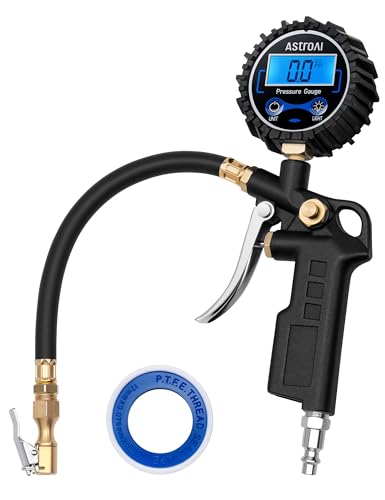
COMPATIBLE WITH both ¼” and ½” NPT air compressors outputs. COMPATIBLE WITH Standard Schrader Valves.
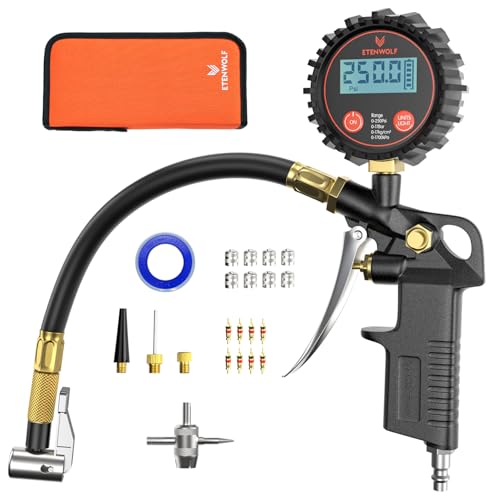
PROCESS LEVEL ACCURACY: This heavy duty tire pressure gauge with inflator is manually calibrated to ANSI B40.7 Grade 2A(plus-minus 0.5% PSI)
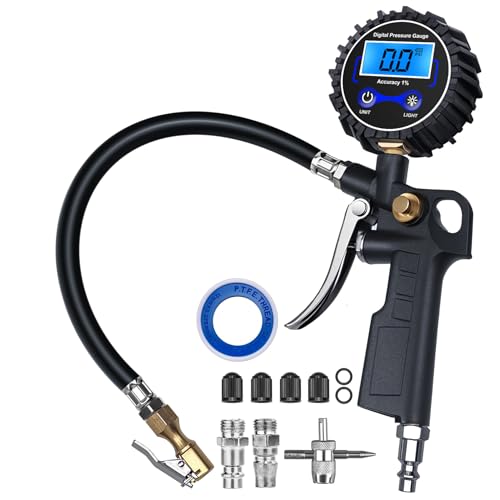
【Accuracy】The digital tire pressure gauge has 4 different measurement units: PSI, KPA, BAR, KG/CM². It reads within 1% of the exact tire pressure, with a resolution of 0.1 PSI and the measuring range is 3-250 PSI (0.2-17.2 Bar; 20-1724 Kpa; 0.2-17.5 kg/cm^2)
Troubleshooting and Safety Tips: Overinflation, Underinflation and Seasonal Changes
Watch for overinflation because it reduces tire contact patch and raises blowout risk, degrading handling and braking. Underinflation increases rolling resistance and wear, especially in high temperatures, so check pressures before long trips. Since pressure falls roughly 1 PSI per 10°F drop, you’ll need to adjust inflation seasonally to maintain traction and stability.
[Products Worth Considering]

PROCESS LEVEL ACCURACY: Each ETENWOLF’s digital tire pressure gauge is calibrated manually to ANSI B40.7 Grade 2A(plus-minus 1 PSI).Presta valve adapter not included, if used for bicycles, it must be purchased separately
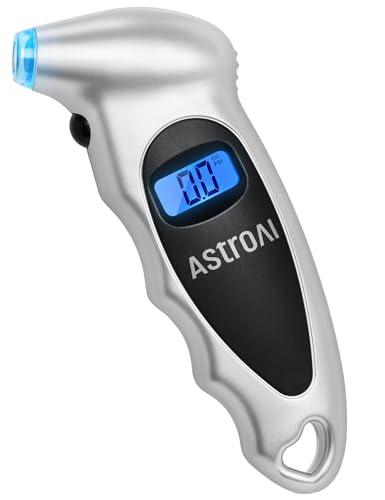
EXPERT-GRADE CALIBRATION: Each AstroAI Tire Pressure Gauge is calibrated with professional-grade tools, ensuring quick and accurate measurement results within plus-minus 1PSI. Stay prepared for any roadside emergency and travel with peace of mind.

Digital Tire Pressure Gauge 2 Pack, Industrial Tire Gauge 3-200 PSI, Calibrated to ANSI B40.7 Grade 2A(plus-minus 0.5%), Air Pressure Gauge with Replaceable AAA Batteries
Overinflation Risks
Because overinflation raises tire pressure above the manufacturer’s PSI, your tire’s contact patch narrows and handling becomes less predictable, especially during cornering or emergency maneuvers. You need to treat overinflation as a measurable compromise: excessive PSI or kPa reduces traction, concentrates wear at the tread center, and shortens tire life. It also increases blowout risk under heat or heavy load, undermining safety and your ability to travel.
- Monitor: check tire pressure with a calibrated gauge; compare PSI/kPa to the placard, adjust cold.
- Inspect: watch for central tread wear and bulges; replace compromised tires immediately to preserve handling.
- Balance priorities: avoid overinflation to maintain fuel efficiency while protecting safety and long-term mobility.
Seasonal Pressure Adjustments
When temperatures fall, your tire pressure drops roughly 0.1 Bar (approx. 1.5 PSI) for every 10°C decrease, so you should check and adjust pressures more often during seasonal changes to keep them within the manufacturer’s specified range. You’ll monitor tire pressure in PSI or kPa and make precise adjustments to counter seasonal temperature changes: check monthly and before long trips. In cold months, increase pressure about 1–2 PSI to avoid underinflated tires that raise rolling resistance, reduce fuel efficiency, and impair handling. Avoid overcorrection—overinflation causes uneven wear and harsher ride. Stay aligned with manufacturer recommendations for ideal performance and safety. Regular, measured checks save you from preventable failures and reduce blowout risk.
Frequently Asked Questions
How Many kPa Is 35 Lb of Pressure?
35 psi equals about 241.32 kPa. You’ll use this pressure conversion for tire pressure checks; pressure measurement shows PSI significance, kPa usage, bar advantages inform inflation guidelines, promoting tire safety and ensuring confident maintenance.
Why Use kPa Instead of PSI?
Because you want consistency and control, kPa advantages include finer pressure accuracy and metric preference aligning with global standards; you’ll improve tire maintenance and pressure monitoring using conversion methods and measurement tools that save you from unit confusion.
Is 1 BAR 14.5 or 14.7 PSI?
1 bar is 14.50377 psi, so you’ll usually use 14.5 psi. For bar vs psi and pressure conversion, follow tire maintenance and inflation tips, use accurate pressure gauges, heed measurement standards and safety concerns.
What Is 35 to 45 PSI in BAR?
35–45 PSI converts to about 2.41–3.10 bar. You’ll use conversion methods for accuracy, monitor pressure for safety, apply inflation tips, perform tire maintenance, use pressure monitoring, and optimize vehicle performance.
Conclusion
You are responsible for the safety of your vehicle — treat tire pressure like mission-critical data. Check the door sticker or manual, use a calibrated gauge, and set PSI/Bar/kPa to the recommended value; don’t guess. Overinflate and you’ll lose grip, underinflate and you’ll damage the sidewalls. Repeat seasonally, record readings, and ignore anyone who says “close enough.” Your tires will thank you with longer life and safer stops.







Leave a Reply