
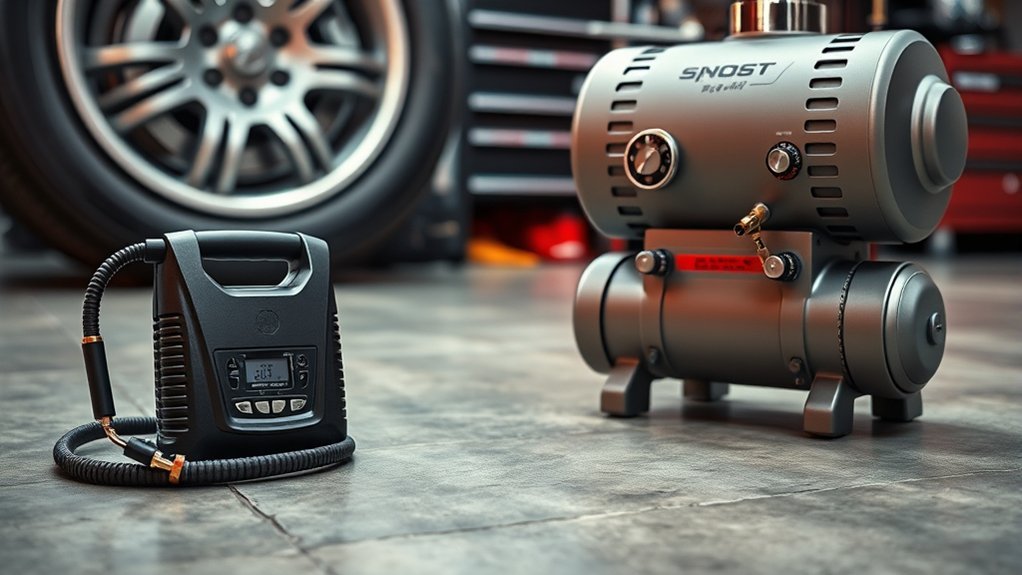
A tire inflator is best when you need fast, portable pressure fixes. It’s compact, pulls air directly, auto-shuts off, and works great for roadside or camping use. Go with an air compressor when you need sustained pressure, higher CFM, and the power to run tools or handle continuous inflation. Compressors have larger motors, tanks, and greater durability for shop or contractor work. Compare max PSI, CFM, power source, and portability to match your tasks. Below you’ll find detailed guidance.
Quick Answer
- Pick a tire inflator if you want a lightweight, portable device for topping up car tires, bike tires, or sports balls on the go. Most max out at 150 PSI and include auto shut-off.
- Pick an air compressor if you need sustained airflow (higher CFM) to run pneumatic tools like impact wrenches, spray guns, or nail guns, or if you regularly inflate large tires.
- Key specs to compare: maximum PSI, CFM (airflow rate), power source (battery/12V vs. AC outlet), weight, and tank size.
- Budget note: Portable tire inflators typically cost $70 to $130, while capable air compressors start around $150 and up.
Inflator or Compressor: Which Should You Buy?
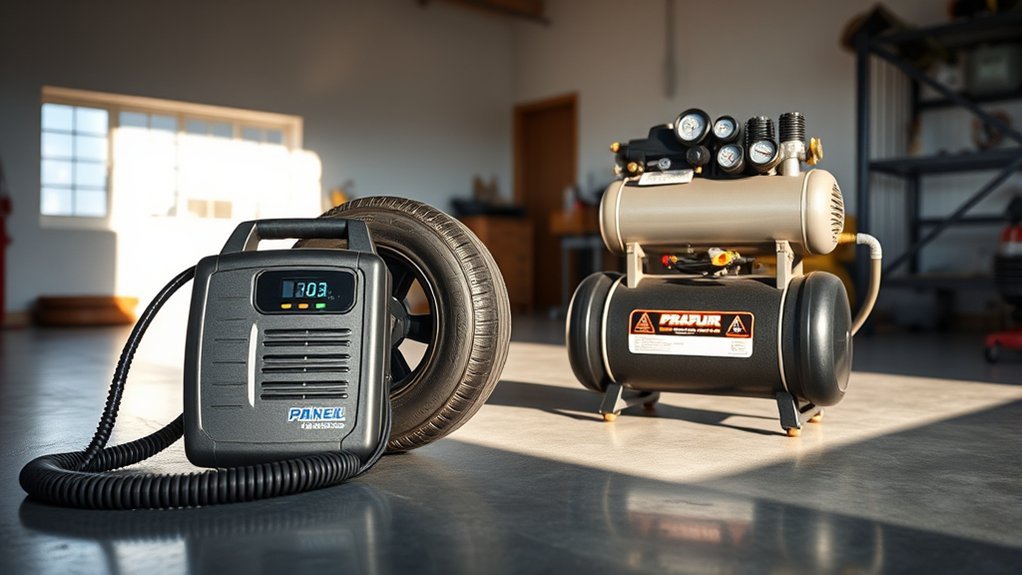
Wondering whether to buy a tire inflator or an air compressor? Match capability to convenience. Tire inflators are lightweight, focused tools that let you inflate tires quickly while staying mobile. A portable tire inflator like the Fanttik X8 Apex offers automatic shut-off, straightforward controls, and everyday emergency readiness, making it a solid pick for drivers who want something simple and reliable. Air compressors, such as CRAFTSMAN models, deliver broader power and versatility. You can run pneumatic tools or tackle bigger DIY tasks, though they cost more and take up more space. Both device types can reach pressures up to 150 PSI, but air compressors trade portability for performance. If you need portable, fast inflation and easy maintenance, pick a tire inflator. If you need multiuse capacity and heavier-duty output, get an air compressor.
How Tire Inflators Work, and When They’re the Smarter Choice
Portable inflators like the Fanttik X8 Apex pull air directly from the environment and push it straight into the tire. There’s no storage tank involved, which means fast, on-the-spot inflation. You get immediate pressure correction for vehicle tires, and the unit’s compact design frees you from hauling bulky compressors when speed and mobility matter. Automatic shut-off stops inflation at your set PSI, so you won’t overinflate.
- Connect the portable inflator to a 12V outlet (or use its battery), set the target pressure, and start. Air moves directly into the tire with minimal lag.
- The lightweight form factor makes it ideal for roadside repairs, cycling, and modest vehicle tires where tank capacity isn’t needed.
- Precision controls and auto-stop give you repeatable, safe results without constant monitoring.
- Choose a tire inflator when you want a quick turnaround and don’t need to power air tools.
How Air Compressors Work, and When They Win
An air compressor‘s motor and pump pull in ambient air, compress it to high PSI, and store that pressurized air in a storage tank for on-demand use. The tank smooths output and delivers sustained airflow, while pressure regulation systems control cut-in/cut-out thresholds and downstream pressure for consistent tool performance. That combination of mechanics, storage, and regulation is why compressors outperform inflators for heavy-duty, continuous, or multi-tool tasks.
Motor and Pump Mechanics
When you need sustained, high-pressure airflow, an air compressor’s motor-driven pump is what delivers it. An electric motor turns the pump’s crank, compressing air into a storage tank so you get continuous output on demand. Direct-drive motors are common in compact portable units, while belt-drive systems are used in larger, more serviceable setups.
- Motor size matches duty cycle: larger motors sustain higher PSI and run longer without overheating.
- Pump type dictates responsiveness: single-stage pumps suit light tasks, while two-stage pumps push PSI above 150 for heavy-duty tools.
- Portability trades off with power: tire inflators use small, direct-drive pumps for quick inflation, not sustained airflow.
- Maintenance matters: belt-drive systems let you service the pump and extend its life.
Tank Storage Dynamics
An air compressor’s tank stores pressurized air so you can draw steady, high-flow output without the motor running nonstop. Fill the reservoir, then use compressed air to power pneumatic tools, run multiple devices, or inflate large vehicle tires. Larger tanks extend run time before a refill, making air compressors a better fit than small tire inflators for demanding work. Tanks add bulk, but they deliver reliable, consistent flow and pressure for tasks like spray painting or heavy-duty shop work. Choose capacity to match your duty cycle and tool demand.
| Capacity (L) | Use case |
|---|---|
| Small | Portable tire inflators |
| Large | Workshop pneumatic tools |
Pressure Regulation Systems
Pressure regulation governs both safety and performance, so it’s worth understanding how compressors manage output. Air compressors use pressure switches that adjust airflow and cycle the motor on and off to hold a preset PSI. That stored air in a tank gives sustained delivery and the ability to handle higher PSI than most tire inflators. For a deeper look at how CFM and PSI interact, Atlas Copco’s guide to CFM vs. PSI is a helpful resource.
- Pressure switches automate on/off cycles to prevent over-inflation and save energy.
- Tanks smooth pulsation, enabling continuous tool operation.
- Higher PSI capacity supports heavy-duty pneumatic tools and large tires.
- Tire inflators trade capacity for portability; compressors trade portability for power.
Specs That Matter: PSI, CFM, Power, and Portability
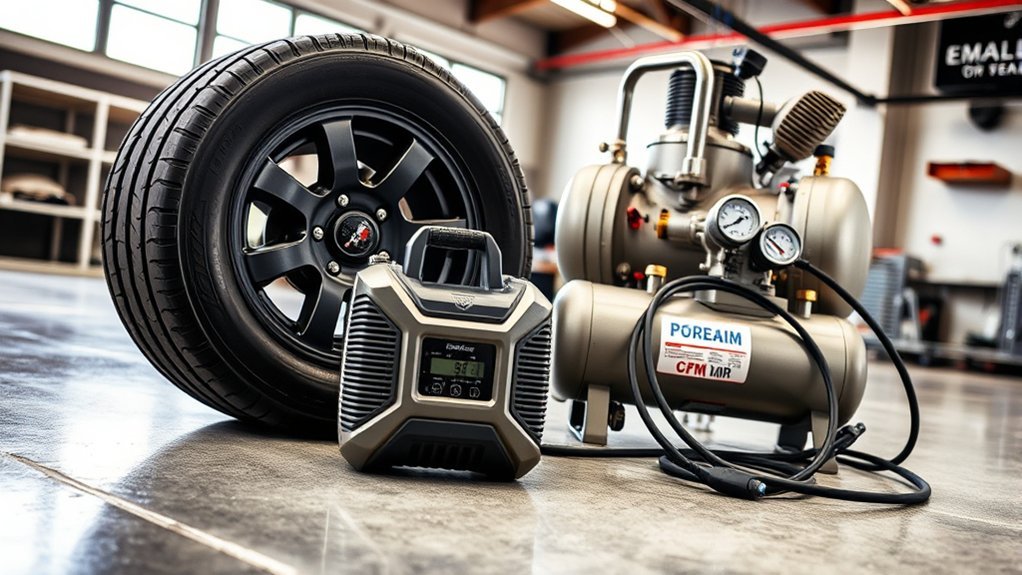
Match the tool to the job by comparing PSI, CFM, power source, and portability. For passenger tires, a 150 PSI inflator is usually enough. Heavier tasks need compressors with higher PSI and measurable CFM to run pneumatic tools. Also check whether you need 12V portability or a higher-power AC unit, and be realistic about weight and storage.
[Products Worth Considering]

【50s Fast Inflation】: Equipped with Industrial-Leading chip, sensor and Zinc-Alloy motor, Inzeetor Tire Inflator takes only 50 seconds to inflate a tire (195/65R15) from 30 to 36 PSI.

Powerful Inflation Performance – With a built-in true 6000mAh rechargeable battery, this tire inflator can support up to 4 car tires (195/55 R15) and charge them from 30PSI to 36PSI in 45 seconds

Fast Inflation & Easy Operation: The air pump’s high-quality cylinder delivers 25L/Min inflation, filling a tire from 29 PSI to 36 PSI in just one minute. Easy operation, quick inflation. Please note that you should allow the air compressor to cool off for a while after 15 minutes of continuous operation. (NOTE: This tire inflator can only be used if connected to a 12 V DC, 15 A cigarette lighter). NO AC!
PSI vs. Pressure Needs
When comparing PSI ratings, focus on the job rather than the label. Most inflators and compressors top out near 150 PSI, but their usefulness depends on required pressure stability, fill speed (CFM), and power source. Match PSI to tire specs and task demands. Car and bike tires rarely need more than what portable tire inflators deliver. Heavy truck tires and tools often require sustained pressure that air compressors handle better. According to the NHTSA’s tire safety guidelines, most passenger vehicles call for 30 to 35 PSI when cold.
- Match maximum PSI to the tire or tool rating. Don’t buy excess capacity.
- Use cubic feet per minute as a secondary spec. Higher CFM equals faster fills.
- Prefer tire inflators for portability and roadside convenience.
- Choose air compressors for sustained, heavy-duty pressure.
CFM, Power, and Portability
Once you’ve matched PSI to your tires or tools, weigh CFM, power source, and portability to pick the right device. CFM is often the limiting factor. Tire inflators deliver low CFM suitable for quick inflation, while air compressors supply higher CFM for sustained duty with power tools. Both can top out near 150 PSI, but compressors reach pressure faster thanks to their tanks. For on-the-road use, tire inflators win. They’re lightweight, often cordless or 12V-powered, and easy to stash in a vehicle. Air compressors demand AC power and dedicated storage, so they’re better suited to a workshop. Match your tool’s CFM needs to your unit. Choose tire inflators for mobility and compressors for continuous, higher-CFM work.
Real-World Picks: Drivers, DIYers, and Pros
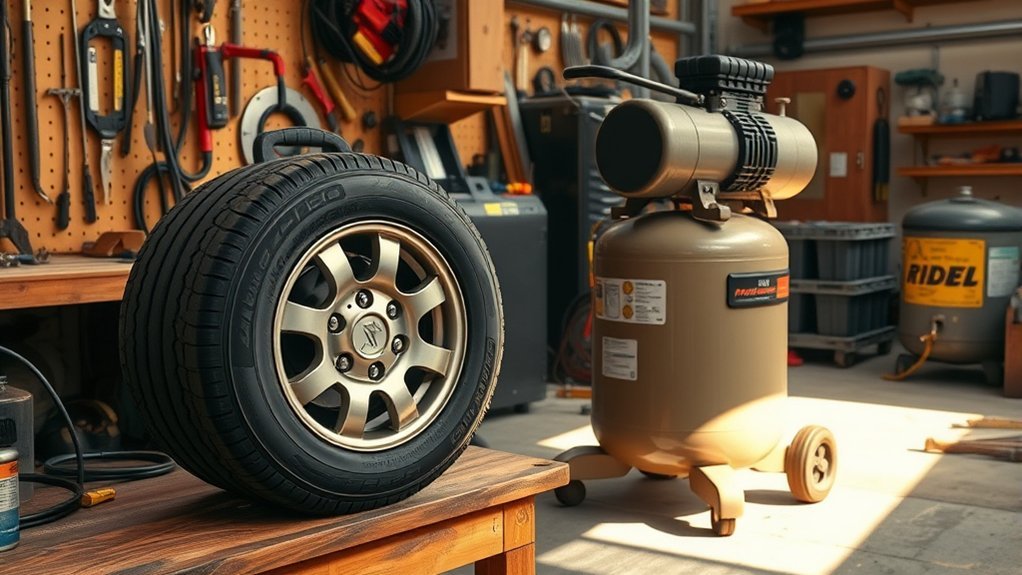
Although both tools move air, your choice should match real-world needs. Drivers and outdoor enthusiasts benefit from a lightweight, portable tire inflator with auto shut-off and a digital gauge for fast on-the-go pressure corrections. DIYers and pros lean toward air compressors for higher PSI, continuous airflow, and the versatility to run pneumatic tools, paint jobs, and larger tires.
- Vehicle owners: Tire inflators deliver portability, quick digital readings, and auto shut-off so you can handle a low tire without fuss.
- Outdoor enthusiasts: Keep a compact inflator in your pack or trunk for camping, cycling, or off-road recovery. They’re lightweight and user-friendly.
- DIYers: Air compressors supply steady CFM and pressure to run impact wrenches, staplers, and spray guns in a home shop.
- Professionals: Contractors and mechanics need robust air compressors to power multiple tools continuously and meet production schedules.
Choose the tool that matches your mission: mobility and simplicity, or power and multi-tool capability.
[Products Worth Considering]

[Fast & Efficient Inflation] The OlarHike tire inflator features a high-performance motor that delivers rapid airflow—inflate a standard car tire (195/65 R15) from 30 to 35 PSI(+5 PSI) in just 55 seconds, or a larger SUV tire (235/65 R17) from 30 to 35 PSI(+5 PSI) in only 2.2 minutes. Ideal for cars, SUVs, light Pickup(Within 51 PSI), motorcycles, bicycles, and sports balls. Important Note: The unit can only inflate car/pickup truck tires up to 51 PSI
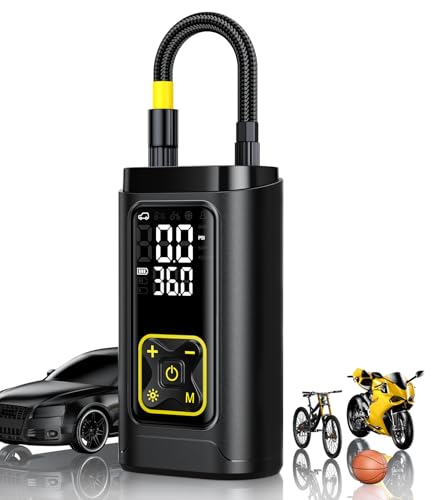
💪【150PSI Rapid Inflation – 1 Minute to Ready】This cordless tire inflator delivers 150PSI max pressure, powering a standard car tire (195/65 R15) from 28 to 36 PSI in just 60 seconds. The built-in rechargeable battery, the flexible carry handle hose and super-bright LED flashlight make nighttime roadside emergencies safer and easier. Compact enough to stash in any glove box or door pocket—your ultimate roadside guardian.

Please Note: This product must be powered by a 12V DC Cigarette Lighter to function properly, and ensure the vehicle is in a running state. And it equipped with a 9.8-foot cord, which can meet the usage needs of most regular-sized vehicles.
Safety and Maintenance Tips
No matter which device you choose, a few habits will keep it running well and keep you safe.
For tire inflators: Store them in a cool, dry place. Charge the battery regularly, even during off-season months, to preserve battery health. Inspect the hose and nozzle for cracks before each use. Always check your vehicle’s recommended tire pressure (found on the driver-side door jamb) rather than the max PSI printed on the tire sidewall.
For air compressors: Drain moisture from the tank after every use to prevent rust buildup. Check and replace the air filter on schedule. Inspect hoses, fittings, and safety valves periodically. If you have a belt-drive model, check belt tension and condition monthly.
General safety: Never exceed the rated PSI of any tire or tool. Wear eye protection when using pneumatic tools. Let the compressor cool down if it’s been running near its duty cycle limit.
Price vs. Value: Seven Features to Check Before Buying
Decide what you need to accomplish first, then weigh price against seven practical features that determine real value: maximum PSI, airflow (CFM), power source, portability, auto-shutoff/digital gauge accuracy, build quality/noise, and useful extras like a power bank or flashlight.
Tire inflators like the Fanttik X8 Apex cost less than a CRAFTSMAN air compressor but can meet the same maximum PSI ratings (up to 150 PSI) for vehicle tires. Check airflow if you’ll run tools; compressors beat inflators on CFM. Verify power source: 12V or battery-powered inflators give true portability for roadside fixes, while compressors often need wall power. Test gauge accuracy and reliable auto-shutoff to avoid overinflation. Inspect build quality and noise levels for frequent use. Finally, factor in extras: a built-in power bank and flashlight add emergency utility that can tip value in favor of inflators for drivers who need an all-in-one roadside kit.
[Products Worth Considering]

QUICK & ACCURATE: Built with the highest quality materials, Airmoto is a portable tire inflator for car, trucks, SUVs, motorcycles, and bicycles. Quickly inflate your vehicle's tires in just minutes with precision accuracy up to 120 PSI. Small and compact car air pump that fits in your glove box or trunk.

ADVANCED TRUEGAUGE SCREEN: This battery tire inflator includes updated sensor technology, capable of collecting pressure data from tire inflators at a frequency of 200 times per second. Its valid data rate is higher than 80%, which is 60% better than the market average. Wherever you go, accurate readings help you drive safely.

[Auto Shut-off & Fast Inflation] This car air pump ensures a worry-free experience with its auto shut-off feature. Simply set your desired pressure, start inflating, and the car air compressor will automatically stop once it reaches the right level – no more overinflating. With a rapid 30 LPM airflow, it can inflate a flat 195/60 R14 tire to 36 PSI under 3 minutes or a 215/60 R16 tire to 36 PSI under 5 minutes. Quick tire top-ups are easy
Frequently Asked Questions
Should I Get an Air Compressor or a Tire Inflator?
Get a tire inflator if you need portability, quick inflation, and a simple power source for emergencies. Choose an air compressor for sustained power, larger capacity, and the ability to run pneumatic tools.
What Are the Disadvantages of Tire Inflators?
Portable inflators can struggle with high-pressure or high-volume tasks. Common downsides include limited pressure output, slower inflation on larger tires, battery dependency, and higher noise levels for their size. For demanding jobs, keep a backup plan.
Can a Tire Inflator Be Used as an Air Compressor?
For light tasks, yes. A tire inflator can substitute for an air compressor when you just need to inflate tires or sports balls. However, its lower CFM and lack of a tank limit what it can do. It won’t reliably power pneumatic tools or handle continuous-duty work.
What Is the Main Difference Between a Pump and a Compressor?
A pump moves air directly from one place to another. A compressor builds up and stores pressurized air in a tank for on-demand use. Choose based on whether you need immediate airflow (pump/inflator) or stored, high-pressure air (compressor).
Conclusion
Pick the inflator if you want quick, portable tire top-ups. Choose the compressor when you need sustained power for tools or frequent heavy jobs. Check PSI, CFM, power source, and duty cycle before buying. Inflators are best for roadside fixes and efficiency. Compressors are best for workshops and versatility. Be pragmatic: buy the tool that fits your regular needs, not the fanciest model.







Leave a Reply