
Judge a tire inflator by volts, amps, and watts. These three values determine fill speed, battery drain, and whether the motor can sustain rising pressure without overheating. Corded 12V units typically draw 5–15A (60–180W). Battery inflators usually draw less and run slower. Battery capacity (mAh) and C-rating set how many fills you get, while duty cycle and motor efficiency limit continuous use. The BMS controls peak current and protects cells. Read on for concrete runtime and calculation examples.
Quick Answer
- Most tire inflators draw 5–15 amps at 12V, which equals roughly 60–180 watts.
- Watts = Volts x Amps. A 120W unit at 12V draws about 10A.
- Battery capacity (mAh) and C-rating determine how many tires you can inflate per charge.
- Duty cycle limits (typically 15–30 minutes) prevent overheating. Let the motor cool between uses.
- The BMS caps peak current to protect cells, which can slow inflation at high pressures.
How Volts, Amps, and Watts Determine Inflator Speed and Pressure
When comparing inflators, focus on volts, amps, and watts. These three values define how quickly and how forcefully a unit delivers air. Volts set the electrical potential available. Higher-voltage units allow greater wattage headroom. Amps reflect current draw under load and scale directly with inflation speed. More amps usually means faster airflow, but also higher power consumption.
Use Watts = Volts x Amps to judge true power. A 120W device at 12V draws 10A, so you can predict runtime and thermal stress before you buy. Efficient designs combine adequate volts and controlled amps with features like auto shut-off and adjustable PSI to minimize wasted energy while hitting target pressure.
Typical Amperage and Wattage: Corded, 12V, and Battery Inflators
Start with corded pumps. Most run on 12V and draw roughly 5–15A depending on motor size, putting power output between about 60W and 180W. A 120W example at 12V requires about 10A, which shows how current scales with wattage and inflation speed. Battery-powered inflators usually cap at lower currents (around 6A for models like the Woowind LP1), so they deliver lower wattage and slower fill rates unless they use higher-voltage or high-discharge batteries.
[Products Worth Considering]

Fast-Inflation & Compact: Our compact and lightning-fast upgrade to the popular R7 air compressor portable. With a powerful 40L/Min cylinder, this air pump for car can inflate a tire (215/50 R17) in under a minute (26-35PSI) and even Tesla tires (235/40 R19) in just 1.5 minutes (28-36PSI). Say goodbye to slow and cumbersome inflation processes – This 150PSI tire inflator portable air compressor offers a smoother, faster solution for all your inflation needs.

Fast Inflation & Easy Operation: The air pump’s high-quality cylinder delivers 25L/Min inflation, filling a tire from 29 PSI to 36 PSI in just one minute. Easy operation, quick inflation. Please note that you should allow the air compressor to cool off for a while after 15 minutes of continuous operation. (NOTE: This tire inflator can only be used if connected to a 12 V DC, 15 A cigarette lighter). NO AC!

Digital Screen, Real-Time Pressure Display: The bike pump with large digital screen displays the tire's real-time pressure for a more accurate and intuitive experience. Avoids pressure reading errors common with dial tire pumps.
Corded Pump Power Draw
Corded tire inflators typically draw about 5–15 amps from a 12V source, so expect roughly 60–180 watts of power demand depending on the model and duty cycle. Before using one, check the amperage stamped on the unit. The electric motor determines peak and steady power consumption. A 120W inflator at 12V draws about 10A. Efficient motor design reduces current draw while preserving inflation speed. AC-capable corded units handle higher wattages but require mains power.
12V DC Current Demand
Most 12V tire inflators draw between about 5A and 15A, so expect roughly 60–180W of power demand depending on design and duty cycle. Use Ohm’s law to translate between amps and watts. A 120W unit at 12V draws about 10A, so you can plan electrical load and fuse sizing precisely.
Corded 12V units sit in that 5–15A band. Heavy-duty AC models exceed 120W but need mains electricity. Battery-powered inflators often present lower steady amperage. Models like the Woowind LP1 run near 6A, which extends usable runtime. Match the current draw to your cigarette-plug outlet, inverter, or vehicle battery to keep your gear reliable.
Battery Pack Wattage
Battery pack wattage determines how long a portable inflator can run and how much instantaneous power it can deliver. Match battery capacity and voltage to the inflator’s current draw. Corded 12V units draw 5–15A (about 60–180W). A battery-powered inflator with a 7.4V/4000mAh pack draws roughly 6A (about 44.4W), and higher-wattage designs (around 70W) achieve faster airflow. Motor efficiency matters too. Efficient designs lower amperage while maintaining inflation rate.
- Match: battery voltage x capacity must exceed the device’s current draw.
- Select: cyclists favor 5–7A portable packs; drivers generally want 10–15A for faster fills.
- Verify: check label wattage and expected power consumption before buying.
Why Duty Cycle, Motor Efficiency, and Pressure Change Power Draw
Prolonged operation raises internal temperature and mechanical load, so an inflator’s duty cycle directly affects how much power it draws and how long you can safely run it. Duty cycle limits (commonly 15–30 minutes) exist because heat accumulation forces the system to throttle or stop to prevent damage.
Motor efficiency determines how much electrical energy becomes mechanical work. Brushless DC units run at over 85% efficiency, meaning they draw less current than 60–70% efficient brushed motors for the same task. This reduces battery stress and extends usable inflation time.
As pressure rises during inflation, back-pressure increases torque demand, so power draw climbs, especially near high targets like 150 PSI. Designs built for fast inflation trade higher peak amps for shorter run times. A BMS may cap draw during high-pressure phases to protect cells and manage heat. Evaluate duty cycle, motor efficiency, expected pressure levels, and desired inflation time together when choosing an inflator.
Battery Capacity, C-Rating, and How Many Inflations You Can Expect
Capacity (mAh) sets the total energy available. The C-rating and discharge current determine whether that energy can be delivered fast enough for effective inflations. Use battery capacity to estimate total amp-hours, then check the C-rating to confirm the battery can supply the required discharge rate without voltage sag. A 10A inflator needs roughly 1000mAh for one minute of continuous draw. A 4000mAh pack can therefore deliver multiple inflations, subject to efficiency and starting pressure. Expect some degradation over time and with poor storage.
- Calculate: required current divided by capacity (mAh) gives runtime. Factor in efficiency losses.
- Verify: C-rating must support peak discharge rate (C x capacity in amps) to avoid underperformance.
- Estimate inflations: a 4000mAh battery at a realistic 5A usable discharge rate commonly yields three to four inflations on a typical 30 PSI car tire.
[Products Worth Considering]

[150PSI Dual Emergency Solution] – 5-Minute Tire Inflation & 4000A Jump Starter Equipped with a high-performance 150PSI inflation pump (22-cylinder design) and a 4000A peak current jump starter, this 12V portable power station quickly inflates car tires (0→35PSI in 5 mins) and jump-starts 6.0L gas/4.0L diesel vehicles. Four preset inflation modes (car/motorcycle/bike/ball) plus intelligent battery clamps with reverse polarity protection ensure safe, hassle-free emergency starts—even in low-voltage conditions.
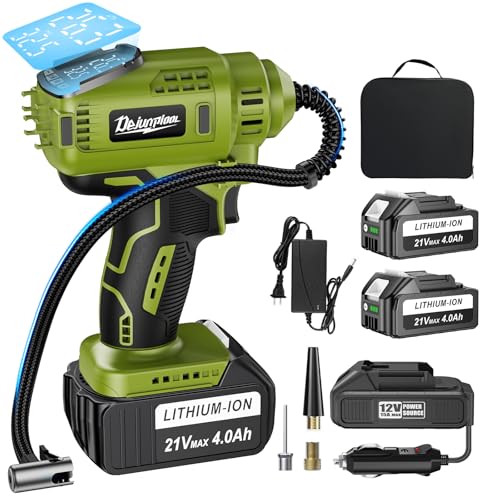
【Dual Battery and Car Power Supply, Double Safety】With dual 21V 4000mAh rechargeable batteries, our Tire Inflator Portable Air Compressor effortlessly inflates 4 tires (0→36 PSI) in under 4 minutes per tire when fully charged. Plus, use the DC 12V adapter for direct power. Pro Tip: For best battery health, give your pump a full charge before first use. This helps extend its long-term performance!

High-pressure inflation mode with automatic shutoff
How the BMS Affects Peak Current and Real-World Output
Once capacity and C-rating are matched to your inflator’s draw, the Battery Management System (BMS) becomes the gatekeeper for how much current the pack actually delivers under load. The BMS regulates peak current to safe levels, preventing thermal runaway and extending cell life during portable tire inflator use. By capping burst currents, the BMS intentionally trades raw power for longevity. That cap can reduce inflation speed when demand would otherwise cause harmful stress.
The BMS also provides over-current cutoffs, under-voltage lockout, and thermal throttling to keep the system within safe electrical and thermal limits. Effective management minimizes voltage sag so the pump maintains reliable output across repeated cycles. Choose a pack whose BMS limits align with your inflator’s 5–15A requirements for predictable, consistent performance.
Real-World Calculations: Power and Runtime for Car and Bike Tires
Calculate energy per inflation by converting required pressure and volume into work, then matching that to the inflator’s wattage to get time. Use battery capacity and expected current draw to estimate runtime. For example, a 4000mAh 7.4V pack at 6A yields about 40 minutes of theoretical runtime. Then compare power draw against target pressure and tire volume to predict how long a car versus a bike tire will take.
Energy Per Inflation
Energy use varies with pressure rise and inflator efficiency, so expect different kilowatt-hour costs when inflating car versus bike tires. Both portable and mains-powered tire inflators convert electricity into compressed air with finite efficiency. Energy consumption scales with desired PSI and leak losses. Calculate energy per inflation using power x run time.
- Car tire: roughly 0.5–1.0 kWh to raise a 15-inch tyre from 30 to 35 PSI, depending on inflator efficiency.
- Bike tire: roughly 0.1–0.2 kWh for typical 40–60 PSI fills, far more efficient per fill.
- Example: 120W x 10 min = 0.02 kWh. Use precise math to budget energy costs accurately.
Battery Runtime Estimates
Estimate battery runtime from capacity and load. Average portable tire inflator batteries span 2000–4000mAh, yielding roughly 15–30 minutes of continuous use depending on power rating and efficiency. For example, a 70W unit at 12V draws about 5.83A. On a 4000mAh battery, that works out to about 41 minutes of theoretical runtime (4000mAh / 5830mA). Brushless motors reduce battery consumption and extend runtime compared to brushed designs.
Real-world use varies by application. Car tire duties (higher volume at around 30 PSI) consume more energy per inflation than most bike tasks. A rechargeable tire inflator typically recharges in 3–5 hours and can inflate roughly 2–4 car tires or 5–7 bike tires per charge.
Power Draw vs Pressure
Power draw scales with required pressure rise and the flow needed to fill volume. Car tires need higher sustained amperage. Bike tires demand less. Use these quick rules to plan charging:
- Car tire: a typical 120W unit at 12V draws about 10A. Raising pressure from 30 to 35 PSI often takes 10–30 minutes depending on inflation speed and pump flow.
- Bike tire: 70W–90W pumps (about 5–7A) reach pressure in 3–5 minutes, making them energy-efficient for small volumes.
- Product example: the Woowind Ventus Pro (70W, 20–22 L/min) illustrates the tradeoff between power draw and airflow for electric air pumps.
Choosing the Right Inflator: Vehicle Type, Portability, and Power Limits
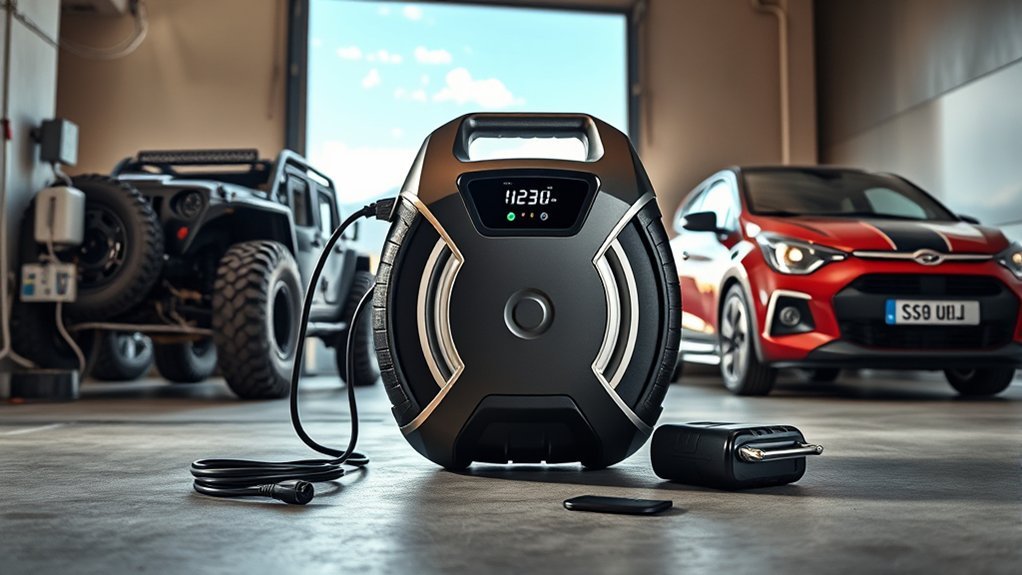
Match the inflator’s maximum pressure and current draw to your vehicle type and intended use. Passenger cars require at least 6.89 bar (100 psi). Larger vehicles and trucks need higher-pressure units. A cordless tire inflator gives flexibility for roadside fixes, but corded models deliver continuous power for heavier tasks.
Check power limits. Most 12V DC tire inflators draw 5–15A. Low-draw 5–7A units work well for bicycles and sports gear. Units drawing 10–15A provide faster car tire inflation. Look for auto shut-off to prevent over-inflation and extend battery life. Balance weight, battery capacity, and current draw against your actual use case so the device fits your needs without surprises.
[Products Worth Considering]

[Fast & Efficient Inflation] The OlarHike tire inflator features a high-performance motor that delivers rapid airflow—inflate a standard car tire (195/65 R15) from 30 to 35 PSI(+5 PSI) in just 55 seconds, or a larger SUV tire (235/65 R17) from 30 to 35 PSI(+5 PSI) in only 2.2 minutes. Ideal for cars, SUVs, light Pickup(Within 51 PSI), motorcycles, bicycles, and sports balls. Important Note: The unit can only inflate car/pickup truck tires up to 51 PSI

Please Note: This product must be powered by a 12V DC Cigarette Lighter to function properly, and ensure the vehicle is in a running state. And it equipped with a 9.8-foot cord, which can meet the usage needs of most regular-sized vehicles.

【Fast and Efficient Inflation】Equipped with a powerful motor that delivers rapid airflow, this inflator can inflate a standard car tire (195/65 R15) from 30 to 35 PSI (+5 PSI) in just about 55 seconds. Ideal for cars, motorcycles, bicycles, and sports balls, this portable tire inflator enhances convenience for everyday life and travel. Note: It can only inflate car tires up to 51 PSI
Safety, Charging, and Best Practices to Maximize Performance
Portable inflators give you on-demand air, but managing charging, duty cycle, and thermal protection keeps them safe and performing. Store lithium-ion models at around 50% charge in cool conditions. Verify the Battery Management System (BMS) is functioning. Observe rated duty cycles (typically about 15 minutes) to prevent overheating.
Use corded 12V power when you need higher sustained amperage. Use batteries for mobility, but respect their reduced continuous output. Check the battery management system periodically to confirm cell balancing, over-current cutoffs, and thermal limits are working. Units with auto shut-off and adjustable PSI help avoid over-inflation and wasted cycles.
Store lithium inflator batteries at about 50%, respect 15-minute duty cycles, verify BMS function, and prefer auto shut-off for safe, lasting use.
- Charge to about 50% for storage. Top up before long trips.
- Stick to duty cycle limits. Allow cooling periods after about 15 minutes of use.
- Inspect BMS function and test auto shut-off periodically.
Frequently Asked Questions
Do Portable Tire Inflators Drain the Battery?
Yes, they can. Running a 12V inflator with the engine off risks draining your car battery, especially with repeated use. Keep sessions short, monitor usage frequency, and recharge the inflator battery promptly after use.
How Much Power Does a Tire Inflator Use?
Most tire inflators draw 5–15A at 12V, which equals roughly 60–180W. Inflator efficiency, power rating, and usage frequency all affect battery drain. Efficient models get the job done with less current draw.
What Is the Difference Between a 12V and 120V Tire Inflator?
A 12V inflator runs off your car’s power outlet or a portable battery, making it convenient for roadside use. A 120V unit plugs into household mains power and typically inflates faster at higher wattage. Choose based on where and how often you’ll use it.
How Many Watts Does an Air Compressor Use per Hour?
Typically 40–120 watts per hour for a portable tire inflator. Actual consumption depends on compressor efficiency, pressure rating, inflation time, and motor design. Checking the label wattage before use helps you plan power needs accurately.
Conclusion
Volts set electrical potential, amps set airflow rate, and watts set total work output. Check amps for inflation speed, watts for power demand, and volts for compatibility with your power source. Match battery capacity to the number of inflations you need, match C-rating to peak current draw, and match duty cycle to repeated use. Brushless motors and a robust BMS extend runtime and protect cells. Match the right charger for fast recovery between uses, and pick an inflator that fits your vehicle type, portability needs, and safety limits.







Leave a Reply