
You’ll see tire pressure listed in PSI, Bar, or kPa. While they all measure the same thing, confusion between them can lead to safety issues. PSI (pounds per square inch) is standard in the U.S., Bar (1 Bar ≈ 14.5 PSI) is common in Europe, and kPa (100 kPa = 1 Bar) is the technical standard. Always use the vehicle’s recommended value found on the door jamb or manual, check cold with a reliable gauge, and adjust accordingly.
Quick Answer: Which Tyre Pressure Unit Should You Use?
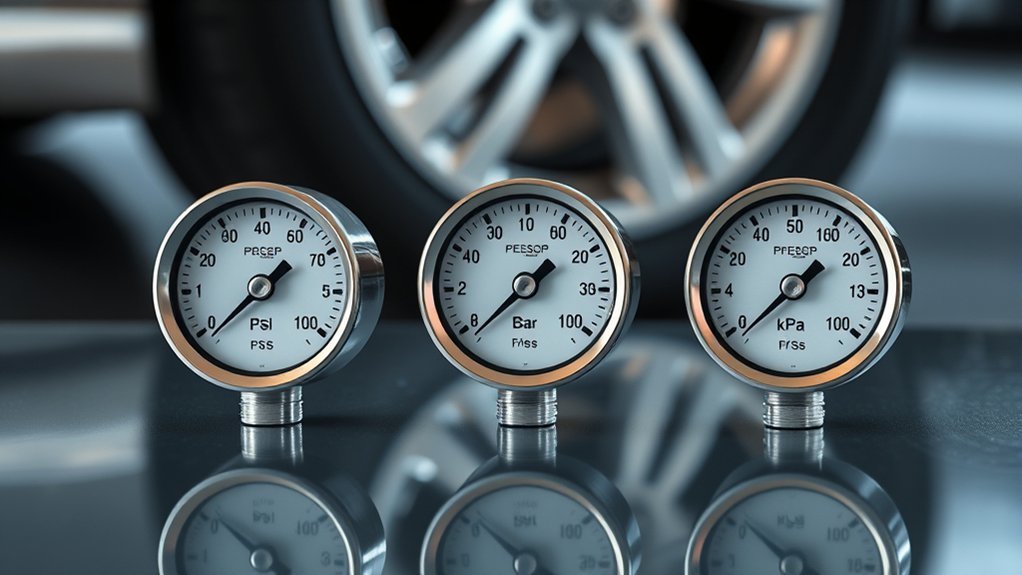
Which unit should you use? The answer is simple: use the unit shown on your vehicle’s placard or manual. Use PSI for most U.S. passenger vehicles, Bar for many European cars, and kPa if your manufacturer uses the metric standard. The value on your vehicle manual or door sticker is the authority. If your gauge uses a different unit than your sticker, use a simple conversion: multiply Bar by 14.5 to get PSI, or divide kPa by 6.9 to get PSI. Accurate tire pressure preserves handling, fuel efficiency, and safety.
What PSI Means and Where You’ll See It
PSI stands for pounds per square inch. It measures the force exerted on one square inch of the tire’s casing. It is the standard unit in the United States and the UK for passenger vehicle tires. Always compare your measured values directly to the manufacturer’s specified number using a quality digital gauge to verify safety and fuel economy.
Common Uses And Labels
You will typically see PSI on the door placards of U.S. vehicles. Typical recommended pressures for passenger cars generally run between 32–35 PSI, though larger SUVs and EVs may require higher pressures (40+ PSI). You may also encounter Bar and kPa on imported vehicles; remember that 1 Bar ≈ 14.5 PSI. Look in the owner’s manual, driver’s door jamb, or inside the fuel filler flap for these values.
| Label location | Units shown |
|---|---|
| Door jamb | PSI / Bar / kPa |
| Fuel cap area | kPa / Bar |
| Owner’s manual | All Units |
| Tire sidewall | Max Pressure (Do Not Use) |
How To Read PSI
When checking tire pressure, simply ensure your gauge is set to the ‘PSI’ mode. If your gauge only reads in Bar or kPa, you will need to convert. Use a calibrated gauge and check tires when they are “cold” (parked for at least 3 hours) to ensure an accurate reading, as heat expands the air and gives a false high reading.
- Know the target PSI from your door jamb.
- Check tires when cold.
- Verify with a reliable gauge.
- Inflate or deflate to match the target.
What BAR Means and How It Maps to Tyre Specs
Bar is the metric pressure unit most European manufacturers (like BMW, VW, and Mercedes) use. It is a very convenient unit because 1 Bar is approximately equal to atmospheric pressure at sea level. You should treat Bar as the reference when reading tire pressure specifications on European cars. 1 Bar ≈ 14.5 PSI.
Practically, typical passenger tyre pressures fall around 2.2–2.5 Bar. You can convert mentally: 2.0 Bar ≈ 29 PSI and 2.5 Bar ≈ 36 PSI. If you are driving an imported vehicle, ensure your air compressor gauge can display Bar, or perform the conversion before inflating.
What kPa Means and Why Some Cars Use It
You’ll see kPa (kilopascal) on many vehicle placards and TPMS readouts because it is the official scientific unit (SI) for pressure. Manufacturers favor it for its precision. Read the specified kPa value directly from the door placard; typical passenger ranges are about 200–250 kPa.
Why Manufacturers Prefer kPa
Manufacturers often specify tire pressures in kilopascals (kPa) because it aligns with global engineering standards. Using kPa removes the confusion of decimal points often found in Bar measurements and avoids the ambiguity of Imperial units. You’ll find manufacturers use kPa to ensure exact terms (often 220–250 kPa) that support ideal performance.
Reading kPa On Vehicles
kPa is widely used in Australia, Canada, and Europe. A typical passenger car range is 200–250 kPa (≈29–36 psi). You will find this number on the door sill or fuel cap. Simply set your digital gauge to ‘kPa’ to match this number directly without doing any math.
Converting kPa To PSI
When a vehicle lists tire pressure in kPa, you can convert it to PSI by multiplying by 0.145 (or roughly dividing by 7). For example, 220 kPa × 0.145 ≈ 32 PSI. Knowing this allows you to use standard U.S. air pumps even if your car lists metric values.
- Precise measurements ensure safety.
- Exact conversion prevents over-inflation.
- Regular checks improve fuel economy.
Tyre Pressure Conversions: PSI ↔ BAR ↔ kPa (Quick Rules)
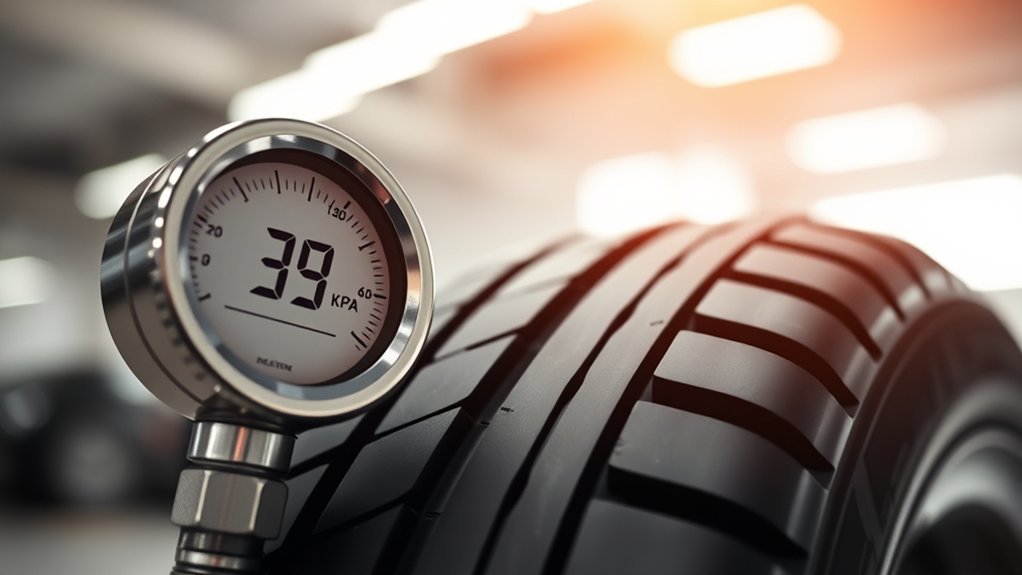
Use these simple multipliers to switch between PSI, BAR and kPa quickly:
- Bar to PSI: Multiply by 14.5 (e.g., 2.2 Bar ≈ 32 PSI).
- PSI to kPa: Multiply by 6.9 (e.g., 30 PSI ≈ 207 kPa).
- kPa to Bar: Divide by 100 (e.g., 220 kPa = 2.2 Bar).
Remember that 1 Bar equals exactly 100 kPa, making that conversion the easiest one. These rules let you control tire pressure checks precisely, whether you’re servicing vehicles internationally or interpreting specifications from varied sources.
Quick Chart: Common Tyre Pressures (PSI | BAR | kPa)
If you need a quick reference, this compact chart lists typical tyre pressures. Always verify against your vehicle’s recommended values before final adjustment.
- Passenger Cars: 32–35 PSI (2.2–2.4 Bar | 220–240 kPa)
- Sports Cars (Performance): 30–40 PSI (2.1–2.8 Bar | 200–275 kPa)
- Light Trucks/SUVs: 35–45 PSI (2.4–3.1 Bar | 240–310 kPa)
- Bicycles (Road): 80–120 PSI (5.5–8.3 Bar | 550–830 kPa)
Where to Find Your Car’s Recommended Tyre Pressure
Where do you find the correct tyre pressure? Check the driver’s door jamb first—manufacturers commonly place a sticker there (the Tire and Loading Information placard). If it is not there, check inside the fuel cap door or the owner’s manual. Use these factory values as your baseline. Note: Do not use the “Max Press” number stamped on the tire sidewall; that is the maximum safety limit, not the recommended driving pressure.
[Products Worth Considering]
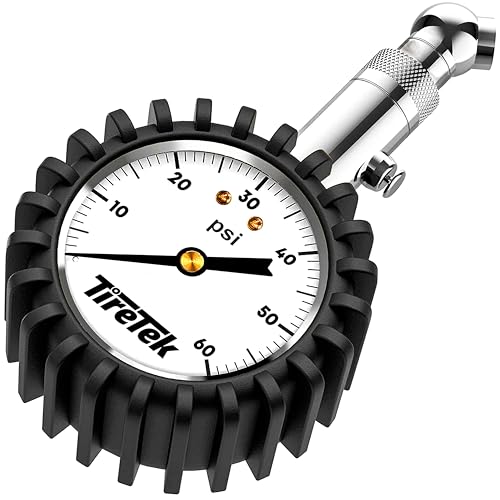
Professional Tire Pressure Gauge for Cars – This heavy duty mechanical tire pressure gauge is calibrated to ANSI B40.1 Grade A (2%) international accuracy standard so you get a precise, accurate pressure reading every time you use it. Makes great car accessories, car stuff, tire deflator, car stuff for men, cool car gadgets, car gifts for men, him, dad

PROCESS LEVEL ACCURACY: Each ETENWOLF’s digital tire pressure gauge is calibrated manually to ANSI B40.7 Grade 2A(plus-minus 1 PSI).Presta valve adapter not included, if used for bicycles, it must be purchased separately

HIGH ACCURACY: Every ETENWOLF's pencil tire gauge is calibrated to ANSI B40.1 Grade B, it is accurate to 2% of span in the middle 50% of range and 3% of span in the lower and upper 25% of range. Each of ETENWOLF pencil tire pressure gauge is manually calibrated and has its unique calibration number printed on the pencil
How to Check and Set Tyre Pressure: Tools and Step-by-Step
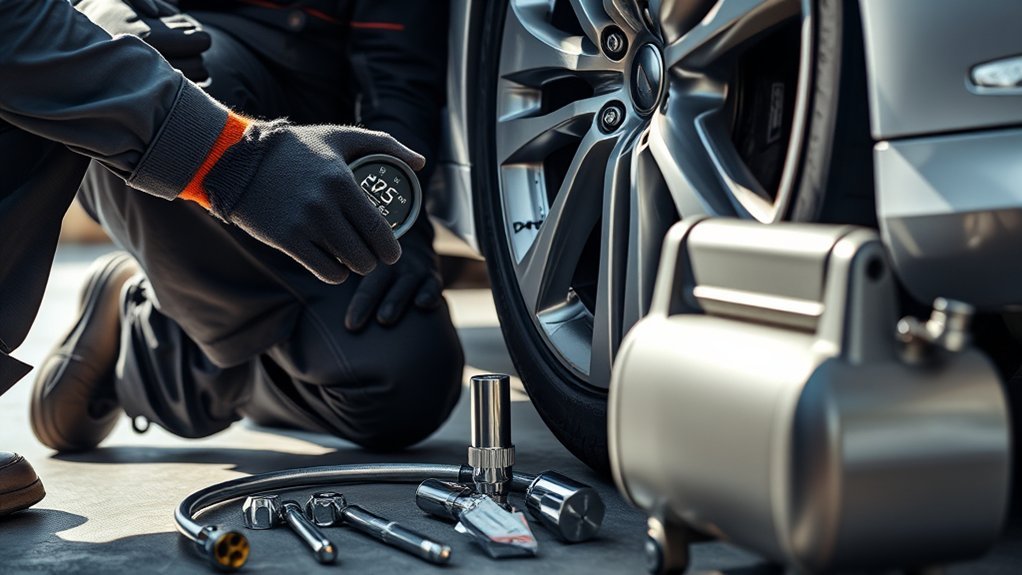
Gather a reliable tire pressure gauge and an air compressor. Work with cold tires (tires that haven’t been driven for ~3 hours) so heat expansion won’t skew readings. Remove valve caps, press the gauge firmly onto the valve stem to avoid leaks, and note the reading. Compare readings to the recommended values in the door jamb. Add air or release small amounts to reach the target pressure. Replace valve caps tightly.
[Products Worth Considering]
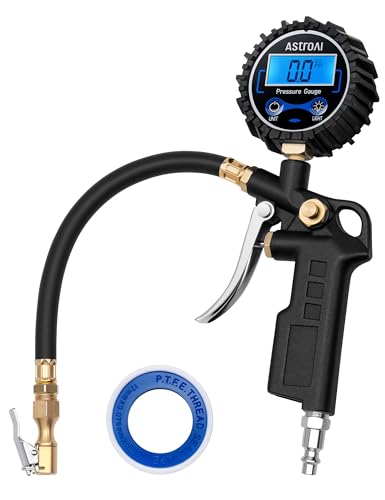
COMPATIBLE WITH both ¼” and ½” NPT air compressors outputs. COMPATIBLE WITH Standard Schrader Valves.

ADVANCED ACCURACY: Professionally calibrated to always return an accurate reading within 1% of the exact pressure of your tire. Accurately measures FOUR DIFFERENT UNITS in a range from 3-250 PSI (0.2-17.2 Bar; 0.21-1724 Kpa; 0.2-17.5 kg/cm^2). Stocking Stuffers for Men

【Accurate Digital Tire Gauge】The digital pressure gauge always returns a stable reading within 1% of the exact pressure of your tire by incredible 0.1 display resolution. No more guessing!
Troubleshooting & When to Visit a Garage
If a warning light appears or handling feels odd, immediately verify pressures with a gauge. If vehicles use a TPMS, confirm the reading manually. Uneven wear or repeated flats mean you should visit a professional.
| Symptom | Action |
|---|---|
| TPMS light on | Check pressure immediately with a manual gauge |
| Uneven tread wear | Check alignment and inflation levels |
| Recurrent pressure loss | Inspect for punctures, nail, or valve leaks |
| Vibration at speed | Wheel balancing required (visit garage) |
| Reduced fuel efficiency | Inflate tires to recommended PSI |
[Products Worth Considering]

PROCESS LEVEL ACCURACY: Each ETENWOLF’s digital tire pressure gauge is calibrated manually to ANSI B40.7 Grade 2A(plus-minus 1 PSI).Presta valve adapter not included, if used for bicycles, it must be purchased separately
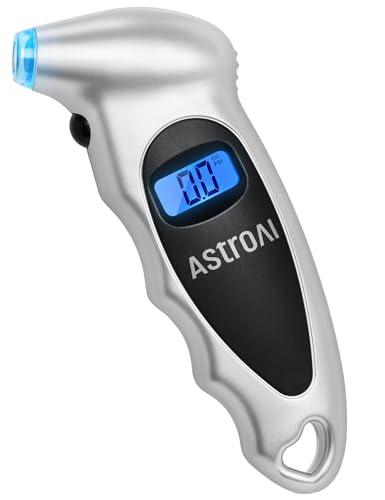
EXPERT-GRADE CALIBRATION: Each AstroAI Tire Pressure Gauge is calibrated with professional-grade tools, ensuring quick and accurate measurement results within plus-minus 1PSI. Stay prepared for any roadside emergency and travel with peace of mind.

PROCESS LEVEL ACCURACY: This heavy duty tire pressure gauge is calibrated manually to ANSI B40.1 Grade A (plus-minus 1% of span)
Frequently Asked Questions
Why Use kPa Instead of PSI?
You should use kPa if your vehicle manufacturer specifies it. It offers a more precise standard for engineering and eliminates the confusion between different “Bar” or “PSI” definitions globally.
Is 1 BAR 14.5 or 14.7 PSI?
For tire pressure, 1 Bar is treated as 14.5 PSI. While standard atmospheric pressure is roughly 14.7 PSI, the conversion used for mechanical pressure gauges is typically 14.5.
What Is 30-35 PSI in kPa?
30–35 PSI equals approximately 207–241 kPa. This range covers most standard passenger vehicles.
How Many kPa Is 40 PSI?
40 PSI equals approximately 276 kPa. This is common for larger SUVs or vehicles carrying heavy loads.
Conclusion
Use PSI, Bar, or kPa interchangeably once you know the conversion: 1 Bar ≈ 14.5 PSI ≈ 100 kPa. Most passenger cars use about 30–35 PSI (2.2–2.4 Bar); always check your door placard for the specific number. Proper tire pressure is critical—under-inflation can reduce fuel consumption and tire life. Check pressures cold with a calibrated gauge monthly to stay safe.







Leave a Reply