
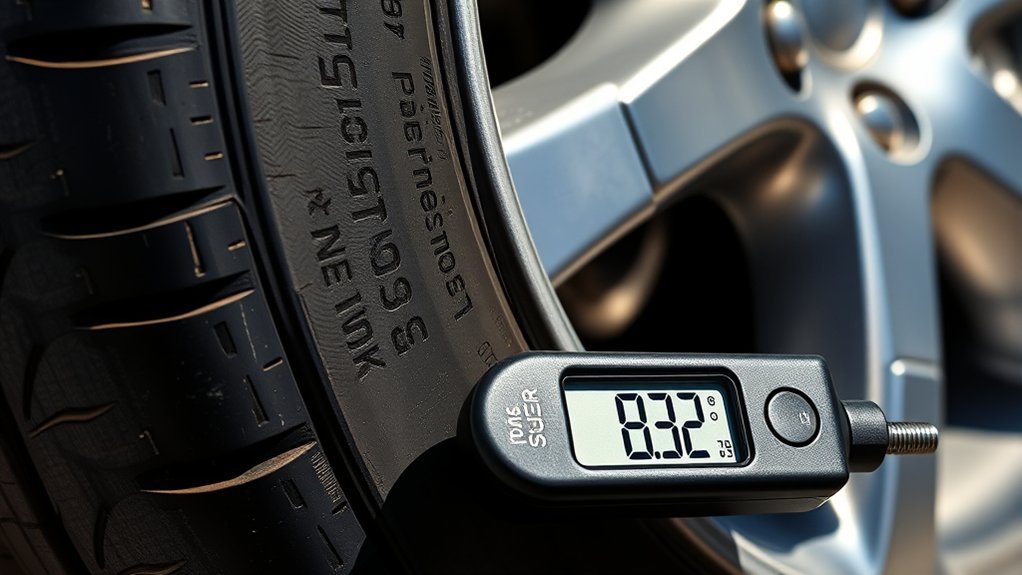
Don’t use the tire sidewall’s max PSI as your everyday target — follow the door‑jamb (or owner’s manual) recommendation instead. The sidewall number is a structural ceiling the tire can tolerate, not the optimized pressure for ride, handling, or wear; overinflating to the sidewall max can cause harsh ride and center wear. Check pressures cold with a good gauge, adjust for heavy loads, then return to the manufacturer PSI to preserve safety and performance — more details follow.
Quick Answer: Use the Door‑Jamb PSI for Daily Driving
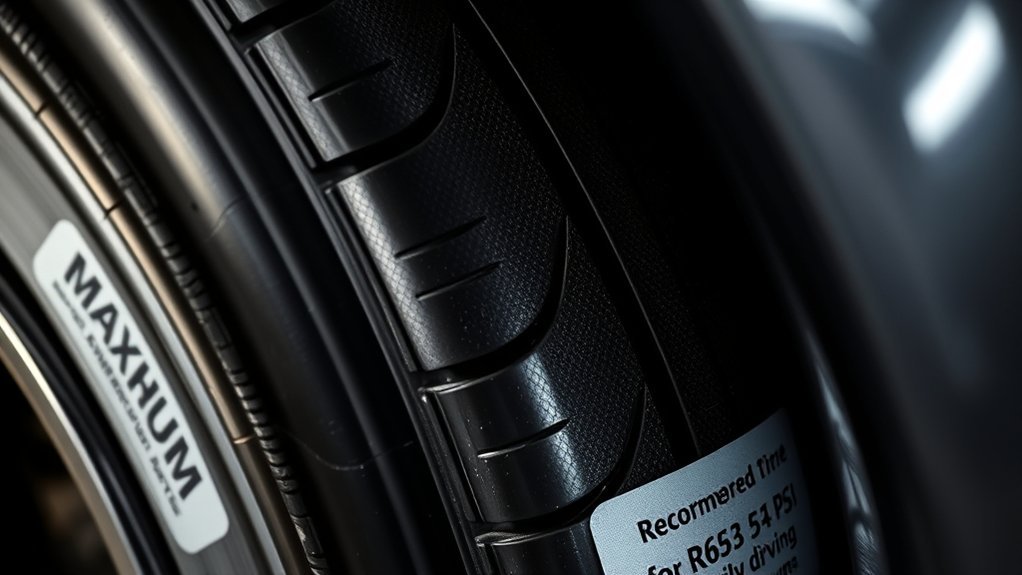
Although the tire sidewall lists a maximum PSI, you should inflate your tires to the door‑jamb recommendation for daily driving because that figure is tuned by the manufacturer for ideal handling, wear, and safety. You’ll preserve the proper tire behavior by following the recommended tire pressure—typically 30–35 PSI for most passenger cars—rather than the sidewall’s maximum pressure, which can be much higher. Inflating to the sidewall max sacrifices ride comfort, causes uneven wear, and degrades handling; under‑inflated tires also create risks, but over‑inflation from following the sidewall number is common. Make it routine to check your tire pressure when tires are cold and address deviations promptly. Use a quality gauge, record readings, and top off according to the door jamb guidance. This practice extends tread life, improves fuel economy, and keeps control predictable. Choosing the door‑jamb PSI is a deliberate act of autonomy over safety and performance.
[Products Worth Considering]
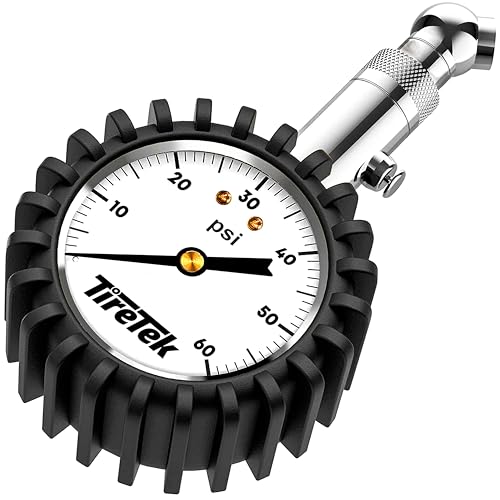
Professional Tire Pressure Gauge for Cars – This heavy duty mechanical tire pressure gauge is calibrated to ANSI B40.1 Grade A (2%) international accuracy standard so you get a precise, accurate pressure reading every time you use it. Makes great car accessories, car stuff, tire deflator, car stuff for men, cool car gadgets, car gifts for men, him, dad

PROCESS LEVEL ACCURACY: Each ETENWOLF’s digital tire pressure gauge is calibrated manually to ANSI B40.7 Grade 2A(plus-minus 1 PSI).Presta valve adapter not included, if used for bicycles, it must be purchased separately

Enhanced Visibility in Low Light: Features a green backlit LCD screen and integrated flashlight, allowing for clear reading of tire pressure even in dark or dimly light conditions.
Where to Find Your Car’s Recommended Tire Pressure (Door Tag & Manual)
You’ve seen why the door‑jamb PSI is the right number to use; now here’s where to find it. Look at the driver’s door tag first — often on the door jamb, trunk lid, console, or fuel door — for the recommended tire pressure specified by the manufacturer. That sticker summarizes testing data to give you the correct tire pressure for everyday driving and loaded conditions.
Also consult the owner’s manual for model‑specific guidance, sequences for a proper pressure check, and any axle‑specific values. Don’t confuse the tire’s sidewall maximum pressure with the vehicle’s recommendation: the sidewall shows a safety limit, not the optimized setting. Follow the door tag and manual to maintain handling, wear, and fuel efficiency. Make pressure checks a habit — cold tires, consistent gauge, and adjust to the recommended tire pressure. That practice frees you from guesswork and keeps control where it belongs: in your hands.
What “Sidewall Maximum” Actually Means for Your Tires
Think of the sidewall maximum as a hard safety ceiling, not your daily target: it’s the highest pressure the tire’s construction can tolerate (usually 35–50+ PSI), expressed in PSI on the tire sidewall. That max value is a structural limit set by the tire maker, not the vehicle manufacturer’s recommended number for normal driving. You’ll see it stamped on tires so technicians and owners know the upper bound for inflation.
Respecting the sidewall max prevents blowouts, but routinely inflating to that value harms ride quality, traction and accelerates center tread wear. The manufacturer’s recommended PSI — found on your door jamb or in the manual — balances load capacity, comfort and longevity and is typically lower than the sidewall max. Use the recommended PSI for everyday driving; view the sidewall max as a safety fallback for situations requiring higher inflation for load or emergency use, not as a performance target for your tires.
[Products Worth Considering]

PROCESS LEVEL ACCURACY: Each ETENWOLF’s digital tire pressure gauge is calibrated manually to ANSI B40.7 Grade 2A(plus-minus 1 PSI).Presta valve adapter not included, if used for bicycles, it must be purchased separately
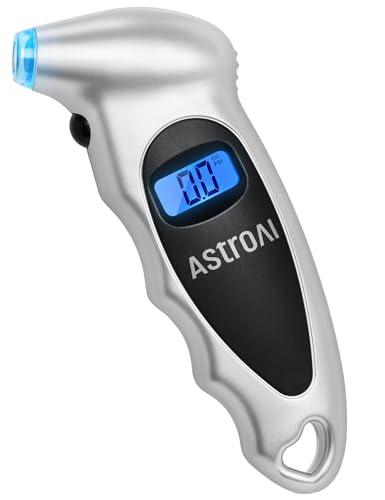
EXPERT-GRADE CALIBRATION: Each AstroAI Tire Pressure Gauge is calibrated with professional-grade tools, ensuring quick and accurate measurement results within plus-minus 1PSI. Stay prepared for any roadside emergency and travel with peace of mind.

PROCESS LEVEL ACCURACY: This heavy duty tire pressure gauge is calibrated manually to ANSI B40.1 Grade A (plus-minus 1% of span)
How to Check and Set Cold Tire Pressure (Tools, Heat, Altitude, Load)
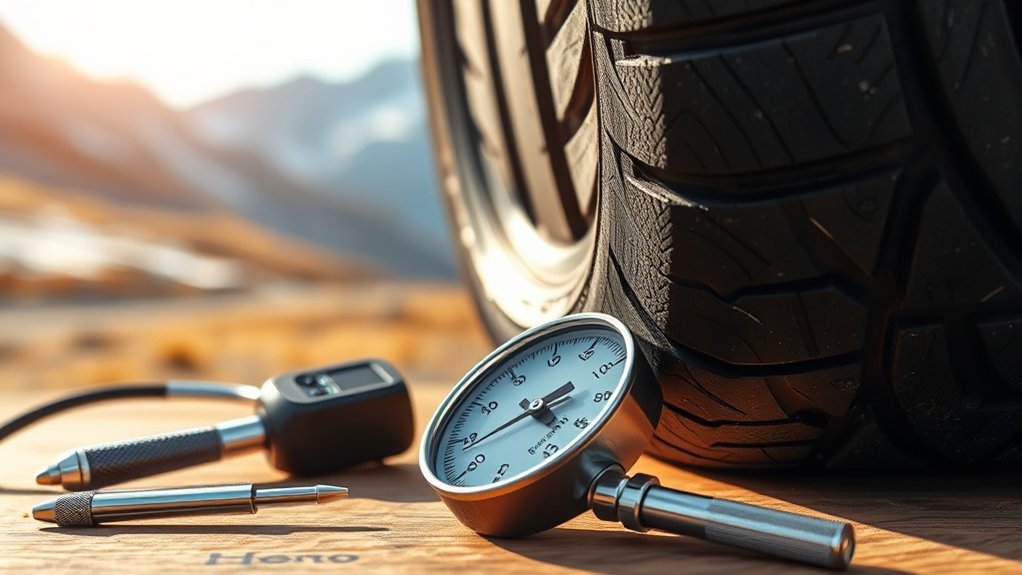
When checking cold tire pressure, start with a reliable gauge and measure the tires before driving or after they’ve sat for at least three hours so you get a true baseline; pressures rise with heat from driving (about 1-2 PSI per 10°F) and with altitude (roughly 0.5 PSI per 1,000 ft), so factor those when interpreting readings. Use the sticker inside the driver’s door or the owner’s manual for the manufacturer’s recommended pressure rather than the tire’s sidewall maximum. Remove valve caps, press the gauge firmly, and adjust with an air compressor or release air until each tire hits the recommended PSI. If temperatures or elevation change, recheck and compensate: cold mornings may read lower, high passes read higher. When you load the vehicle, consult load inflation guidance to increase pressure appropriately; a slightly higher pressure for heavy loads keeps handling predictable. Check all four tires plus the spare periodically. Accurate, consistent checks free you from surprises and extend control and safety.
[Products Worth Considering]
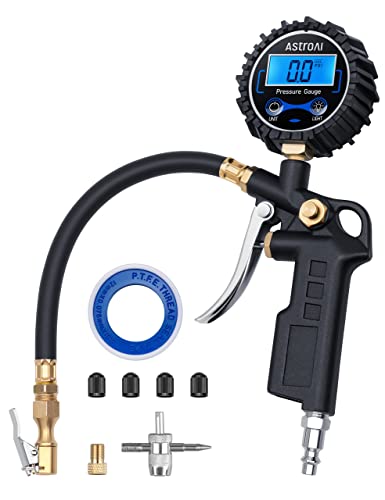
COMPATIBLE WITH both ¼” and ½” NPT air compressors outputs. COMPATIBLE WITH Standard Schrader Valves.

Advanced accuracy: Professionally calibrated tire pressure gauges for cars. Accurately measures from 0-100 PSI with a resolution of +/-1 PSI.

ADVANCED TRUEGAUGE SCREEN: This battery tire inflator includes updated sensor technology, capable of collecting pressure data from tire inflators at a frequency of 200 times per second. Its valid data rate is higher than 80%, which is 60% better than the market average. Wherever you go, accurate readings help you drive safely.
Risks: Sidewall Max vs Recommended – Handling, Wear, and When Max Is OK
Although the sidewall lists a tire’s maximum inflation, that number is a construction limit—not the pressure you should run daily; instead use the vehicle manufacturer’s recommended PSI (usually 30–35 PSI) to preserve handling, even tread wear, and safety. You’ll protect grip and steering response by following the manufacturer’s recommended pressure rather than the maximum tire pressure on the sidewall. Over-inflation causes center tire wear, harsher ride, and higher blowout risk; under-inflating tires raises rolling resistance, heat buildup, and failure risk. Inflate your tires to recommended PSI for balanced performance. In heavy-load or towing scenarios you may temporarily increase pressure toward the sidewall max, but return to manufacturer’s recommended pressure afterward.
| Issue | Cause | Action |
|---|---|---|
| Poor handling | Over-inflation | Reduce to recommended PSI |
| Center wear | Maximum tire pressure used | Re-inflate to spec |
| High fuel use | Under-inflating tires | Inflate to spec |
| Blowout risk | Excess pressure | Avoid regular max use |
| Load support | Heavy load/towing | Temporarily increase pressure |
Frequently Asked Questions
Is It Better to Have Max Tire Pressure or Recommended Tire Pressure?
You should use recommended tire pressure for ideal performance, tire safety, fuel efficiency, proper wear patterns, handling characteristics, and ride comfort; only adjust for load capacity or temperature effects, but don’t habitually inflate to the sidewall maximum.
Should You Inflate Tires to the Max Rating on the Sidewall?
No — you shouldn’t inflate to the sidewall max. You’ll harm tire performance, handling dynamics and comfort level, worsen wear patterns, raise safety concerns and temperature effects, reduce fuel efficiency; use vehicle-recommended pressure for load capacity.
What Is the 5 Psi Rule?
The 5 PSI rule means you adjust tire pressure about 1-2 PSI per 10°F change, so you’ll tweak pressures for safety considerations, performance impact, fuel efficiency, wear patterns, weather effects, load capacity and routine maintenance tips.
What Is the 3% Tire Rule?
Want safer, ideal tires? You’ll keep tire pressure within 3% of recommended PSI to protect tire performance, handling dynamics, load capacity, fuel efficiency, reduce tread wear and heat buildup, and guide inflation frequency for freedom.
Conclusion
Use the door‑jamb PSI; don’t default to the sidewall maximum. That maximum is a manufacturer’s limit for the tire, not a vehicle‑specific setting, and it can compromise comfort, traction, and wear if used for daily driving. Check cold pressures with a calibrated gauge, adjust for load or altitude as the manual advises, and inspect regularly. Prioritize the recommended pressure for predictable performance, proper footprint, and preserved safety.







Leave a Reply