

To convert PSI to bar, divide the PSI value by 14.5038 (or roughly by 15 for a fast estimate). So 30 PSI ≈ 2.07 bar, 50 PSI ≈ 3.45 bar, and 100 PSI ≈ 6.89 bar. For tyre checks, 30–35 PSI is about 2.07–2.41 bar; check cold and note gauge type. Use a calculator for precision to avoid compounding rounding errors, and continue for conversion tips, common pitfalls, and practical examples.
Quick PSI→Bar Answer
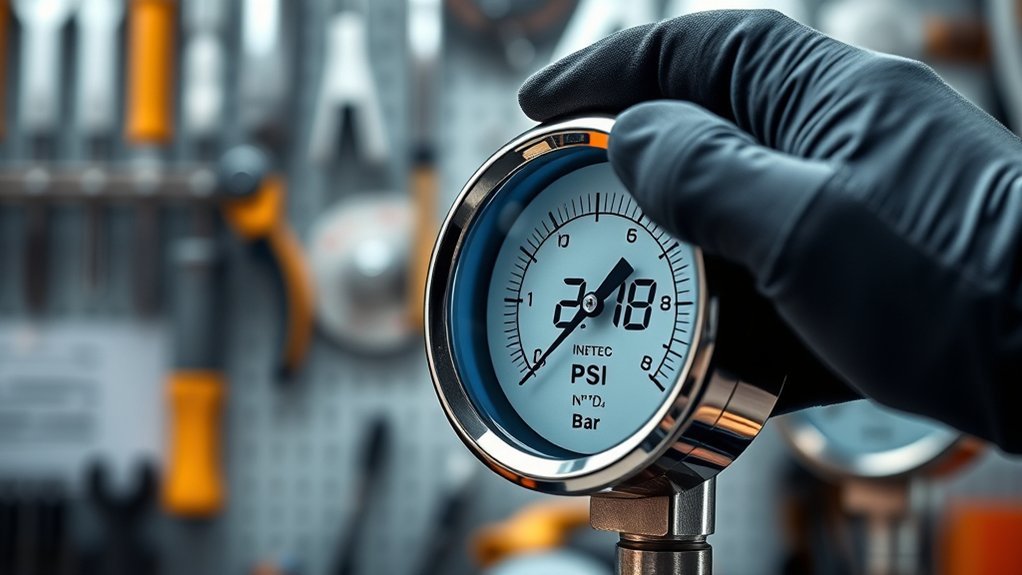
One clear way to convert PSI to bar is to divide by 14.5038, since 1 PSI ≈ 0.0689476 bar. You’ll use the PSI to BAR conversion to translate pressures swiftly: BAR = PSI / 14.5038. That conversion formula gives precise results—30 PSI ≈ 2.07 BAR, 100 PSI ≈ 6.89 BAR, 40 PSI ≈ 2.76 BAR, and 50 PSI ≈ 3.45 BAR. For quick and easy mental checks, remember 15 PSI is roughly 1 BAR; that rule frees you from constant calculation when you need a fast estimate. You can apply these values directly to equipment checks, tire settings, or system diagnostics to reclaim control over your environment. Stay exact where precision matters and use the simple approximation where speed matters. This keeps your conversions actionable and liberating: accurate when required, fast when practical, without sacrificing clarity or integrity.
Conversion Formula and Calculator Tips
Start with the exact formula: BAR = PSI / 14.5038, and use it for precise conversions; when speed matters, divide by about 15 for a quick estimate that’s usually within a few percent. Use the conversion formula as your reliable rule: plug PSI values directly to get BAR and avoid guesswork. You’ll free yourself from uncertainty by committing the divisor or bookmarking a trusted calculator.
When accuracy counts in pressure measurements, use a digital calculator or an online PSI to BAR converter to eliminate human rounding errors. Enter the PSI, confirm units, and record the BAR output; repeatable inputs yield repeatable results. For field work, carry a compact conversion chart or a simple app that stores your preferred precision (two or three decimal places).
Adopt these habits to reclaim control over technical choices: rely on the exact formula for final values, use the approximate divide-by-15 method for fast checks, and let calculators guarantee consistency in all your pressure measurements.
[Products Worth Considering]

MANUFACTURER DIRECT
MANUFACTURER DIRECT
MANUFACTURER DIRECT
Common PSI→Bar Conversions (10, 30, 50, 100)
Use the exact formula BAR = PSI / 14.5038 to convert quickly: you can apply it to common reference points so you act decisively. For 10 PSI the conversion gives about 0.69 BAR — useful for low-pressure checks and simple benchmarks. At 30 PSI you get roughly 2.07 BAR, a typical passenger-tire range you’ll recognize. For 50 PSI the result is approximately 3.45 BAR, relevant when performance demands higher stiffness. At 100 PSI the conversion equals about 6.89 BAR, a level you’ll see in many industrial contexts.
Keep these anchors in mind to free yourself from slow arithmetic: 10→0.69 BAR, 30→2.07 BAR, 50→3.45 BAR, 100→6.89 BAR. Use them to verify gauges, set systems, or cross-check specifications quickly. Precision in PSI to BAR conversion protects components and gives you control over pressure decisions without unnecessary hesitation.
[Products Worth Considering]
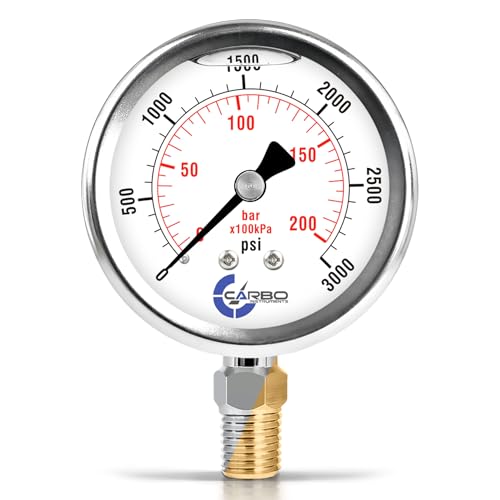
ASME B40.1 Grade A Accuracy (+/-2-1-2%): Professionally manufactured for reliable performance; large 2-1/2" (63mm) dial with high-contrast markings ensures easy pressure reading.
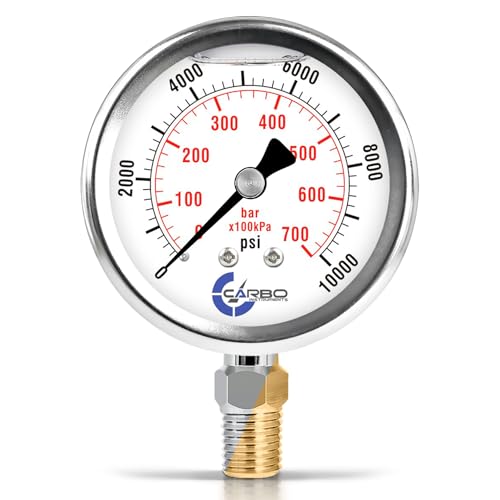
ASME B40.1 Grade A Accuracy (+/-2-1-2%): Professionally manufactured for reliable performance; large 2-1/2" (63mm) dial with high-contrast markings ensures easy pressure reading.

Brass and Stainless Steel – Wetted parts for measuring non-corrosive liquid and gas pressure. Such as water, oil pressure test.
Converting Tyre Pressure: PSI→Bar for Cars and Bikes
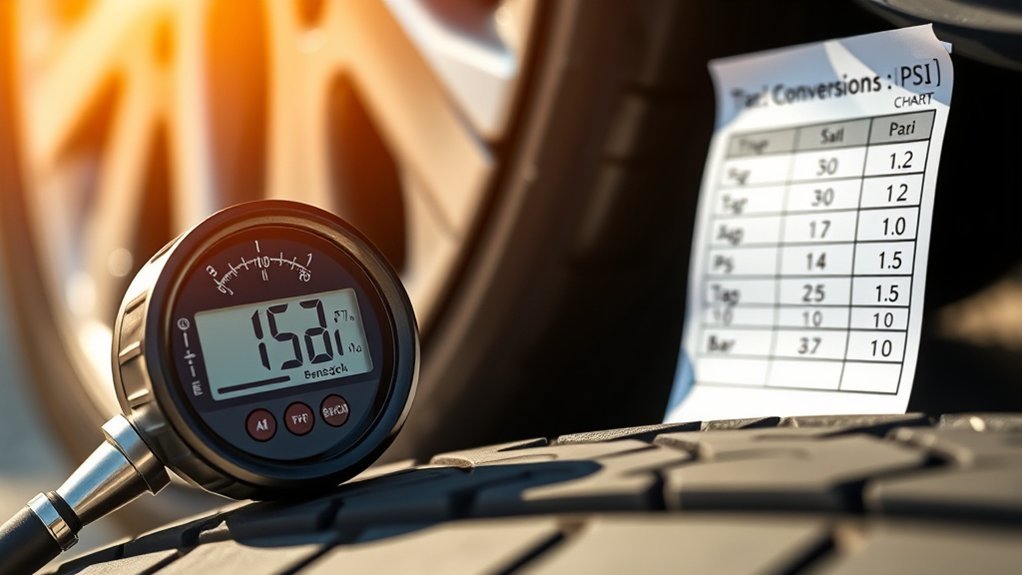
For most passenger cars and bikes you’ll convert tyre pressures by dividing the PSI reading by 14.5038 to get BAR, so a typical car range of 30–35 PSI becomes about 2.07–2.41 bar and common truck/SUV settings of 35–40 PSI convert to roughly 2.41–2.76 bar. You’ll use a pressure gauge to read PSI and then convert PSI to BAR for consistent documentation or when a facility displays metric units. Check tyres cold for accuracy and note manufacturer recommendations—high-performance vehicles may call for pressures above 40 PSI (over 2.76 BAR). Maintain tyre pressure for safety, fuel efficiency, and handling; underinflation costs freedom through reduced range and control. If you measure in PSI, keep a simple conversion method: divide by 14.5038 or use a reliable digital gauge that toggles units. Regular checks, clear targets in BAR or PSI, and decisive adjustments let you reclaim control of your vehicle’s performance without wasting time.
[Products Worth Considering]

PROCESS LEVEL ACCURACY: Each ETENWOLF’s digital tire pressure gauge is calibrated manually to ANSI B40.7 Grade 2A(plus-minus 1 PSI).Presta valve adapter not included, if used for bicycles, it must be purchased separately
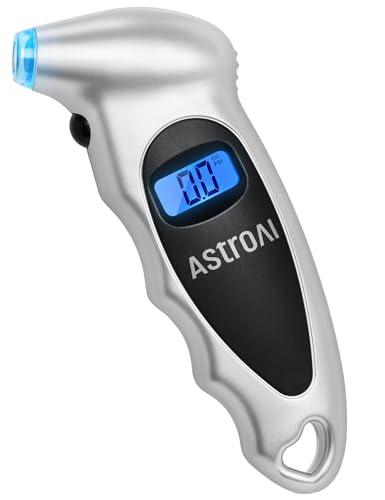
EXPERT-GRADE CALIBRATION: Each AstroAI Tire Pressure Gauge is calibrated with professional-grade tools, ensuring quick and accurate measurement results within plus-minus 1PSI. Stay prepared for any roadside emergency and travel with peace of mind.

Enhanced Visibility in Low Light: Features a green backlit LCD screen and integrated flashlight, allowing for clear reading of tire pressure even in dark or dimly light conditions.
Two Fast PSI→Bar Approximations
Two quick approximations let you convert PSI to bar in your head: divide PSI by 15 for a close estimate (30 PSI ≈ 2 bar; 100 PSI ≈ 6.7 → ~7 bar) or use the 2:3 ratio—multiply bar by 1.5 to get PSI (2 bar × 1.5 = 3 PSI) as a reciprocal check; both methods trade a little accuracy for speed and work well for everyday tyre and workshop ranges. You’ll use divide-by-15 for fast PSI→BAR conversion: 200 PSI ≈ 13.33 → ~14 BAR, 30 PSI = 2 BAR. The 2:3 ratio gives a simple reciprocal: if a gauge reads 2 BAR, 2 × 1.5 = 3 PSI (useful as a mental check). Both are tools for liberation from complex calculators: they free you to act confidently in the moment. Use rounding conscientiously; for critical systems revert to exact math. These approximations focus on practicality, not perfection, and suit common pressure ranges encountered in vehicles and workshops.
- A tyre gauge, wrist motion, quick divide.
- A shop compressor, glance, fast read.
- A roadside repair, calm decision, liberation.
Avoid These PSI→Bar Conversion Errors
Watch out for rounding shortcuts like treating 1 bar as 15 psi or using ad‑hoc percent rules — they’ll shift results enough to matter. Also confirm whether your psi reading is gauge or absolute before converting, because mixing the two will produce incorrect pressures. Use the 14.5038 factor and clear pressure type to avoid systematic errors.
Wrong Rounding Shortcut
When you use rough shortcuts—like treating 15 psi as 1 bar or simply dividing psi by 2—you introduce measurable error into your pressure readings; always divide by 14.5038 (BAR = PSI / 14.5038) and avoid excessive rounding, because shortcuts can produce errors up to about 4% and grow larger at higher pressures. You want freedom from guesswork, so convert with intent: apply the exact formula, keep significant digits, and don’t truncate intermediate values. Rounding down early compounds error; rounding up masks risk. Use a calculator or script to preserve precision, then round only the final result to the necessary tolerance for your task.
- A machinist checking a hydraulic line, squinting at a rounded gauge
- A diver trusting precise pressure readouts before descent
- An engineer refusing to trade safety for speed
Mixing Gauge And Absolute
Because gauge and absolute pressures use different zero points, you can’t treat 30 psi gauge and 30 psi absolute as equivalent when converting to bar. You must check whether your reading is gauge pressure (relative to atmosphere) or absolute pressure (relative to vacuum) before any conversion calculations. Gauge zero equals atmospheric pressure; absolute includes that atmosphere offset, so a blind psi→bar conversion will under- or overstate true pressure. To avoid errors, label inputs, add or subtract atmospheric pressure (≈14.7 psi) when switching between types, and then convert to bar. This discipline prevents mistaken assumptions that lock you into faulty designs or unsafe outcomes. Be deliberate: clarify measurement type, apply the correct offset, then carry out conversion calculations for accurate, liberating results.
Why PSI and Bar Aren’t the Same
You should recognize that PSI and Bar come from different unit systems—PSI from imperial/US customary and Bar from the metric system—which affects regional conventions and tooling. They reference pressure differently: PSI is force per square inch while Bar is defined as 100,000 pascals, so their numerical values and scales don’t match. That difference has practical consequences for readings, equipment specs, and international communication, so accurate conversion is essential.
Different Unit Systems
Although they both measure pressure, PSI and bar come from different measurement traditions and aren’t directly interchangeable without conversion. You’ll recognize PSI as pounds per square inch, rooted in the U.S. imperial system, while bar is a metric-derived, non-SI unit used internationally. One bar ≈ 14.5038 PSI, so you’ll depend on a conversion table or a simple multiplier when you switch contexts. That step preserves safety, clarity, and cross-border collaboration.
- Picture a tire gauge stamped in PSI on one side and bar on the other.
- Imagine an engineer consulting a conversion table before signing off on a design.
- Visualize a mechanic toggling a BAR to PSI calculator to avoid error.
You’ll act deliberately; the right unit system frees you to communicate and build confidently.
Measurement Reference Differences
Having seen how PSI and bar come from different measurement traditions, let’s look at why their readings aren’t interchangeable in practice. You’ll encounter PSI in imperial contexts and BAR where metric norms hold; each defines pressure differently and ties to distinct reference areas and standards. One BAR equals about 14.5038 PSI, so numeric values shift simply because the base units differ, not because the physical force changed. That distinction matters when you translate specifications across borders or systems: misreading units can undermine safety and autonomy over your work. Learn both pressure units, verify the unit label before acting, and insist on clear conversions. Doing so helps you reclaim control and prevent avoidable errors.
Practical Impact On Use
Because PSI and bar measure the same physical quantity using different bases, you need to convert values carefully to avoid practical mistakes—1 bar is about 14.5 PSI, so reading a tire at “30” without checking the unit could mean underinflation or overinflation by a large margin. You’ll protect safety and freedom of movement by treating PSI and BAR as distinct inputs: convert, then act. Misreading units skews handling, fuel economy, and wear. High-performance settings demand exact PSI; passenger and truck ranges differ, so convert to the unit your gauge or manual uses. Atmospheric pressure (~1 BAR/14.7 PSI) biases measurements, so compensate for altitude when needed.
- A flattened tire in fog, you check PSI vs BAR.
- A race setup, you tune PSI precisely.
- A long haul, you confirm BAR readings.
Frequently Asked Questions
What Is the Formula for Converting PSI to Bar?
The formula is BAR = PSI / 14.5038. You’ll use conversion methods grounded in pressure units and measurement standards, so you can confidently translate values, challenge reliance on guesses, and reclaim precise, liberated control.
What Is 40 to 60 PSI in Bar?
40–60 PSI equals about 2.76–4.14 bar, so you’ll convert using PSI conversion methods and apply results to bar pressure applications; you’re linking pressure measurement systems to freedom through precise, analytical control.
What Is 32 PSI in Bar?
32 PSI equals about 2.20 bar. You’ll grasp pressure measurement differences quickly, see psi applications explained for tires, and follow bar usage guidelines confidently, empowering you to control safety, efficiency, and performance.
Is 2.4 Bar 35 PSI?
No — 2.4 bar isn’t exactly 35 psi; it’s about 34.8 psi. You’ll apply conversion methods for pressure units, understand practical applications like tire maintenance, and make precise, liberating choices for safety.
Conclusion
Now you know the quick PSI→bar answer and the clear steps to convert accurately — think of the numbers as gears meshing: one turn in psi gives a predictable turn in bar when you use the formula. Use the precise multiplier (1 psi ≈ 0.0689476 bar) or the fast approximations for rough checks, and avoid common pitfalls. Keep conversions tight and repeatable, and your pressure readings will stay in sync like a well-calibrated instrument.







Leave a Reply