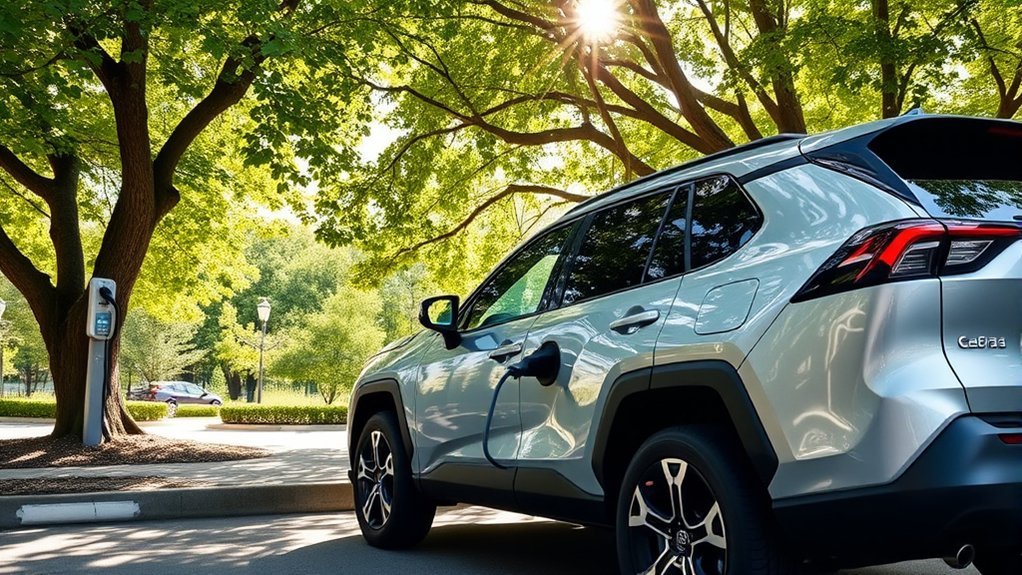
Toyota RAV4 Prime charging time depends on the model year, the car’s onboard charger, the power source, and battery temperature. Toyota used the RAV4 Prime name for U.S. models through 2024, renamed it the RAV4 Plug-in Hybrid for 2025, and introduced new charging hardware for 2026. That model-year split matters more than the charger brand on the wall.
Quick Answer
For early RAV4 Prime models, a full charge takes about 12 hours on 120V, 4.5 hours on 240V with the 3.3kW onboard charger, or 2.5 hours with the 6.6kW unit. Most 2023–2025 models take about 2.5 hours on Level 2. The redesigned 2026 model has different trim-specific charging speeds.
Key Takeaways
- 120V Level 1: About 12 hours for a full charge on 2021–2025 U.S. models under ideal conditions.
- 240V Level 2: About 4.5 hours with the early 3.3kW onboard charger or about 2.5 hours with the 6.6kW charger.
- 2026 changes: SE and GR SPORT use a 7kW onboard charger, while XSE and Woodland add an 11kW AC charger and CCS1 DC fast charging.
- The car sets the limit: A high-power charging station cannot make the vehicle exceed its onboard AC charging rate.
- Verify your equipment: Check the model year, trim, original window sticker, build sheet, or owner’s manual before relying on one universal time estimate.
RAV4 Prime Charging Time at a Glance
Charging Time at a Glance
| Model and charging setup | Toyota estimate under ideal conditions |
| 2021–2022, 120V household outlet | About 12 hours for a full charge |
| 2021–2022, 240V with 3.3kW onboard charger | About 4.5 hours for a full charge |
| 2021–2022, 240V with 6.6kW onboard charger | About 2.5 hours for a full charge |
| 2023–2025, 120V household outlet | About 12 hours for a full charge |
| 2023–2025, 240V Level 2 | About 2.5 hours for a full charge |
| 2026 SE or GR SPORT, Level 2 | Around 4 hours from 10% to 80% |
| 2026 XSE or Woodland, compatible DC fast charger | Approximately 30 minutes from 10% to 80% |
The early figures come from Toyota’s 2021 RAV4 Prime sourcebook. Toyota made the higher-output AC charger standard for 2023, and the 2024 RAV4 Prime and 2025 RAV4 Plug-in Hybrid are rated at about 12 hours on 120V or 2.5 hours on Level 2. Package content can vary by market, so confirm a 2021–2022 vehicle’s equipment from its original build information.
Note: Toyota’s estimates are not guarantees. A session can take longer because of battery temperature, the starting charge level, a shared or lower-power station, charging losses, cabin climate use, or battery conditioning.
Understanding the Charging Options for the RAV4 Prime
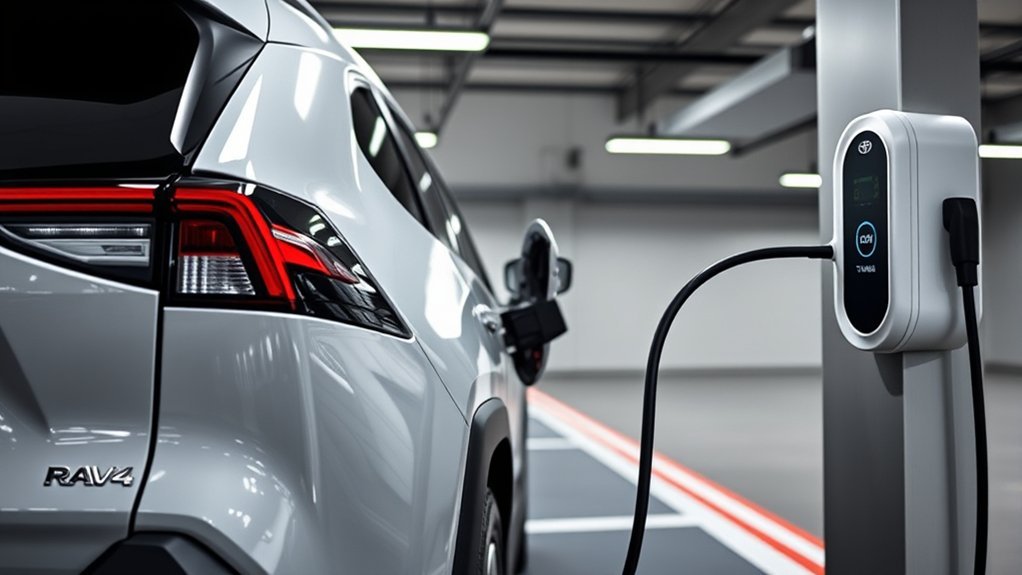
Three parts control AC charging speed:
- The electrical supply: A 120V outlet provides Level 1 charging. A 208V or 240V charging station provides Level 2 charging.
- The charging equipment: The portable cable or wall unit safely delivers power and tells the vehicle how much current is available.
- The vehicle’s onboard charger: This converts AC power to DC power for the traction battery and sets the car’s maximum AC charging rate.
A station rated for 9.6kW or 11kW does not force that much power into an older RAV4 Prime. A vehicle with a 3.3kW onboard charger remains limited to roughly that rate. A 6.6kW-equipped model can use more of a capable Level 2 station, which is why it finishes much sooner.
How to Identify Your Onboard Charger
Start with the model year and trim, then confirm the equipment rather than guessing from the charge port. Useful places to check include:
- The original window sticker or dealer build sheet
- The vehicle identification number through a Toyota dealer
- The charging specifications in the owner’s manual
- The original package list for a 2021–2022 XSE
For 2021 U.S. models, Toyota listed a 3.3kW onboard charger as standard and a 6.6kW unit as part of an available XSE premium package. For 2023, Toyota made the higher-output AC charger standard across the RAV4 Prime lineup. The 2024 and 2025 versions list a 6.6kW onboard charger as standard.
How Long Does It Take to Charge on a Standard 120V Outlet?
A 2021–2025 RAV4 Prime or RAV4 Plug-in Hybrid takes about 12 hours to recharge from empty on a suitable 120V household outlet under ideal conditions. The outlet, not the onboard charger’s full rating, is the main limit at Level 1.
This setup works well when the vehicle remains parked overnight. Plugging in after the evening commute can restore the battery before the next morning without installing a Level 2 station. It is also practical for drivers whose daily use stays within the vehicle’s electric range and who rarely need a second full charge on the same day.
Warning: Use a grounded, code-compliant outlet on the circuit specified by Toyota. Do not use a damaged receptacle, a household extension cord, a multi-plug adapter, or equipment that becomes unusually hot. Have an electrician inspect an old, loose, or frequently tripping outlet before charging.
Why Upgrade to a 240V Level 2 Charger?
Level 2 charging is most useful when you drive more than one electric-range trip per day, arrive home with a low battery, or have less than a full night available to recharge.
- Shorter charging time: A compatible 240V setup cuts an early 3.3kW model’s full-charge time to about 4.5 hours and a 6.6kW-equipped model’s time to about 2.5 hours.
- More flexibility: You can recharge between errands, shifts, or school runs instead of waiting overnight.
- Potentially lower charging losses: Level 2 charging often spends less total time running pumps, electronics, and conversion hardware, although actual efficiency varies.
- Better use of scheduled charging: A shorter session makes it easier to finish near your departure time or during a utility’s lower-rate period.
Level 2 does not increase the battery’s capacity or its rated electric range. It only reduces the time needed to replace energy.
Equipment Needed for Level 2 Charging
A home Level 2 setup needs a compatible EV charging station, a properly sized 208V or 240V circuit, and enough electrical-panel capacity. The station may plug into a suitable receptacle, such as a correctly installed NEMA outlet, or be hardwired. The right choice depends on the charging unit, local code, weather exposure, and the home’s electrical service.
The U.S. Department of Energy’s Alternative Fuels Data Center recommends safety-certified equipment and a qualified electrical contractor. An electrician can perform a load calculation, choose the circuit and protection required by local code, secure permits when needed, and confirm that the outlet or hardwired connection can carry a continuous charging load.
Pro Tip: Buy for the car you have and the car you may own next. A higher-capacity wall unit will not speed up a 3.3kW or 6.6kW RAV4 Prime beyond the vehicle’s limit, but suitable wiring may reduce the cost of a later upgrade.
How Public Level 2 Charging Affects Time
Public Level 2 stations use the same basic AC charging process as a home wall unit, but the displayed station rating is not always what the car receives. Charging can be slower when:
- The site supplies 208V instead of residential 240V
- Two connectors share one power cabinet
- The station limits current because of building demand
- The battery is very hot, very cold, or nearly full
- Cabin climate control or battery conditioning uses some incoming power
For 2021–2025 models, plan around the car’s 3.3kW or 6.6kW onboard limit, not the station’s highest advertised number. Public stations may also charge by energy, time, session, or parking duration, so check the posted pricing before leaving the vehicle connected.
Key Factors That Impact Charging Speed and Battery Longevity
The main factors are the onboard charger, available voltage and current, starting state of charge, battery temperature, and energy used by vehicle systems during the session. Charging also slows or changes near the top of the battery’s usable range, so a simple hours-per-percent calculation is only an estimate.
There is no Toyota rule requiring routine charging to stay between 35% and 65%. The vehicle manages charging and protects the traction battery through its control systems. Charge to the level needed for normal use, use the built-in schedule when it helps, and follow the storage and charging instructions in the owner’s manual.
For 2024 and 2025 models, Toyota’s published estimate is about 12 hours on 120V or 2.5 hours on Level 2 under ideal conditions.
Estimating a Partial Charge
For a rough estimate, multiply the published full-charge time by the fraction of usable charge you want to add. Adding about half a battery might take close to half the full-charge time, but the result can differ because charging is not perfectly linear.
For example, a 6.6kW-equipped 2021–2025 model may add a useful amount of range during a 20-minute Level 2 stop, but the exact miles depend on efficiency, temperature, starting charge, and power delivered. Use the vehicle’s displayed completion time instead of expecting one fixed mileage gain.
How Much Does a Full Charge Cost?
Use this simple formula:
Energy drawn from the wall × your electricity rate = estimated charging cost.
The 2021–2025 battery is roughly 18–19kWh, and the wall must supply somewhat more than the battery stores because charging is not 100% efficient. As a simple example, 20kWh at $0.15 per kWh costs about $3.00. Replace both numbers with your actual charging-session energy and utility rate for a better estimate.
Fast Charging Options for the Toyota RAV4 Prime
The answer now depends on model year:
- 2021–2024 RAV4 Prime: No DC fast-charging port. Level 2 is the fastest external charging method.
- 2025 RAV4 Plug-in Hybrid: No DC fast charging. It uses Level 1 or Level 2 AC charging.
- 2026 SE and GR SPORT: J1772 port for Level 1 and Level 2 charging. Toyota estimates about four hours from 10% to 80% on Level 2.
- 2026 XSE and Woodland: An 11kW onboard AC charger and CCS1 port add DC fast charging. Toyota estimates about 30 minutes from 10% to 80% under ideal conditions.
Toyota’s 2026 RAV4 specifications also state that all 2026 plug-in hybrid grades include a dual-voltage cable for 120V or 240V home charging.
What Owners Can Expect in Daily Use
Level 1 can be enough when the vehicle sits for 10–12 hours each night. Level 2 becomes more valuable when the daily commute uses most of the electric range, the vehicle returns home late, or the driver wants to recharge between separate trips.
A full battery does not mean the gasoline engine can never start. Strong acceleration, high speed, low temperature, defrost use, system protection, or the selected drive mode may cause the engine to run. On 2021–2025 models, the published electric range is up to 42 miles, but actual range changes with weather, speed, terrain, tires, and heating or air-conditioning use. The redesigned 2026 model is rated by Toyota at up to 52 manufacturer-estimated electric miles on SE and XSE, with lower estimates for Woodland and GR SPORT.
Tips for Optimizing Your RAV4 Prime Charging Routine
- Use the charging schedule: Set a start or departure time so charging finishes when you need the vehicle. This can also help you use lower utility rates where available.
- Choose Level 2 for quick turnarounds: A 240V station is most helpful when you need more than one electric-range trip in a day.
- Leave battery management to the car: Do not create an unsupported daily 35%–65% rule. Use the battery normally and follow Toyota’s manual for long-term storage.
- Use regenerative braking smoothly: Regeneration recovers some energy that would otherwise become brake heat. It improves efficiency, but it does not replace plugging in.
- Check the completion estimate: The dashboard or app estimate is more useful than a fixed calculation because it reflects current conditions.
- Keep the connector clean and supported: Protect it from dirt, damage, strain, and standing water, and stop using equipment that shows heat damage or exposed wiring.
How Does Temperature Affect Your Charging Time?
Battery temperature can change both charging speed and available electric range. Toyota does not publish one universal “ideal” outdoor range such as 35°F to 95°F for every charging session, so exact cutoffs should not be treated as specifications.
The 2024 RAV4 Prime owner’s manual describes battery-heating and battery-cooling functions that may operate when the traction battery is outside its preferred temperature range. Those functions can use energy and extend the charging session.
Cold Weather Impact
In cold conditions, the battery may accept energy more slowly, and some power may be used for battery or cabin heating. Electric range can also fall because the cabin heater and defroster draw energy. Parking in a garage and scheduling charging to finish near departure can help the battery start the trip warmer, but the result depends on the vehicle, settings, and temperature.
Heat Effects on Charging
High battery temperature can trigger battery cooling or reduced charging power. Avoid relying on unsupported claims that charging always drops to a specific wattage or that parking above one outdoor temperature always causes throttling. Parking in shade, charging during a cooler part of the day, and allowing the vehicle’s battery-cooling system to work can reduce heat-related delays.
RAV4 Prime Charging Troubleshooting
Charging Does Not Start
- Confirm the connector is fully inserted and locked as described in the manual.
- Check whether a charging schedule is delaying the start.
- Use “Charge Now” when you need to override the schedule.
- Check the outlet, breaker, charging-station screen, and cable indicator for an error.
- Try another known-good compatible station before assuming the car has failed.
The Breaker Trips or the Outlet Gets Hot
Stop charging if the plug, receptacle, cable, or wall area becomes unusually hot, smells burned, sparks, or shows discoloration. A tripping breaker can indicate an overloaded circuit, a worn receptacle, incorrect wiring, or a fault. Do not repeatedly reset it without finding the cause; have a qualified electrician inspect the circuit.
Charging Takes Longer Than Expected
Check the station’s actual delivered power, starting charge level, battery temperature, cabin climate use, shared-power limits, and whether the battery heater or cooler is operating. A public Level 2 station may also supply 208V, which can be slower than a similar residential 240V setup.
Frequently Asked Questions
How long does it take to charge a RAV4 Prime at a charging station?
At a compatible Level 2 station, an early model with a 3.3kW onboard charger takes about 4.5 hours for a full charge. A 6.6kW-equipped 2021–2025 model takes about 2.5 hours under ideal conditions. The 2026 charging time depends on trim and charging method.
Can you charge a RAV4 Prime with a regular outlet?
Yes. A suitable 120V household outlet can charge the vehicle with compatible Toyota charging equipment. A full charge takes about 12 hours on 2021–2025 models under ideal conditions. Use the outlet and circuit specified in the owner’s manual.
Is 20 minutes enough to charge a RAV4 Prime?
On 2021–2025 models, 20 minutes on Level 2 adds only a partial charge, and the exact range gained varies. A 2026 XSE or Woodland can use compatible DC fast charging, for which Toyota estimates about 30 minutes from 10% to 80% under ideal conditions.
How many electric miles will a RAV4 Prime go on a full charge?
The 2021–2025 U.S. models are rated at up to 42 electric miles. Toyota gives the 2026 SE and XSE a manufacturer-estimated range of up to 52 miles, while Woodland and GR SPORT have lower trim-specific estimates. Actual range varies with conditions.
How do I know whether my RAV4 Prime has the 3.3kW or 6.6kW charger?
Check the original window sticker, dealer build sheet, owner’s manual, or vehicle identification number with a Toyota dealer. Early 2021–2022 models may have different equipment, while the higher-output AC charger became standard for 2023.
Can I leave the RAV4 Prime plugged in overnight?
Yes, when you use compatible equipment and a safe electrical circuit. The vehicle controls the charging session. The built-in schedule can delay the start or target a departure time, which may be useful for utility rates and battery conditioning.
Does the Toyota RAV4 Prime support DC fast charging?
The 2021–2025 models do not. For 2026, XSE and Woodland have a CCS1 port and DC fast-charging capability; SE and GR SPORT use J1772 for Level 1 and Level 2 charging only.
Does regenerative braking fully recharge the RAV4 Prime?
No. Regenerative braking recovers some energy during slowing and helps improve efficiency, but it cannot replace the energy used to move the vehicle. Plugging in is the normal way to restore a full electric charge.
Conclusion
For most 2021–2025 RAV4 Prime and RAV4 Plug-in Hybrid models, expect about 12 hours on a regular 120V outlet or about 2.5 hours on Level 2 when the vehicle has the higher-output onboard charger. Early 3.3kW-equipped models need about 4.5 hours on Level 2. The 2026 redesign adds new trim-specific AC rates and DC fast charging on XSE and Woodland.
Use the model year and build equipment as your starting point, then account for station power, battery temperature, and starting charge. A safe home circuit, a sensible schedule, and the correct charging method will help you use more electric miles without relying on exaggerated range or battery-care rules.
Sources
- Toyota 2021 RAV4 Prime Sourcebook — 3.3kW and 6.6kW charging equipment, charging times, battery size, and electric range.
- Toyota: What’s New for 2023 — higher-output AC onboard charger becoming standard for the 2023 RAV4 Prime.
- Toyota 2024 RAV4 Prime — 12-hour Level 1 and 2.5-hour Level 2 estimates, 6.6kW onboard charger, and 42-mile range.
- Toyota 2025 RAV4 Plug-in Hybrid — name change, charging times, onboard charger, battery size, and electric range.
- Toyota 2026 RAV4 Plug-in Hybrid — trim-specific AC charging, CCS1 DC fast charging, 10%–80% estimates, and electric range.
- U.S. Department of Energy Alternative Fuels Data Center — home charging equipment, dedicated circuits, electrical capacity, permits, and qualified installation.