Firestone All Season 225/65R17 Review: Dependable Year-Round Grip at a Practical Price
Disclosure: As an Amazon Associate, we earn from qualifying purchases. If you click a link on this page and make a purchase, we may receive a small commission at no extra cost to you.
You need tires that handle wet roads, stay quiet on the highway, and don’t wear out after two winters. That’s the everyday ask for most drivers, and it’s exactly the promise the Firestone All Season 225/65R17 102H makes. This review breaks down whether it delivers, what its real limitations are, and who should buy it.
Our Verdict
Rating: 7.5/10 — Recommended
Best For: Daily drivers of sedans, CUVs, and minivans who want reliable wet-weather traction and long tread life without paying a premium price.
Bottom Line: The Firestone All Season delivers solid wet grip, low road noise, and a 65,000-mile warranty that’s hard to beat at this price point. It’s not a high-performance tire, and it won’t impress in heavy snow, but for year-round commuting it earns its keep.
| Specification | Detail |
|---|---|
| Brand | Firestone |
| Model | All Season (Part #013343) |
| Tire Size | 225/65R17 |
| Load Index / Speed Rating | 102H (1,874 lbs per tire / 130 mph max) |
| Tread Depth | 10/32nds |
| Tread Pattern | Symmetrical, silica-enhanced compound |
| UTQG Rating | 480 A B (Treadwear / Traction / Temperature) |
| Construction | Radial — polyester casing, dual steel belts, spiral-wrapped nylon cap |
| Rim Width | 6.5 inches |
| Overall Diameter | 28.5 inches |
| Weight | 24.1 lbs |
| Max Inflation Pressure | 44 PSI |
| Sidewall | Black Side Wall (BSW) |
| Warranty | 65,000-mile limited treadwear (passenger sizes); 55,000-mile (CUV sizes) |
| Vehicle Types | Coupes, sedans, CUVs, minivans |
| Load Range | SL (Standard Load) |
What Is the Firestone All Season 225/65R17?
The Firestone All Season is a touring all-season tire built for passenger cars, sedans, CUVs, and minivans. Firestone, a brand with over a century of tire manufacturing history and now part of Bridgestone Americas, positions this tire as a no-frills, everyday performer in the mid-range touring category. It’s not a performance tire, a dedicated winter tire, or a truck-focused option — it’s designed to handle whatever a typical commuter or family driver encounters across all four seasons.
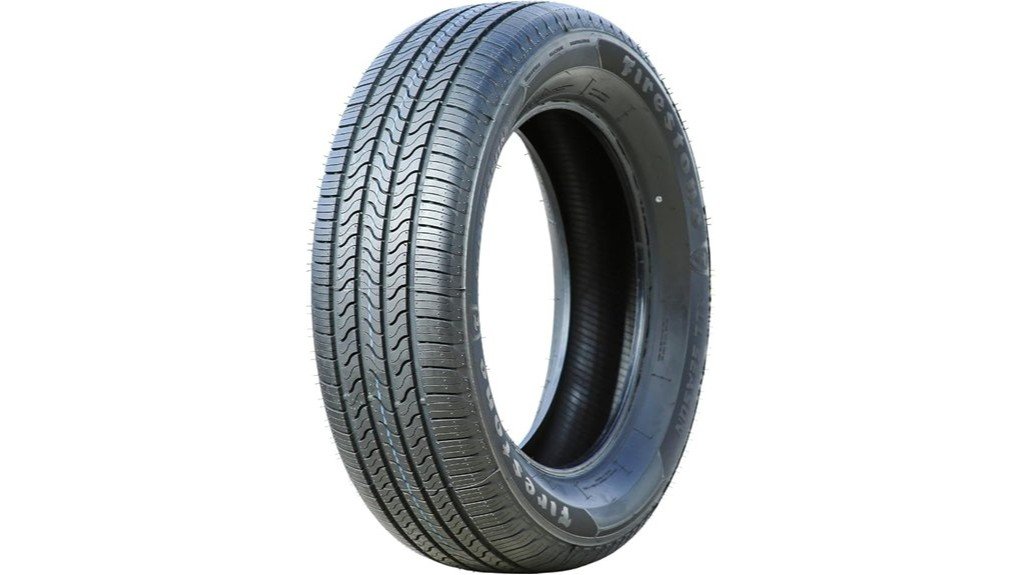
What sets it apart at this price tier is the combination of a silica-enhanced tread compound with four wide circumferential grooves and in-depth sipes. That design pairing is normally found in pricier touring tires. The silica compound helps the rubber stay pliable in cooler temperatures, improving wet and light-snow grip without sacrificing dry-road stability. The internal structure adds to ride quality: the tire is reinforced with a polyester casing, dual steel belts, and a spiral-wrapped nylon cap above the belts, which helps maintain shape under load and absorbs road vibrations before they reach the cabin.
At 24.1 lbs for the 225/65R17 size, it’s a reasonable weight for its class. The tire carries a UTQG rating of 480 A B, meaning it’s rated above average for treadwear (480 vs. the baseline 100), A-rated for wet traction, and B-rated for heat resistance. That UTQG treadwear score aligns with Firestone’s 65,000-mile warranty for passenger car fitments.
Who It’s For
- Daily commuters driving sedans or CUVs who encounter regular rain and occasional light snow and want reliable grip without shopping for separate seasonal tires.
- Minivan and family-hauler owners who prioritize a quiet, comfortable ride and want a long-lasting tire that doesn’t need replacing every two or three years.
- Value-focused buyers who want a recognized brand name with a solid warranty and won’t need extreme performance in corners or on track days.
Who Should Skip It
- Drivers in regions with frequent heavy snowfall or ice — this tire’s H-speed-rated all-season compound is not a substitute for a dedicated winter tire, and traction can drop quickly on packed snow or ice.
- Performance car owners or enthusiasts who want sharper handling response and shorter dry braking distances — a summer or ultra-high-performance all-season would be a better fit.
Firestone All Season 225/65R17 Tread Design and Grip
The Firestone All Season 225/65R17 uses a symmetrical tread pattern built around four wide circumferential grooves that run the full circumference of the tire. These grooves do the primary job of channeling water away from the contact patch as quickly as possible. Paired with in-depth sipes cut across the tread blocks, the design creates a large number of biting edges for grip on wet, slick, or lightly snow-covered surfaces.
The tread depth starts at 10/32nds, which is standard for a new all-season touring tire. Deeper tread means more water-evacuation capacity early in the tire’s life. As the tire wears toward the wear indicators (typically at 2/32nds), wet and snow grip will decline — that’s normal for any tire, but the 480 UTQG treadwear rating suggests this compound holds up well over time compared to many competitors at similar prices.
The silica-enhanced compound is worth noting because silica improves wet-road grip and keeps the rubber more flexible in cooler temperatures compared to traditional carbon-black compounds. This contributes directly to the A-rated wet traction score on the UTQG scale. Dry grip is stable and predictable thanks to the symmetrical pattern, which distributes contact load evenly across the tread face during straight-line driving and cornering.
Wet Weather Performance: Traction, Hydroplaning Resistance, and Braking
Wet performance is where this tire earns its recommendation. The four circumferential grooves rapidly move water out from under the tread footprint, which is the primary mechanism for resisting hydroplaning. At typical highway speeds in moderate rain, the 225/65R17 size maintains a confident contact patch. The sipes add secondary grip by deforming slightly to grip micro-texture on wet pavement, which helps during cornering and acceleration when the grooves alone aren’t enough.
For braking in wet conditions, the 102H load and speed rating supports the tire handling emergency stops within normal driving loads. The 225mm width gives a reasonably wide footprint without being so wide that it struggles to push water aside. Consistent 44 PSI inflation (check your door placard for your vehicle’s recommended pressure, which may be lower than the tire’s maximum) keeps the contact patch geometry correct and braking distances predictable.
Hydroplaning resistance improves with proper inflation and degrades as tread wears down. At 10/32nds new depth, this tire handles standard rainfall well. Drivers who frequently encounter heavy downpours will benefit from checking tread depth regularly — once below 4/32nds, wet-weather performance drops noticeably on any all-season tire.
Comfort and Noise: Ride Quality and Sound Levels
The Firestone All Season is tuned for touring comfort, and that shows in cabin noise levels. The symmetrical tread pattern avoids the aggressive block edges that create the pronounced road hum found in truck or all-terrain tires. On smooth highway pavement, the tire runs quietly. On rough chip-seal or coarser pavement, some noise is audible, but it stays within the range typical for this tire class.
Ride quality benefits from the internal construction. The dual steel belts and spiral-wrapped nylon cap absorb minor road irregularities and keep the tire’s shape stable under load, which reduces the vibration transferred to the chassis. The polyester body casing contributes additional compliance over bumps and expansion joints. The result is a ride that feels settled and predictable — not sporty or sharp, but comfortable and consistent for daily driving.
| Measure | What it means | Driver feeling |
|---|---|---|
| Low road noise tuning | Symmetrical tread minimizes hum | Quieter commute |
| 10/32nds tread depth | Stable grip and water clearance | Confident rolling |
| Dual steel belts + nylon cap | Shape stability under load | Smooth, settled ride |
Fitment Check: Rim Width and Recommended Tire Pressure
Getting fitment right directly affects how this tire wears and handles. The Firestone All Season 225/65R17 is designed for a 6.5-inch rim width. Running the tire on a rim significantly narrower or wider than this spec causes the tread to cup inward or flare outward, which accelerates uneven wear and compromises the contact patch shape.
The maximum tire pressure is 44 PSI, but you should not inflate to this number by default. Your vehicle’s recommended cold tire pressure — printed on the driver’s door jamb sticker — is almost always lower than the tire’s maximum. Inflating to the vehicle placard pressure gives you the correct contact patch size for your vehicle’s weight and the best balance of ride comfort, handling, and wear rate.
- Verify wheel width is near 6.5 inches before mounting
- Inflate to your vehicle’s door-jamb placard PSI, not the tire maximum
- Recheck pressure monthly and after significant temperature swings (pressure drops roughly 1 PSI per 10°F drop)
- Use a quality gauge for accurate readings — gas station gauges vary
- Inspect valve stems for cracks or corrosion at each rotation
How It Performs in Real Use
On a Daily Commute
For stop-and-go city driving punctuated by highway stretches, the Firestone All Season delivers exactly what most commuters need. The low noise tuning keeps cabin sound manageable on long drives. The silica compound provides predictable braking response in both dry and wet morning conditions. There’s nothing exciting about how this tire drives — and for commuters, that’s the point.
On Highway Road Trips
At sustained highway speeds, the tire stays composed and quiet. The 102H rating allows for speeds up to 130 mph, which comfortably covers all legal highway driving with margin to spare. The symmetrical tread pattern contributes to stable tracking — the steering doesn’t wander, and lane changes feel confident. On long trips, the comfortable ride quality means less driver fatigue compared to stiffer performance tires.
In Wet and Light-Snow Conditions
This is where the four circumferential grooves and silica compound do their most important work. In moderate rain, the tire clears water effectively and maintains confidence under braking. In light snow and slush, the in-depth sipes and all-season compound provide enough traction for careful driving. It’s not a winter tire — you’ll feel the limits quickly in heavy accumulation or icy conditions — but for regions with mild winters or occasional light snow, it handles the weather adequately.
Pros and Cons
Pros
- Four circumferential grooves plus in-depth sipes deliver A-rated wet traction (UTQG)
- 65,000-mile limited treadwear warranty (passenger sizes) — strong for the price tier
- Silica-enhanced compound stays pliable in cool temperatures for better all-season grip
- Low road noise from symmetrical tread pattern suits highway commuting
- Dual steel belts and spiral-wrapped nylon cap provide a stable, comfortable ride
Cons
- Traction drops quickly in heavy snow or ice — not a substitute for dedicated winter tires
- No road hazard coverage included; only the standard limited treadwear warranty applies
- CUV fitments get a shorter 55,000-mile warranty, not the headline 65,000-mile figure
Warranty, Mileage Coverage, and Overall Value
The Firestone All Season comes with a limited treadwear warranty of up to 65,000 miles for passenger car fitments. For CUV sizes — which this 225/65R17 may qualify as, depending on your vehicle — the warranty is 55,000 miles. The exact coverage depends on the size and speed rating listed on your tire’s sidewall, so verify before assuming the headline figure applies to your purchase.
Either figure is strong for a tire at this price point. The 480 UTQG treadwear rating backs up those numbers — higher treadwear ratings generally correlate with longer-lasting compounds. A 30-day return guarantee provides a short window if the tire doesn’t fit your vehicle as expected, though once mounted and driven, return eligibility typically ends.
Overall value is genuinely good here. You’re getting a highly rated brand, a silica compound, four circumferential grooves, and a long warranty without climbing into premium tire pricing. For drivers who cover 12,000 to 15,000 miles per year, a 65,000-mile warranty translates to four or five years of use — a compelling proposition for a budget-conscious buyer.
Is It Worth the Price?
The Firestone All Season sits in the mid-range touring category, and it performs at that level without pretending to be more. The value proposition is straightforward: you get a well-known brand with proven wet-weather technology, a long warranty, and a comfortable ride for everyday driving. Compared to budget off-brand tires, the Firestone earns its premium through the UTQG ratings, the silica compound, and the warranty backing.
Compared to true premium tires like the Michelin Defender T+H or Continental TrueContact Tour, this tire gives up some dry cornering precision and may not match their wet-stopping distances in independent tests. But for a driver who spends most miles on commutes and highway drives rather than canyon roads, those differences are unlikely to matter. The strong treadwear warranty also means the cost-per-mile math often favors the Firestone when comparing total ownership cost rather than just sticker price.
How It Compares to Alternatives
If long tread life is your top priority and you’re willing to spend more, the Michelin Defender T+H is the benchmark in this size — it consistently tops independent treadwear and wet-braking tests, though it carries a higher price. For buyers who want similar all-season performance at a comparable price point, the Goodyear Assurance All-Season is a frequently cited alternative with a similar warranty structure and wet-grip profile. If you drive a truck or larger SUV rather than a sedan or CUV, the Cooper CS5 Grand Touring offers a heavier-duty option in this size range with stronger handling feedback.
The Firestone All Season remains the practical choice for drivers who want a dependable, quiet, long-wearing tire from a recognized brand without paying flagship prices. It’s particularly strong on value when purchased as a set of four, where the per-tire warranty math becomes most compelling.
Frequently Asked Questions
Does the 65,000-mile warranty apply to all vehicles, including CUVs and crossovers?
Not always. Firestone’s limited treadwear warranty is 65,000 miles for passenger car sizes and 55,000 miles for crossover utility vehicle (CUV) sizes of the All Season tire. The 225/65R17 size can be fitted to both categories, so check the specific warranty terms for your vehicle type before purchasing. The warranty also requires proper inflation and regular rotation to remain valid.
Is the Firestone All Season 225/65R17 safe to drive in light snow?
Yes, with caution. The silica-enhanced compound, in-depth sipes, and 10/32nds tread depth provide adequate traction on lightly packed snow and slush at moderate speeds. However, this tire does not carry the Three-Peak Mountain Snowflake (3PMSF) symbol, meaning it has not been independently tested to the severe snow traction standard. For regions with regular heavy snowfall or frequent ice, dedicated winter tires are strongly recommended.
What rim width does the 225/65R17 require, and what happens if my rim is slightly different?
Firestone specifies a 6.5-inch rim width for this tire. A rim that is 0.5 inches narrower or wider than spec is generally acceptable, but greater deviations cause the sidewall to bulge inward or flare outward. This distorts the contact patch, increases edge wear, and can reduce wet-grip performance. Always verify your rim width against the tire’s fitment guide before mounting.
How does the UTQG 480 A B rating translate to real-world performance?
The UTQG system rates three factors: treadwear (480 means the tread is expected to wear about 4.8 times as long as the reference tire at 100), traction (A is the second-highest grade, indicating strong wet-pavement stopping ability), and temperature resistance (B indicates the tire withstands heat buildup adequately for highway use). The 480 treadwear rating is above average for all-season touring tires and supports the 65,000-mile warranty claim.
Can I rotate the Firestone All Season with other tires of a different brand if the size matches?
You can rotate tires of the same size (225/65R17) and compatible load and speed rating (102H or higher) regardless of brand, as long as the tread pattern type is compatible — all four positions should ideally be non-directional all-season tires. Mixing tire models can create minor handling imbalances, so it’s best to run all four of the same model where possible. If mixing is necessary, always put the higher-traction pair on the rear axle.
Is road hazard coverage included with this tire?
No. The Firestone All Season includes only the standard limited treadwear warranty of up to 65,000 miles (passenger) or 55,000 miles (CUV), plus a 30-day return window from most retailers. Road hazard protection — which covers damage from potholes, nails, and curb impacts — is not included from the manufacturer. Some retailers and third-party providers offer road hazard plans as an add-on at the time of purchase, which is worth considering given that sidewall damage is not covered under the treadwear warranty.
The Bottom Line
The Firestone All Season 225/65R17 is a solid, practical tire for everyday drivers who need year-round reliability without a premium price tag. Its four circumferential grooves, silica compound, and 10/32nds tread depth deliver on wet traction, and the 65,000-mile warranty (for passenger fitments) is one of the better coverage figures at this price level. If you drive a sedan, CUV, or minivan primarily on commutes and highway trips in a mild-to-moderate climate, this tire earns a confident recommendation at a 7.5/10. Drivers in heavy-snow regions or those who want sharper performance handling should look at winter-tire pairings or premium all-season alternatives instead.
Ready to Buy?