

You want an inflator that uses the least electricity to reach an accurate PSI, because efficiency is about energy per volume pumped (watt‑hours per cubic foot), not just raw CFM. Choose diaphragm or brushless designs for lower draw and less heat; prioritize ±0.5–1 PSI accuracy and an automatic shutoff. Watch duty cycle and cooling features to avoid downtime and wear. Keep measurements consistent for real comparisons, and if you keep going you’ll learn practical selection and testing tips.
What Tire Inflator Efficiency Actually Means and Why It Matters
Think of inflator efficiency as the energy cost to add air to a tire — lower watt-hours mean you use less electricity per inflation and pay less over time if you fill tires often. You’ll judge a portable tire inflator by its energy efficiency: how many watt-hours it needs to reach proper tire pressure. That metric ties directly to energy consumption, operating cost, and environmental impact. You’ll prefer diaphragm designs over piston compressors when you want fewer moving parts and lower draw, and you’ll value high-quality motors that cut losses through better insulation and low resistance. Variable-speed motor control matters because it matches power to demand, trimming consumption during slow fills and avoiding waste. For someone seeking autonomy from wasted energy and recurring bills, selecting an efficient inflator reduces carbon footprint and preserves resources while keeping tires at safe pressure. Efficient choice is liberation — you control cost, consumption, and performance.
Accuracy Vs Airflow: Why ±0.5–1 PSI Beats Raw CFM
Although a high CFM rating promises faster fills, you’ll get more real-world benefit from an inflator that holds pressure to ±0.5–1 PSI because accuracy directly preserves safety, tire life, and fuel economy. You want tools that measure, not guess. Digital pressure readouts prevent over-inflation and flag underinflated tires before they cost you grip, rubber, or mpg. Small PSI deviations compound: a 3 PSI drop can cut fuel efficiency by about 3%. Prioritizing accuracy over raw airflow lets you stop when you reach the target, saving energy and reducing wear.
| Metric | Benefit |
|---|---|
| ±0.5–1 PSI accuracy | Optimized safety |
| Digital pressure | Repeatable readings |
| High CFM alone | Faster but imprecise |
| Underinflated tires risk | Wear, instability |
| Energy efficiency | Lower long-term consumption |
Choose precision. You’ll free yourself from waste, extend tire life, and reclaim control over performance and consumption.
Compressor Types Compared: Piston, Diaphragm, Brushless Motor
Now that you’ve prioritized accurate pressure control over raw CFM, pick the compressor architecture that best delivers that balance of performance and efficiency. You’ll find three main compressor types: piston units, diaphragm compressors, and systems driven by brushless motors. Piston compressors are familiar and deliver high flow, but they consume more energy during prolonged use and generate excess heat and wear. Diaphragm compressors use a flexible membrane to compress air with fewer moving parts, so they typically show better energy efficiency and lower maintenance. Brushless motors reduce electrical resistance and heat compared with brushed designs, improving overall device efficiency and longevity when paired with either piston or diaphragm heads. Quantify efficiency in watt-hours per cubic foot of air to compare models objectively. Choose diaphragm compressors when you want sustained, efficient operation with minimal losses; prefer brushless-motor drives when you need durable, energy-conscious control. Your choice liberates you from wasted energy and unnecessary replacements.
[Products Worth Considering]

Ultra-Fast & Ultra-Quiet Inflation: Experience the power of an ultra quiet air compressor. Engineered with a high-performance motor and advanced noise reduction, it delivers strong 45L/min airflow while keeping operation remarkably quiet. It inflates a standard car tire in under 48 seconds, with auto shut-off for perfect pressure every time.
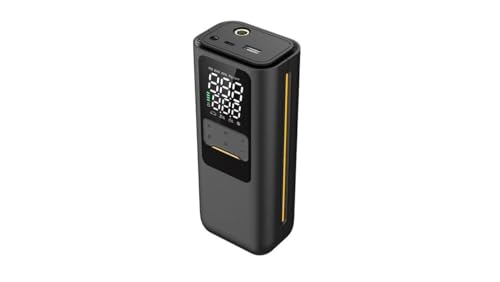
USB-C Rechargeable & Truly Cordless – Enjoy fast and universal charging with the included USB-C cable. The built-in rechargeable battery allows full portability—perfect for inflating your tires or sports gear anytime, anywhere, without being tethered to a power outlet.
Thermal Management and Duty Cycle : Staying Safe and Fast
You should evaluate an inflator’s heat dissipation design—finned housings, airflow channels, and thermal interface materials—to judge how quickly it sheds heat under load. Follow the manufacturer’s duty cycle guidelines (commonly ~30 minutes) to prevent motor wear and automatic thermal shutdowns. Regular maintenance and respecting cooldown intervals will keep the unit safe and operating at peak efficiency.
[Products Worth Considering]

[Fast & Efficient Inflation] The OlarHike tire inflator features a high-performance motor that delivers rapid airflow—inflate a standard car tire (195/65 R15) from 30 to 35 PSI(+5 PSI) in just 55 seconds, or a larger SUV tire (235/65 R17) from 30 to 35 PSI(+5 PSI) in only 2.2 minutes. Ideal for cars, SUVs, light Pickup(Within 51 PSI), motorcycles, bicycles, and sports balls. Important Note: The unit can only inflate car/pickup truck tires up to 51 PSI

QUICK & ACCURATE: Built with the highest quality materials, Airmoto is a portable tire inflator for car, trucks, SUVs, motorcycles, and bicycles. Quickly inflate your vehicle's tires in just minutes with precision accuracy up to 120 PSI. Small and compact car air pump that fits in your glove box or trunk.

Tired of inflators that get too hot and shut down halfway? Ours won’t let you down. Thanks to a smart cooling design, this pump stays cool even during extended use. You can easily inflate 3 standard car tires (195/65 R15) on a full charge — no overheating, no stopping, just get the job done
Heat Dissipation Design
Because heat is the primary limiter of continuous operation, a tire inflator’s thermal management and duty cycle determine how safe and quickly you can inflate tires without damaging the unit. You’ll prioritize heat dissipation design to extend life, reduce wasted energy, and keep portable inflators ready for tire inflation tasks. Efficient cooling—vents, heat sinks, and thermal sensors—lets you work longer without stopping. Choose models with controlled thermal paths so heat exits where it won’t harm components. That liberates you from slow, cautious cycles and lowers operational cost. Below is a concise comparison of thermal features to guide choices.
| Feature | Benefit | Impact |
|---|---|---|
| Vents | Direct airflow | Lower temps |
| Heat sinks | Surface area | Faster cooling |
| Sensors | Active control | Safer runs |
| Insulation | Protects electronics | Longer life |
Duty Cycle Guidelines
After evaluating heat sinks, vents, and sensors, focus next on duty cycle guidelines to manage how long your inflator can run without overheating. You’ll treat duty cycle as a safety window: most portable tire inflators allow 20–50% duty cycles — for example, 10 minutes on, 10–40 minutes off — to prevent overheating and preserve motor life. Respect those intervals to avoid reduced efficiency or failure. High-efficiency designs extend run time via active thermal management, but you still monitor temperature and rest when advised. By understanding and following duty cycle limits you protect equipment, maintain consistent inflation that minimizes tire wear, and keep operations liberating rather than constrained by avoidable breakdowns.
Measuring Efficiency: Watt‑Hours per Cubic Foot and Practical Tests
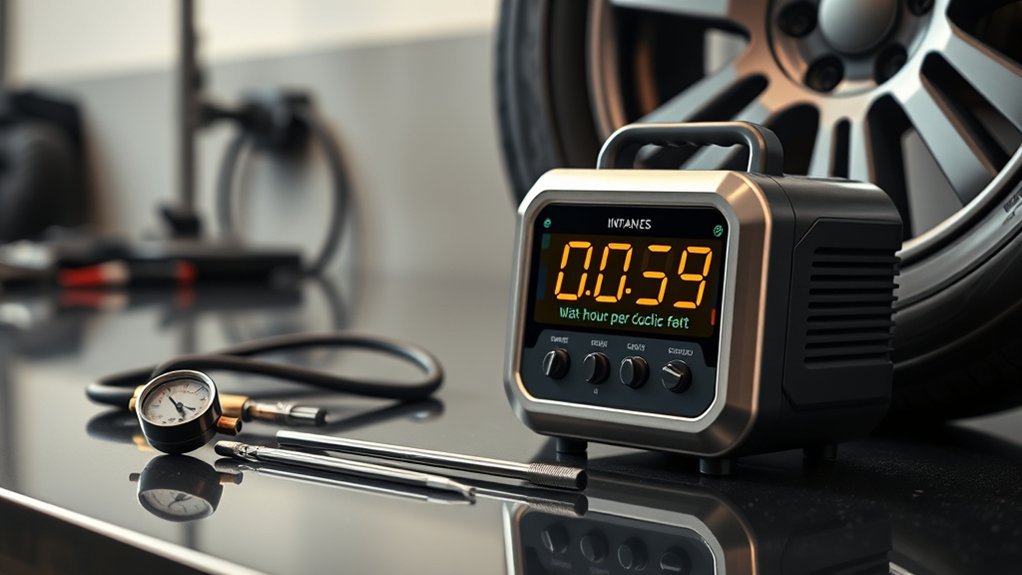
You’ll compare watt‑hours per cubic foot to judge how much electricity an inflator uses to move a given volume of air, with lower values meaning better efficiency and lower operating cost. Run real‑world inflation tests—timing fills from a standard empty tire to target pressure while recording energy use—to see how diaphragm vs piston units and variable‑speed motors perform in practice. Use those measured WH/ft³ figures to rank models and predict annual energy costs for your typical usage.
Watt‑Hours Per Cubic Foot
Think of watt‑hours per cubic foot as the single metric that tells you how much electrical energy a tire inflator uses to move a fixed volume of air into a tire. You’ll use watt-hours per cubic foot to compare energy efficiency across tire inflators, favoring lower numbers to cut operating costs and shrink your environmental footprint. Practical bench tests quantify that metric so you can choose models that align with frugality and autonomy.
- Compare watt-hours per cubic foot across models before buying.
- Prioritize low figures to reduce electricity use and operating costs.
- Use consistent test conditions to guarantee fair comparisons.
This metric frees you from vague claims: it’s precise, actionable, and directly links energy efficiency to real savings and sustainable choice.
Real‑World Inflation Tests
When you run real‑world inflation tests, measure watt‑hours per cubic foot for each model under identical conditions so you get a direct, comparable energy metric; this lets you rank diaphragm and piston compressors by true operating cost rather than marketing claims. You’ll test tire inflators on the same tire size, start pressure, and ambient temperature, recording energy consumed and volume delivered. Diaphragm units usually show lower watt‑hours per cubic foot because fewer moving parts and smoother loads cut losses. Measure with and without variable speed control engaged to see motor efficiency effects. For a portable inflator, prioritize low watt‑hours per cubic foot and quality motor specs; frequent users free themselves from waste and shrink both bills and carbon footprint.
Real-World Impact: Inflation Time, Electricity Cost, and Battery Life
Although an efficient inflator won’t eliminate all cost or time concerns, it can cut both meaningfully: you’ll see real savings in inflation time, electricity cost, and battery life when you choose energy-efficient tire inflators. A large SUV tire typically takes about 7.6 minutes to go from 20 to 35 PSI; inflating all four takes roughly 30 minutes, so efficiency adds up when you’re regaining freedom on the road.
An efficient inflator trims inflation time, electricity and battery drain — saving minutes and money when you’re back on the road.
- Diaphragm compressors and well-designed motors lower watt-hours per cubic foot, trimming electricity cost.
- Variable speed control matches power to demand, preserving battery life and reducing wasted energy.
- For portable use expect trade-offs: cordless convenience can shorten run time and reduce efficiency during prolonged inflation.
You want liberation from recurring expense and delay. Prioritize devices with high-quality motors, good insulation, and adaptive controls to minimize energy draw and maximize uptime without sacrificing portability.
How to Pick the Right Inflator for Your Vehicle and Use Case
Which inflator fits your vehicle and use case depends on three practical factors: power source, inflation performance, and control features. You’ll choose 110V AC for home efficiency or a cordless battery-powered unit if you need true portable freedom; 12‑V plug models sit between—convenient for roadside top‑ups without separate charging. Prioritize energy efficiency by comparing watt-hour figures and expect lower operational cost from lower consumption.
Assess inflation performance quantitatively: check airflow (L/min) and target PSI time—larger units fill faster but reduce mobility. For control features, select a tire inflator with a digital pressure gauge and automatic shut-off to prevent over-inflation and maintain safety. Match form factor to mission: compact, lightweight units serve emergency kits; heavier, higher‑capacity models suit frequent highway use. You’ll reduce waste and dependence by aligning power source, speed, and controls to your routine—liberating you from unnecessary energy drain and ill‑fitting gear.
[Products Worth Considering]

Please Note: This product must be powered by a 12V DC Cigarette Lighter to function properly, and ensure the vehicle is in a running state. And it equipped with a 9.8-foot cord, which can meet the usage needs of most regular-sized vehicles.

ADVANCED TRUEGAUGE SCREEN: This battery tire inflator includes updated sensor technology, capable of collecting pressure data from tire inflators at a frequency of 200 times per second. Its valid data rate is higher than 80%, which is 60% better than the market average. Wherever you go, accurate readings help you drive safely.

【Accurate Digital Tire Gauge】The digital pressure gauge always returns a stable reading within 1% of the exact pressure of your tire by incredible 0.1 display resolution. No more guessing!
Maintenance Checklist to Maximize Efficiency and Longevity
Having picked the right inflator for your needs, you should set up a short maintenance checklist that keeps tires at recommended PSI and preserves both fuel economy and tire life. You’ll perform bi-weekly tire pressure checks with tires cold, since temperature skews PSI and performance. Use calibrated digital tools or high-efficiency air compressors to measure and correct tire pressure; visual checks under-report inflation by ~25%. Inspect tread and sidewalls for damage and note environmental factors that affect pressure. Record target PSI, last check date, and device calibration on your maintenance checklist so corrective action’s immediate.
Set a simple bi-weekly cold-tire checklist: calibrated gauge checks, damage inspection, logged PSI and calibration for prompt corrections.
- Bi-weekly cold tire pressure checks with calibrated digital gauge
- Inspect tires for damage; log target PSI and correction actions
- Maintain and calibrate air compressors; replace faulty hoses or gauges
Stick to this regimen to reclaim efficiency and autonomy: correct tire pressure boosts fuel economy up to 3% and extends tire life, reducing waste and cost while keeping you free to move.
Frequently Asked Questions
What Is the 3% Tire Rule?
The 3% tire rule means keeping proper tire pressure can boost fuel efficiency by about 3%, improving safety benefits, reducing rolling resistance, and extending tire lifespan so you save fuel, money, and gain greater driving freedom.
What Is Better, H or V Rating on Tires?
About 60% of performance drivers prefer V-rated tires; you’ll pick V for superior tire performance and handling characteristics at higher speeds, while H favors comfort and marginally better fuel efficiency—choose based on your driving style.
What Is the 5 PSI Rule?
The 5 PSI rule says you should keep tires within 5 PSI of the manufacturer’s recommendation because psi measurement techniques show tire pressure effects on fuel use and handling; inflation frequency importance guarantees tire performance optimization and safety.
What Are the Disadvantages of Tire Inflators?
Like a ticking clock, you’ll face noise levels that grate, portability issues when batteries fail, higher power consumption on long jobs, and durability concerns from overheating or weak parts—so you won’t stay dependent on poor gear.
Conclusion
You now know what efficiency really means: balancing accurate pressure with steady airflow, minimizing watts per cubic foot, and managing heat to extend duty cycle. You’ll compare compressor types, weigh trade-offs between CFM and ±0.5–1 PSI accuracy, and test real-world performance. You’ll choose the inflator that fits your vehicle and use, you’ll track inflation time and energy cost, and you’ll keep up routine maintenance to preserve efficiency and longevity.







Leave a Reply