Before you approve a Toyota RAV4 timing belt replacement, confirm which engine is in the vehicle. For U.S.-market gasoline and hybrid RAV4s, the basic split is simple: 1996-2000 models use a timing belt, while 2001 and newer models use a timing chain. Imported and diesel versions may differ, so the engine code or VIN is the final authority.
Quick Answer
Most U.S.-market Toyota RAV4 models from 2001 onward use a timing chain. The 1996-2000 RAV4 with the 2.0-liter 3S-FE engine uses a timing belt. Because engines vary by country and trim, verify the engine code through the owner’s manual, VIN records, or a Toyota service department before approving service.
Key Takeaways
- U.S. 1996-2000 RAV4 models with the 2.0-liter 3S-FE engine use a timing belt.
- U.S. gasoline, hybrid, and plug-in hybrid RAV4 engines from 2001 onward use timing chains.
- A timing chain normally has no routine replacement interval, but it can still wear or develop guide and tensioner problems.
- A visible rubber belt under the hood is usually an accessory or serpentine belt, not the hidden timing belt.
- Cold-start rattle, timing-related fault codes, rough running, or low oil pressure deserve diagnosis, but none of these symptoms proves the chain is bad by itself.
At a Glance
| Time Required | About 5-15 minutes to verify the model year, engine, and VIN |
| Difficulty | Easy to verify; timing-system repair is an advanced professional job |
| Tools Needed | Owner’s manual, VIN, maintenance records, and a phone or computer |
| Cost | Usually free to verify; inspection and repair charges vary by engine, location, and damage found |
What Type of Timing Component Does the Toyota RAV4 Use?
The Toyota RAV4 has used both timing belts and timing chains. The timing drive keeps the crankshaft and camshaft synchronized so the valves open and close at the correct point in the engine cycle.
A timing belt uses reinforced rubber and runs behind protective covers. A timing chain uses metal links and normally runs inside a sealed metal cover where engine oil lubricates it. Toyota’s current engine timing-component chart identifies the 3S-FE as a belt engine and later RAV4-related engine families such as the 2AZ-FE, 2AR-FE, 2GR-FE, A25A-FKS, and A25A-FXS as chain engines.
For a vehicle-specific answer, use the Toyota manuals and warranties portal, then confirm the engine through the VIN or a Toyota parts or service department.
Note: The year ranges below are for common U.S.-market gasoline, hybrid, and plug-in hybrid RAV4 models. Toyota sold different engines in other countries, including diesels, so imported vehicles must be checked by engine code.
Which RAV4 Years Have a Timing Belt or Chain?
The following chart is a practical U.S.-market guide. It is accurate for the common factory engines listed, but a VIN check is still wise when the vehicle was imported, engine-swapped, or registered with incomplete records.
| U.S. RAV4 Model Years | Common Engine | Timing Component | Service Approach |
|---|---|---|---|
| 1996-2000 | 2.0L 3S-FE four-cylinder | Timing belt | Follow the exact maintenance supplement and documented service history |
| 2001-2005 | 2.0L or 2.4L gasoline four-cylinder | Timing chain | No routine chain replacement; inspect when symptoms or related faults appear |
| 2006-2012 | 2.4L/2.5L four-cylinder or 3.5L V6 | Timing chain | Condition-based diagnosis and repair |
| 2013-2018 | 2.5L gasoline; 2.5L hybrid from 2016 | Timing chain | Condition-based diagnosis and repair |
| 2019-2025 | 2.5L Dynamic Force gasoline, hybrid, or plug-in hybrid | Timing chain | Condition-based diagnosis and repair |
| 2026 | 2.5L A25A-FXS hybrid or plug-in hybrid | Timing chain | Condition-based diagnosis and repair |
Toyota moved the U.S. RAV4 to a fully electrified hybrid and plug-in hybrid lineup for 2026. Toyota identifies the 2026 gas engine as the A25A-FXS, which its official engine chart lists as chain-driven.
The engine code is more reliable than the model-year badge when you need a final belt-or-chain answer.
How to Confirm Your Exact RAV4 Timing System
Confirm the timing setup before approving a replacement, comparing repair quotes, or buying parts. A few minutes of checking can prevent a belt estimate from being applied to a chain-driven engine.
- Check the owner’s manual and maintenance guide. Search for “timing belt,” “camshaft drive belt,” or a scheduled replacement item. A chain usually is not listed as routine maintenance.
- Locate the VIN. It is normally visible through the lower driver’s-side windshield and appears on registration and insurance documents.
- Decode basic vehicle data. The NHTSA VIN Decoder can show manufacturer-reported vehicle information. It may not settle every engine detail, so use the result as a starting point.
- Ask Toyota to check the VIN. A Toyota parts or service department can match the VIN to the original engine and timing components.
- Review maintenance records. A 1996-2000 RAV4 should have documentation showing whether and when the timing belt was inspected or replaced.
- Check the engine code if the vehicle is imported. Market-specific engines can break the simple U.S. year rule.
Pro Tip: Ask the shop to write the engine code and “timing belt” or “timing chain” on the estimate. That makes it easier to compare quotes and catch a parts-catalog mistake before work begins.
Do Not Confuse the Timing Belt With the Serpentine Belt
A RAV4 can have a timing chain and still have a visible rubber belt under the hood. That visible belt is normally the accessory or serpentine belt, which drives components such as the alternator, air-conditioning compressor, or water pump, depending on the engine design.
The timing belt on a 1996-2000 RAV4 sits behind protective covers. The timing chain on newer models sits behind a sealed metal cover and is lubricated by engine oil. Seeing a rubber belt near the front or side of the engine does not mean the engine uses a timing belt.
| Part | Where It Is | What It Drives |
|---|---|---|
| Timing belt | Hidden behind timing covers | Camshaft timing |
| Timing chain | Inside a sealed, oil-lubricated metal cover | Camshaft timing |
| Serpentine or accessory belt | Usually visible from the engine bay | External engine accessories |
Advantages of Timing Chains Over Timing Belts
A timing chain is durable and normally does not appear as a routine replacement item in Toyota’s maintenance schedule. That can reduce planned maintenance compared with a belt-driven engine.
However, “no scheduled replacement” does not mean “maintenance-free” or “guaranteed for life.” The chain, guides, sprockets, variable-valve-timing components, and hydraulic tensioner still depend on the correct oil level, oil condition, and oil pressure.
A timing belt does not share the engine’s oil supply. It ages through heat, time, mileage, contamination, and mechanical wear, so owners must follow the exact schedule and service history for that engine.
Timing Belts vs. Timing Chains: Key Differences
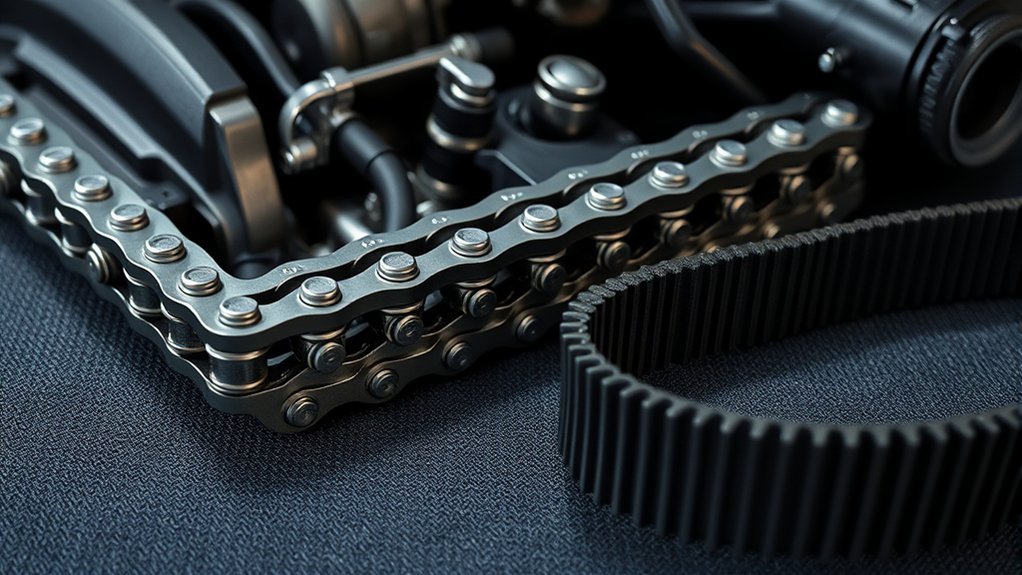
Timing belts and chains perform the same basic job, but their materials, location, and service needs differ.
| Feature | Timing Belt | Timing Chain |
|---|---|---|
| Material | Reinforced rubber or composite | Metal links |
| Location | Behind protective covers | Inside a sealed, oil-lubricated cover |
| Routine service | Inspection or replacement based on the exact maintenance guide | Usually no periodic replacement; diagnose by condition |
| Common wear points | Belt teeth, backing, tensioner, idlers, seals, and related pulleys | Chain, guides, tensioner, sprockets, oil supply, and variable-timing parts |
| Possible warning signs | Unknown service history, visible damage during inspection, hard starting, or timing faults | Start-up rattle, timing-correlation codes, rough running, or evidence of guide and tensioner wear |
Identifying Signs of Timing Chain Issues
A new rattle at start-up can justify inspection, especially when it appears with a check engine light, low oil level, low oil pressure, rough running, or timing-correlation fault codes. The sound may come from the chain, guide, tensioner, variable-valve-timing gear, accessory drive, or another engine part, so diagnosis matters.
Rough idle, stalling, poor acceleration, hard starting, or misfires can occur when valve timing is wrong, but these symptoms also have many ignition, fuel, air, sensor, and compression-related causes.
| What You Notice | What It Could Mean | Next Step |
|---|---|---|
| Brief or repeated rattle after a cold start | Possible oil-pressure delay, tensioner, guide, chain, VVT gear, or accessory noise | Record the sound and request a cold-start inspection |
| Rough idle, stalling, or weak acceleration | Possible timing error, sensor fault, ignition problem, fuel problem, or low compression | Scan for codes and perform mechanical diagnosis |
| Camshaft/crankshaft correlation code | The computer sees timing data outside the expected relationship | Check oil condition, sensors, wiring, VVT operation, and mechanical timing |
| Low oil-pressure warning | Possible lubrication failure that can affect the timing system and the entire engine | Shut the engine off safely and arrange diagnosis |
| Low compression or no-start condition | Possible incorrect mechanical timing or internal engine damage | Do not keep cranking; request immediate testing |
What Could Go Wrong With a Failing Timing Chain?
A worn chain system can allow valve timing to move outside its intended range. The engine may run poorly, set fault codes, stall, or fail to start. If the chain jumps far enough or breaks, internal damage is possible, although the exact result depends on the engine and the failure.
Warning: Stop the engine and arrange service if a loud mechanical rattle appears with a low oil-pressure warning, a flashing check engine light, severe misfiring, or sudden loss of power. Continuing to drive may turn a repairable fault into major engine damage.
- Valve timing can move out of synchronization with crankshaft position.
- A worn guide or weak tensioner can allow excess chain movement and noise.
- The engine may lose power, misfire, stall, or refuse to start.
- A severe timing error can reduce compression.
- Low oil, dirty oil, sludge, or oil-pressure problems can accelerate wear in a chain-driven system.
When Should You Inspect Your Timing Chain?
Most RAV4 timing chains are inspected because of symptoms, diagnostic codes, oil-pressure concerns, or related engine work rather than at a fixed mileage. High mileage alone does not prove that replacement is needed.
Request an inspection when the engine develops a new start-up rattle, repeated camshaft/crankshaft correlation codes, rough running that remains after basic diagnosis, metal or guide material in the oil, or an oil-pressure problem.
A complete check may include the oil level and condition, stored and pending fault codes, sensor data, mechanical timing, chain elongation, guides, tensioner, sprockets, VVT components, and oil-pressure testing. The correct scope depends on the symptoms and engine.
Maintenance Tips for Timing Chains in the RAV4
You can reduce avoidable timing-chain wear by maintaining the lubrication system and responding early to new noises or warning lights.
Regular Oil Changes
Follow the oil type, viscosity, level-check method, and service interval in the owner’s manual for your exact RAV4. Severe use, including repeated short trips, towing, dusty operation, long idling, or extreme temperatures, may change the maintenance needs listed in the guide.
- Use oil that meets Toyota’s specification for the engine.
- Keep the oil level within the dipstick’s safe range.
- Repair leaks and investigate abnormal oil consumption.
- Do not ignore an oil-pressure warning.
- Note whether a new rattle appears only after an overnight cold soak or continues after oil pressure builds.
Inspecting Chain Wear
A mechanic should test before recommending a complete chain replacement. The chain may be serviceable while a guide, tensioner, VVT gear, sensor, wiring circuit, or oil-supply problem causes the symptom.
| Component or Check | What the Technician Looks For |
|---|---|
| Timing chain | Excess elongation, slack, damaged links, or incorrect timing alignment |
| Tensioner | Sticking, leakage, weak extension, or an oil-pressure-related problem |
| Guides | Cracks, grooves, missing material, or abnormal contact |
| Sprockets and VVT parts | Wear, sticking, timing errors, or actuator faults |
| Oil supply | Low level, wrong viscosity, sludge, restricted passages, or low pressure |
| Sensors and wiring | A false timing signal caused by a sensor, connector, wiring, or control fault |
Signs of Failure
Timing-chain symptoms overlap with many other engine faults. Ask for test results rather than approving a chain kit based on noise alone.
- Persistent mechanical rattle from the timing-cover area
- Repeated timing-correlation or camshaft-position codes
- Unexpected stalling, misfiring, or rough idle
- Weak acceleration combined with timing faults
- Low compression caused by incorrect valve timing
- Visible chain, guide, tensioner, or sprocket damage during inspection
Does a RAV4 Timing Belt Need Scheduled Replacement?
Yes. If your RAV4 has the 3S-FE timing belt, use the maintenance guide and documented service history for that exact model and market. Do not apply a generic internet interval without checking the Toyota schedule.
Toyota’s Japan-market engine chart lists belt-driven engines with a 100,000-kilometer replacement reference and chain-driven engines with no periodic replacement. That chart is useful for understanding Toyota’s general distinction, but a U.S. owner should still follow the U.S. warranty and maintenance supplement because inspection and replacement instructions can vary by model year and operating conditions.
If the history is unknown on a 1996-2000 RAV4, have a qualified technician inspect the vehicle and identify the safest next step. Age, contamination, tensioner and idler condition, oil leaks, coolant leaks, and prior installation quality can matter as much as the odometer.
During belt service, a shop may recommend the tensioner, idler pulleys, seals, accessory belts, or water pump when inspection or labor overlap supports it. Ask which items are required, which are worn, and which are optional preventive work.
Note: A timing-belt replacement and a timing-chain repair are different jobs with different parts, labor, and diagnostic needs. Confirm the engine and failed component before comparing estimates.
What a Timing-System Estimate Should Include
An itemized estimate helps you understand whether the shop is performing scheduled belt service, diagnosing a noise, or repairing confirmed chain damage.
- Vehicle identification: VIN, model year, engine size, and engine code.
- Diagnosis: Fault codes, test results, noise source, oil-pressure findings, and the reason replacement is recommended.
- Parts: Belt or chain, guides, tensioner, sprockets, seals, gaskets, fluids, and any related components.
- Labor: Diagnostic time separated from replacement labor when possible.
- Optional work: Preventive parts should be labeled separately from parts that failed inspection.
- Warranty: Coverage for parts and labor, plus any conditions that apply.
For a chain-driven RAV4, be cautious of an estimate that lists only “timing chain” without explaining the evidence. A complete diagnosis should address oil condition, tensioner and guide wear, timing data, sensors, and VVT components where relevant.
Common Mistakes to Avoid
- Assuming every RAV4 follows one global year chart. U.S. gasoline and hybrid models are simple, but imported and diesel engines may differ.
- Confusing the visible accessory belt with a timing belt. A chain-driven RAV4 still uses external drive belts.
- Approving belt replacement without VIN or engine confirmation. Most 2001 and newer U.S. RAV4s use chains.
- Calling a chain “lifetime” and ignoring oil care. No scheduled replacement is not the same as no possible wear.
- Diagnosing a chain from a rattle alone. VVT parts, accessory components, oil-pressure delay, and other faults can sound similar.
- Continuing to drive with low oil pressure or severe misfiring. These warnings can indicate a broader engine risk.
- Comparing non-itemized estimates. Belt service, chain diagnosis, and internal engine repair are not equivalent jobs.
Why Choose Berglund Toyota for Toyota Timing Service?
For drivers near Lynchburg, Virginia, Toyota lists Berglund Toyota as an authorized local dealer. Its service department is one option for VIN-based engine identification, Toyota parts lookup, diagnosis, and repair. It is not the only qualified choice, so compare the written diagnosis, parts, warranty, and total scope with another Toyota dealer or an experienced independent shop when the repair is major.
- Toyota-focused technicians: The service department states that it uses Toyota factory-trained technicians.
- VIN and parts-catalog access: A dealer can match the VIN to the original engine and factory parts listing.
- Online scheduling: The dealer provides service appointment options through its website.
- Complete inspection: Ask for the oil, sensors, VVT system, chain, guides, and tensioner to be evaluated as the symptoms require.
- Current offers: Check any service special’s terms and expiration before assuming it applies to timing-system work.
- Local access: Toyota lists the dealership at 19018 Forest Road in Lynchburg, Virginia.
Bring the VIN, maintenance records, videos of any cold-start noise, and previous diagnostic results. Readers outside the Lynchburg area can use Toyota’s dealer search or choose a reputable independent repair facility with Toyota engine experience.
Frequently Asked Questions
What year did the Toyota RAV4 switch from a timing belt to a timing chain?
For common U.S.-market gasoline models, the change occurred with the 2001 model year. The 1996-2000 2.0-liter 3S-FE uses a timing belt, while the 2001 and newer U.S. gasoline, hybrid, and plug-in hybrid engines use timing chains. Verify imported vehicles by engine code.
Does a Toyota RAV4 timing chain need scheduled replacement?
Normally, no. Toyota identifies chain-driven engines as having no periodic chain replacement. Replacement is based on confirmed wear, damage, tensioner or guide failure, timing errors, or another diagnosed condition.
What is the most common timing-chain warning sign?
A new rattle from the timing-cover area, especially at start-up, is a common reason to request inspection. It is not proof of chain failure because VVT gears, tensioners, accessory parts, and oil-pressure delays can produce similar sounds.
Can low or dirty oil damage a RAV4 timing chain?
Yes. The chain, guides, hydraulic tensioner, and variable-valve-timing system rely on the correct oil level, viscosity, cleanliness, and pressure. Low oil or lubrication problems can increase wear and cause timing-related faults.
When should the timing belt be replaced on a 1996-2000 RAV4?
Use the maintenance supplement for the exact model year and market. Do not rely on a universal mileage range. When service history is missing, have the belt system inspected and ask a Toyota service department to confirm the applicable schedule by VIN.
How can I tell whether my RAV4 has a belt or chain without opening the engine?
Check the model year and engine code, search the owner’s maintenance guide, review service records, and ask Toyota to look up the VIN. The NHTSA VIN Decoder can provide basic manufacturer-reported data, but Toyota’s engine or parts lookup is the better final check.
Is the rubber belt I can see under the hood the timing belt?
Usually not. The visible belt is normally the serpentine or accessory belt. A timing belt is hidden behind covers, while a timing chain runs behind a sealed metal cover inside the lubricated part of the engine.
Can I keep driving if the RAV4 rattles at start-up?
A brief noise needs timely diagnosis, especially if it repeats. Stop driving and shut the engine off safely when the rattle is loud or continuous, or when it appears with low oil pressure, severe misfiring, a flashing check engine light, or sudden power loss.
Sources
- Toyota engine timing-component chart — identifies belt-, chain-, and gear-driven Toyota engine families and their general replacement approach.
- Toyota Manuals and Warranties — provides vehicle-specific owner’s manuals and maintenance guides.
- NHTSA VIN Decoder — provides manufacturer-reported vehicle information from a VIN.
- Toyota USA: 2026 RAV4 overview — confirms the 2026 U.S. hybrid and plug-in hybrid lineup and A25A-FXS engine.
- Toyota dealer listing for Berglund Toyota — confirms the Lynchburg dealership’s authorized Toyota listing and location.
Conclusion
For common U.S.-market RAV4s, the practical rule is clear: 1996-2000 models use a timing belt, and 2001 and newer gasoline, hybrid, and plug-in hybrid models use timing chains. Confirm the VIN and engine code before approving work, especially on an imported or engine-swapped vehicle. Follow the exact maintenance guide for belt service, maintain the correct oil level and oil-change schedule on chain-driven engines, and request a real diagnosis when noise or timing faults appear.