The right automatic tire inflators are the ones whose listing matches how you will use them. This page lists 5 Amazon products with the details from their listings, and we have not tested them. Check the stated maximum pressure, the power source and how long the inflator can run before it needs a break. Then compare the stated features and any extra costs before you order.
Disclosure: some links on this page are Amazon affiliate links, and we may earn a commission at no extra cost to you. Product details come from the Amazon listings and can change; we have not tested these products.
Who this guide is for: This guide is for everyday drivers, DIY enthusiasts, and occasional roadside users looking for reliable automatic tire inflators. It’s not for professional mechanics who already have shop-grade compressors or those needing industrial-level equipment for heavy trucks.
| Rapidair 175 PSI Automatic Tire Inflator K3015 | 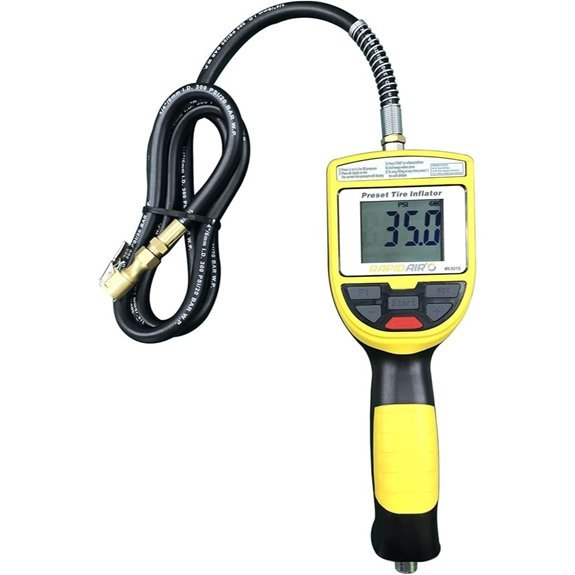 |
Reliable Professional | $$$ | Power Options: Requires external air compressor; powered by (7) AA batteries (not included) for digital controls | Automatic Shutoff / Auto Pressure Control: Automatic shutoff at preset pressure | Digital Display / Pressure Readout: Digital display with pressure preset | Check price on Amazon | Read Our Analysis |
| Goodyear Digital Automatic Tire Inflator Head Unit | 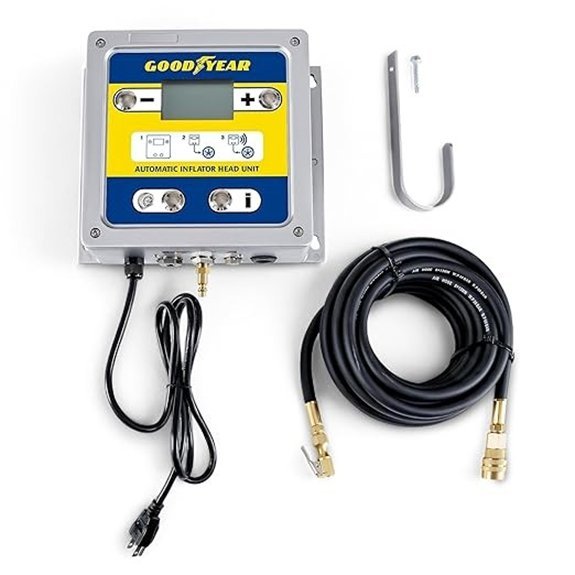 |
Shop-Grade Precision | $$ | Power Options: Requires external air compressor (1/4″ NPT inlet) | Automatic Shutoff / Auto Pressure Control: Automatic inflate/deflate to preset PSI (auto control) | Digital Display / Pressure Readout: LCD display showing PSI, BAR, etc. | Check price on Amazon | Read Our Analysis |
| AstroAI Cordless 20V Tire Inflator 160PSI Portable | 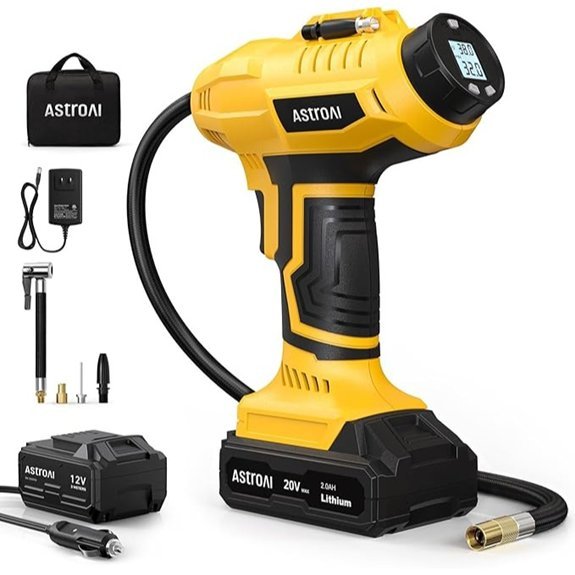 |
Fast Cordless Power | $$ | Power Options: Dual — 12V DC and 20V rechargeable battery (cordless option) | Automatic Shutoff / Auto Pressure Control: Automatic shutoff when preset pressure reached | Digital Display / Pressure Readout: Back-lit LCD showing current and desired pressure | Check price on Amazon | Read Our Analysis |
| DEWALT 20V MAX Portable Tire Inflator (DCC020IB) | 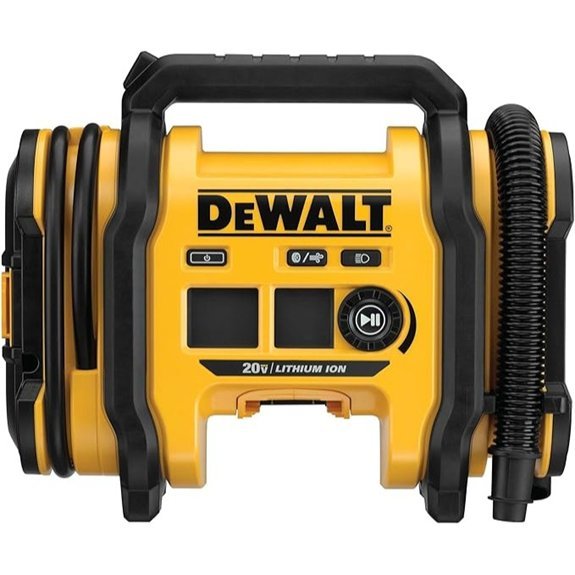 |
Rugged All-Power | $$$ | Power Options: Three — 20V battery, 12V DC, and 110V AC | Automatic Shutoff / Auto Pressure Control: Automatic shutoff feature included | Digital Display / Pressure Readout: Digital gauge (threaded chuck) | Check price on Amazon | Read Our Analysis |
| Portable Cordless Tire Inflator with Digital Gauge | 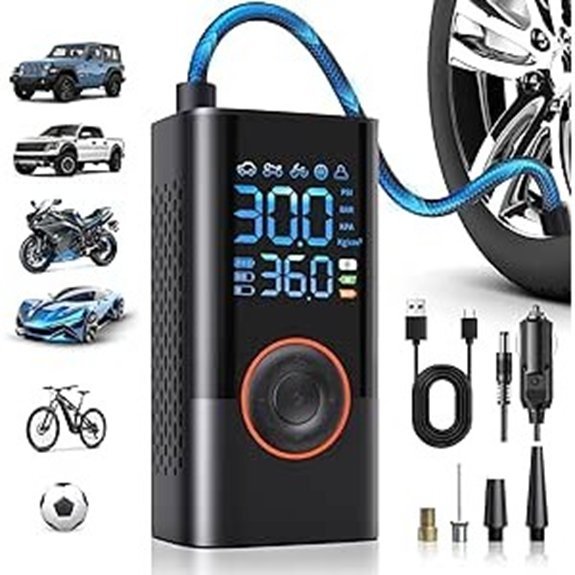 |
Versatile Emergency Pack | $ | Power Options: Dual — rechargeable battery and 12V DC car power cord | Automatic Shutoff / Auto Pressure Control: Automatic shut-off when preset pressure reached | Digital Display / Pressure Readout: Built-in LCD display for real-time pressure | Check price on Amazon | Read Our Analysis |
-
Rapidair 175 PSI Automatic Tire Inflator K3015
If you need a heavy-duty, easy-to-use inflator for professional or frequent use, the Rapidair K3015 delivers with a 175 PSI capacity and automatic shutoff so you can set the pressure and step away. You’ll appreciate the metal construction while the digital display lets you preset pressure precisely. It requires an external air compressor and uses (7) AA batteries (not included) to power the digital controls, with the manufacturer listing accuracy at +/- 1 PSI. It weighs 3.41 pounds, uses a Schrader-thread connection, and carries Rapidair’s model and part number K3015 for reference.
- Power Options:Requires external air compressor; (7) AA batteries required (not included)
- Automatic Shutoff / Auto Pressure Control:Automatic shutoff at preset pressure
- Digital Display / Pressure Readout:Digital display with pressure preset
- Maximum Pressure Capability:175 PSI
- Portability / Intended Mobile Use:Handheld, lightweight (3.41 lb) — portable for shop/garage use with an air compressor
- Multi-Application / Valve Compatibility:Schrader thread type (works with standard vehicle valves)
- Additional Feature:Metal construction durability
Pros
- 175 PSI capacity for heavy-duty use
- Automatic shutoff lets you step away
- Metal construction with digital pressure preset
Cons
- Requires an external air compressor
- Seven AA batteries not included
-
Goodyear Digital Automatic Tire Inflator Head Unit
For professionals and serious DIYers who need precise, hands-free inflation, the Goodyear Digital Automatic Tire Inflator Head Unit delivers automatic fill-and-deflate control to a preset PSI with ±0.3 PSI accuracy. You connect it to your air compressor via the 1/4″ NPT fitting and set target pressure on the LCD, which displays PSI, BAR, and more. It handles 10–145 PSI and works from 14°F to 122°F. Built with an ABS case, alloy-steel internals, and a polyurethane hose, it’s rugged for shop use. At 12.8 pounds and model GUT186, it’s a professional-grade controller that doesn’t run independently.
- Power Options:Requires external air compressor (1/4″ NPT inlet)
- Automatic Shutoff / Auto Pressure Control:Automatic inflate/deflate to preset PSI (auto control)
- Digital Display / Pressure Readout:LCD display showing PSI, BAR, etc.
- Maximum Pressure Capability:145 PSI (pressure range 10–145 PSI)
- Portability / Intended Mobile Use:Rugged head unit for shop/pro use (requires compressor) — portable between shops but dependent on external air source
- Multi-Application / Valve Compatibility:Standard chuck/hose for vehicle tires (1/4″ NPT fittings)
- Additional Feature:±0.3 PSI accuracy
- Additional Feature:Rugged ABS housing
- Additional Feature:1/4″ NPT fittings
Pros
- Automatic fill-and-deflate to preset pressure
- Accurate to within 0.3 PSI
Cons
- Requires your own air compressor
- Supports only 10 to 145 PSI
-
AstroAI Cordless 20V Tire Inflator 160PSI Portable
Drivers who value fast, cordless convenience will like the AstroAI Cordless 20V Tire Inflator, which pairs a 160 PSI pump with a rechargeable battery and automatic shut-off when your preset pressure’s reached. The manufacturer rates it at 22 L/min inflation speed with a maximum continuous run time of 20 minutes, and the included pack is 18V 2.0Ah (20V max). The back-lit LCD shows current and target pressure in PSI, kPa, or bar. It includes a battery, charger, and storage bag (plus common adapters), and it’s intended for cars/SUVs/motorcycles/bikes rather than large truck or RV tires.
- Power Options:Dual — 12V DC and 20V rechargeable battery (cordless option)
- Automatic Shutoff / Auto Pressure Control:Automatic shutoff when preset pressure reached
- Digital Display / Pressure Readout:Back-lit LCD showing current and desired pressure
- Maximum Pressure Capability:160 PSI (maximum)
- Portability / Intended Mobile Use:Portable cordless with storage bag and LED light for transport/night use
- Multi-Application / Valve Compatibility:Compatible with cars, SUVs, motorcycles, bicycles, balls (not for large truck tires)
- Additional Feature:20-minute continuous runtime
- Additional Feature:Included LED light
Pros
- Cordless 160 PSI pump with auto shut-off
- Back-lit LCD shows current and target pressure
Cons
- Continuous run time capped at 20 minutes
- 2.0Ah battery limits fills per charge
-
DEWALT 20V MAX Portable Tire Inflator (DCC020IB)
You’ll appreciate the DCC020IB if you need a versatile inflator that works at home, on the road, or at the campsite — it runs on a 20V MAX battery, 12V DC, or 110V AC so you won’t be stranded without power. You get high-pressure inflation with automatic shutoff, a digital gauge and threaded chuck for secure valve connection, plus high-volume mode for mattresses and rafts. Note: this ASIN is the tool-only version; battery, charger, and AC power adapter are sold separately.
–>
- Power Options:Three — 20V battery, 12V DC, and 110V AC
- Automatic Shutoff / Auto Pressure Control:Automatic shutoff feature included
- Digital Display / Pressure Readout:Digital gauge (threaded chuck)
- Maximum Pressure Capability:160 PSI (high-pressure mode)
- Portability / Intended Mobile Use:Portable with onboard storage, rubber feet, LED — multi-power for mobile use
- Multi-Application / Valve Compatibility:Car, bike, and general inflation (threaded chuck for secure valve connection)
- Additional Feature:Three power sources
- Additional Feature:Onboard accessory storage
Pros
- Powered by 20V MAX battery, 12V or 110V
- Threaded chuck locks securely onto valves
- High-volume mode inflates mattresses and rafts
Cons
- Larger and heavier than pocket inflators
- Cordless mode needs a 20V MAX battery
-
Portable Cordless Tire Inflator with Digital Gauge
Compact yet powerful, this portable cordless inflator is ideal for drivers who want a fast, versatile tool for topping off tires on the go. Four presets (bike, motorcycle, car, ball) plus custom settings simplify use. The LCD monitors pressure and auto shut-off helps prevent overfill. It includes multiple nozzle/adapters plus a Type-C charging cable and 12V DC power cord.
- Power Options:Dual — rechargeable battery and 12V DC car power cord
- Automatic Shutoff / Auto Pressure Control:Automatic shut-off when preset pressure reached
- Digital Display / Pressure Readout:Built-in LCD display for real-time pressure
- Maximum Pressure Capability:150 PSI
- Portability / Intended Mobile Use:Portable cordless with compact size (1 lb) and carry accessories
- Multi-Application / Valve Compatibility:Includes multiple nozzles/adapters — car tires, bikes, balls, French adapter, etc.
- Additional Feature:USB-C charging (Type-C cable included)
- Additional Feature:Multiple nozzle adapters included
Pros
- Runs on battery or 12V car cord
- Four presets plus custom settings
Cons
- Battery runtime limits cordless fills
- Best suited to top-offs, not big jobs
Head-to-Head Comparisons
Cordless Portable Inflators: AstroAI vs. DEWALT vs. Portable Cordless
| Feature | AstroAI Cordless 20V | DEWALT 20V MAX | Portable Cordless |
| Power Options | Dual — 12V DC and 20V battery | Three — 20V battery, 12V DC, 110V AC | Dual — battery and 12V DC |
| Max PSI | 160 PSI | 160 PSI | 150 PSI |
| Inflation Speed | 22 L/min | Not specified | 35 L/min |
| Runtime | 20 minutes | Not specified | Not specified |
| Price Tier | $$ | $$$ | $ |
| Our Score | 4.3/5 | 4.8/5 | 4.0/5 |
Compressor-Dependent Units: Rapidair vs. Goodyear
| Feature | Rapidair 175 PSI | Goodyear Digital |
| Power Options | External compressor + AA batteries | External compressor |
| Max PSI | 175 PSI | 145 PSI |
| Accuracy | +/- 1 PSI | ±0.3 PSI |
| Build | Metal | ABS |
| Price Tier | $$$ | $$ |
| Our Score | 4.2/5 | 4.5/5 |
Our Scoring Methodology
Scores are out of 5, with higher scores indicating better performance across these criteria.
How to Choose automatic tire inflators
Before you order:
- Pressure: check the maximum pressure the listing states against what your tires or bike need; the correct value is on your vehicle door-jamb label or in the manual.
- Power: check whether it runs from the car 12-volt socket, a battery or mains power, and how long the cable or hose is.
- Run time: many inflators need rest breaks, so check the stated duty cycle and do not run one continuously.
- Gauge and shut-off: look for a gauge or digital display and an auto shut-off, and cross-check the reading with a separate gauge.
- Fittings: check that the nozzle suits your valve type, such as Schrader or Presta, and which adapters are included.
- Safety: never exceed the tire maximum, never leave an inflator running unattended and keep it away from children.
Specs come from the Amazon listings and can change; confirm the details on the listing before you order.
When you’re choosing an automatic tire inflator, focus on pressure range and accuracy so you get the right PSI every time. Check power source options, inflation speed, and automatic shutoff reliability to match your typical use and emergencies. Finally, consider portability and weight so the unit’s easy to store and carry when you need it.
Pressure Range Accuracy
Because correct pressure affects safety and tire life, check an inflator’s pressure range and accuracy before you buy. You’ll want a unit that covers from about 10 PSI up to 175 PSI so it’s versatile for cars, bikes, SUVs, and some truck tires. Confirm the maximum PSI matches your largest tires; standard models may fall short for heavy-duty wheels. Prefer inflators with a preset pressure stop to avoid over-inflation and potential damage. A clear digital display helps you monitor current and preset pressures during inflation.
Power Source Options
You’ll want to match the inflator’s power source to how and where you’ll use it: AC units (110V) deliver steady power for garage work, DC 12V models plug into your car for roadside emergencies, and rechargeable battery options give true cordless portability. Consider dual-power models that combine a rechargeable battery with a car power cord so you’re covered both at home and on the road. Look for quick-charge batteries that refill rapidly after use, useful when you need the unit again soon. Remember that AC units usually sustain longer runs, while cordless models maximize portability; pick the balance of convenience and sustained output that matches your typical use.
Inflation Speed Performance
Matching the power source to your use case sets the stage, but inflation speed determines how quickly you’ll get back on the road. You should check PSI capability—some units reach up to 175 PSI for rapid inflation—alongside airflow (liters per minute); higher L/min, like 35, fills tires faster. If you use battery-powered models, note that advanced batteries (a 20V example) can fill a standard car tire in roughly four minutes. Also consider continuous operation time: longer duty cycles let you inflate multiple tires or larger items without overheating or losing performance. Finally, preset pressure features improve efficiency by stopping at your chosen PSI, saving time and avoiding guesswork while you get moving again.
Automatic Shutoff Reliability
A reliable automatic shutoff is one of the most important safety features to check when picking a tire inflator, since it stops inflation at your preset PSI and prevents over-inflation. You’ll want a unit that consistently stops within a tight tolerance—typically ±0.3 PSI—so you don’t risk damaging tires. Remember temperature can affect accuracy; some inflators only operate effectively within specific temperature ranges, so consider where you’ll use it. The automatic shutoff also frees you from watching the gauge, letting you multitask safely while inflation completes.
Portability And Weight
After confirming the automatic shutoff will protect your tires, consider how easy the inflator is to carry and store. You’ll want a unit that’s light — around 1 pound is effortless to toss in a backpack, but anything under 5 pounds stays manageable for longer jobs or when you’re juggling tools. Compact dimensions matter too: a few inches in height or width lets the pump slip into glove boxes or tight trunk nooks. Balance weight, size, power source, and build for real-world convenience.
Hose And Chuck Quality
You’ll want a hose made from tough materials like polyurethane rather than cheap rubber so it resists wear and stays flexible in cold weather. Aim for at least 10 feet of length so you can reach all tire positions without stretching or moving the unit. Reinforced construction matters if your inflator handles above 150 PSI — it prevents bulging and failure under pressure. Inspect the chuck design for a tight, leak-free connection and for easy attachment and removal; a fiddly chuck slows you down in emergencies.
Display And Controls
Good hose and chuck design get you connected quickly, but the inflator’s display and controls determine how accurately and easily you’ll hit the target pressure. You want a clear digital display that shows current pressure and settings, ideally with PSI, BAR, and kPa options so you’re not converting on the fly. Backlit LCDs make nighttime or dim work straightforward. Look for user-friendly controls and preset pressure settings that auto-shutoff at your target to avoid over-inflation. Check responsiveness and stated accuracy (for example ±0.3 PSI) — tighter accuracy means better results. Advanced models let you customize pressures and switch inflation modes for bikes, cars, or equipment. Prioritize precise, well-lit controls for fast, reliable inflation.
Safety And Warranty
Inspect construction materials—metal housings and reinforced hoses last longer under pressure and reduce failure risk.
Common Mistakes to Avoid When Using Automatic Tire Inflators
1.
2. Ignoring the duty cycle and overheating the unit by running it too long.
3. Forgetting to secure the chuck properly, causing air leaks and inaccurate readings.
4.
5. Neglecting to maintain the battery or power source, resulting in failure during emergencies.
Related reading:
Frequently Asked Questions
What tire pressure should I use?
Use the pressure on your vehicle door-jamb label or in the owner manual, not the maximum printed on the tire sidewall.
Can an inflator run continuously?
Usually not. Many models need cool-down breaks, so follow the maker duty cycle and instructions.
How accurate is the built-in gauge?
Built-in gauges can be off, so check the reading against a separate gauge, especially when the pressure matters.
Will it fit my valve?
Check the valve type and the adapters the listing names, because some bikes use Presta valves that need an adapter.
Conclusion
You’ll thank yourself when a roadside low-tire situation turns from panic to quick fix — with a cordless inflator that can top off tires without hunting for a gas station. With models topping 175 PSI and others offering 20V portability, pick one that matches your vehicle, pressure needs, and how often you’ll use it. Think of your inflator as a pocket-sized air station: reliable, fast, and ready when you need to breathe easy.