
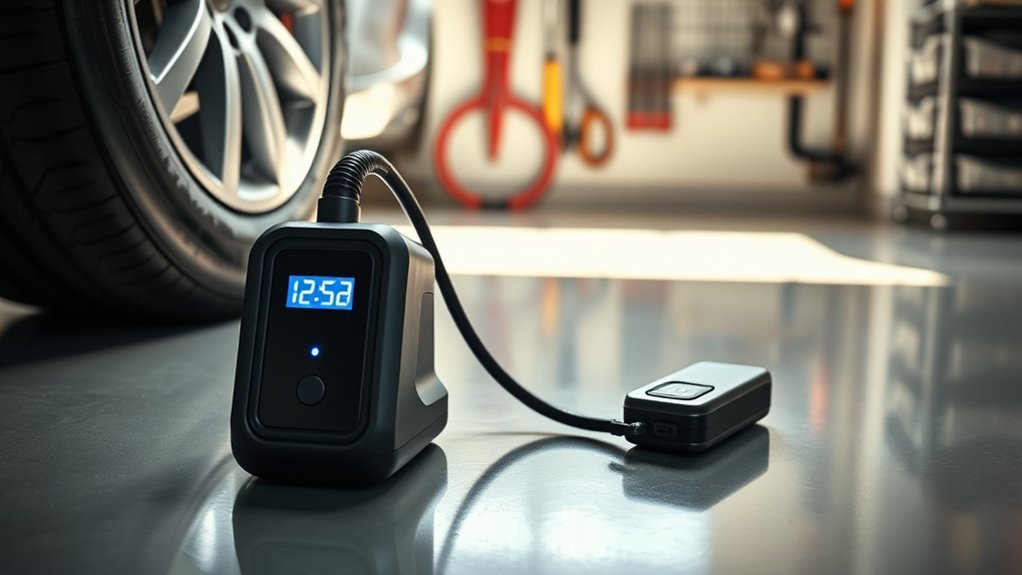
A battery-powered tire inflator gives you portable air without an outlet. It’s great for road trips, motorcycles, bikes, and quick roadside fixes. The trade-off is runtime. Batteries drain, cold weather slows things down, and many units pause or shut off to avoid overheating. Before you buy, check PSI range, speed, run time (or duty cycle), and safety features like auto shutoff.
Key takeaways
- Best for top-offs and emergencies; frequent “from-flat” fills favor bigger or plug-in units.
- Cold weather cuts power—plan extra time and don’t count on the last bar of charge.
- Look for preset pressure + auto shutoff, a screw-on chuck, and a stated run/rest limit in the manual.
Quick Answer: When to Choose a Cordless (Battery-Powered) Tire Inflator
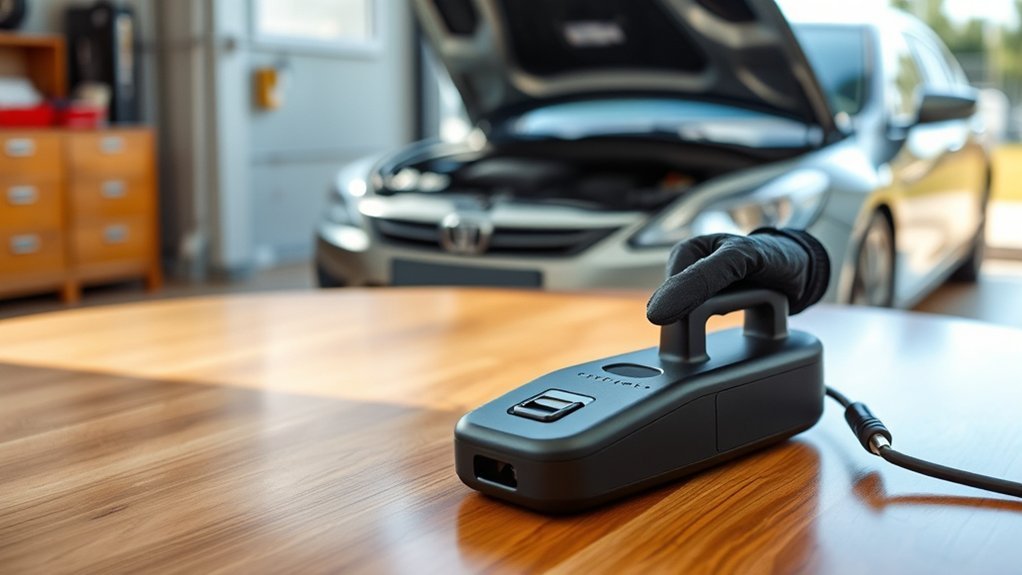
Pick a cordless tire inflator when you want fast, grab-and-go inflation anywhere. It’s useful if you ride a motorcycle, travel off-grid, or keep an emergency kit in the trunk. Compare three things: (1) how many top-offs it can do per charge, (2) how it charges (USB-C is common), and (3) whether the hose and chuck fit your valve stem easily. Expect a higher price than basic 12V inflators, but less hassle when you’re on the shoulder of the road.
How Cordless Inflators Work: Real-World Battery Limits
Most cordless inflators use lithium-ion cells because they pack a lot of energy into a small size. In real use, output depends on temperature, battery age, and how hard the motor has to work. Many consumer lithium-ion packs are rated for a few hundred full charge cycles before you notice a clear drop in capacity. Heat is the other limit. Small compressors can get hot during back-to-back fills, so they may slow down or shut off until they cool.
Battery Chemistry Basics
Lithium-ion batteries are strong for their size, but they age. After many charge cycles, you’ll get fewer minutes of run time. Cold weather also reduces output because internal resistance rises. If you can, store and charge the inflator indoors and bring it to the vehicle shortly before use.
- Control
- Reliability
- Predictability
- Resilience
Real-World Capacity
Real-world capacity decides how many tires you can service on one charge. For most handheld inflators, plan on several top-offs (for example, 30→35 PSI) but fewer “from-flat” jobs. Bigger tires, higher PSI targets, and colder air all reduce what you can do on one charge. Presets help because they stop at the target PSI instead of overshooting.
| Metric | Typical range | What it means |
|---|---|---|
| Battery aging | Hundreds of full cycles | Less run time over the years |
| Cold-weather hit | Noticeable near freezing; worse below | Slower fills and fewer tires per charge |
| From-flat inflation time | Several minutes (varies widely) | May need rest breaks on large tires |
Thermal and Duty Cycle
Heat can stop a cordless inflator before the battery does. The duty cycle is the run/rest limit that keeps the motor and battery safe. Some brands list it as minutes at a set pressure (for example, “25 minutes at 30 PSI”). Others use a percent duty cycle. Follow the run/rest guidance so the inflator doesn’t shut off mid-fill.
- Check the duty cycle and follow cool-down times.
- Expect shorter run time as the battery ages.
- Look for thermal protection and auto shutoff.
- For lots of large tires, consider a higher-duty 12V compressor.
Battery Life, Cold-Weather Impact, and How Many Tires One Charge Will Fill
As of , “tires per charge” is best treated as a range, not a promise. Many inflators can do multiple top-offs at room temperature. Cold weather and bigger tires cut that down. Around freezing, some lithium-ion cells deliver about 80% of their room-temperature capacity under heavy load. In much colder air, the drop can be far larger. Plan extra time, and avoid storing the inflator in an unheated trunk for long periods.
| Condition | What to expect | Practical tip |
|---|---|---|
| After heavy use | Shorter run time | Recharge after trips; replace if it won’t hold charge |
| Cold weather | Less power and less usable capacity | Keep it warm; inflate in short bursts if needed |
Compare Specs: PSI Range, Inflation Speed, Duty Cycle, and Safety
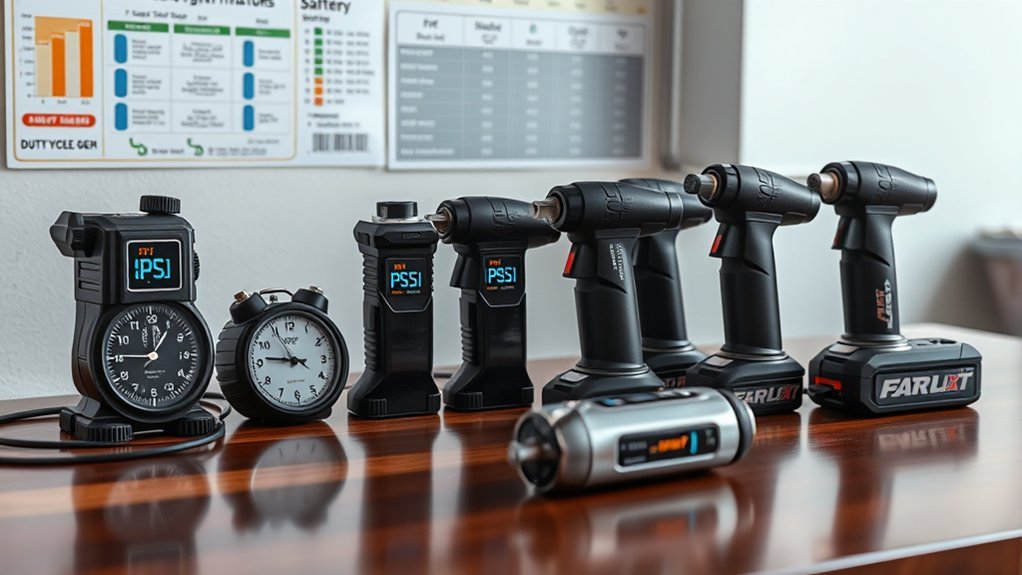
Start with PSI range. Many portable inflators are rated to 150 PSI, which is enough for most car and motorcycle tires. After that, speed and heat handling matter more than max PSI. Check for thermal cutoff, overload protection, and preset + auto shutoff. A built-in light is also helpful for night use.
[Products Worth Considering]

ADVANCED TRUEGAUGE SCREEN: This battery tire inflator includes updated sensor technology, capable of collecting pressure data from tire inflators at a frequency of 200 times per second. Its valid data rate is higher than 80%, which is 60% better than the market average. Wherever you go, accurate readings help you drive safely.

【Rechargeable Car Air Pump】This tire pump portable for car has a built-in Real rechargeable battery, and no external power supply is required during use. This tire air pump for car portable inflates 2 times faster than ordinary cordless tire inflators on the market. On a single charge, it can inflate 5x car tires (27-35 PSI) or 10x motorcycle tires, ensuring you never face tire pressure run out.

【METAL INFLATABLE STRUCTURE】: It’s composed of metal cylinder and metal gear, it could continuously work for 20 minutes, the maximum air pressure could reach 160psi, meet the needs of 4 tires at a time, more efficient and faster to use.
PSI Range Explained
A clear PSI range tells you what the inflator can handle. For most cars, accuracy in the 30–45 PSI band matters more than a very high max PSI. Higher max PSI can still help for some motorcycle tires and for multi-use adapters. Presets and auto shutoff help you hit the target without watching the gauge the whole time.
- You’ll gain control.
- You’ll avoid delays.
- You’ll reduce risk.
- You’ll stay ready.
Duty Cycle & Safety
Duty cycle tells you how long the inflator can run before it needs a cool-down. Safety features—thermal cutoff, short-circuit/overload protection, and a stable pressure sensor—help reduce overheating and battery stress. If you inflate several large tires in a row, expect rest breaks with many cordless models.
Cordless vs. Plug-In: Which Is Best for Road Trips, Off-Road, and Home Use?
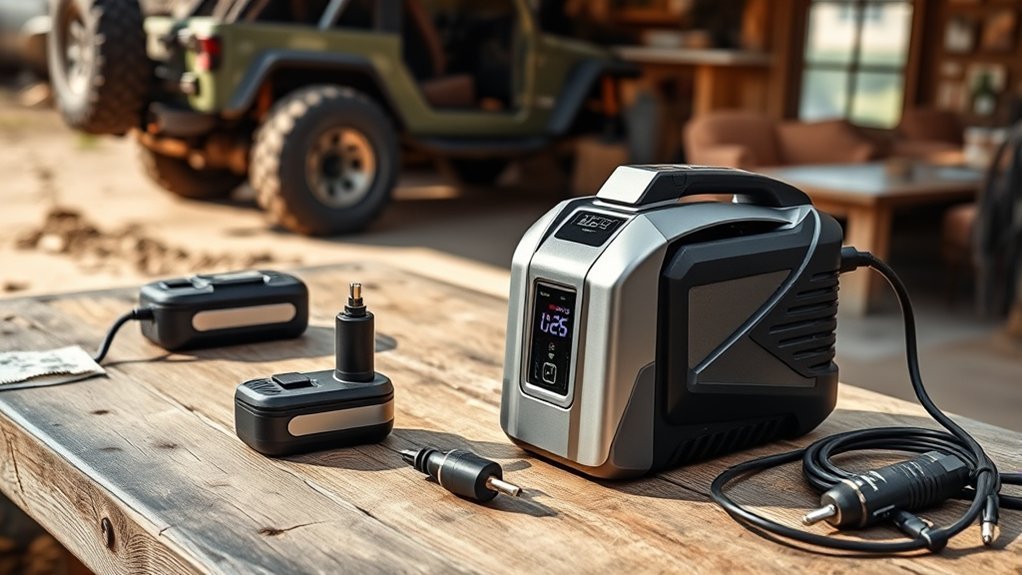
Both cordless and plug-in inflators can solve a low-tire problem, but they fit different jobs. Cordless units are quick to deploy and easy to pack. Plug-in (12V or AC) models can run longer and are better for repeated fills or larger tires. If you want one tool for many jobs, look at dual-power models that can run on a battery and a 12V plug.
- Road trips: cordless is convenient when you don’t want to hunt for a working pump.
- Off-road: repeated airing down/up often favors a higher-duty 12V compressor.
- Home use: plug-in is cheaper and doesn’t need charging.
- Mixed needs: keep cordless for the road and plug-in for heavy work.
[Products Worth Considering]

[Fast & Efficient Inflation] The OlarHike tire inflator features a high-performance motor that delivers rapid airflow—inflate a standard car tire (195/65 R15) from 30 to 35 PSI(+5 PSI) in just 55 seconds, or a larger SUV tire (235/65 R17) from 30 to 35 PSI(+5 PSI) in only 2.2 minutes. Ideal for cars, SUVs, light Pickup(Within 51 PSI), motorcycles, bicycles, and sports balls. Important Note: The unit can only inflate car/pickup truck tires up to 51 PSI

AC/DC dual power supply design: Our portable air compressor's multifunctional AC/DC dual power supply design can draw power from both vehicle and wall outlets. Its DC plug is designed for a 12V cigarette lighter socket while its AC plug is designed for a 110V/120V wall outlet. Includes 3 extra nozzles: Suitable for cars, motorbikes, bike tires, sports equipment, and other inflatable items. Our portable air compressor can be used indoors or on the road.

12 V DC/120 V AC Dual Power: The AstroAI Tire Inflator features dual power supplies, compatible with 12 V car cigarette lighters and 120 V household outlets, convenient for both home and travel use. The AstroAI Tire Inflator can easily switch between high-pressure and high-current inflation modes. High-pressure mode inflates car, bicycle and motorcycle tires along with sports equipment and other small inflatables. Large-volume mode inflates bigger low-pressure objects like air mattresses
Buying Checklist + Three Recommended Setups (Commuter, Overlander, Family SUV)
Match the inflator to your vehicle and how often you’ll use it. Prioritize a clear display, preset + auto shutoff, a hose long enough to reach all valve stems, and easy charging (USB-C is common). For rain or winter, a screw-on chuck and a stable base make the job easier.
| Use case | Recommended setup |
|---|---|
| Commuter | Compact cordless inflator for quick top-offs; preset + auto shutoff; USB-C charging (example: Fanttik X8 Apex) |
| Overlander | Higher-duty 12V compressor for multiple large tires, plus a small cordless unit as a backup (example backup: Fanttik X9 Pro) |
| Family SUV | Mid-size inflator with longer hose, work light, and clear presets; consider dual-power (battery + 12V) for travel |
[Products Worth Considering]

Effective Tire Inflation: Tire inflator offers rapid inflation up to 150 PSI, with a built-in gauge for precise readings. It's an essential accessory for car, bike, motorcycle, ball, and inflatables

Digital Screen, Real-Time Pressure Display: The bike pump with large digital screen displays the tire's real-time pressure for a more accurate and intuitive experience. Avoids pressure reading errors common with dial tire pumps.
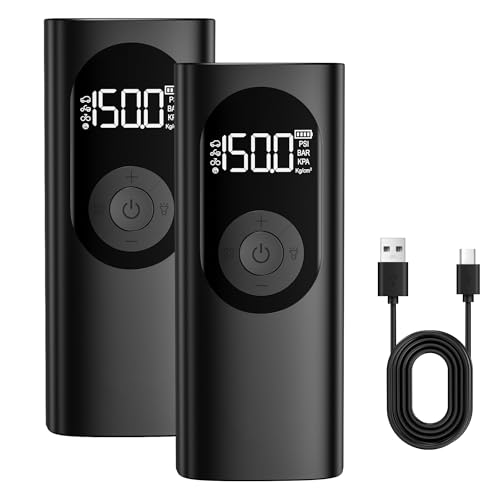
【Made for everyday car owners】 Quickly inflates car tires at home or on the road – no trips to the gas station, no waiting. Compact enough to keep in your trunk for daily use or emergencies.
Frequently Asked Questions
Do Cordless Tire Inflators Really Work?
Yes. A good cordless inflator can keep tires topped off and handle many emergencies. The main limits are battery charge, cold weather, and heat during repeat fills. For frequent “from-flat” work, choose a larger unit or a plug-in compressor.
What Are the Disadvantages of Tire Inflators?
Battery models can be slower on large tires, may need cool-down breaks, and require charging. They can also be loud. Plug-in compressors are often cheaper and can run longer, but they’re less handy away from the vehicle or an outlet.
What’s the Best Battery-Powered Tire Inflator?
There isn’t one best option for everyone. As of , independent tests often pick different winners based on tire size, speed, accuracy, and power source. Decide what you need first (top-offs vs. from-flat), then compare test results, warranty support, and ease of use.
Which Is Better, Cordless or Corded Tire Inflator?
Choose cordless if speed and portability matter most. Choose corded/plug-in if you want longer continuous runtime and you often inflate several tires. Many drivers keep both: cordless for the road, plug-in for the garage.
Conclusion
A cordless inflator is a solid emergency tool, but it’s not endless power. Cold weather and heat are the two big limits. Buy based on your tire size, how often you inflate from low pressure, and the duty-cycle guidance in the manual. With a good match, you’ll stay ready without carrying a full-size compressor.







Leave a Reply