
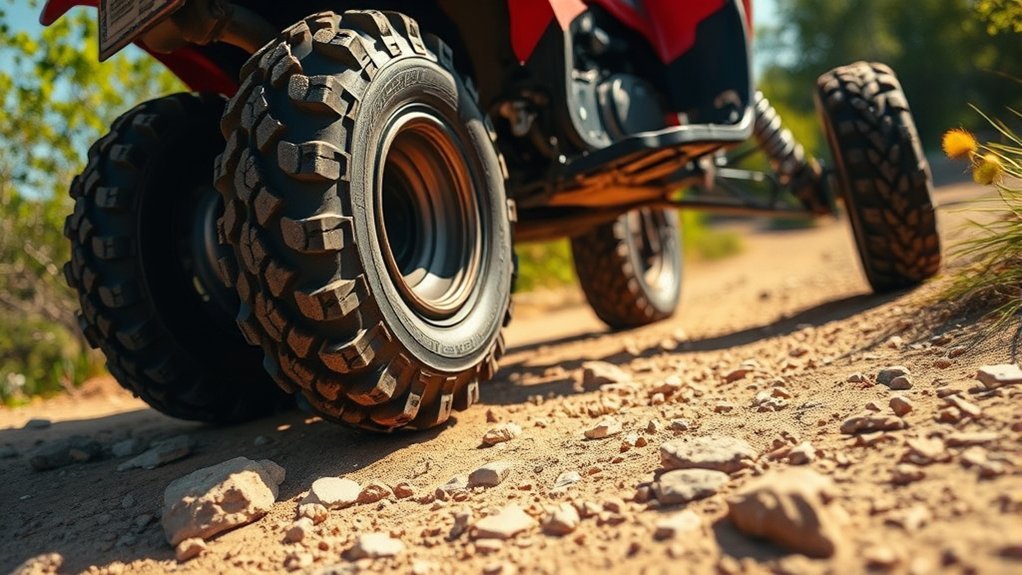
Matching your ATV tire pressure to the terrain gives you better traction and safer handling. Lower PSI increases the contact patch. This lets the tire sidewalls conform to the ground. However, setting the pressure too low risks punctures and rim damage. Use about 3 to 5 PSI for mud or wet sand. Dry sand also needs 3 to 5 PSI. Hard-packed trails and rocks require 7 to 10 PSI. Always check cold tires with a low-pressure gauge and adjust the air slowly. Remember to factor in your vehicle weight, outside temperature, and altitude. Keep reading for practical adjustment tips.
What ATV Tire Pressure Means and Why Lower PSI Helps Traction
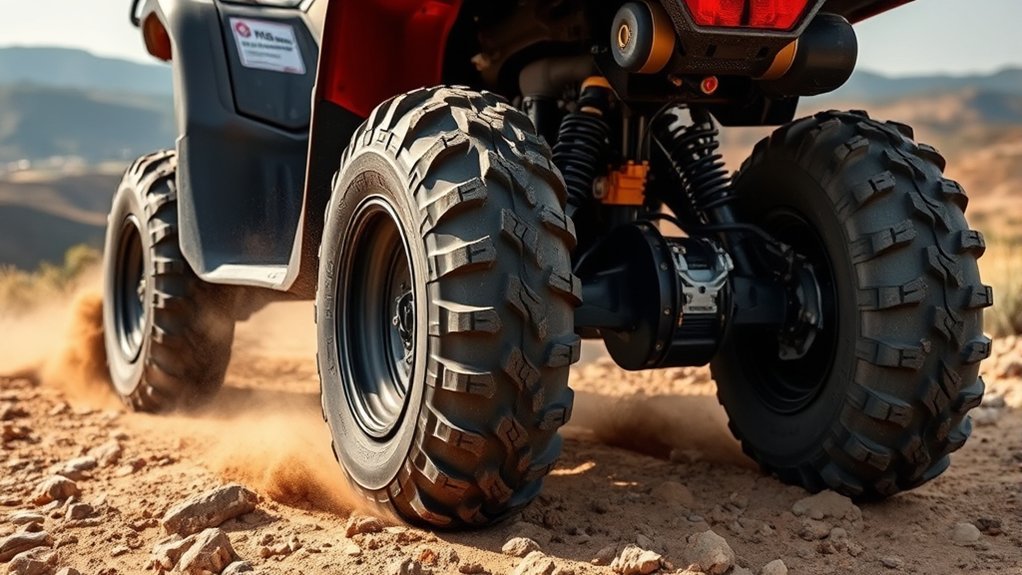
When you lower ATV tire pressure, you increase the tire’s contact patch with the ground. This gives you better traction and more predictable handling on soft surfaces. Lowering the PSI spreads the tire’s tread. The larger contact patch helps the tire grip sand or mud instead of digging in. Your tires also gain flexibility. This allows the sidewalls to conform to uneven terrain. It improves ride comfort and absorbs shocks. That said, lower PSI reduces puncture resistance. You need to avoid sharp objects and check your tires often. Use the recommended PSI ranges as starting points. Adjust them to find the ideal tire pressure for your route. Balancing traction and protection helps you maintain confident control. Tune your pressures to the conditions, monitor your ATV’s performance, and inspect the tires after your ride. This practical approach keeps you safe while maximizing comfort.
Quick Decision: What PSI to Use by Terrain (Cheat Sheet)
Now you know how lower PSI boosts traction and higher PSI fights punctures. Use this cheat sheet to pick a starting pressure for your terrain: mud or wet sand needs 3 to 5 PSI. Dry sand takes 3 to 5 PSI. Turf and grass require 7 to 10 PSI. Hard-packed trails and rocks need 7 to 10 PSI. Snow calls for 3 to 5 PSI.
Lower tire pressure on soft terrain expands the tire footprint for better traction. Raise the pressure on hard-packed trails to protect your tires and prevent flats. Match your PSI to your riding style and the terrain. You can tweak small amounts later based on load, speed, or weather.
Use this quick guide to choose PSI: lower for soft ground to boost traction, raise for hardpack to protect tires.
- Visualize the footprint: softer ground needs a bigger contact patch, so drop the PSI.
- Think about protection: rocks and compact trails need higher PSI to keep the tread shape.
- When riding in snow, go very low for float and control.
This approach gives you peak performance without guessing. You can ride smart and ride safely.
ATV Tire Pressure Ranges: Sand, Mud, Rocks, Pavement, Snow, Turf
Terrain varies, so you must match your ATV’s tire pressure to the surface. This maximizes traction and protects the tires. For sand and loose snow, drop to 3 to 5 PSI. This low pressure creates a wider contact patch. It lets your ATV float and steer easily. Mud also requires 3 to 5 PSI. The tires dig in and keep your forward momentum without burying the machine. On rocky terrain, aim for 5 to 7 PSI. This gives the sidewalls some cushion while keeping a solid grip on irregular rocks. For hard-packed trails and pavement, set your tires to 7 to 10 PSI. Higher pressure stabilizes handling and improves fuel efficiency. Turf and grass call for 8 to 10 PSI. This minimizes ground damage. To support this, Tread Lightly! guidelines recommend proper inflation to protect sensitive environments. You will notice each pressure change affects handling right away. Adjusting the pressure for the terrain is a practical step toward safer riding. Keep these ranges as your guide and respect the limits of your tires and rims.
[Products Worth Considering]

"Measuring range and accuracy: these low pressure tire gauges measure 0-20 PSI, in 1/2 lb, increments and are calibrated 1-20 PSI in 1/2 lb, 10-140 kPa in 5 kPa and .1-1.4 bar in .05 bar, please confirm related data before buying"
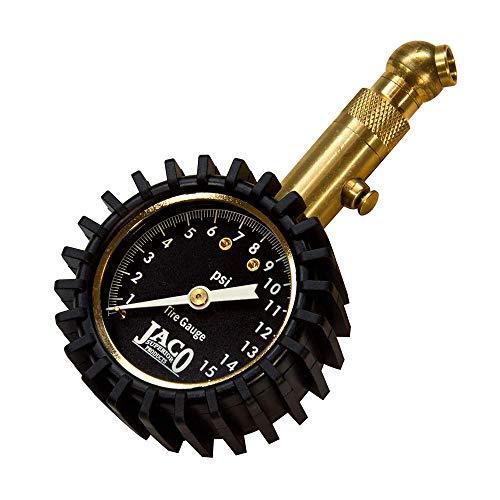
Mechanic Recommended – performance tested, certified, & calibrated accurate within ANSI Standards (±1.5%) at our NIST accredited industrial facility, ensuring precise tire pressure readings without relying on batteries; 0-15 PSI scale is ideal for low pressure tires found on an ATV, trail & dirt bikes, tractors, quads, and more
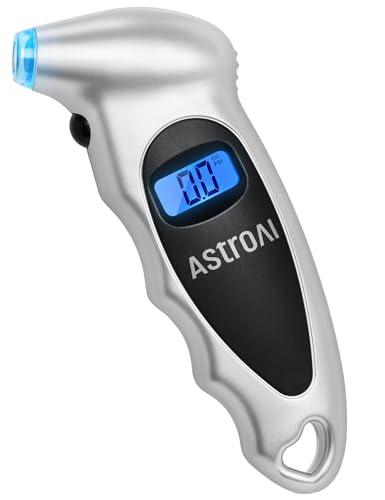
EXPERT-GRADE CALIBRATION: Each AstroAI Tire Pressure Gauge is calibrated with professional-grade tools, ensuring quick and accurate measurement results within plus-minus 1PSI. Stay prepared for any roadside emergency and travel with peace of mind.
The Role of Beadlock Wheels
If you plan to run very low tire pressures, consider beadlock wheels. Standard rims rely on air pressure to hold the tire bead against the wheel. Dropping your pressure to 3 PSI on standard rims greatly increases the risk of the tire peeling off the wheel during tight turns. Beadlock wheels physically clamp the tire bead to the rim using a heavy-duty ring and bolts. This lets you safely run pressures as low as 2 or 3 PSI for maximum traction in deep mud, sand, or snow without worrying about de-beading a tire.
[Products Worth Considering]
![System 3 SB-4 Beadlock 15x7 ATV/UTV Wheel - Matte Black (4/156) 4+3 [15S3-3157]](https://m.media-amazon.com/images/I/515slwVsXpL._SL500_.jpg)


RockTrix Wheel Offroad Beadlock Rim – Fits machines with 4/156 Bolt Pattern and a hub bore no larger than 131mm. Works with various ATV, UTV, Side by Side, Quads. Verify fitment by checking that your machine's bolt pattern, center hole, and offset match that of our ATV wheels before making your purchase.
How to Measure and Adjust ATV Tire Pressure Like a Pro
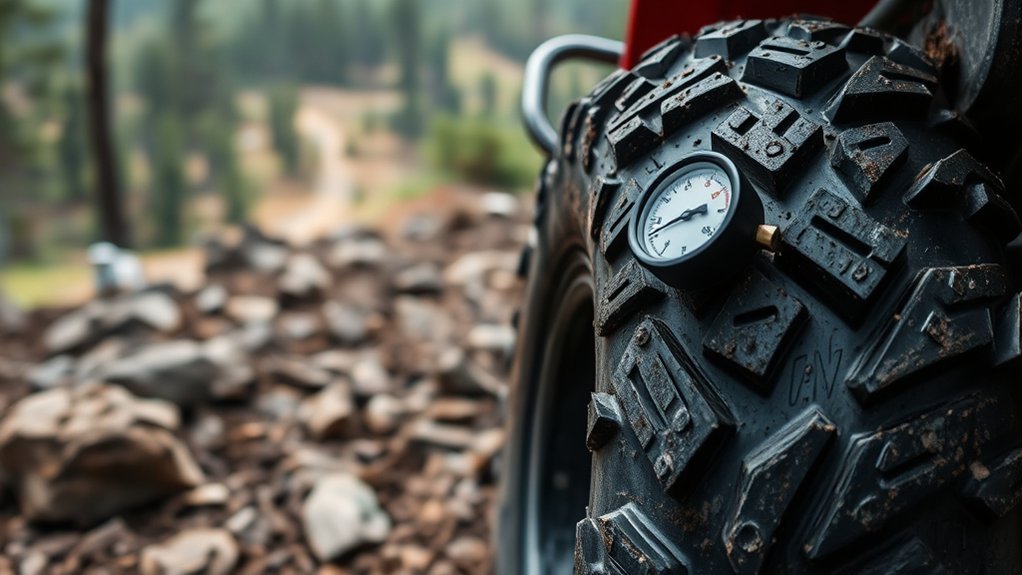
Matching tire pressure to the terrain is only half the job. You also need to know how to measure and adjust it correctly. Use a low-pressure tire gauge made specifically for ATVs. Standard automotive gauges will not provide accurate readings in the 0 to 15 PSI range. Do your pressure checks when the tires are cold. Follow the PSI levels in your owner’s manual and inspect the tread wear before adding or removing air.
- Check: Confirm the cold PSI with your gauge and note the current reading.
- Adjust: Bleed the air slowly or use a portable compressor to raise the pressure.
- Recheck: Verify the new PSI matches your target for the terrain.
For soft surfaces, drop the pressure to about 3 to 5 PSI. Increase it to 7 to 10 PSI for hard surfaces. Adjust the ATV tire pressure progressively and safely. Small changes matter. Carry a compact compressor on your rides so you can adapt easily. Keep records of your preferred settings for different trails. You will ride with more confidence knowing your tires have the right amount of air.
[Products Worth Considering]

Performance tested & calibrated accurate to ANSI standards (±1.5%), ensuring precise low PSI tire pressure readings without relying on batteries; designed for the low pressure tires on your ATV, UTV, dirt bike, tractor, or off-road vehicle

The WYNNsky tire gauge is designed specifically to provide precision measurements for low pressure readings that higher PSI gauges are unable to provide

PROCESS LEVEL ACCURACY: Each ETENWOLF’s digital tire pressure gauge is calibrated manually to ANSI B40.7 Grade 2A(plus-minus 1 PSI).Presta valve adapter not included, if used for bicycles, it must be purchased separately
How Weight, Temperature, and Altitude Change Your PSI
Weight, temperature, and altitude all change the air pressure inside your tires. You need to check and adjust your PSI whenever these variables shift. Adding a passenger or heavy gear typically means you should bump the pressure up by 1 or 2 PSI. Cold weather reduces tire pressure. A good rule of thumb from the National Highway Traffic Safety Administration (NHTSA) is that pressure drops about 1 PSI for every 10°F drop in outside temperature. Climbing 1,000 feet in altitude can also lower your pressure by roughly 1 PSI.
Monitor your tire pressure when the weather or altitude changes. Increase the PSI slightly with an added load to preserve peak performance and reduce wear. Decrease the pressure only when the terrain calls for softer tires to improve traction. Track the environmental conditions before and during your rides. Use a reliable gauge and make incremental adjustments. Small changes have big effects. Check your tires after long rides or major weather swings to avoid blowouts and uneven tire wear. Staying attentive to your PSI guarantees predictable handling.
Common Mistakes and Troubleshooting: Flats, Poor Handling, Uneven Wear
Knowing how weight, temperature, and altitude affect your PSI helps you avoid common mistakes. Neglecting your tires leads to flats, poor handling, and uneven wear. Prevent problems by making regular pressure checks part of your routine. Ignoring this causes under-inflation, sidewall blowouts, and flat tires. Riding with uneven tire pressure degrades your ATV’s overall performance fast.
- Check your PSI before every ride. Inconsistent pressure creates poor handling and reduces traction.
- Match your adjustments to the terrain. Softer surfaces need lower PSI. Hard-packed trails need higher PSI to avoid sluggish steering.
- Inspect the sidewalls and tread. Cuts or bulges signal an imminent failure, even if the pressure is correct.
Troubleshoot steering issues by isolating one variable at a time. Check for the correct PSI first. Next, look at your load and the terrain. You gain the freedom to ride safely when you treat tire pressure as a strict maintenance rule. For more on safe riding practices, consult the ATV Safety Institute.
Frequently Asked Questions
Does Lower PSI Mean More Traction?
Yes. Lowering your PSI usually increases traction. It improves tire performance, off-road capabilities, and terrain adaptability. You must balance these pressure adjustments for ride comfort, stability, handling dynamics, tire wear, and driving efficiency.
What Is the Reason for Low Pressure Tires on an ATV?
You lower the pressure to increase traction, boost flotation, and improve comfort. This helps with terrain adaptation, handling stability, obstacle clearance, and weight distribution. Always keep an eye on tire wear, heat buildup, fuel efficiency, and puncture resistance.
What Is the 4 PSI Rule?
The 4 psi rule means you drop ATV tire pressure to about 4 PSI for a traction improvement on soft terrain. This provides great terrain adaptability and ride comfort. However, you need to watch your tire durability, handling, and overall off-road performance when running such low air pressure.
What PSI Should ATV Tires Be At?
For ideal traction and safety, you should run 7 to 10 PSI for general trail use. Lower the pressure to 3 to 6 PSI on soft sand or mud. Use accurate tire pressure gauges, monitor the wear indicators, and follow basic tire maintenance tips.
Conclusion
Lowering your ATV tire pressure boosts traction by increasing the contact patch. Do not drop the pressure too low, or you risk rim damage and de-beading. Use the cheat sheet pressures for sand, mud, rocks, pavement, snow, and turf. Check your tires with a reliable low-pressure gauge before every ride. Account for the vehicle weight, outside temperature, and altitude. Always carry a portable pump and a tire patch kit. Incorrect PSI can ruin a great ride. Put safety first, adjust your tires carefully, and ride smart.






Leave a Reply