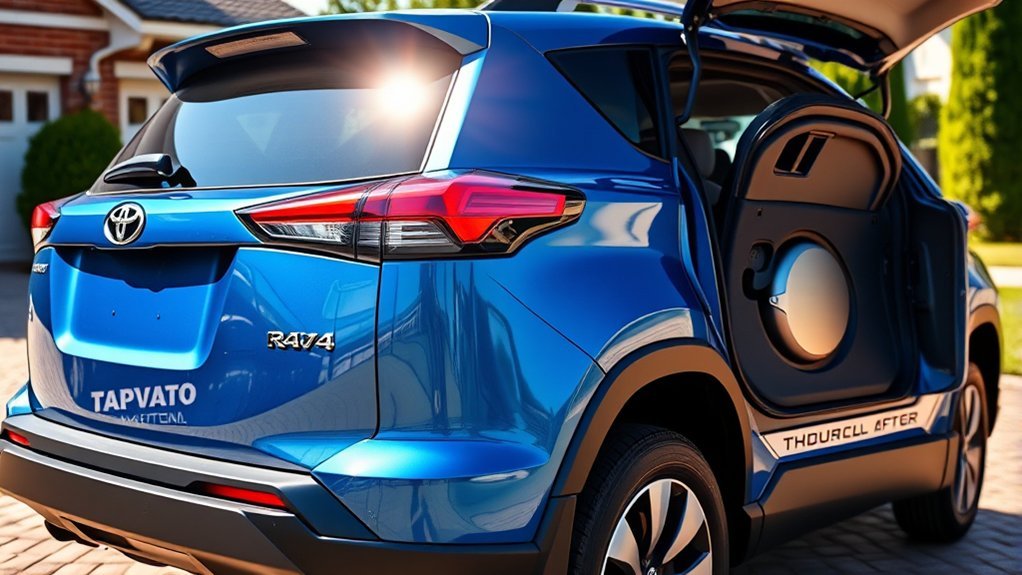
The 2025 Toyota RAV4 has a 14.5-gallon (55-liter) fuel tank across the gas, hybrid, and plug-in hybrid lineups. That number tells you the tank’s total capacity, but it does not mean you will pump 14.5 gallons at every stop. Your usable driving range depends on the powertrain, trim, weather, speed, terrain, and how much fuel remains when you refill.
Quick Answer
The 2025 Toyota RAV4 holds 14.5 gallons (55 liters) of fuel. A gas LE FWD can calculate to about 392 city or 508 highway miles using its EPA ratings, while most RAV4 Hybrid trims calculate to about 595 city or 551 highway miles. Actual range is usually lower and varies by conditions.
Key Takeaways
- The 2025 gas, hybrid, and plug-in hybrid RAV4 models use a 14.5-gallon fuel tank.
- Range figures made by multiplying MPG by 14.5 are planning estimates, not guaranteed miles between fill-ups.
- Most RAV4 Hybrid trims are rated up to 41 city and 38 highway MPG, while the gas LE FWD is rated at 27 city and 35 highway MPG.
- The pump normally stops before you add the tank’s full capacity because fuel is still in the tank.
- Use regular unleaded gasoline with an octane rating of 87 or higher, and follow the fuel and maintenance instructions for your exact model.
How Much Fuel Does the 2025 Toyota RAV4 Hold?
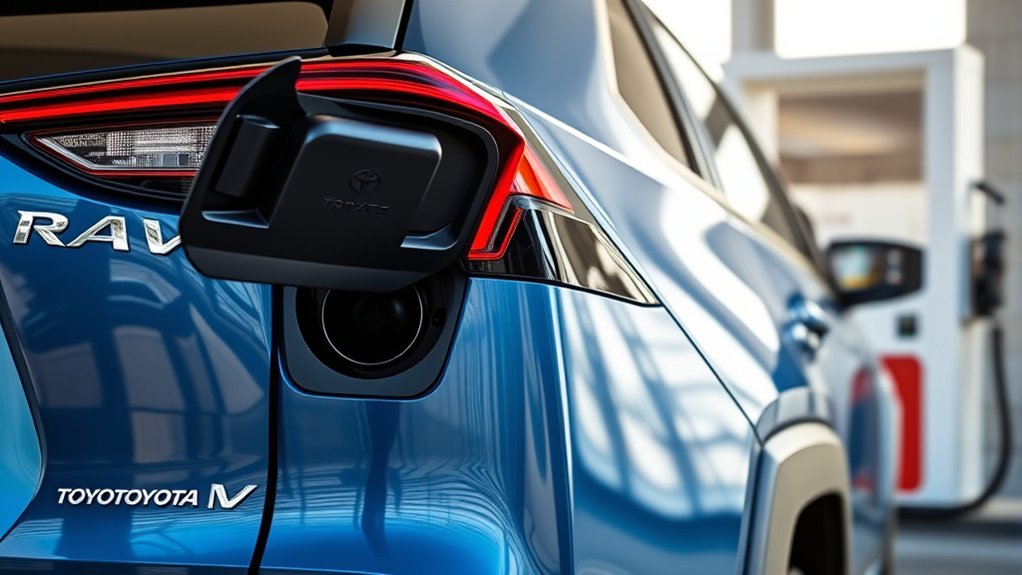
The 2025 Toyota RAV4 holds 14.5 U.S. gallons, or about 55 liters. The same listed capacity applies to the conventional gas model, RAV4 Hybrid, and RAV4 Plug-in Hybrid. Toyota lists different fuel-economy ratings for each powertrain, so vehicles with the same tank size can travel very different distances.
| 2025 RAV4 powertrain | Fuel tank | Fuel or energy note |
|---|---|---|
| Gas | 14.5 gal / 55 L | Regular unleaded, 87 octane or higher |
| Hybrid | 14.5 gal / 55 L | Regular unleaded, 87 octane or higher |
| Plug-in Hybrid | 14.5 gal / 55 L | Gasoline tank plus a rechargeable traction battery |
Note: Tank capacity is not the same as the amount you will add during a normal refill. The low-fuel warning comes on while some fuel remains, and the pump nozzle should be allowed to stop automatically.
What Is the Driving Range of the 2025 RAV4?
The original “full-tank range” numbers often seen online are simple calculations: EPA MPG multiplied by 14.5 gallons. They are useful for comparing trims, but they assume every gallon is used and the vehicle exactly matches its rating. In normal driving, you refill before the tank is empty, so your practical range between stops will usually be lower.
Estimated Range by Powertrain and Trim
| Example configuration | Published rating | Rating × 14.5-gal estimate | What to know |
|---|---|---|---|
| Gas LE FWD | 27 city / 35 highway MPG | About 392 city / 508 highway miles | AWD and other trims may have lower ratings. |
| Most Hybrid trims | 41 city / 38 highway MPG | About 595 city / 551 highway miles | City mileage can be higher because the hybrid system recovers energy and can use electric assistance at low speeds. |
| Hybrid Woodland Edition | 38 city / 35 highway MPG | About 551 city / 508 highway miles | Its all-terrain equipment lowers MPG compared with most other Hybrid trims. |
| Plug-in Hybrid | 38 MPG combined in hybrid operation; up to 42 EV miles | About 551 gasoline-based miles at 38 MPG | Charging frequency, temperature, route, and EV use change the total distance before gasoline is needed. |
A 14.5-gallon tank does not guarantee a 595-mile trip. That figure is the result of multiplying a 41-MPG rating by the tank’s total capacity.
How Does Gas Range Compare With Hybrid Range?
The RAV4 Hybrid normally travels farther on the same listed tank capacity because it uses less gasoline per mile. A gas LE FWD is rated at 30 MPG combined, while most Hybrid trims are rated at up to 40 MPG combined. The Hybrid also produces 219 system horsepower, so its efficiency does not require giving up normal merging and passing performance.
The Plug-in Hybrid works differently. It can cover many short trips using stored electricity before operating like a conventional hybrid. Toyota lists an estimated 42 miles of EV-only range, but cold weather, cabin heating, speed, hills, and driving style can reduce that figure.
Which Factors Affect Your Daily Range?
- Speed: Sustained high-speed driving increases aerodynamic drag.
- Temperature: Cold weather can reduce gasoline and battery efficiency.
- Traffic: Hybrids often perform well in stop-and-go traffic, but long idling and aggressive acceleration still waste energy.
- Terrain: Steep climbs use more fuel; downhill sections may recover some energy in a hybrid.
- Tires and load: Low pressure, heavy cargo, and roof-mounted equipment increase resistance.
- Climate control: Strong heating or air-conditioning demand can lower range.
- Driving history: The dashboard distance-to-empty estimate adjusts to recent use and may change after a refill.
How to Calculate Your Own Real-World Range
Your fuel receipts provide a better personal estimate than a generic online number:
- Fill the tank until the nozzle clicks off, without topping off.
- Reset a trip meter.
- At the next fill, record the miles driven and gallons added.
- Divide miles driven by gallons added to calculate your real MPG.
- Multiply that MPG by the amount of fuel you normally use between refills, not automatically by all 14.5 gallons.
For example, if you drive 360 miles and add 12 gallons, you averaged 30 MPG. If you normally refill after using about 12 gallons, a practical planning range near 360 miles is more useful than a theoretical empty-tank figure.
How Do Gas, Hybrid, and Plug-in Hybrid Fuel Economies Compare?
What Is the Gas Model Efficiency?
The most efficient gas configuration, the LE with front-wheel drive, is rated at 27 city, 35 highway, and 30 combined MPG. Ratings vary by trim and drivetrain, so check the window sticker or official specifications for the exact vehicle you are considering.
- It offers the simplest powertrain choice and does not need charging.
- It generally has a lower starting price than a comparable electrified model, although trim equipment can change the comparison.
- Its highway rating is strong for a compact gasoline SUV.
- Its practical range depends on how early you refill and how closely your driving matches the rating.
What Are the Hybrid Model Advantages?
Most 2025 RAV4 Hybrid trims are rated at 41 city, 38 highway, and 40 combined MPG. The Hybrid has standard electronic all-wheel drive and 219 system horsepower. It is especially attractive for drivers who want lower gasoline use without plugging in.
What Does the Plug-in Hybrid Add?
The 2025 RAV4 Plug-in Hybrid has 302 system horsepower, standard all-wheel drive, and an estimated 42 miles of EV-only range when charged. After the usable battery charge is depleted, it continues as a hybrid. Toyota lists a 38-MPG combined rating during hybrid operation.
How Often Do You Need to Refuel?
Refueling frequency depends on miles driven, MPG, and how much fuel you add at each stop. For a 300-mile weekly commute, the monthly distance is about 1,300 miles:
- At 30 MPG, a gas RAV4 would use about 43 gallons per month, or roughly three 14.5-gallon tank equivalents.
- At 40 MPG, a RAV4 Hybrid would use about 32.5 gallons per month, or roughly 2.2 tank equivalents.
- A Plug-in Hybrid may use much less gasoline if it is charged regularly and many trips fit within its EV range.
These are fuel-volume comparisons, not guaranteed numbers of station visits. You may stop more often because you refill before empty, or less often if your monthly mileage is lower.
Why Can’t You Add the Full 14.5 Gallons at the Pump?
A normal refill begins while fuel is still in the tank. The low-fuel light, gauge, and distance-to-empty display are designed to encourage refueling before the vehicle runs dry. As a result, adding 10 to 12 gallons after a warning light can be normal and does not prove the tank is undersized.
The amount accepted can also vary with the parking angle, fuel temperature, nozzle sensitivity, and how the fuel sits inside the tank. Stop when the nozzle automatically clicks off. Repeatedly squeezing in more fuel can overfill the evaporative-emissions system.
Warning: Do not deliberately run the tank empty, and do not top off after the nozzle clicks. Refuel promptly when the low-fuel warning appears, especially before remote travel, severe weather, or long highway stretches.
There is no verified universal rule that you must keep exactly 1.5 gallons in the tank to cool the fuel pump. The safer, manufacturer-aligned advice is simpler: avoid running out of fuel and respond to the warning light.
Why Does Fuel Tank Size Matter for Road Trips?
The 14.5-gallon tank gives the RAV4 useful road-trip flexibility, but efficiency matters more than tank size alone. A Hybrid can travel farther per gallon, while a Plug-in Hybrid can begin a trip with electric range when charged. Gas-only highway range varies by trim and speed.
- Start with the correct cold tire pressure shown on the driver-door placard.
- Plan an earlier stop in rural areas instead of depending on the final miles of the display.
- Allow extra fuel for wind, mountain grades, winter conditions, traffic, and detours.
- Remove unused roof cargo when possible because it adds aerodynamic drag.
- Use the trip computer as a guide, not a promise.
How Does the RAV4 Compare With Other Compact SUVs?
The RAV4’s tank is similar in size to several compact-SUV competitors. However, a larger tank does not automatically provide a longer range. Powertrain efficiency, drivetrain, wheels, tires, and test ratings all matter.
| 2025 vehicle | Listed fuel-tank capacity | Context |
|---|---|---|
| Toyota RAV4 | 14.5 gallons | Gas, hybrid, and plug-in hybrid choices have different efficiency. |
| Honda CR-V | 14.0 gallons | A slightly smaller tank does not necessarily mean less range. |
| Mazda CX-5 | 15.3 gallons | Its larger tank must be considered together with its MPG rating. |
| Nissan Rogue | 14.5 gallons | It matches the RAV4’s listed capacity, but range still varies by configuration. |
Use this table as a capacity comparison, not a ranking. Verify the exact trim’s official specifications before buying because manufacturers can list different capacities or ratings by market and configuration.
How Can You Maximize Fuel Efficiency?
- Use the door-jamb pressure: Check tires cold and use the pressure listed for your exact tires and trim. Do not assume every RAV4 should be set to 35 PSI.
- Follow Toyota’s maintenance guide: Inspect and replace the engine air filter at the specified intervals, with earlier service in dusty or severe conditions.
- Use the specified engine oil: Check the oil-filler cap and owner’s manual for the correct viscosity for your powertrain. Do not rely on a general internet rule.
- Skip unnecessary additives: An annual fuel-injector-cleaner treatment is not a universal Toyota requirement. Use suitable fuel and address symptoms through proper diagnosis.
- Drive smoothly: Gradual acceleration and steady speed normally use less fuel than repeated hard acceleration and braking.
- Reduce drag and weight: Remove unused roof accessories and unnecessary heavy cargo.
- Limit needless idling: Start driving gently when conditions allow instead of warming the vehicle for a long time while parked.
Pro Tip: Eco mode softens accelerator response and can reduce climate-control demand. It may help in stop-and-go traffic, but smooth driving and correct maintenance still have a larger effect than selecting a mode alone.
What Type of Gas Does the 2025 RAV4 Use?
The 2025 RAV4 is designed for regular unleaded gasoline with an octane rating of 87 or higher. Premium fuel is not required simply because the vehicle is a hybrid or plug-in hybrid. For a fuller explanation, see whether a Toyota RAV4 can take premium gas.
Use fuel that meets the requirements in the owner’s manual. If your vehicle has unusual knocking, warning lights, hard starting, or poor performance, do not try to hide the problem with additives or higher-octane fuel; have the cause diagnosed.
Is the RAV4 a Good Choice for Daily Driving?
The RAV4 combines useful cargo space with competitive fuel economy. The gas model suits drivers who want a conventional setup, the Hybrid reduces fuel use without charging, and the Plug-in Hybrid can handle many short trips on electricity when charged regularly.
Cargo needs also affect the right trim and setup. Drivers comparing passenger and luggage space can review whether a Toyota RAV4 can hold four large luggage bags.
- Gas: Simple ownership and up to 35 highway MPG in the most efficient configuration.
- Hybrid: Up to 40 MPG combined and 219 system horsepower.
- Plug-in Hybrid: Up to 42 miles of estimated EV-only range and 302 system horsepower.
- All versions: A listed 14.5-gallon fuel tank for longer-trip flexibility.
Frequently Asked Questions
Which RAV4 years should I avoid?
There is no official universal list of RAV4 years that every buyer should avoid. Reliability can vary by engine, drivetrain, maintenance, mileage, and VIN. Check the vehicle’s recall status, service history, title history, complaints, and inspection results instead of relying on a three-year blacklist. A pre-purchase inspection is especially important for an older or high-mileage RAV4.
How many gallons does a 2025 RAV4 hold?
The listed fuel-tank capacity is 14.5 U.S. gallons, or about 55 liters, for the 2025 gas, hybrid, and plug-in hybrid RAV4 models.
What caused the fuel-tank lawsuit involving the RAV4 Hybrid?
Lawsuits involving earlier RAV4 Hybrid vehicles alleged that some owners could not add the expected amount of fuel and received less driving range than anticipated. Separate Toyota customer-support programs addressed certain refueling and fuel-gauge concerns on some 2020 vehicles. Those older allegations do not establish that every vehicle had the condition or that the 2025 RAV4 is affected.
How much does it cost to fill a 2025 RAV4?
Multiply the gallons you add by the local price per gallon. Filling an entirely empty 14.5-gallon tank would cost $43.50 at $3.00 per gallon, $50.75 at $3.50, or $58.00 at $4.00. A normal refill costs less because fuel remains in the tank.
Does zero miles to empty mean the tank is completely empty?
No. Distance to empty is an estimate based partly on recent driving, and the system is intended to prompt refueling before the tank is dry. Do not use any remaining reserve as planned driving range; refuel as soon as practical.
Does the 2025 RAV4 need premium gas?
No. Toyota specifies regular unleaded gasoline with an octane rating of 87 or higher. Premium gasoline is not required for normal operation.
Final Thoughts
The 2025 Toyota RAV4 has a 14.5-gallon fuel tank, but the distance you can travel depends more on MPG and driving conditions than on capacity alone. Use about 392 to 508 miles as a mathematical gas LE FWD comparison and up to about 595 city miles as a mathematical estimate for most Hybrid trims, not as guaranteed refill intervals. Refuel when warned, stop at the first automatic nozzle click, use regular 87-octane fuel, and calculate your own MPG for the most useful range estimate.
Sources
- 2025 Toyota RAV4 — Toyota USA Newsroom — official gas-model press kit and product specifications.
- 2025 Toyota RAV4 Hybrid — Toyota USA Newsroom — hybrid MPG, drivetrain, and horsepower information.
- 2025 Toyota RAV4 Plug-in Hybrid — Toyota USA Newsroom — EV range, powertrain, and horsepower information.
- 2025 RAV4 Warranty & Maintenance Guide — Toyota — official maintenance intervals and operating-condition guidance.
- Toyota RAV4 Hybrid Customer Support Program — NHTSA-hosted Toyota document — reserve, refueling, distance-to-empty, and certain earlier-model fuel-gauge concerns.
- Recall Lookup — National Highway Traffic Safety Administration — VIN-based recall checks for used-vehicle research.