Motorcycle tire pressure is not a one-size-fits-all number. The correct setting is the cold front and rear PSI listed in your motorcycle owner’s manual or on its information label. Bike design, approved tire, load, temperature, and whether you are riding on the street, track, or dirt can all affect the correct value.
Quick Answer
Use the motorcycle manufacturer’s recommended cold pressure for normal road riding. Check it before riding with an accurate gauge, and use the separate loaded setting when carrying a passenger or luggage. Do not copy another bike’s PSI, use the tire sidewall maximum as a target, or lower street pressure for extra grip.
Key Takeaways
- Use the cold front and rear PSI in the motorcycle owner’s manual or on the motorcycle’s pressure label.
- The pressure molded on the tire sidewall is not a universal everyday riding target.
- Use the manual’s loaded setting for a passenger or luggage instead of automatically adding 2–4 PSI.
- Street, track, and off-road pressures are not interchangeable.
- Never bleed air from a warm tire to make it match a cold-pressure specification.
At a Glance
| Time Required | About 5 minutes |
| Difficulty | Easy |
| Tools Needed | Accurate tire-pressure gauge and an air pump or compressor |
| Cost | Usually no added cost if you already own a gauge and air source; equipment cost varies |
Warning: Generic pressure charts cannot override your motorcycle or tire documentation. Incorrect pressure can damage a tire, change handling, increase heat, reduce impact resistance, or contribute to tire failure.
What PSI Should Motorcycle Tires Be?
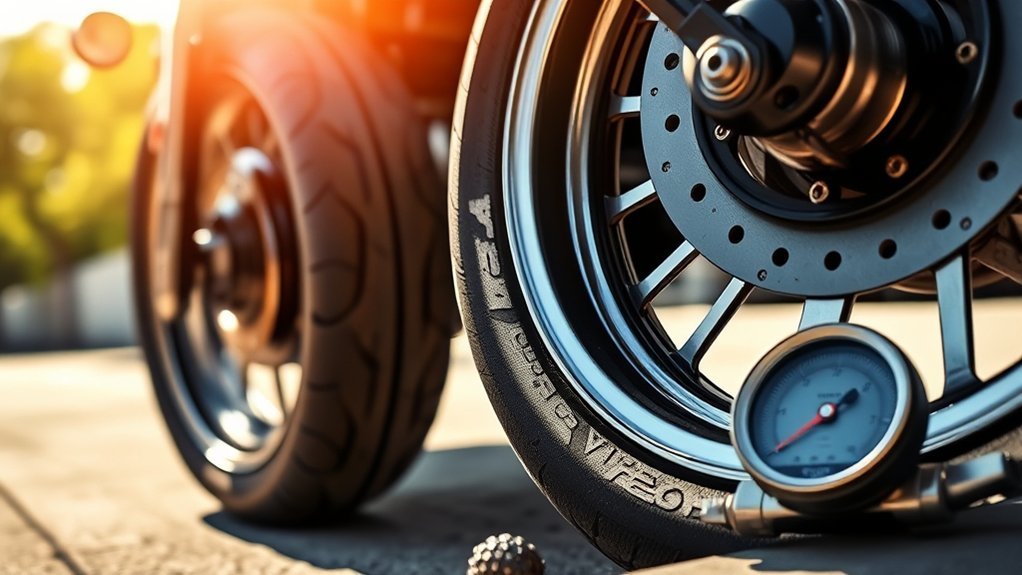
The correct motorcycle tire pressure is the cold PSI specified for your exact motorcycle. Front and rear pressures are often different, and the recommended settings may also change when the motorcycle carries a passenger or luggage.
Broad labels such as sportbike, cruiser, lightweight, or dirt bike are not precise enough to determine a safe pressure. Two motorcycles in the same category can use different tires, wheel sizes, suspension settings, axle loads, and pressure specifications.
Official documentation shows how wide the differences can be. Some Harley-Davidson street motorcycles specify combinations such as 30 PSI front and 40 PSI rear, while others specify 36 PSI front and 42 PSI rear. Michelin’s dedicated off-road products include recommended pressures from about 6 PSI for certain trials tires to more than 20 PSI for some desert applications. These are examples, not settings to copy to another motorcycle.
| Riding situation | Pressure source to use |
| Normal road riding | The motorcycle owner’s manual or information label |
| Passenger or luggage | The manual’s loaded or two-up specification |
| Replacement street tires | The motorcycle specification unless the tire manufacturer provides a specific approved exception |
| Closed-course track riding | The exact tire model’s track data or qualified trackside tire support |
| Off-road riding | The motorcycle and tire manufacturer’s terrain-specific recommendation |
Find Your Bike’s Cold-Pressure Specification
Start with your owner’s manual. It is the main source for front and rear cold pressure, loaded settings, tire sizes, load limits, suspension adjustments, and any temperature-related instructions.
You may also find a tire-information label on the motorcycle. Common locations include the swingarm, chain guard, frame, steering-head area, or beneath a seat or side panel. Placement varies, so check the manual if the label is difficult to find.
The pressure molded into the tire sidewall serves a different purpose. It normally relates to the tire’s load and inflation limits. It is not a general recommendation for everyday use on every compatible motorcycle. The motorcycle manufacturer may specify a lower pressure, or occasionally the same pressure, after considering the motorcycle’s weight, handling, and approved tire fitment.
Note: A tire manufacturer may publish special pressure data for a racing or off-road product. That specialized data applies only to the listed tire, use, and conditions. Return to the motorcycle’s approved road setting before normal street riding.
How to Check and Set Motorcycle Tire Pressure
- Park the motorcycle and let the tires cool. As a conservative general rule, check them before riding or after the motorcycle has been parked for at least three hours. Follow a different definition if your manual provides one.
- Find the correct specification. Record the front, rear, and loaded pressures from the owner’s manual or motorcycle label.
- Inspect the tires first. Look for cuts, punctures, embedded objects, cracking, bulges, exposed cords, unusual wear, damaged valve stems, or a tire that is not evenly seated.
- Remove the valve cap. Keep it clean because the cap helps protect the valve core from dirt and moisture.
- Press the gauge squarely onto the valve. A brief hiss is normal while the gauge seats, but continued hissing means the seal is poor.
- Compare the reading with the correct cold specification. Check front and rear separately because they may require different pressures.
- Add or release air in small amounts. Recheck after every adjustment until the gauge shows the correct value.
- Replace the valve cap and record the result. A written or phone record can help reveal a slow leak over time.
A digital gauge can be convenient, but it is not automatically more accurate than a good dial or pencil gauge. Consistency matters. If two gauges disagree, compare yours with a known, accurate gauge at a motorcycle or tire shop.
The Motorcycle Safety Foundation’s T-CLOCS checklist includes cold tire pressure, tread, weathering, bulges, embedded objects, wheels, bearings, brakes, and other pre-ride checks.
Pro Tip: Keep one dependable gauge with the motorcycle and use the same gauge each time. This makes small changes easier to identify, even if another gauge reads slightly differently.
For general gauge, inflator, and household tool comparisons, these practical home and tool product guides may help you compare basic equipment.
How Often Should You Check Motorcycle Tire Pressure?
Pressure should be checked more often on a motorcycle than many riders expect because motorcycle tires contain relatively little air and small changes can affect handling.
- Include tire condition and pressure in your regular pre-ride inspection.
- Use a gauge at least weekly if you ride regularly.
- Check before a long journey or after the motorcycle has been parked for an extended period.
- Recheck after a noticeable weather change.
- Check immediately if steering, stability, comfort, or tire appearance changes.
Do not judge pressure by looking at or squeezing the tire. A motorcycle tire can appear normal while being several PSI below its specification.
Adjust Pressure for a Passenger, Luggage, and Heavy Loads
Use the motorcycle manual’s loaded, passenger, or two-up pressure specification. Do not automatically add 2–4 PSI to the rear tire. Some manuals increase only the rear pressure, some change both pressures, and some specify one approved setting for all normal loads.
Pressure is only one part of preparing for extra weight. The manual may also instruct you to increase rear suspension preload, adjust damping, reposition luggage, or limit the total cargo weight. Tire pressure cannot compensate for an overloaded motorcycle or incorrectly adjusted suspension.
Count the rider, passenger, riding gear, luggage, accessories, and any added equipment when checking the motorcycle’s allowable load. Stay within the motorcycle’s gross vehicle weight rating and axle limits, as well as the load limits of both tires.
Warning: Do not exceed the motorcycle’s load rating or a tire’s load and pressure limits. Excess weight can increase heat, damage the tires, reduce ground clearance, lengthen braking distance, and make the motorcycle unstable.
Street, Track, and Off-Road Pressure Are Different
Public-Road Riding
Use the motorcycle manufacturer’s cold road pressure. Do not lower pressure for aggressive cornering on public roads. A lower number does not automatically create safer grip, and it can increase tire flex, heat, steering effort, rim-damage risk, or instability.
Closed-Course Track Riding
Track pressures are tire-specific. Racing and track-focused tires may use a cold starting pressure and a separate target hot pressure. The correct values depend on the exact tire model, motorcycle, track surface, ambient temperature, pace, tire warmers, and advice from the tire supplier.
For example, Michelin’s official track-pressure data lists substantially different rear pressures for different track products. Those numbers are not general street recommendations. Restore the approved road pressure before returning to public roads.
Off-Road Riding
Off-road pressure can vary even more. Terrain, speed, tire construction, tubes, tubeless systems, rim locks, mousse inserts, motorcycle weight, and puncture risk all matter. A pressure that works for a slow trials motorcycle may be unsafe for a heavy adventure motorcycle traveling quickly over rocks.
Use the motorcycle and tire manufacturer’s instructions. Michelin’s off-road pressure guide, for example, gives different values for motocross, enduro, desert, mini, and trials products.
Pro Tip: Write your approved road pressures on a small card stored with the gauge. After a track or off-road session, use the card as a reminder to restore the road settings before riding home.
How Temperature Affects Motorcycle Tire Pressure
Air pressure changes with temperature. Around common road pressures, a change of roughly 1 PSI for every 10°F is a useful rule of thumb, but the exact change depends on the starting temperature and pressure.
Check the tires cold at the current ambient temperature and restore them to the motorcycle’s specified value. Some motorcycle manuals provide a temperature-adjustment table, especially for very hot conditions. Follow that model-specific table when one is supplied.
Riding flexes and warms the tires, so the measured pressure normally rises. This warm increase does not mean the tire was overinflated when cold.
Warning: Never bleed a warm tire down to the cold specification. The tire may become underinflated after it cools. If you must add air while the tire is warm, follow the motorcycle or tire manufacturer’s instructions and recheck it when cold.
The NHTSA tire-safety guidance also explains that recommended inflation is a cold specification and should not be confused with the pressure molded on a tire.
Can Motorcycle TPMS Replace a Pressure Gauge?
No. A tire-pressure monitoring system is useful for alerts, but it should not replace a handheld gauge when setting pressure.
A TPMS reading may update at intervals rather than immediately while you add or release air. Its warning threshold may also be lower than the recommended pressure, which means the tire can be below specification before the warning appears.
Use an accurate gauge to set cold pressure. Treat TPMS as a backup that can alert you to a developing problem while riding. If the dashboard reading differs significantly from a trusted gauge, check the owner’s manual and have the system or sensor inspected.
Common Motorcycle Tire-Pressure Problems
| Symptom | Possible cause | What to do |
| Pressure repeatedly falls | Puncture, leaking valve core, damaged stem, bead leak, rim damage, or temperature change | Record cold readings. A loss greater than about 2 PSI per month, or any rapid loss, deserves professional inspection. |
| Sluggish or vague steering | Low pressure, tire damage, unusual wear, load, or a chassis problem | Slow down, check cold pressure and tire condition, and arrange inspection if the feeling remains. |
| Harsh ride or rapid center wear | Pressure may be too high for the motorcycle’s specification | Check with a trusted gauge when cold and correct it to the manual’s value. |
| Shoulder wear or excessive heat | Low pressure, overloading, or demanding use | Correct the pressure and load. Have the tire inspected if it was run significantly low. |
| Cupping or scalloping | Incorrect pressure, wheel imbalance, worn suspension, steering wear, braking forces, or tire characteristics | Check pressure, wheel balance, bearings, steering, and suspension. The existing wear cannot be reversed. |
| Bulge, exposed cord, severe crack, sudden vibration, or rapid loss | Possible structural tire or wheel damage | Do not continue normal riding. Stop safely and arrange professional inspection or transport. |
Note: A wear pattern is a clue, not a complete diagnosis. Pressure, wheel balance, suspension, bearings, alignment, braking habits, road surface, and tire design can interact.
The safest pressure is not the number most riders use. It is the cold front and rear specification approved for your motorcycle, load, tire, and type of riding.
Frequently Asked Questions
What is the proper PSI for motorcycle tires?
The proper PSI is the cold front and rear pressure in the motorcycle owner’s manual or on its information label. There is no universal 32–40 PSI rule that safely applies to every motorcycle.
Is 40 PSI too high for motorcycle tires?
Not automatically. Forty PSI is an approved rear pressure on many motorcycles, but it may be too high for a front tire or for a motorcycle that specifies a lower value. Use the exact front or rear specification for your model.
Is 40 PSI too high for bike tires?
For a motorcycle, 40 PSI may be correct or incorrect depending on the model and tire position. For a bicycle, the answer depends on tire width, rim, rider weight, and tire construction. Motorcycle and bicycle pressure advice should not be mixed.
Is 50 PSI too high for motorcycle tires?
Fifty PSI is above the normal road specification for many motorcycles, but the correct decision must come from the motorcycle manual and the tire’s limits. Do not set a tire to 50 PSI unless the approved documentation specifically requires it.
Should front and rear motorcycle tires use the same PSI?
Not necessarily. The rear tire often carries more weight and may require a higher pressure, but some motorcycles specify equal pressures. Check both values separately instead of assuming they match.
Should I increase tire pressure with a passenger?
Use the passenger or loaded specification in the motorcycle owner’s manual. Do not automatically add a fixed number. Also follow the manual’s suspension-preload and load-placement instructions.
Can I rely on motorcycle TPMS instead of a gauge?
No. TPMS is useful for warnings, but readings can update slowly and the alert threshold may be below the recommended pressure. Use an accurate handheld gauge to set cold pressure.
Sources
- Motorcycle Safety Foundation T-CLOCS Checklist — cold-pressure and pre-ride tire inspection guidance
- Michelin: How to Check Motorcycle Tire Pressure — cold checks, manufacturer specifications, hot tires, and valve caps
- Bridgestone Motorcycle Tire Safety and Maintenance Manual — inflation, loading, pressure loss, damage, and tire safety
- Michelin Track-Day Pressure Information — tire-specific cold and hot track pressures
- Michelin Off-Road Tire Pressure Guide — product- and terrain-specific off-road pressures
- Official LiveWire Service Information — cold-pressure, temperature, warm-tire, and TPMS guidance
Conclusion
Keep both tires at the manufacturer-approved cold pressure for your motorcycle, load, and type of riding. Check them with an accurate gauge, inspect the tread and sidewalls, and use the manual’s loaded setting when carrying a passenger or luggage.
Do not use the sidewall maximum as a routine target, lower street pressure for extra cornering grip, or copy track and off-road numbers from another tire. If pressure drops repeatedly, handling changes, or you find a bulge, exposed cord, severe crack, or rapid leak, stop riding and have the motorcycle inspected.