How to Set Truck Tire Pressure: PSI Guide for Light, Heavy-Duty, and Commercial Trucks

There is no single correct PSI for every truck. A half-ton pickup, an LT-tire work truck, and a loaded highway tractor can require very different pressures. For a pickup with its original tire size and type, start with the vehicle manufacturer’s cold-pressure specification. Commercial operators may also need axle weights and the tire manufacturer’s load-and-inflation table.
Quick Answer
Use the cold PSI printed on your truck’s door-jamb tire placard when it has the original tire type and size. For commercial trucks or approved replacement-tire setups, weigh the loaded axles and use the tire manufacturer’s load-and-inflation table. Never use a broad PSI range or the sidewall maximum as your only guide.
Key Takeaways
- The correct truck tire pressure depends on the vehicle, tire construction, axle load, and operating conditions.
- Use the door placard for an original-equipment pickup instead of inflating every tire to the sidewall maximum.
- Commercial load-table calculations require accurate loaded axle weights and the correct single or dual table column.
- Check tires cold and restore the specified pressure as outdoor temperatures change.
- TPMS can warn about pressure loss, but it does not replace a reliable gauge or a visual inspection.
At a Glance
| Time Required | About 10–20 minutes |
| Difficulty | Easy for placard-based checks; advanced for commercial load-table calculations |
| Tools Needed | Accurate pressure gauge, air source, valve caps, placard or manual, and axle-scale ticket when required |
| Cost | Usually free to about $40 for a dependable gauge; commercial scale fees vary |
Warning: Do not inflate a tire that has exposed cords, a bulge, sidewall separation, severe impact damage, an audible leak, or signs that it has been driven flat. Commercial and multi-piece wheel assemblies can fail violently and should be handled only by trained tire-service professionals using approved equipment.
Truck Tire PSI Ranges by Vehicle Type
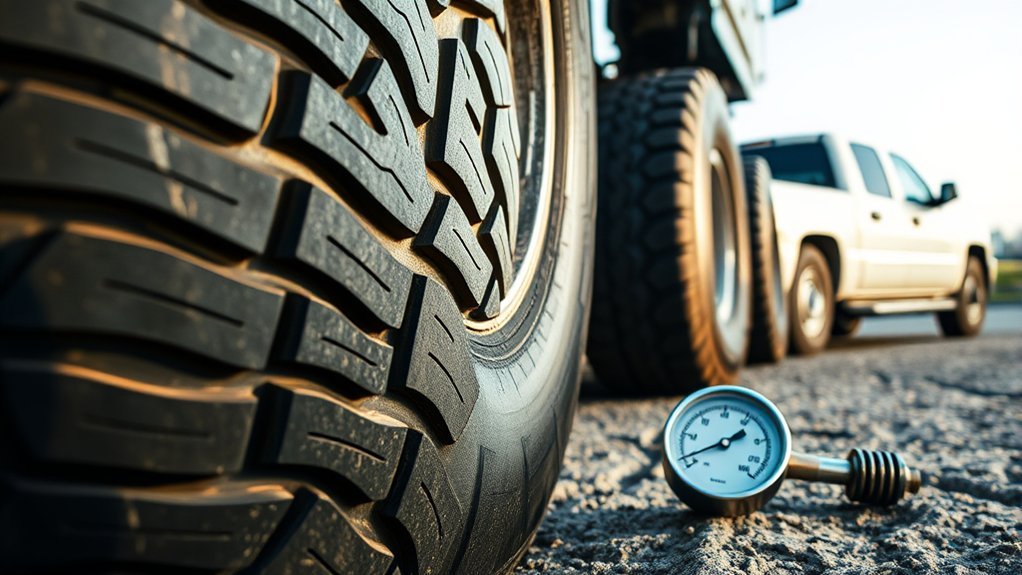
Truck pressures commonly span from the low 30s on some light pickups to more than 100 PSI on certain commercial tires. That wide range is why the truck category alone cannot determine the correct setting.
| Truck or Tire Type | Broad Example Range | Primary Reference |
| Light pickup with original passenger-type tires | Often in the low 30s to low 40s PSI | Door-jamb placard and owner’s manual |
| Pickup supplied with LT tires | May use roughly 40–80 PSI, depending on the vehicle and load | Door-jamb placard; approved manufacturer guidance |
| Medium or heavy highway truck | Many applications fall around 80–120 PSI, but values vary | Loaded axle weights and tire load/inflation tables |
| Industrial, mining, crane, or off-road truck | Highly application-specific | Equipment and tire manufacturer engineering data |
These ranges are examples, not inflation recommendations. Two trucks that look similar may use different pressures because of tire size, load index, axle rating, wheel configuration, or manufacturer testing.
Where to Find the Right PSI: Placard, Manual, and Tire Sidewall
For a pickup or light truck with its original tire size and construction, check the Tire and Loading Information label on the driver’s door edge or door jamb. The owner’s manual may provide additional instructions for full loads, towing, high-speed operation, or alternate tire packages.
The National Highway Traffic Safety Administration advises drivers to use the vehicle manufacturer’s recommended cold pressure rather than the number molded on the tire itself.
The pressure on a tire sidewall is not a universal daily target. It is tied to the tire’s rated load and maximum operating limits.
- Find the front and rear cold-pressure values on the door-jamb placard.
- Confirm that the installed tire size and type match the placard or an approved replacement specification.
- Check the owner’s manual for towing, full-load, dual-wheel, or special-use instructions.
- Use the tire sidewall to confirm size, load index or load range, and maximum limits.
- Record and compare tire pressure measurements when troubleshooting a leak or seasonal pressure change.
Note: A load-range E tire may allow inflation up to 80 PSI, but that does not mean every truck using that tire should run 80 PSI. The required pressure still depends on the vehicle specification and load.
How Axle Weights and Load Determine Correct Truck Tire Pressure
A truck’s total weight does not tell you how much load each tire carries. Cargo, passengers, fuel, equipment, a trailer’s tongue weight, and body configuration can place substantially different loads on the steer and drive axles.
Owners of original-equipment pickups should normally follow the placard rather than lowering pressure through an informal load calculation. Axle-based pressure programs are most appropriate for commercial fleets, specialty vehicles, and replacement configurations evaluated with the correct manufacturer data.
How to Use an Axle Scale and Load Table
- Load the truck normally. Include passengers, cargo, tools, fuel, trailer tongue weight, and equipment normally carried.
- Weigh each axle group. Obtain separate steer-, drive-, and trailer-axle weights where applicable.
- Confirm the limits. Compare the scale ticket with the truck’s GVWR and GAWR, plus the load ratings of the tires and wheels.
- Calculate load per tire. For a two-tire steer axle, divide the axle weight by two. For a four-tire dual axle, use the tire manufacturer’s dual-load table rather than simply treating it as four single tires.
- Open the correct table. Match the exact tire size, construction, speed/application category, and single or dual configuration.
- Select sufficient cold pressure. Use the pressure that supports at least the measured load per tire, following the tire manufacturer’s and fleet’s approved margin.
- Apply the same target across an axle. Tires sharing an axle should normally use the same approved cold pressure unless the vehicle manufacturer specifies otherwise.
Commercial operators should review the tire requirements in 49 CFR 393.75. The rule prohibits operating a commercial motor vehicle on a tire with a cold inflation pressure below the amount specified for the load carried.
Pro Tip: Keep the scale ticket and the exact tire manufacturer’s table together. A chart for another tire size, load range, or single/dual configuration can produce the wrong pressure even when the numbers look similar.
Why Front and Rear Pressures Often Differ for Trucks
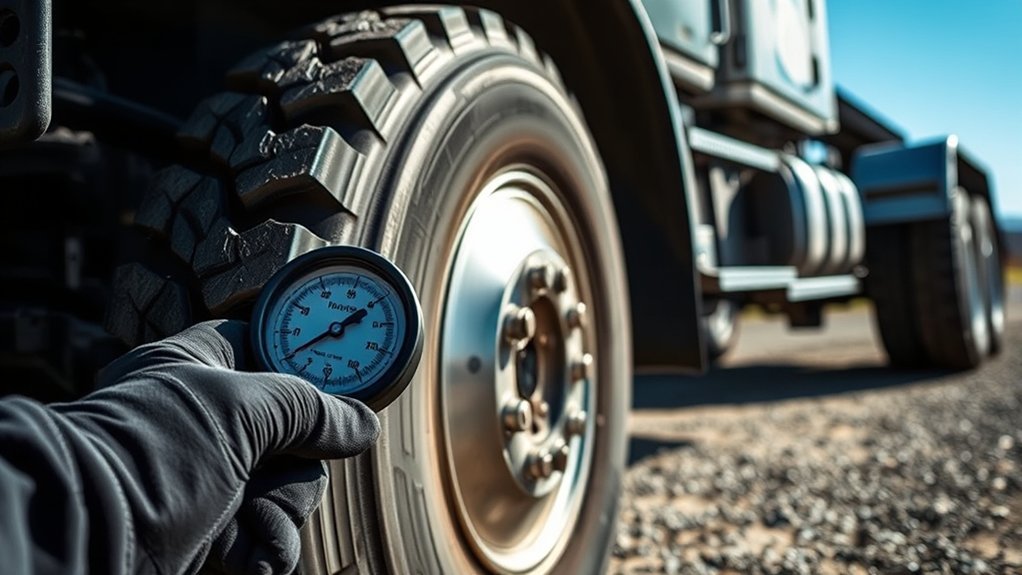
Front and rear pressures differ when the axles carry different loads or use different tire sizes and configurations. There is no rule that the front must always be higher or that the rear must always be higher.
- Front axle: The engine, cab, steering components, and accessories often create a steady load. Some commercial steer axles therefore need substantial pressure.
- Rear axle: Cargo and trailer tongue weight can increase the rear load sharply. Many pickups specify higher rear pressure when designed to carry heavy payloads.
- Dual rear wheels: The tire manufacturer’s dual-load column applies. Both tires in a dual pair should be matched closely for pressure, size, and overall diameter.
- Unloaded operation: Some manufacturers or commercial fleets provide approved reduced-pressure settings. Do not create your own lower setting if the placard or manufacturer does not allow one.
Changing pressure changes the tire’s load capacity, heat generation, ride, steering response, and wear. Pressure cannot increase the truck’s GVWR, GAWR, wheel rating, hitch rating, or structural payload limit.
Cold vs. Hot Tires: When to Check and What to Adjust
Inflation specifications are normally cold values. A cold tire is generally one that has not been driven for at least three hours. Driving flexes and heats the tire, causing the pressure to rise.
Check Tires When Cold
- Park the truck for at least three hours whenever practical.
- Check every road tire with a dependable gauge before driving.
- Compare each reading with the placard or approved load-table target.
- Add or release air until the cold target is reached.
- Reinstall the valve caps and inspect the valve stems for damage.
- Check the spare tire according to the vehicle manufacturer’s specification.
For personal-use pickups, check at least monthly and before towing, carrying a heavy load, or taking a long trip. Commercial inspection frequency should follow the fleet’s maintenance program, manufacturer instructions, and applicable regulations.
Understand Hot Tire Pressure
A hot tire normally reads higher than it did before the trip. The exact increase varies with load, speed, tire size, starting pressure, road temperature, and driving time.
Do not release air from a normally operating hot tire merely to return it to the cold specification. Doing so can leave the tire underinflated after it cools.
If a tire is found significantly low while hot, add enough air to avoid running it severely underinflated, then inspect it and reset it accurately when cold. A tire that repeatedly loses pressure needs repair or professional evaluation.
Adjust for Temperature Changes
Outdoor temperature changes can raise or lower a tire’s cold reading. A commonly used estimate is about 1–2 PSI for each 10°F change, although actual results vary.
Do not automatically add 2–3 PSI above the listed target for winter. Instead, check the tires at the current outdoor temperature and restore them to the specified cold pressure. In hot weather, do not intentionally underinflate the tires to make room for the expected pressure rise.
- Check more often when temperatures change sharply.
- Use the same cold target unless the vehicle or tire manufacturer provides a different seasonal setting.
- Do not exceed the limits of the tire or wheel.
- Investigate a pressure drop that is larger than the surrounding tires or continues after adjustment.
How to Check and Set Tire PSI: Tools, Timing, and Record-Keeping
When to Check
Check pressure before the first drive of the day when possible. Also inspect the tires before towing, after changing the load, after a major temperature shift, and whenever the truck’s handling or TPMS warning changes.
- Read the placard or approved load-table target before connecting the air source.
- Remove the valve cap and press the gauge squarely onto the valve.
- Repeat an unusual reading to rule out a poor seal or gauge error.
- Add air in short bursts and recheck.
- Release small amounts of air only when the tire is cold or when following an approved hot-pressure procedure.
- Reinstall the cap and check for audible leaks.
Tools and Records
A quality digital or commercial stick gauge is usually easier to read consistently than a worn service-station gauge. The gauge must cover the pressure range involved. A 50-PSI passenger-car gauge is not suitable for a 110-PSI truck tire.
- Gauge: Compare it periodically with a trusted reference gauge.
- Air source: Use a compressor or inflator rated for the required pressure.
- Valve access: Use the correct dual-wheel extension or air chuck without placing side force on the valve.
- Records: Note recurring losses, repairs, unusual wear, and fleet pressure targets.
Maintenance records are useful for spotting slow leaks and repeated failures. They may also be required by a company program or a particular regulation. They should not be described as a universal legal requirement for every privately owned truck.
Towing, Payload, and Unloaded Driving
Towing adds load to the truck through tongue or pin weight. That load often falls mainly on the rear axle, although a weight-distributing hitch can shift part of it toward the front axle and trailer axles.
- Load the truck and trailer as they will travel.
- Confirm the truck, hitch, trailer, axle, wheel, and tire ratings.
- Use the truck manufacturer’s towing-pressure instructions when provided.
- For an approved commercial load-table program, weigh the loaded axle groups and recalculate pressure.
- Check the trailer tires separately using the trailer manufacturer’s specification and the correct tire data.
Adding air does not make an overloaded truck safe. Pressure helps a tire support its rated load, but it cannot raise the vehicle’s certified axle or gross-weight limits.
When the truck is unloaded, do not lower the pressure below the placard simply to improve ride comfort unless the manufacturer provides an approved light-load setting. Commercial fleets using variable pressure should document the approved loaded and unloaded targets.
Replacement Tires, LT Conversions, and Dual Tires
Changing from a passenger-type tire to an LT tire, moving to a different size, or changing the load range may change the pressure required to carry the same load. The old placard number and the new tire’s sidewall maximum are not enough by themselves to complete that calculation.
Bridgestone’s light-truck tire guidance explains that replacement LT-tire pressure should be selected through the applicable load-and-inflation tables so the replacement provides sufficient load capacity.
- Use a tire size, load capacity, and speed rating approved for the vehicle.
- Confirm that the wheel supports the required pressure and load.
- Do not mix incompatible tire constructions on the same axle.
- Use the dual-load rating for tires installed as duals.
- Keep dual tires closely matched in inflation and overall diameter.
- Ask a qualified tire professional to calculate pressure after a P-metric-to-LT conversion.
How to Read Wear, Handling, and Noise to Spot Wrong PSI
Wear and handling changes can provide clues, but they do not prove that inflation is the only problem.
- Wear on both shoulders: May result from underinflation, overloading, or repeated hard cornering.
- Wear in the center: May be associated with excessive pressure for the load, but tire design and operating conditions also matter.
- Wear on one shoulder: More often points toward alignment, suspension, or axle problems.
- Cupping or scalloping: Can involve balance, shocks, suspension looseness, rotation intervals, or tire uniformity.
- Mushy steering: May indicate low pressure, overloading, tire damage, or a steering problem.
- Harsh ride and reduced grip: May occur when pressure is unnecessarily high for the vehicle and load.
- Thumping or vibration: Stop and inspect for separation, impact damage, a flat spot, loose wheel components, or severe imbalance.
Begin with an accurate cold-pressure check. If the pressure is correct, inspect alignment, balance, suspension, wheel condition, tire damage, and loading.
Maintenance Options: TPMS, Auto-Inflation Systems, and Service Routines
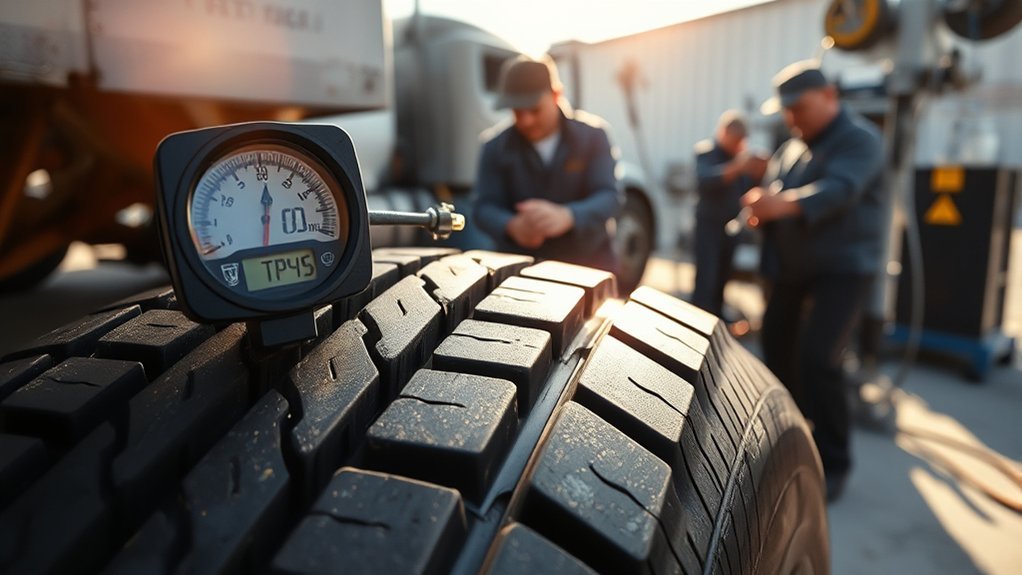
A tire pressure monitoring system can warn the driver when pressure falls significantly, but it may not warn about a smaller pressure error that still affects loaded tire capacity. It also cannot identify every bulge, cut, damaged valve, uneven wear pattern, or overloaded axle.
- Factory TPMS: Keep sensors working and follow the vehicle’s relearn procedure after tire or wheel service.
- Aftermarket TPMS: Set alarm thresholds from the approved cold target, not a guessed universal PSI.
- Automatic tire inflation: These systems can help maintain trailer or fleet setpoints, but hoses, seals, wheel ends, and warning indicators still need inspection.
- Manual verification: Compare system readings periodically with a trusted gauge.
Proper inflation can reduce rolling resistance and unnecessary fuel use. The U.S. Department of Energy also notes that properly inflated tires generally last longer and operate more efficiently.
Quick Checklist: Daily and Monthly Tire-Pressure Tasks
Inspect tires before driving, measure pressure when cold, and investigate any tire that loses more air than the others.
Before Driving or Towing
- Walk around the truck and look for visibly low tires, cuts, bulges, exposed cords, objects, and valve damage.
- Check cold pressure when required by the vehicle’s use, fleet policy, or recent pressure history.
- Confirm that the load has not changed enough to require a different approved setting.
- Respond to TPMS or automatic-inflation warnings before continuing.
- Do not operate on a tire that is flat, leaking badly, structurally damaged, or unable to support the load.
Monthly or Scheduled Maintenance
- Measure all road tires and the spare with a dependable gauge.
- Inspect tread depth and wear across the full tread width.
- Check valve stems, extensions, caps, and accessible wheel surfaces.
- Compare dual tires for pressure and visible size differences.
- Review recurring losses and repair punctures, valve leaks, bead leaks, or wheel problems.
- Verify the gauge against a known reference.
Commercial drivers must be satisfied that required equipment, including tires and wheels, is in good working order before driving. See 49 CFR 392.7. Exact inspection and documentation duties can also depend on the operation, cargo, company policy, and applicable state or federal rules.
Frequently Asked Questions
What PSI should I put in my truck tires?
Use the cold front and rear pressures on the driver-door placard when the truck has its original tire size and type. Commercial or modified setups may require loaded axle weights and the exact tire manufacturer’s load-and-inflation table.
Is 40 PSI too high for truck tires?
Forty PSI may be correct for one pickup, excessive for another light vehicle, and far too low for a loaded commercial tire. Compare it with the vehicle placard or the approved load-table target instead of judging the number by itself.
Is 35 or 45 PSI better for a truck tire?
Neither is automatically better. Use the pressure specified for the truck, tire, axle, and load. Raising pressure without additional load may worsen ride and grip, while using too little pressure can reduce load capacity and increase heat.
Is 30 PSI too low for truck tires?
It depends. Thirty PSI may be close to the placard value on some light pickups with passenger-type tires, but it can be dangerously low for an LT or commercial tire carrying a heavy load. Check the correct specification before driving.
Should I inflate truck tires to the sidewall maximum?
Not automatically. The sidewall value is tied to the tire’s rated limits and does not replace the vehicle placard or load table. Use the sidewall to confirm that the tire can safely handle the required pressure and load.
Can I lower the rear pressure when my truck is unloaded?
Only when the manufacturer or an approved fleet pressure program provides a light-load setting. Do not lower an original-equipment pickup below its placard pressure solely to soften the ride.
How much should truck tire pressure rise while driving?
There is no single correct increase. Pressure rises as the tire warms, and the amount depends on load, speed, tire size, road temperature, and trip length. Do not bleed a normally operating hot tire back to its cold specification.
Conclusion
The right truck tire pressure is the pressure that safely supports the actual vehicle and axle load without exceeding any vehicle, tire, or wheel limit. For an original-equipment pickup, begin with the cold front and rear values on the door placard. For an approved commercial pressure program, use accurate axle weights and the exact tire manufacturer’s load-and-inflation table.
Check pressures cold, respond promptly to unusual air loss, and do not adjust a normal hot tire back to its cold number. Proper inflation supports predictable braking, steering, tire life, load capacity, and fuel efficiency.
Sources
- National Highway Traffic Safety Administration: TireWise — vehicle placards, cold tire pressure, tire maintenance, and TPMS guidance
- Electronic Code of Federal Regulations: 49 CFR 393.75 — commercial tire condition, load, and inflation requirements
- Electronic Code of Federal Regulations: 49 CFR 392.7 — commercial vehicle equipment inspection and use
- Continental Truck Tires: Load and Inflation Tables — load-based pressure data for truck and bus tire sizes
- Bridgestone Americas: Light Truck and SUV Tire Information — LT-tire selection and replacement-pressure considerations
- U.S. Tire Manufacturers Association: Commercial Truck and Bus Tire Care — industry tire inspection, inflation, and service guidance