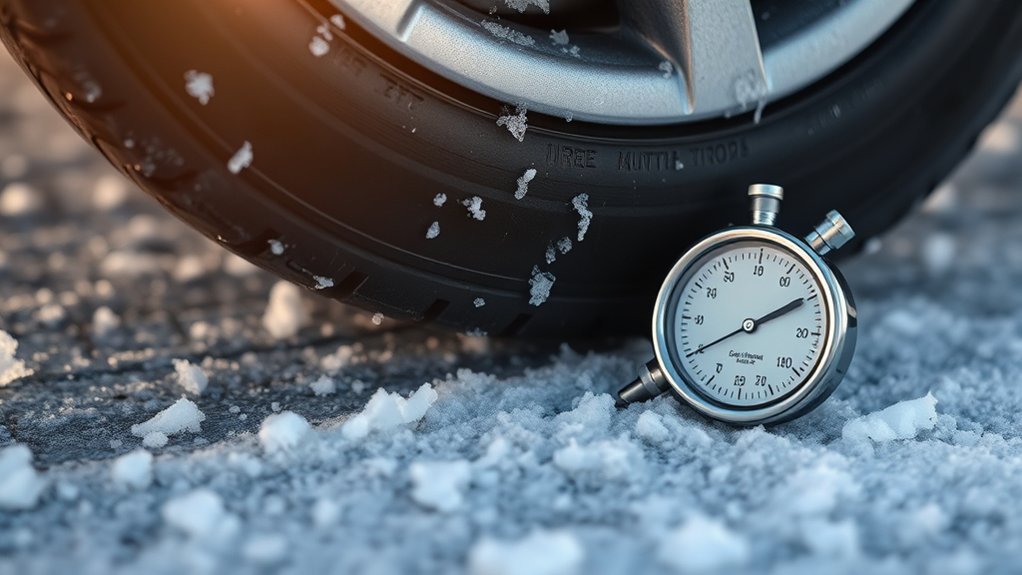
When temperatures drop, your tire pressure drops with it—and that can cost you money, safety, and peace of mind. Cold air contracts, lowering tire pressure by about 1 PSI for every 10°F drop. A sudden 20°F cold snap can shave 2–4 PSI off your tires, triggering your TPMS light and worsening handling, fuel economy, and tread wear.
This guide explains why tire pressure falls in winter, how much you’ll lose, and what to do to stay safe. You’ll learn how to check pressure correctly, where to inflate tires, and when to worry about that TPMS warning light. Most importantly, you’ll get a simple monthly checklist to avoid the hassle and risk of underinflated tires.
Why Tire Pressure Drops in Cold Weather
The Science: Air Contraction and the 1 PSI Rule
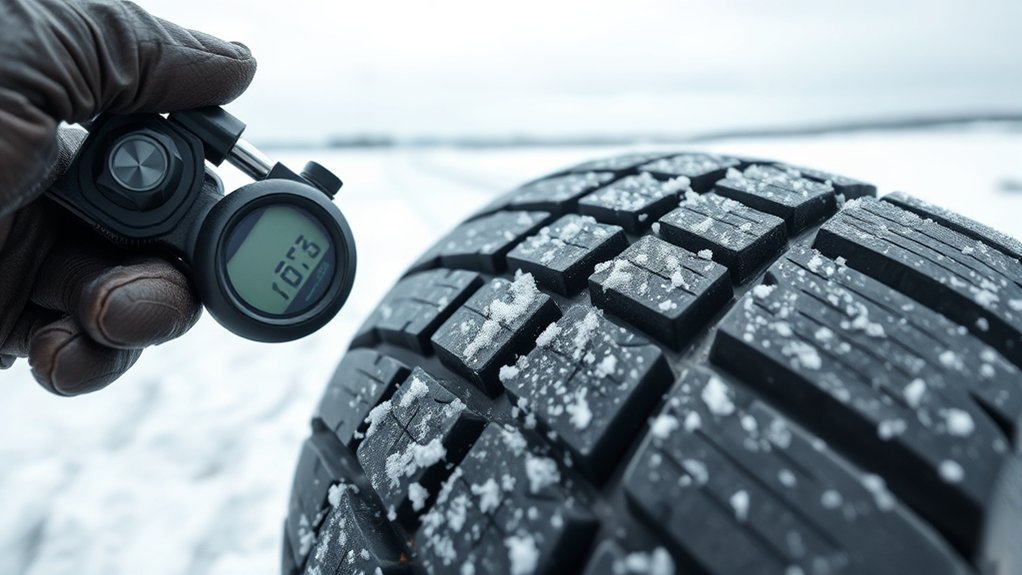
Air is made of molecules that move more slowly as temperature drops. Slower molecules take up less space, so the volume of air inside your tire shrinks—and pressure falls as a result.
The rule of thumb: tire pressure drops about 1 PSI for every 10°F decrease in temperature. This isn’t just theory. If you inflate your tires to 32 PSI on a 70°F day, they’ll read about 28 PSI on a 30°F morning—a 4 PSI loss that’s enough to trigger your TPMS light and affect handling.
On top of that, tires naturally lose about 1 PSI per month through tiny pores in the rubber (a process called permeation). Cold weather doesn’t cause that leak, but it compounds the problem. You might check your tires in September, hit a cold snap in November, and suddenly be 5–6 PSI low without ever hitting a nail.
How Much Pressure Will You Lose? (Real Examples)
Here’s what to expect as temperatures fall:
- 10°F drop (e.g., 60°F to 50°F): Lose ~1 PSI
- 20°F drop (e.g., 60°F to 40°F): Lose ~2 PSI
- 40°F drop (e.g., 70°F to 30°F): Lose ~4 PSI
- 70°F drop (e.g., 70°F to 0°F): Lose ~6–7 PSI
Example: You live in a region where daytime temps are 50°F in October, but overnight lows hit 20°F by December. That 30°F swing could drop your tire pressure by 3 PSI—plus another 1–2 PSI from natural permeation over two months. If your recommended pressure is 32 PSI, you’re now at 27–28 PSI, which is low enough to hurt fuel economy and tire wear.
Bottom line: Check your tire pressure monthly during winter, and any time temperatures drop sharply.
Why Low Tire Pressure in Winter Is Dangerous
Even a small pressure loss has real consequences. Here’s what happens when your tires are underinflated:
Safety Risks (Handling, Braking, Blowouts)
- Longer stopping distances: Underinflated tires deform more under braking, reducing grip. On icy or snowy roads, this can be the difference between stopping in time and sliding into an intersection.
- Poor handling: Low pressure reduces steering response, especially in corners. Your car feels “mushy” and less predictable.
- Increased blowout risk: Underinflated tires flex more, generating heat. In extreme cases (highway speeds, heavy loads), this can cause tread separation or a blowout.
Cost Impacts (Fuel Economy, Tire Wear)
- Fuel economy: Every 1 PSI drop costs you about 0.2% in fuel efficiency. That might not sound like much, but 5 PSI low = 1% worse MPG. Over a year, that’s $50–100 in wasted gas.
- Uneven tire wear: Low pressure causes the tire’s outer edges to wear faster than the center. You’ll need to replace tires sooner—often thousands of miles earlier than normal.
- Higher rolling resistance: Underinflated tires drag more, making your engine work harder.
When Your TPMS Light Comes On
Your Tire Pressure Monitoring System (TPMS) light (the horseshoe-shaped icon with an exclamation point) typically triggers when one or more tires drop 25% below the recommended pressure. For a 32 PSI tire, that’s about 24 PSI—a loss of 8 PSI.
In cold weather, the TPMS light often comes on first thing in the morning, then turns off after you’ve driven a few miles (because driving warms the tires and raises pressure slightly). This is a warning, not a false alarm. Don’t ignore it.
How to Check Tire Pressure Correctly in Cold Weather (Step-by-Step)
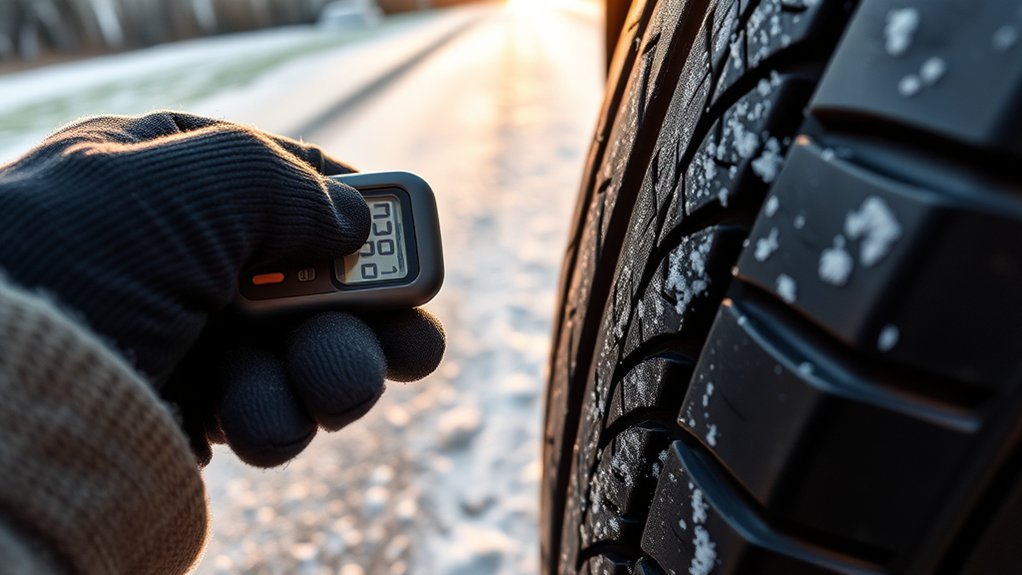
Checking tire pressure correctly is simple, but many people do it wrong. Follow these steps for accurate results:
When to Check (Cold Tires vs. Warm Tires)
Always check tire pressure when tires are “cold”—meaning the car has been parked for at least 3 hours, or hasn’t been driven more than a mile. Driving heats up tires and raises pressure by 2–4 PSI, giving you a false reading.
Best time to check: early morning, before you start the car.
Tools You Need (Best Tire Pressure Gauges)
You need a tire pressure gauge. Don’t rely on the air pump at the gas station—those built-in gauges are often inaccurate.
Options:
- Pencil-style gauge ($5–10): Cheap, reliable, no batteries needed. Good for basic use.
- Digital gauge ($15–30): Easier to read, more precise (±0.5 PSI). Best for regular checks.
- Dial gauge ($10–20): Analog display, durable, but bulkier.
Where to Find Your Recommended PSI
Your vehicle’s recommended tire pressure is listed in two places:
- Driver’s side door jamb: Open the driver’s door and look for a sticker on the door frame. It lists PSI for front and rear tires (and sometimes the spare).
- Owner’s manual: Check the “Tires” or “Specifications” section.
Do NOT use the number on the tire sidewall. That’s the tire’s maximum pressure, not what your vehicle needs. Most cars run 30–35 PSI; trucks and SUVs may go higher (35–40 PSI).
Checking Process (5 Steps)
- Remove the valve cap from one tire. (Set it somewhere you won’t lose it.)
- Press the gauge firmly onto the valve stem. You should hear a brief hiss of air. Hold it steady for 1–2 seconds.
- Read the gauge. Digital gauges display instantly. Pencil gauges have a sliding stick—read the number where it stops.
- Compare to the recommended PSI. If it’s low, you’ll need to add air. If it’s high (rare in winter), release air by pressing the valve pin with your gauge or a pen.
- Repeat for all four tires (and the spare). Write down each reading.
Pro tip: If you hear a long hiss when you press the gauge, you don’t have a good seal. Try again.
How to Maintain Proper Tire Pressure All Winter
Target PSI and How to Adjust for Temperature
Inflate to the PSI listed on your door jamb (usually 28–35 PSI). Don’t try to “overinflate” to compensate for future cold—just set it to the recommended number when tires are cold.
If you inflated your tires in the summer (70°F) and winter temps drop to 30°F, your tires will naturally lose about 4 PSI. Check them and top off as needed.
Formula:
Expected loss = (Starting temp – Current temp) ÷ 10 = PSI drop
Example: 70°F to 30°F = 40°F drop ÷ 10 = ~4 PSI loss
How Often to Check (Monthly Minimum)
Check tire pressure at least once a month during winter. Also check:
- After a sharp temperature drop (10°F+ overnight)
- Before long road trips
- Any time the TPMS light comes on
Set a recurring reminder on your phone (e.g., first Sunday of each month).
Where to Inflate Tires (Options + Costs)
Free or cheap options:
- Gas station air pumps: Usually free or $1–2. Look for digital displays (more accurate). Bring quarters or a credit card.
- Discount/auto parts stores: Many offer free air (Costco, Discount Tire, some AutoZones).
At-home options:
- Portable air compressor: $30–80. Plugs into your car’s 12V outlet or wall outlet. Convenient for driveway checks.
- Bike pump with car adapter: $20–40. Slower, but works in a pinch.
Portable Air Compressor Recommendations
A portable compressor is worth the investment if you check tires regularly. Look for:
- PSI range: At least 100 PSI (enough for car tires)
- Auto shut-off: Stops inflating at your target PSI
- LED light: Useful for roadside fixes at night
- Power source: 12V (plugs into car) or rechargeable battery
Troubleshooting: TPMS Light Won’t Turn Off
Common Causes (Cold Weather, Slow Leaks, Sensor Issues)
If your TPMS light stays on after you’ve inflated all tires to the correct PSI, the problem might be:
- Tire hasn’t warmed up yet: Drive for 10–15 minutes. The TPMS recalibrates after pressure stabilizes.
- Slow leak: One tire is losing air faster than normal (nail, damaged valve stem, rim corrosion). Check for hissing or visual damage.
- Spare tire low: Some vehicles monitor the spare. Check it too.
- Dead TPMS sensor battery: Sensors last 5–10 years. If your car is older, a sensor may have failed.
- Sensor damaged during tire change: If you recently had tires rotated or replaced, a sensor may have been broken or not reinstalled correctly.
How to Reset Your TPMS
Some vehicles require a manual reset after inflating tires. Check your owner’s manual for the exact procedure. Common methods:
- Hold the TPMS reset button (usually under the steering wheel or in the glove box) for 3–5 seconds until the light blinks.
- Drive 10–15 minutes at 50+ mph. The system recalibrates automatically.
- Use the infotainment system: Some cars have a TPMS reset option in the vehicle settings menu.
If the light still won’t turn off, see a mechanic.
When to See a Mechanic
Get professional help if:
- The TPMS light stays on after inflating and resetting
- One tire keeps losing pressure (slow leak)
- The tire looks visibly damaged (bulge, deep cuts, exposed cords)
- You hear a hissing sound from a tire
- The TPMS light blinks (this indicates a sensor malfunction, not low pressure)
Cost: TPMS sensor replacement typically costs $50–100 per sensor (parts + labor). Leak repairs range from free (nail removal + patch) to $20–30.
Winter Tire Pressure Checklist (Print This)
Monthly Tasks
- Check all four tires (plus spare) with a gauge when cold
- Inflate to door-jamb PSI if low
- Inspect tread depth (use a penny—Lincoln’s head should be partly covered)
- Look for uneven wear, cracks, or bulges
- Clean valve stems and replace caps if missing
Emergency Kit Items
- Tire pressure gauge (digital or pencil-style)
- Portable air compressor or tire inflator
- Tire repair kit or sealant (Fix-a-Flat)
- Flashlight or headlamp
- Gloves (for handling cold valve stems)
Before-Trip Checklist
- Check tire pressure (all tires + spare)
- Verify tread depth is adequate for winter conditions
- Confirm TPMS light is off
- Pack emergency kit in trunk
Frequently Asked Questions
Can I Drive With the TPMS Light On?
You can, but you shouldn’t. The TPMS light means at least one tire is 25% below the recommended pressure—low enough to affect handling, braking, and fuel economy. Check your tires as soon as possible. If you must drive, keep speeds low (under 50 mph) and avoid hard braking or sharp turns.
Should I Use Nitrogen Instead of Air in Winter?
Nitrogen is slightly better at resisting pressure changes (it leaks more slowly than regular air), but the difference is minimal for passenger vehicles. Unless you’re racing or driving in extreme conditions, regular air works fine. Nitrogen also costs $5–10 per tire, while air is usually free.
Verdict: Not necessary for most drivers. Save your money and just check pressure more often.
How Do I Know if My TPMS Sensor Is Broken?
If your TPMS light blinks for 60–90 seconds when you start the car, then stays solid, the system has detected a sensor malfunction (not low pressure). You’ll need a mechanic to diagnose which sensor failed. If the light comes on solid without blinking, it’s just low tire pressure.
Is It Safe to Inflate Tires When They’re Hot?
It’s safe, but you’ll get an inaccurate reading. Hot tires (from driving) read 2–4 PSI higher than cold tires. If you inflate to the recommended PSI while tires are hot, they’ll be underinflated once they cool down. Always check and inflate when tires are cold (parked for 3+ hours).
What PSI Should I Use for Winter vs. Summer?
Use the same PSI year-round—the number on your door jamb. Don’t increase pressure for winter. The recommended PSI already accounts for typical driving conditions. If you switch to winter tires, they may have a different PSI recommendation; check the door jamb or tire manufacturer’s specs.
Do I Need to Adjust Pressure for Winter Tires?
Winter tires (also called snow tires) may have a different recommended PSI than your car’s original tires. Check the tire sidewall or the manufacturer’s website for the correct pressure. The door-jamb sticker applies to the original tires your car came with, which may not match winter tire specs.
Final Checklist: Don’t Let Cold Weather Catch You Off Guard
Cold weather tire pressure loss is predictable and preventable. Here’s what to do right now:
- Find your recommended PSI (door jamb or owner’s manual).
- Buy a tire pressure gauge (digital or pencil-style, $5–30).
- Check all four tires + spare when cold (early morning).
- Inflate to the recommended PSI (gas station air or portable compressor).
- Set a monthly reminder to recheck (first Sunday of each month works well).
Do this once a month all winter, and you’ll avoid TPMS warnings, save on gas, and keep your tires lasting longer. It takes 10 minutes and costs almost nothing—far better than dealing with a blowout or buying tires early.
Pro tip: Take a photo of your door-jamb sticker with your phone. You’ll always have the correct PSI on hand.