Break-In Period: Complete Toyota Supra Guide

Your new Toyota GR Supra may feel ready for hard acceleration from the first mile, but Toyota gives its engine, transmission, axle drive, tires, brakes, and manual clutch specific break-in periods. Following those limits is simple: use moderate inputs, avoid maximum performance, watch the mileage, and increase the load gradually after break-in.
Quick Answer
For the first 1,200 miles/2,000 km, keep your Toyota Supra below 4,500 RPM and 100 mph/160 km/h, while always following lower posted limits. Avoid full load, kickdown, and Launch Control. Drive gently on new tires for 200 miles and give the brakes and manual clutch about 300 miles.
Key Takeaways
- Keep the gasoline engine below 4,500 RPM for the first 1,200 miles/2,000 km.
- Remain below 100 mph/160 km/h and always obey the lower posted speed limit.
- Avoid full load, automatic-transmission kickdown, and Launch Control during drivetrain break-in.
- Drive conservatively on new tires for 200 miles/300 km.
- Brake moderately and engage a manual clutch gently for about 300 miles/500 km.
- After 1,200 miles, increase engine and vehicle speed gradually rather than going directly to maximum performance.
At a Glance
| Break-In Distance | 1,200 miles/2,000 km for the engine, transmission, and axle drive |
| Difficulty | Easy |
| Tools Needed | Owner’s manual, safe driving route, tire pressure gauge, and maintenance log |
| Cost | No special cost beyond normal fuel and routine maintenance |
What’s in This Article
- Before You Begin: What You’ll Need
- Simple Step-by-Step Break-In Plan
- Why the Toyota Supra Break-In Period Matters
- Official Toyota Break-In Limits
- Optional Break-In Driving Habits
- Common Break-In Mistakes
- Engine RPM Do’s and Don’ts
- Varying Engine Speed
- Cruise Control During Break-In
- Oil Monitoring
- Early Oil Changes
- What to Do If You Miss a Rule
- What to Expect After Break-In
- Frequently Asked Questions
- Conclusion
Estimated total distance: Plan on 1,200 miles/2,000 km of moderate driving before you gradually use a wider range of engine and vehicle speed.
Before You Begin: What You’ll Need
- Your Toyota Supra owner’s manual or digital manual for the correct production date
- A safe route with normal changes in speed and light to moderate traffic
- A tire pressure gauge for routine cold-pressure checks
- A simple log for mileage, oil-level readings, tire pressure, and service notes
- Enough time to complete the break-in through normal driving rather than unnecessary high-mileage trips
Pro Tip: Toyota publishes different 2026 Supra manuals based on production date. Check the build information for your car and select the matching manual on Toyota’s official manuals page.
Simple Step-by-Step Break-In Plan
- Drive away gently: Do not leave the engine idling for a long warm-up. Start driving without unnecessary delay, but use moderate engine and vehicle speed while the engine is cold.
- Stay below Toyota’s drivetrain limits: For 1,200 miles/2,000 km, remain below 4,500 RPM and 100 mph/160 km/h. Posted speed limits always take priority.
- Avoid maximum load: Do not use full throttle, automatic-transmission kickdown, or Launch Control.
- Use smooth inputs: Accelerate, shift, steer, and slow down progressively instead of making sudden inputs.
- Break in the tires: Drive conservatively for the first 200 miles/300 km while new tires develop their full traction potential.
- Break in the brakes: Brake moderately for approximately 300 miles/500 km unless harder braking is required for safety.
- Protect the manual clutch: On a manual-transmission Supra, engage the clutch gently for approximately 300 miles/500 km.
- Increase performance gradually: After 1,200 miles/2,000 km, add engine speed, throttle, and vehicle speed in steps.
Why the Toyota Supra Break-In Period Matters
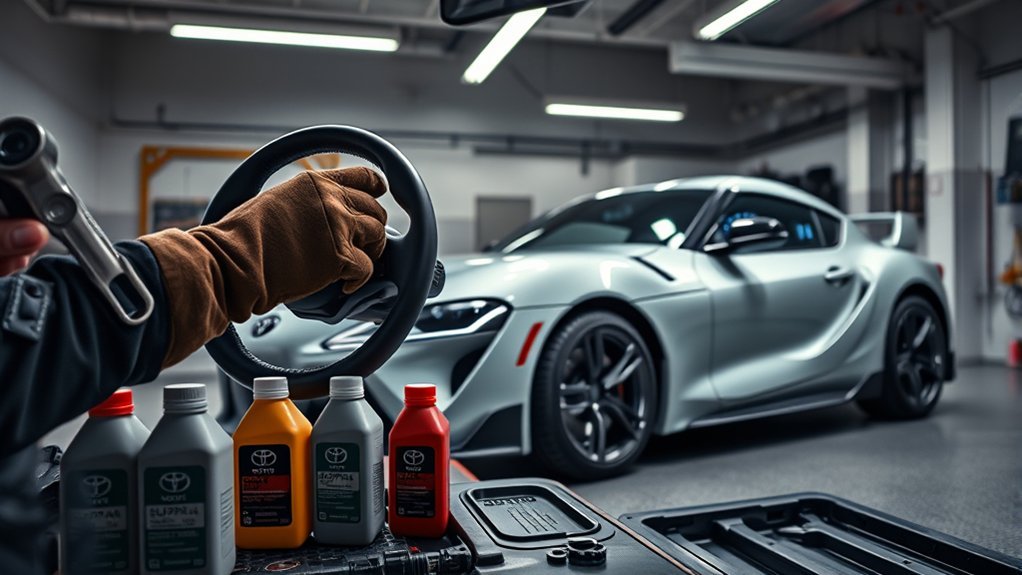
Moving parts in a new Toyota GR Supra need time to begin working together smoothly. Toyota applies a 1,200-mile/2,000-km break-in period to the engine, transmission, and axle drive.
The other components do not all use the same distance. New tires need 200 miles/300 km of conservative driving. The brake discs, brake pads, and manual-transmission clutch need approximately 300 miles/500 km to reach their intended effectiveness or operation.
For the first 1,200 miles/2,000 km, Toyota limits the gasoline engine to less than 4,500 RPM and the vehicle to less than 100 mph/160 km/h.
Warning: The 100-mph/160-km/h figure is a maximum break-in ceiling, not a recommended driving speed. Always obey the lower posted limit and adjust your speed for traffic, weather, visibility, and road conditions.
Toyota also warns that new parts and driver-assistance components may not yet respond exactly as an experienced owner expects. Drive conservatively, leave enough space, and be ready to intervene early when necessary.
Official Toyota Break-In Limits
The following limits come from Toyota’s current 2026 GR Supra owner’s manuals. The exact manual you need depends on your vehicle’s production date.
| Component | Distance | Toyota Guidance |
|---|---|---|
| Engine, transmission, and axle drive | 1,200 miles/2,000 km | Stay below 4,500 RPM and 100 mph/160 km/h. Avoid full load, kickdown, and Launch Control. |
| Tires | 200 miles/300 km | Drive conservatively because brand-new tires have not reached their full traction potential. |
| Brake discs and pads | About 300 miles/500 km | Brake moderately while the components reach full effectiveness. |
| Manual-transmission clutch | About 300 miles/500 km | Engage the clutch gently while it reaches its optimal operation. |
Engine, Transmission, and Axle Drive
For the first 1,200 miles/2,000 km, keep the engine below 4,500 RPM. Avoid full throttle or any other situation that places the drivetrain under maximum load.
On an automatic model, avoid kickdown. Kickdown occurs when deep accelerator input makes the transmission select a lower gear for strong acceleration. Launch Control must also remain unused during break-in.
New Tires
Brand-new tires do not offer their full traction potential immediately. For the first 200 miles/300 km, avoid abrupt acceleration, hard cornering, and unnecessary heavy braking.
Cold tire pressure should still match the specification for your vehicle and tire setup. Check the pressure before a long trip and correct it according to the placard and owner’s manual.
Brake Discs and Pads
The brake discs and pads need approximately 300 miles/500 km to reach full effectiveness. Use moderate braking when traffic and road conditions allow.
Emergency braking always takes priority over break-in. Do not avoid firm braking when it is needed to prevent a collision.
Manual-Transmission Clutch
The manual clutch also needs approximately 300 miles/500 km. Engage it gently, avoid aggressive launches, and do not hold the car on a hill by slipping the clutch.
Use the parking brake or brake pedal to hold the vehicle when stopped on a slope. This reduces unnecessary clutch heat and wear.
After Replacing Parts
Toyota says the relevant break-in procedures should be followed again after the listed components are replaced. For example, drive conservatively after installing new tires, brake moderately after new pads or discs, and engage a replacement clutch gently.
Note: A component replacement does not automatically restart the entire vehicle’s 1,200-mile break-in. Repeat the procedure that applies to the replaced component and follow the installer or Toyota dealer’s instructions.
Optional Break-In Driving Habits
Toyota’s written break-in section gives firm limits for RPM, speed, load, kickdown, Launch Control, tires, brakes, and the manual clutch. It does not separately state that cruise control is forbidden or that RPM must change every few minutes.
Even so, many owners prefer a route that naturally includes normal acceleration, coasting, braking, and gear changes. This avoids spending the entire break-in period at one engine speed and helps the driver learn how the car responds.
Vary Engine Speeds Regularly
You can vary engine load without driving aggressively. Use normal city, suburban, and highway conditions while staying below Toyota’s limits.
- Accelerate smoothly through a moderate RPM range.
- Allow the transmission to use different gears.
- Slow down progressively when traffic conditions allow.
- Avoid lugging the engine in a high gear at very low RPM.
- Keep every speed change legal, smooth, and predictable.
Keep RPM Below Toyota’s Limit
Speed variation does not override the 4,500-RPM ceiling. Downshift carefully and watch the tachometer, especially in a manual model where a low-gear selection can raise RPM quickly.
- Stay below 4,500 RPM: Do not treat 4,500 RPM as a target.
- Use moderate throttle: A lower RPM does not make full throttle appropriate during break-in.
- Avoid lugging: Select a lower gear before asking the engine for strong acceleration at very low RPM.
- Keep a margin: Shift before the limit so an incline or downshift does not carry the engine past it.
Use Engine Braking With Care
Gentle engine braking is acceptable, but aggressive downshifts can send the engine beyond the break-in limit or shock the drivetrain. Choose the next gear carefully and release the clutch smoothly.
Use the service brakes normally when needed. Do not rely on engine braking so heavily that it creates abrupt deceleration or makes your driving unpredictable to other road users.
Avoid These Common Break-In Mistakes From the Start
- Using full throttle below 4,500 RPM: RPM is only one limit. Toyota also says to avoid full load.
- Treating 100 mph as an approved speed: It is only an upper ceiling. Posted speed limits remain controlling.
- Using Launch Control: Save it until break-in is complete and use it only in a suitable controlled environment.
- Triggering kickdown: Use smooth accelerator input in an automatic Supra.
- Launching a manual car aggressively: Engage the clutch gently during its first 300 miles/500 km.
- Driving hard on new tires: Their full traction is not available immediately.
- Repeated heavy braking without need: Give new pads and discs time to reach full effectiveness.
- Idling for a long warm-up: Drive away without unnecessary delay and use moderate speed while the engine warms.
The Do’s and Don’ts of Engine RPMs During Break-In

Engine RPM matters, but it is not the only measure of drivetrain load. Full throttle at 3,000 RPM can place more load on the engine than light throttle at a somewhat higher speed.
Do: accelerate progressively, shift smoothly, leave a margin below 4,500 RPM, and use moderate vehicle speed while the engine is cold.
Don’t: use full throttle, lug the engine, make a high-RPM downshift, chase the 4,500-RPM ceiling, or assume Sport mode cancels the break-in restrictions.
Pro Tip: In a manual Supra, shift early enough to leave room for RPM to rise. In an automatic model, ease off the accelerator before the transmission reaches the kickdown point.
Varying Engine Speed: Why It Can Help During Break-In
Using a range of normal road and engine speeds gives the engine, transmission, and axle drive different light-to-moderate operating conditions. It can also make the first 1,200 miles more representative of normal ownership.
This is practical advice rather than a separately stated Toyota prohibition against steady-speed driving. You do not need to make constant or distracting speed changes.
- Choose mixed routes: Combine local roads and legal highway driving when practical.
- Change speed naturally: Let traffic, grades, and road conditions create smooth variation.
- Avoid aggressive bursts: Do not vary speed with hard acceleration or sudden braking.
- Watch your surroundings: Safe and predictable driving matters more than creating a perfect RPM pattern.
Why Should You Limit Cruise Control During Break-In?
Toyota’s break-in section does not expressly ban cruise control. However, cruise control can hold the vehicle at one road speed for a long period, so some owners choose to limit it during the first 1,200 miles.
You can still drive on the highway. When conditions allow, control the speed yourself and let normal traffic or road grades create gentle changes. Do not weave through traffic or make unnecessary speed changes simply to vary RPM.
Note: Safety comes first. Using cruise control briefly when it reduces fatigue or helps maintain a legal speed is different from holding one speed for an entire long-distance trip.
Keeping Your Engine Healthy: Tips for Oil Monitoring
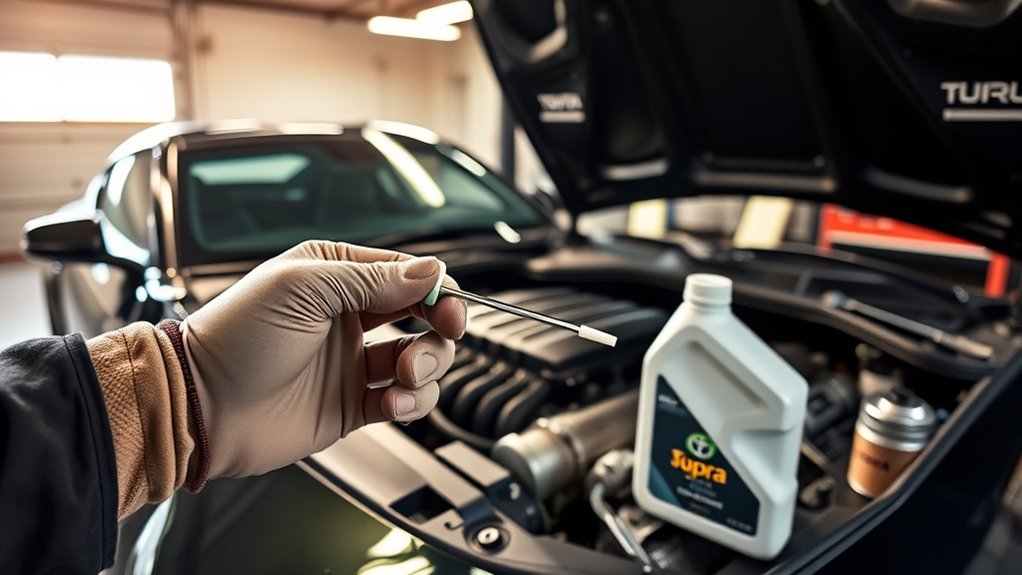
The GR Supra uses an electronic oil-level measurement system rather than a traditional owner-checkable dipstick procedure. Toyota notes that oil consumption depends on driving style and conditions and can increase during engine break-in.
Review the procedure in the owner’s manual for your production date. In general, Toyota directs owners to check the level through Toyota Supra Command after the engine reaches operating temperature.
- Park on level ground: The vehicle must be in a horizontal position for a detailed measurement.
- Bring the engine to operating temperature: The measurement is performed with the engine running.
- Prepare the transmission: Put an automatic model in N or P without pressing the accelerator. On a manual model, select neutral and do not press the clutch or accelerator.
- Open the oil-level menu: Select “My Vehicle,” “Vehicle status,” “Engine oil level,” “Measure engine oil level,” and “Start measurement.”
- Follow the displayed result: Only add oil when the instrument cluster or control display tells you to do so, and use the quantity shown.
- Document unusual changes: Record the mileage and contact a Toyota dealer if the level drops suddenly, a warning appears, or the engine develops an unusual noise or smell.
Warning: Both insufficient oil and excessive oil can damage the engine. Do not add oil based only on a guess or an incomplete measurement.
Why Do Early Oil Changes Matter?
Some Supra owners choose an oil and filter change after the 1,200-mile break-in period for peace of mind. Toyota does not list a mandatory 1,000-mile or 1,200-mile break-in oil change for every street-driven Supra.
Under normal conditions, follow the vehicle’s maintenance system and the current 2026 GR Supra Warranty and Maintenance Guide. If an oil-service warning appears before the normal mileage or time interval, follow the warning.
| Maintenance Choice | When It May Apply | Recommended Action |
|---|---|---|
| Normal scheduled oil service | Normal street driving | Follow the maintenance guide, onboard reminder, and time limit. |
| Optional post-break-in oil change | Owner preference after 1,200 miles | Confirm the correct oil specification and document the service. |
| Shorter service interval | Track events, frequent hard use, or unusual operating conditions | Ask a qualified Toyota dealer or performance specialist for use-specific guidance. |
Keep invoices and record the mileage, date, oil specification, and filter used. Good records help with future maintenance decisions and warranty discussions.
Common Pitfalls and What to Do If They Happen
A brief accidental exceedance does not create a new official break-in period, and Toyota does not publish a procedure that tells owners to restart the mileage count. Resume moderate driving and follow the remaining limits.
- If RPM briefly passed 4,500: Ease off smoothly and remain below the limit for the rest of the break-in period.
- If kickdown occurred: Return to moderate accelerator input and avoid repeating it.
- If cruise control was used: There is no need to restart break-in. Use normal, safe speed variation during later trips if practical.
- If you braked hard: Safety comes first. Continue moderate braking afterward when traffic permits.
- If you notice a warning: Stop when safe, review the message, and follow the owner’s manual.
Contact a Toyota dealer if an exceedance is followed by a warning light, fluid leak, burning smell, persistent vibration, abnormal clutch operation, unusual mechanical noise, or noticeable loss of power.
What to Expect After Completing the Break-In Period
After 1,200 miles/2,000 km, Toyota says engine and vehicle speed can be increased gradually. That does not require an immediate full-throttle run or a trip directly to redline.
A practical transition is to use a little more throttle and RPM over several drives while continuing to warm the engine through moderate driving. Learn how the tires, brakes, transmission, differential, and stability systems respond before approaching the car’s limits.
The 2026 GR Supra’s 3.0-liter turbocharged inline-six produces 382 horsepower and 368 lb-ft of torque in the U.S. 3.0, 3.0 Premium, and MkV Final Edition grades.
Smoother Engine Response
After break-in, you can use a wider RPM range and more throttle. The drivetrain may feel more natural because you are no longer restricting every acceleration event to the same moderate range.
Continue using smooth throttle and clean shifts. The end of break-in does not remove the need to respect cold engine temperatures, road conditions, or maintenance warnings.
More Driving Confidence
The first 1,200 miles also give you time to understand the Supra’s steering, braking, visibility, traction, and driver-assistance behavior.
Build speed only where it is legal and safe. Save Launch Control, high-speed testing, and track-level driving for a suitable closed course with proper instruction and safety preparation.
Frequently Asked Questions
What is the break-in procedure for the Toyota Supra?
For the first 1,200 miles/2,000 km, remain below 4,500 RPM and 100 mph/160 km/h while obeying all lower posted speed limits. Avoid full load, kickdown, and Launch Control. Drive conservatively on new tires for 200 miles and treat the brakes and manual clutch gently for about 300 miles.
Does the Toyota GR Supra need to be broken in?
Yes. Toyota publishes specific break-in instructions for the engine, transmission, axle drive, tires, brakes, and manual-transmission clutch.
What is the break-in period for the B58 engine in the Supra?
In the Toyota GR Supra, the 3.0-liter turbocharged inline-six is covered by Toyota’s 1,200-mile/2,000-km drivetrain break-in guidance. Stay below 4,500 RPM and avoid full load during that period.
Can I drive my new Supra on the highway during break-in?
Yes. Highway driving is allowed as long as you remain within Toyota’s break-in limits and all posted speed limits. Some owners avoid holding one speed for an entire long trip, but Toyota does not separately prohibit highway driving.
Can I use cruise control during the Supra break-in period?
Toyota’s break-in section does not expressly ban cruise control. Limiting long periods at one fixed speed is a practical choice, not a separately stated Toyota requirement. Use cruise control when appropriate for safe and legal driving.
How should I break in a manual-transmission Supra?
Follow the same 1,200-mile drivetrain limits and engage the clutch gently for approximately 300 miles/500 km. Avoid aggressive launches, unnecessary clutch slipping, and downshifts that could raise the engine above 4,500 RPM.
Is an oil change required at the end of break-in?
Toyota does not require every normally driven Supra to receive an oil change at exactly 1,200 miles. Follow the maintenance guide and onboard service reminder. A post-break-in oil change is an optional owner choice unless a warning or service instruction says otherwise.
What if I accidentally went above 4,500 RPM?
Ease off and follow the limits for the remaining break-in distance. Toyota does not publish a rule requiring the mileage count to restart after a brief accidental exceedance. Seek professional inspection if a warning light, unusual noise, leak, vibration, or performance problem appears.
Conclusion
The correct Toyota Supra break-in process centers on a few clear limits. For 1,200 miles/2,000 km, stay below 4,500 RPM, avoid full load, kickdown, and Launch Control, and remain below both Toyota’s 100-mph/160-km/h ceiling and every lower posted speed limit.
Remember the shorter component periods too. Drive conservatively on new tires for 200 miles/300 km, brake moderately for about 300 miles/500 km, and engage a manual clutch gently for the same distance.
After break-in, increase speed and load gradually. Continue checking the electronic oil level, warming the engine through moderate driving, and following Toyota’s maintenance system.
Sources
- Toyota 2026 GR Supra Manuals and Warranties — current production-date owner’s manuals and official vehicle documentation.
- 2026 GR Supra Warranty and Maintenance Guide — scheduled maintenance, warranty, and service guidance.
- Toyota USA Newsroom: 2026 GR Supra MkV Final Edition — current U.S. engine output and model information.