

Set truck tire pressure to the vehicle manufacturer’s cold-PSI specification (door placard or manual) and then adjust by axle and load using the tire’s load-rating tables, not the sidewall maximum. Match pressures to actual axle weights to meet steering, stability, and legal limits. Expect higher pressures on heavy rear axles and different fronts for steering control. Check cold, use a calibrated gauge, log values, and follow TPMS/auto-inflate protocols for compliance.
Quick Answer: Truck Tire PSI Ranges
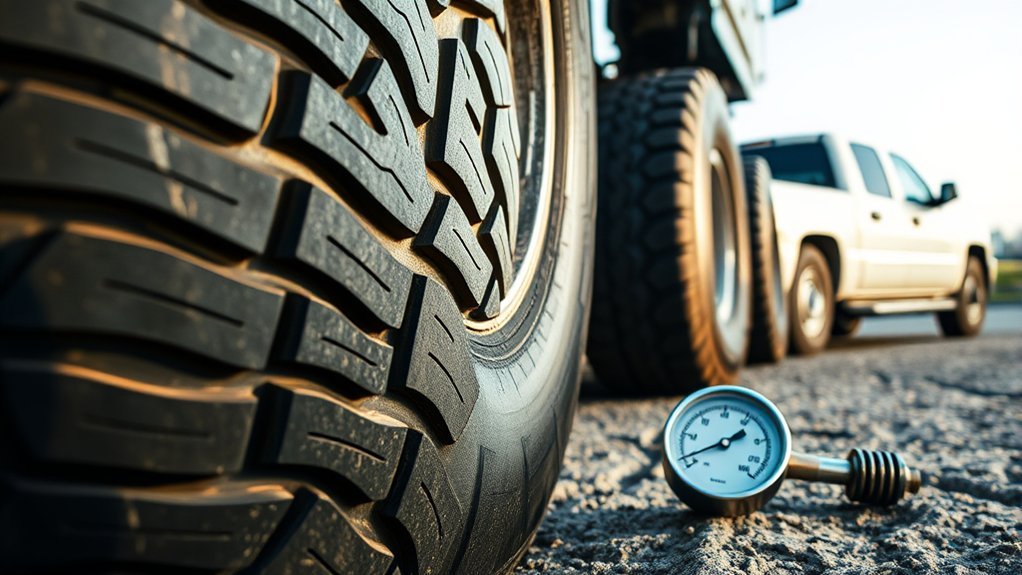
Most truck tires fall into three practical PSI bands: light trucks and pickups typically run 35–45 PSI (adjusted for load and use), heavy-duty pickups often require about 55 PSI front and 80 PSI rear when heavily loaded, and commercial/industrial trucks operate between 70–130+ PSI depending on axle, tire size, and payload. Monitor tire pressure regularly to prevent uneven wear, efficiency loss, and blowouts. Adjust pressures for payload, speed, and temperature changes. For heavy trucks, prioritize axle-specific inflation and documented service intervals, since small deviations increase stress and legal exposure. Record readings, follow specified cold PSI values, and act on pressure alarms promptly. Accurate, consistent inflation protects equipment, conserves fuel, and keeps your vehicle within compliant safety margins.
Where to Find the Right PSI: Placard, Manual, and Tire Sidewall
Check the manufacturer’s tire placard on the driver’s door jamb first, then verify against the owner’s manual. These sources give the vehicle-specific recommended pressures tied to axle loads and OEM specifications. The tire sidewall only shows the maximum inflation rating, not the daily operating setpoint. Use manufacturers’ recommendations to set safe tire pressure that meets regulatory and operational demands. The sidewall value is a structural limit, not an instruction.
Check the driver’s door placard and owner’s manual for cold PSI — the sidewall shows only max rating, not operating pressure.
- Inspect the tire placard for cold PSI values per axle and recommended gross axle weight ratings.
- Cross-check the owner’s manual for use-case guidance (single or dual tire, towing, speed, temperature corrections).
- Read the tire sidewall only to note maximum inflation and load index; don’t use it as your operating target.
- Log and audit tire pressure measurements against manufacturer recommendations for compliance, performance, fuel efficiency, and dependable operation.
How Axle Weights and Load Determine Correct Truck Tire Pressure
After confirming the manufacturer’s recommended cold PSI from the placard and manual, match those targets to the truck’s actual axle weights to determine correct inflation for the current load. Weigh the fully loaded vehicle by axle, then consult the tire load range and pressure charts in the manual or tire placard to select the required tire inflation. Heavier axle weights demand higher pressures. Commercial 3/4- and 1-ton applications often require roughly 55 psi front and 80 psi rear as baseline examples, but confirm specifics for your tire’s load range and construction. Under-inflation increases rolling resistance, accelerates uneven wear, and raises blowout risk. Over-inflation can reduce traction and comfort. Record axle weights, reference the approved tire load versus PSI table, and set cold pressures accordingly. This procedure keeps you compliant with regulatory load limits and maintains vehicle control, efficiency, and tire integrity.
[Products Worth Considering]

Milton precision engineered service gages provide accurate, long life trouble free performance
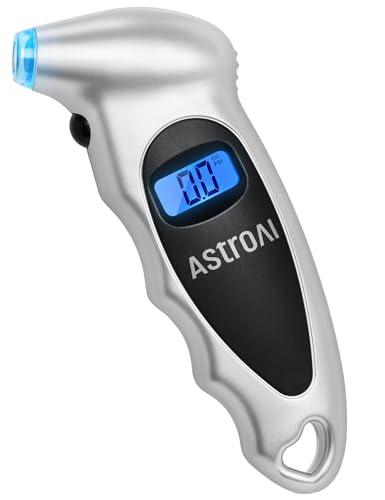
EXPERT-GRADE CALIBRATION: Each AstroAI Tire Pressure Gauge is calibrated with professional-grade tools, ensuring quick and accurate measurement results within plus-minus 1PSI. Stay prepared for any roadside emergency and travel with peace of mind.

DUAL HEAD DESIGN: Equipped with two heads for quick and easy access to both inner and outer valve stems. Streamlining the process of inflating and checking tire pressure, saving you time and effort
Why Front and Rear Pressures Often Differ for Trucks
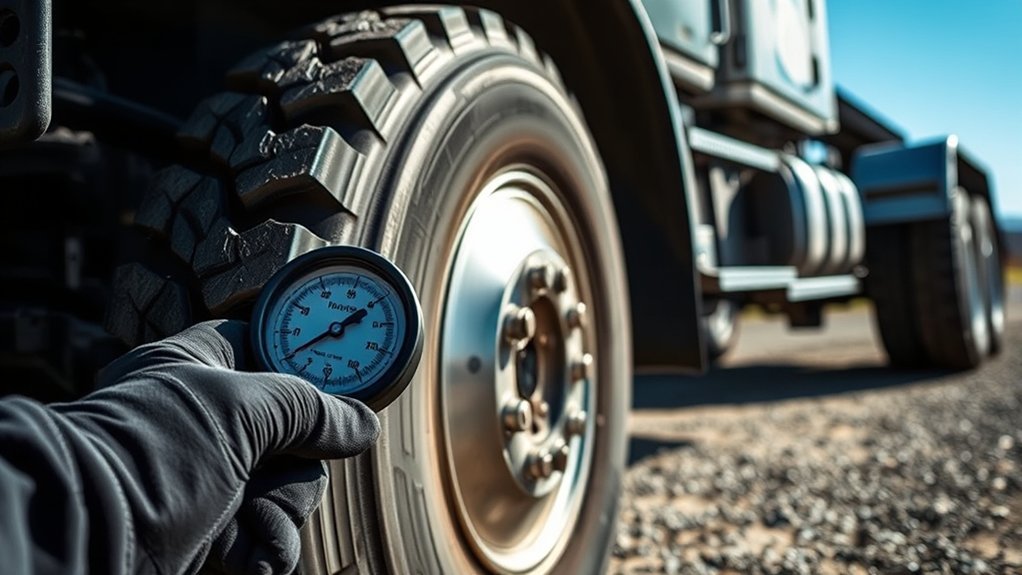
Load distribution and steering dynamics place different demands on each axle. Trucks routinely require differing front and rear tire pressures to meet safety and regulatory performance targets. Set front pressure higher to preserve steering precision and cornering stability; front tires often sit in the 100–130 psi range on heavy-duty trucks. Rear tires carry variable payloads, so increase rear pressure with heavier loads to avoid sagging, uneven wear, and instability. Typical rear ranges run 85–120 psi. Always consult manufacturer tables and placards; they tie legal axle-load limits to specific pressure values.
- Front tires: higher pressure for steering control and regulatory steering-axle ratings.
- Rear tires: adjustable pressure to match payload, maintain ride height, and prevent cupping.
- Fuel/traction: matched pressures optimize rolling resistance and grip under load.
- Compliance: follow OEM specs and placards to satisfy safety inspections and extend tire life.
Cold vs. Hot Tires: When to Check and What to Adjust
Check tire pressures when the tires are cold—measured after the vehicle has sat at least three hours or driven less than a mile—to obtain accurate, compliant readings. Hot tires will show higher PSI (approximately +1 PSI per 10°F), so never release air from a hot tire. Wait for cooldown before adjusting. Regularly compare readings to manufacturer-recommended PSI and adjust for seasonal temperature shifts to prevent under- or over-inflation risks.
Check Tires When Cold
One clear rule governs tire pressure readings: measure them cold. Check your tire pressure after the vehicle has been stationary at least three hours or driven under one mile. Driving heats air and raises readings by about 1 psi per 10°F, so hot checks risk over-inflation. Use manufacturer cold-specs and correct deficits immediately. Establish a monthly cold-check routine to maintain handling, fuel efficiency, and tire life.
- Park for ≥3 hours or drive <1 mile before measuring.
- Use a calibrated gauge; record cold tire pressure values.
- Adjust to manufacturer cold-pressure specifications only.
- Log monthly checks; repair or re-inspect sustained air loss.
Understand Hot Tire Pressure
After setting a cold-pressure baseline, understand how driving alters those numbers. A tire’s air pressure rises as temperature increases, typically 4–6 PSI above cold readings after normal driving. Regulatory practice requires checking pressure when tires are cold—defined as no driving for at least three hours or under one mile at low speed—to guarantee accurate measurement for load and safety compliance. Never release air from a hot tire; that risks underinflation once it cools. Monitor pressures regularly, record cold values, and anticipate the hot increase when evaluating performance.
Adjust for Temperature Changes
Because temperature directly affects tire pressure, measure and record pressures when tires are cold—defined as at least three hours of rest or under one mile at low speed—to guarantee readings match regulatory and load-setting requirements. Check monthly and after large ambient shifts to prevent under-inflated tires or unsafe over-inflation. In cold climates, add 2–3 PSI to the target pressure to compensate for expected drops. In heat, maintain listed pressure rather than reducing it. Use calibrated gauges and documented procedures.
- Inspect when cold; note ambient temperature and PSI.
- Add 2–3 PSI in cold weather as a preventive adjustment.
- Do not reduce pressure in heat; monitor for over-inflation.
- Log readings for compliance and dependable fleet operation.
How to Check and Set Tire PSI: Tools, Timing, and Record-Keeping
Check tire PSI with a calibrated pressure gauge when tires are cold—ideally monthly and before long trips—to capture accurate baseline readings. Use a reliable gauge and an air compressor for adjustments; never exceed the tire sidewall’s maximum or the manufacturer’s recommended PSI found in the owner’s manual or placard. Record each reading, date, and any adjustments to maintain a regulatory-quality maintenance log for load and safety inspections.
[Products Worth Considering]

Enhanced Visibility in Low Light: Features a green backlit LCD screen and integrated flashlight, allowing for clear reading of tire pressure even in dark or dimly light conditions.

1. LONG ZINC ALLOY DUAL HEAD DESIGN : Straight foot air chuck are deisghed for inner wheels or difficult reached valve as well as the 30°reverse chuck are for outer wheels.A good choice for testing your tire pressure also a great father's day gift

【EXTENDED REACH DUAL HEAD】LUMITECO 12" pencil-style pressure gauge is designed with the Integrated Straight foot air chuck and 30°reverse chuck. Ideal for dual wheels and other difficult reached valves. Your good choice for checking tire pressure as well as a great father's day gift.
When to Check
When checking tire PSI, do it with cold tires—before driving or after the vehicle has sat for at least three hours—to avoid heat-induced pressure increases that would skew readings. Establish a disciplined schedule and log results to detect deviations early.
- Check tires cold, ideally before the first trip of the day or after a three-hour rest.
- Use a calibrated gauge; inconsistent instruments undermine compliance.
- Record readings monthly and after heavy loads to track trends and leaks.
- Refer to owner’s manual or door-jamb placard, then adjust PSI for current load.
Tools and Records
Set up the right tools and record-keeping procedures to guarantee measurements are accurate and defensible. Use a calibrated tire pressure gauge and verify readings when tires are cold; heat skews results. Maintain checks at least monthly and before long trips to meet operational and safety obligations. Use an air compressor or portable inflator with a gauge to adjust psi to vehicle manufacturer specifications on the placard or in the manual. Record date, exact PSI readings, temperature, and any adjustments in a maintenance log—digital or paper—with sign-off for accountability. Consider an auto-tire inflation system to automate compliance and reduce manual intervention while maintaining safe, dependable operation.
How to Read Wear, Handling, and Noise to Spot Wrong PSI
Tire wear patterns, handling changes, and abnormal noise are reliable indicators of incorrect PSI. Inspect tread wear: edge wear signals under-inflation; center wear signals over-inflation. Record patterns against axle positions to protect tire life and confirm you’re running the correct tire pressures per the placard or manual. Handling degradation—delayed steering, reduced cornering stability, or a “mushy” feel—points to pressure deviations that compromise safety margins. Increased road noise, vibrations, or thumping during cruise also indicates pressure issues and elevated failure risk; address before critical thresholds are reached.
- Outer-edge wear: check for under-inflation, adjust to correct tire specification, log corrective action.
- Center wear: verify for over-inflation, reduce to placard PSI, update records.
- Handling shifts: evaluate steering response; reconcile PSI with load and vehicle manual.
- Noise/vibration: correlate acoustic change with pressure readings; remediate immediately to preserve tire life.
Maintenance Options: TPMS, Auto-Inflation Systems, and Service Routines
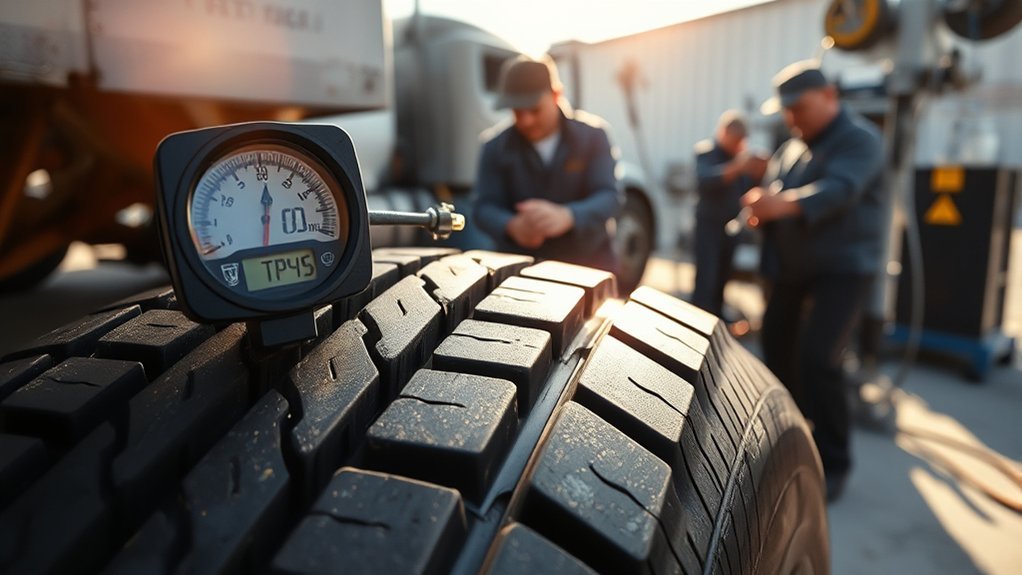
Because pressure deviations directly affect safety margins and operating costs, combine electronic monitoring, automatic inflation, and disciplined service routines to manage truck tire inflation proactively. Use TPMS to get real-time pressure data and alarm thresholds that map to regulatory requirements and your company’s safety policy. Adopt an auto-inflation system—such as Aperia’s Halo—to maintain setpoints automatically, lowering rolling resistance and improving fuel efficiency while reducing manual intervention. Establish a formal service routine: documented monthly pressure verification, visual inspections for cuts, bulges, and sidewall abnormalities, and immediate remediation when TPMS flags deviations. Integrate TPMS logs with maintenance records to demonstrate compliance and justify replacement or retread timing. Train drivers and technicians on interpreting TPMS alerts and on escalation protocols. This combined approach prolongs tire life, minimizes downtime, and keeps operations efficient and compliant.
[Products Worth Considering]

【Precision Monitoring & Ultra-Fast Response】 Professional-grade 24/7 monitoring with ±1.5 PSI precision across 0-144 PSI— the tire pressure sensors update every 0.3 seconds (3x faster than standard TPMS) to track all 6 tires simultaneously. The LCD display refreshes every 6 seconds, delivering real-time alerts for leaks or pressure drops—critical for heavy loads and long-haul towing.

[Accurate Real-time Monitoring & Multi-Alert System]: Tymate TM7 tpms sensor can be used to monitor your tires’ pressure and temperature data within robust accuracy of ±1.5 PSI or ±3°F (The units can be displayed as ℃ or ℉ & BAR or PSI). Designed with six distinct alarm modes: high/low pressure, fast leakage, high temperature, sensor low battery, and sensor signal lost. This system is a reliable tool for maintaining tire health, and it is especially beneficial for DIY enthusiasts and pre-owned vehicle markets, where constant vigilance on tire conditions is paramount for safety and vehicle longevity

[Real Time Monitoring & High Fuel Economy]: GUTA TPMS has a large screen for displaying up to 10 tires’ data in one page, also the display will automatically switch between the front trailer and rear sections. You can view up to 46 tires without press a button. The TPMS handles pressure up to 188 psi and tire temperature up to 185 ℉, specially designed for large vehicle. Maintaining proper tire parameter at all times ensures vehicle safety and helps achieve desired fuel economy
Quick Checklist: Daily and Monthly Tire-Pressure Tasks
Start each day with a documented pre-trip pressure check: use a calibrated gauge on cold tires, verify PSI against the vehicle’s recommended setpoints for axle and load, and note any deviations greater than the allowable tolerance. Log front and rear targets, confirm cold readings, and take immediate corrective action if readings fall outside spec. Monthly, perform a systematic audit to catch slow leaks, permeation loss, or seasonal shifts that erode efficiency and safety.
Start each day with a documented cold-tire pressure check, log deviations, and audit monthly for leaks and seasonal shifts
- Use a calibrated gauge on cold tires; record PSI for each front and rear position and compare to setpoints.
- Adjust pressure to load-appropriate values (e.g., higher PSI for heavy loads); document adjustments and rationale.
- Inspect valves, caps, and tread; flag and repair slow leaks or abnormal wear patterns; note corrective actions.
- Archive daily and monthly logs for regulatory compliance, trend analysis, and dependable fleet operations.
Frequently Asked Questions
What PSI Should I Put My Truck Tires At?
Set tire pressure per your truck’s tire placard or owner’s manual; you’ll typically use 100–130 psi front and 85–120 psi rear depending on load capacity. Adjust pressures to meet legal, safety, and performance limits.
Is 40 PSI Too High for Truck Tires?
It often isn’t for light trucks but can be too low for heavy-duty rigs. Check tire pressure against manufacturer specs to avoid safety concerns and regulatory noncompliance.
Is 35 or 45 PSI Better for a Tire?
Choose 45 psi when carrying heavier loads; 35 psi may suit light-use vehicles. Guarantee peak performance by following manufacturer specs, load ratings, and regulatory safety limits.
Is 30 PSI Too Low for Truck Tires?
Yes—30 PSI is generally too low for truck tires. Monitor tire pressure effects closely, follow ideal inflation specs, meet regulatory safety standards, and avoid unnecessary risk.
Conclusion
Match tire pressure to load and axle limits. Use the vehicle placard or manual, account for axle weights, and check pressures cold with a calibrated gauge. Maintain front/rear differences per manufacturer, watch wear patterns and handling for under/overinflation, and employ TPMS or automatic inflation where required. Correct PSI keeps braking, steering, and structural limits within regulatory margins and minimizes safety, legal, and maintenance risk.







Leave a Reply