
You should run your motorcycle tires at the cold PSI the manufacturer specifies. You’ll usually find this on a swingarm placard or in the owner’s manual, not on the tire sidewall (that’s the max). Typical ranges: sportbikes run about 30–33 front and 32–36 rear; cruisers sit around 36 front and 40–42 rear; lightweights a bit lower; dirt bikes much lower for traction. Check pressures with a reliable gauge when cold. Add 2–4 psi for heavy loads and adjust for conditions to keep handling predictable and safe.
Quick Answer
- Use cold tire pressure specs from your owner’s manual or swingarm placard, not the tire sidewall max.
- Sportbikes: ~30–33 psi front, 32–36 psi rear. Cruisers: ~36 psi front, 40–42 psi rear.
- Always check when cold (tires not ridden for 2–3 hours) using a quality digital gauge.
- Add 2–4 psi to the rear for a passenger or heavy luggage.
- Under-inflation causes uneven wear and poor handling; over-inflation reduces grip and ride comfort.
Quick PSI Guide : Typical Front vs Rear Pressures by Bike Type
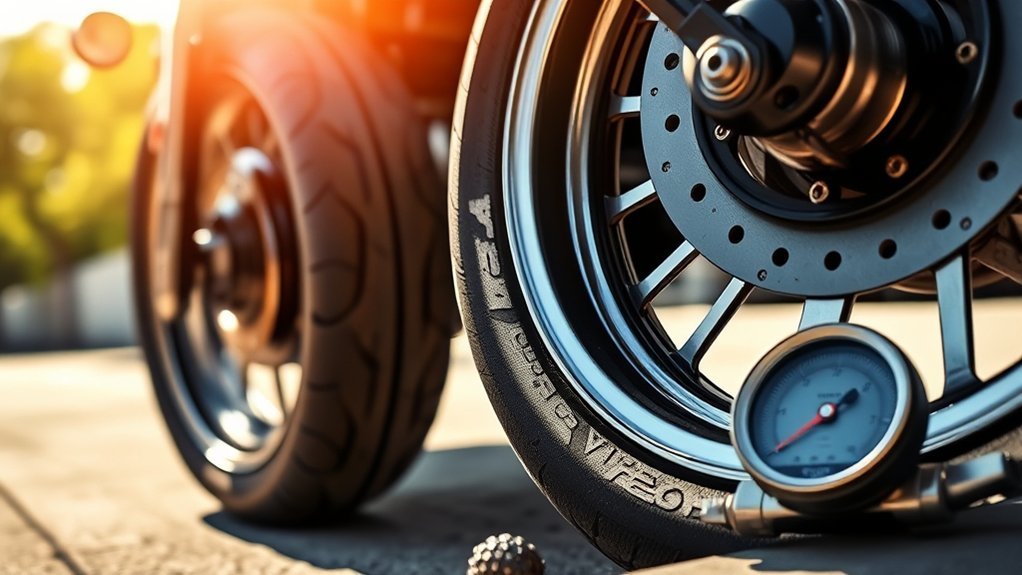
Whether you ride a sportbike, cruiser, middleweight, lightweight, or dirt bike, keeping the correct PSI in both tires matters for safety and handling. Here are clear targets to start with:
Sportbikes generally run 30–33 psi front and 32–36 psi rear to maximize grip and performance. Cruisers usually call for about 36 psi front and 40–42 psi rear to support their heavier weight. Middleweights (400–500 lbs) typically need 33–36 psi front and 36–39 psi rear for balanced handling. Lightweight bikes (300–400 lbs) work best around 28–33 psi front and 30–34 psi rear. Dirt bikes operate much lower, about 15–19 psi front and rear, to improve traction on loose terrain.
Check tire pressure before every ride. Use these ranges as starting points, then adjust for load, conditions, and your preferred feel while keeping safety front of mind.
Find Your Bike’s Cold-Pressure Spec (Placard, Manual, Tyre Sidewall)
Start by locating your bike’s cold-pressure spec. It’s usually posted on a placard on the swingarm, chain guard, or frame. Confirm the numbers in your owner’s manual and note any tire sidewall markings, which show maximum pressure, not recommended pressure.
Your owner’s manual is the authoritative source for the manufacturer’s recommended settings for front and rear tires. The sidewall figure is the maximum the tire can safely hold, not the proper running pressure for your bike.
For cold tires (not ridden for at least two hours), follow the recommended psi from the manufacturer rather than guessing from general ranges. Sticking to the manufacturer’s cold-pressure spec gives you predictable handling, even tread wear, and a safer ride. Make locating and recording those specs part of your routine so you ride with confidence every time.
Check and Set Tyre Pressure (Tools, Cold Check, Step‑by‑Step)
Pick a reliable digital gauge and check pressure when the tires are cold (not ridden for at least three hours) to get an accurate reading. Remove the valve cap, press the gauge firmly onto the valve stem, and read the PSI shown. Record front and rear values, then compare them to the recommended numbers from your owner’s manual or placard. Remember, the sidewall lists max PSI, not your running spec.
While you’re there, inspect tread and sidewalls for cuts, bulges, or embedded objects. If readings are off from the recommended spec, add or release air slowly and recheck. Repeat until both tires match the recommended PSI and you’ve confirmed no damage.
Make this routine: checking cold pressure before rides preserves safety and performance. When finished, replace valve caps and stow your gauge. The Motorcycle Safety Foundation’s T-CLOCS checklist is a great framework for building a complete pre-ride inspection habit.
[Products Worth Considering]
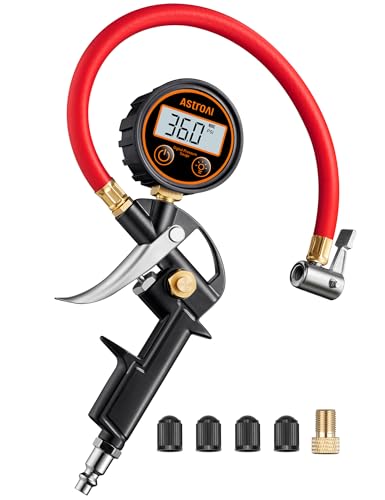
ACCURATE MEASUREMENTS: This heavy-duty tire pressure gauge with inflator is manually calibrated to ANSI B40.7 Grade 2A (± 1PSI). It can freely switch between 4 pressure units: PSI, BAR, KPA, and KG/CM².
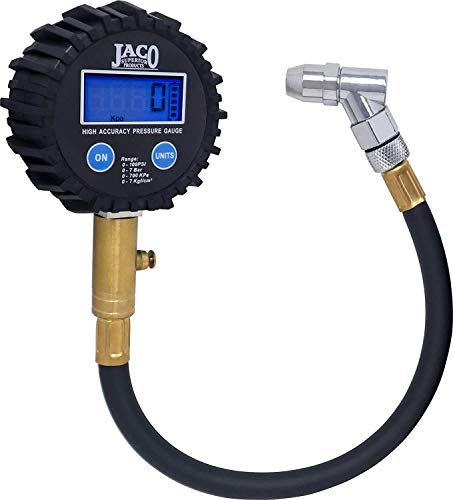
PRO ACCURACY – mechanic recommended, performance tested, & calibrated accurate to professional ANSI 2A standards – with dual pressure sensors certified to ±0.50% FS (0.50 PSI), offering reliable readings up to 100 PSI w/ precise readout resolution of 0.10 PSI – so you can now maintain your tires with a shop-grade mechanic trusted tool
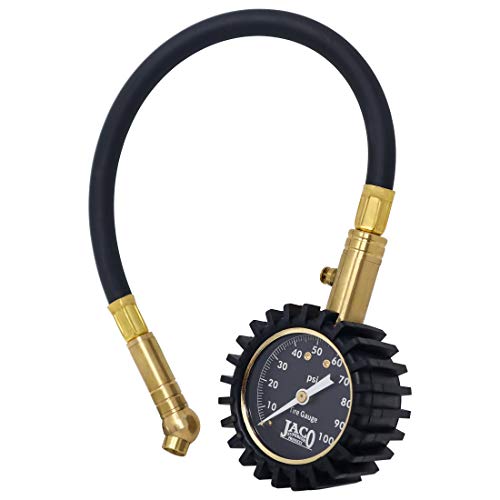
Mechanic Recommended – performance tested, certified, & calibrated accurate within ANSI Standards (±1.5%) at our ANSI accredited calibration facility, ensuring precise tire pressure readings without relying on batteries
Adjust Tyre Pressure for Load, Riding Style, and Temperature
If you’re carrying a passenger or luggage, or planning a different riding style, adjust your tire pressures to match the load and conditions so the bike handles predictably and the tires wear evenly.
Add 2–4 PSI to the rear tire pressure when you carry extra load to keep stability and performance. For spirited sport riding, set front tire pressure around 30–33 PSI and rear 32–36 PSI to improve grip through aggressive cornering. Heading off-road? Drop pressures to roughly 18–25 PSI for better traction on loose surfaces. Street pressures typically sit between 28–40 PSI.
Always check pressures with cold tires for an accurate baseline. Temperature swings change PSI, and riding heats tires enough to raise pressure by about 10%. Monitor and adjust regularly. Keep a reliable gauge handy and make small changes; test and refine to suit your bike and style.
[Products Worth Considering]

High Accuracy: The AstroAI Tire Pressure Gauge accurately measures from 0-60 PSI. With certified ANSI B40.1 accuracy and professional calibration, it always returns precise tire pressure readings, eliminating guesswork with a large 2" glow dial.

MINI DESIGH: size 11.5*1.7*2cm (4.53*0.67*0.79inch), light and portable, can be put the tire gauge in your pocket, carry it with you, easy to use.

1. Reliable Air Pressure Gauge for Tires, full gear precision movement with bronze bourdon tube, no battery required, durable brass construction, accuracy meets ANSI Grade B40.1 Standards, more accurate and reliable than digital tire pressure gauge, maintains good performance for many years.
How Temperature Affects Motorcycle Tire Pressure
Tire pressure changes roughly 1–2 psi for every 10°F (about 6°C) shift in ambient temperature. That means a cold morning ride could drop your pressures several psi below what you set on a warm afternoon. Seasonal riders should recheck pressures whenever the weather shifts noticeably.
During a ride, friction and flexing heat the tire and raise pressure. This is normal, and the manufacturer’s cold-pressure spec already accounts for this rise. Never bleed air from warm tires to hit the cold spec, as you’ll end up under-inflated once they cool down. According to the NHTSA’s tire safety guidelines, proper inflation is one of the most important factors in tire performance and safety.
Common Tyre-Pressure Problems and How to Fix Them
It’s equally important to recognize common tyre-pressure problems and fix them quickly to keep the bike predictable and safe. Always check tire pressure when tires are cold, because heat raises pressure and masks issues.
Under-inflated tires cause scalloping, cupping, and uneven wear, which shortens tire life and hurts handling. Over-inflation hardens the contact patch, increases center wear, and reduces traction and stability.
If you notice vague steering or unstable cornering, stop and inspect pressures. Make pressure adjustments for load and riding conditions. For example, add 2–4 PSI to the rear for two-up riding with luggage. Use a quality gauge, correct to manufacturer specs, and recheck after a short ride.
Persistent uneven wear may point to suspension or alignment problems, not just pressure habits. Keep this routine: regular checks, prompt adjustments, and mindful loading will keep you riding confidently and safely.
[Products Worth Considering]

PROCESS LEVEL ACCURACY: Each ETENWOLF’s digital tire pressure gauge is calibrated manually to ANSI B40.7 Grade 2A(plus-minus 1 PSI).Presta valve adapter not included, if used for bicycles, it must be purchased separately

ADVANCED TRUEGAUGE SCREEN: This battery tire inflator includes updated sensor technology, capable of collecting pressure data from tire inflators at a frequency of 200 times per second. Its valid data rate is higher than 80%, which is 60% better than the market average. Wherever you go, accurate readings help you drive safely.

90 degree head for those difficult to access valve stems.
Frequently Asked Questions
What Is the Proper Psi for Motorcycle Tires?
Set tire pressure according to your owner’s manual, usually somewhere between 32–40 psi. Follow the inflation guidelines for your bike’s load capacity, adjust for temperature, and monitor wear patterns. Proper tire maintenance directly affects handling, performance, and safety.
Is 40 Psi Too High for Motorcycle Tires?
For most street bikes, yes. About 70% of motorcycles recommend under 40 psi. Running 40 psi when the spec is lower risks poorer handling, faster tire wear, and reduced grip. Always follow the manufacturer’s recommendation for your specific bike and account for load and temperature.
Is 40 Psi Too High for Bike Tires?
It can be, depending on the bike. Many motorcycles call for less than 40 psi. Running too high affects ride comfort, handling, and tread wear. Check the manufacturer’s recommendation and adjust for your conditions.
Is 50 Psi Too High for Bike Tires?
For almost all motorcycles, 50 psi is too high. It can cause poor handling, uneven tire wear, and reduced grip. Always check your owner’s manual for the correct range and use proper inflation methods.
Conclusion
Keep your tires at the cold pressure listed on the placard or in the manual. That’s the baseline that keeps you safe and predictable. Check pressures with a reliable gauge before every ride and adjust for load, riding style, and temperature changes. Over-inflation reduces grip; under-inflation generates excess heat and accelerates wear. Treat pressure checks like a preflight checklist. Small habits prevent big problems and keep your bike honest.







Leave a Reply