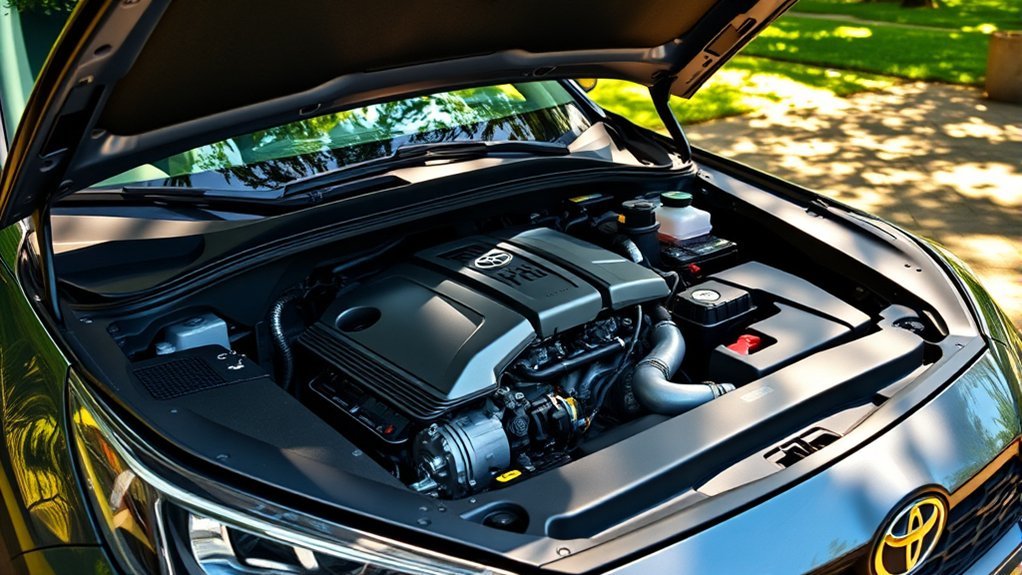
The 2026 Toyota RAV4 does not use a turbocharged engine. Toyota redesigned the U.S. lineup around hybrid and plug-in hybrid powertrains, so every version combines a non-turbo 2.5-liter four-cylinder gasoline engine with electric motors.
Toyota removed the gas-only RAV4 for 2026, not the gasoline engine itself. The standard hybrid is the efficiency-focused choice, while the plug-in hybrid adds a larger battery, external charging, more electric driving, and substantially more power.
Quick Answer
No. The 2026 Toyota RAV4 does not offer a turbocharged engine or a gas-only trim. Standard hybrids make 226 horsepower with front-wheel drive or 236 with all-wheel drive. The plug-in hybrid makes 324 net combined horsepower and offers up to an EPA-estimated 54 miles of electric range on the SE trim.
Key Takeaways
- No 2026 RAV4 trim uses a turbocharger.
- Every model has a non-turbo 2.5-liter engine supported by electric motors.
- The RAV4 Hybrid produces 226 horsepower with FWD or 236 horsepower with AWD.
- The RAV4 Plug-in Hybrid produces 324 horsepower and has standard AWD.
- The highest hybrid fuel-economy rating applies to the most efficient front-wheel-drive configurations; trim and drivetrain change the final rating.
What’s in This Article
- What Powers the 2026 Toyota RAV4?
- RAV4 Hybrid and Plug-in Hybrid Options Explained
- Why Doesn’t the RAV4 Have a Turbocharged Engine?
- Advantages of the RAV4’s Non-Turbo 2.5-Liter Engine
- Performance Metrics: How the RAV4 Stacks Up Without a Turbo
- Fuel Economy Insights for the 2026 RAV4 Hybrid Models
- What Changed From the 2025 RAV4?
- What Do RAV4 Owners Think About Engine Types?
- Future of Turbo Engines in the RAV4
- Comparing the RAV4 With Turbocharged Competitors
- Is the RAV4 the Right SUV for You?
What Powers the 2026 Toyota RAV4?
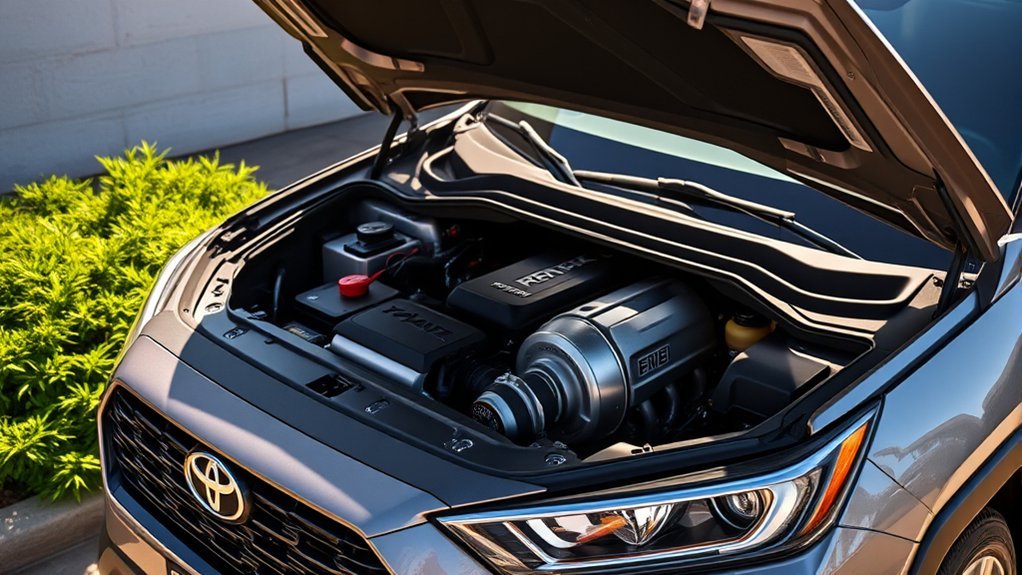
The 2026 Toyota RAV4 uses electrified powertrains across the U.S. lineup. According to Toyota’s detailed 2026 RAV4 specifications, both systems use a 2.5-liter four-cylinder engine, electric motor-generators, a lithium-ion traction battery, and an electronically controlled continuously variable transmission.
The standard hybrid is available with front-wheel drive or Electronic On-Demand All-Wheel Drive, depending on the grade. The plug-in hybrid adds a larger battery, stronger electric motors, an external charging port, and standard AWD.
| Powertrain | System Output | Drivetrain | Charging | Best Fit |
|---|---|---|---|---|
| RAV4 Hybrid FWD | 226 net combined hp | Front-wheel drive | No plug required | Highest fuel economy and simple daily use |
| RAV4 Hybrid AWD | 236 net combined hp | Electronic On-Demand AWD | No plug required | Extra traction without changing your fueling routine |
| RAV4 Plug-in Hybrid | 324 net combined hp | Standard AWD | Level 1 or Level 2; DC fast charging on select grades | Electric commuting and the quickest acceleration |
Note: The 2026 RAV4 has no gas-only trim, but it is not a fully electric vehicle. Every version still uses gasoline as part of its hybrid system.
The electric motors replace the need for turbo boost in the RAV4 lineup, helping deliver immediate low-speed response while the gasoline engine supports longer trips.
RAV4 Hybrid and Plug-in Hybrid Options Explained
The standard hybrid suits drivers who want high fuel economy without plugging in. The plug-in hybrid suits drivers who can charge regularly and want more electric-only driving, faster acceleration, and standard all-wheel drive.
Hybrid Powertrain Overview
The RAV4 Hybrid uses Toyota’s fifth-generation hybrid system. Front-wheel-drive models produce 226 net combined horsepower, while AWD models produce 236 horsepower. A dedicated rear electric motor powers the AWD system instead of a mechanical driveshaft connecting the front and rear axles.
Toyota’s current RAV4 model page lists up to 47 mpg city and 40 mpg highway for the most efficient configurations. You do not need to charge the standard hybrid because regenerative braking and the gasoline engine replenish its traction battery.
This setup works well for commuting, highway travel, and drivers without dependable access to a home or workplace charger.
Plug-in Hybrid Performance Features
The RAV4 Plug-in Hybrid uses a larger traction battery and stronger electric motors. Toyota lists 324 net combined horsepower and up to an EPA-estimated 54 miles of all-electric range for the SE grade on its latest 2026 information.
- SE and GR SPORT: A 7-kW onboard charger and J1772 port support Level 1 and Level 2 AC charging.
- XSE and Woodland: An 11-kW onboard AC charger and CCS1 port add DC fast-charging capability.
- DC charging estimate: Toyota says XSE and Woodland can charge from 10% to 80% in about 30 minutes under ideal conditions.
- Standard AWD: Every plug-in hybrid grade uses Electronic On-Demand All-Wheel Drive.
Charging time and electric range vary with temperature, charging equipment, battery condition, speed, climate-control use, and driving style.
Pro Tip: Choose the plug-in hybrid only if you can charge it regularly. Without frequent charging, you carry the cost and weight of the larger battery while using less of its main benefit.
Note: Toyota’s early preproduction estimates were lower than the finalized figures. Use the latest Toyota model page and window sticker when comparing range, fuel economy, and charging specifications.
Why Doesn’t the RAV4 Have a Turbocharged Engine?
Toyota uses hybrid power, rather than a turbocharger, as the RAV4’s main performance and efficiency strategy. A turbo forces more air into a gasoline engine to create additional power. The RAV4 instead uses electric motors to add torque during acceleration and to recover energy during braking.
This design also supports Toyota’s decision to make the 2026 RAV4 lineup fully electrified. The result is a compact SUV that can deliver useful low-speed response and high fuel economy without a turbocharged gas engine.
That does not mean one system is automatically better. Turbocharged engines, standard hybrids, and plug-in hybrids have different driving characteristics, maintenance needs, purchase prices, and fuel-saving potential.
Advantages of the RAV4’s Non-Turbo 2.5-Liter Engine
The RAV4’s non-turbo 2.5-liter engine avoids turbo-specific parts such as the turbocharger, intercooler, boost-control hardware, and related plumbing. Electric motors provide the extra system output instead.
Potential advantages include fewer boost-related components, smooth power blending through the hybrid transmission, and strong city fuel economy. However, the absence of a turbo does not guarantee lower repair costs or longer engine life. Maintenance history, operating conditions, manufacturing quality, and model-specific design matter more than one component.
Proven Reliability Over Time
The RAV4 nameplate has a strong historical reputation, but the redesigned 2026 model is too new for meaningful long-term reliability data. RepairPal rates the RAV4 4.0 out of 5.0 and ranks it third among 26 compact SUVs, but its figures are based on repair data across multiple model years, not a long-term study of the new 2026 generation.
- What the historical data can show: The RAV4 line has had below-average repair costs and a low rate of severe repairs in RepairPal’s dataset.
- What it cannot prove: It cannot predict the redesigned 2026 model’s long-term battery, software, charging, or powertrain reliability.
- Best buying practice: Review warranty coverage, current recalls, service history, and owner reports for the exact year and trim.
Cost-Effective Maintenance Benefits
RepairPal lists an average annual RAV4 repair cost of about $429, compared with $521 for compact SUVs in its dataset. That is an all-model-years average, not a forecast for a new 2026 RAV4.
The 2026 model has no turbocharger to service, but it still has hybrid-specific parts, cooling circuits, high-voltage components, sensors, and software. Follow Toyota’s maintenance schedule for engine oil, filters, coolant inspections, tire rotations, brakes, and other service items.
Regenerative braking may reduce friction-brake use in some driving, but brake condition still needs regular inspection, especially in climates where corrosion is common.
Performance Metrics: How the RAV4 Stacks Up Without a Turbo
The 2026 RAV4 does not need a turbocharger to deliver competitive everyday performance. The standard hybrid prioritizes efficiency, while the plug-in hybrid uses a larger battery and stronger motors for much quicker acceleration.
- Hybrid FWD output: 226 net combined horsepower.
- Hybrid AWD output: 236 net combined horsepower.
- Hybrid acceleration: Car and Driver recorded 7.1 seconds from 0 to 60 mph in an AWD RAV4 Hybrid.
- Plug-in hybrid output: 324 net combined horsepower.
- Plug-in hybrid acceleration: Car and Driver recorded 5.2 seconds from 0 to 60 mph in a Woodland PHEV.
Towing capacity also depends on grade and drivetrain. Toyota rates selected AWD hybrid and plug-in hybrid grades for up to 3,500 pounds, while FWD models and the LE AWD carry a lower 1,750-pound rating. Always confirm the exact vehicle’s rating and account for passengers, cargo, hitch equipment, and tongue weight.
Fuel Economy Insights for the 2026 RAV4 Hybrid Models
Fuel economy is one of the RAV4’s main advantages. Toyota lists up to 47 mpg city and 40 mpg highway for the most efficient front-wheel-drive configurations.
The current Toyota model page shows 47/40 mpg for LE, SE, and XLE Premium, 41/35 mpg for Woodland, and 43/37 mpg for XSE and Limited. Drivetrain and equipment can change the rating, so compare the exact trim’s Monroney window sticker rather than assuming every version receives the headline number.
The plug-in hybrid can reduce gasoline use further when it begins trips with a charged battery. Toyota lists up to an EPA-estimated 54 miles of electric driving for the SE, while other plug-in hybrid grades may have lower range because of tires, equipment, weight, and tuning.
Real-world economy changes with temperature, speed, traffic, elevation, tire pressure, roof accessories, cargo, climate-control use, and charging frequency. Hybrids often perform especially well in city driving because regenerative braking can recover energy that a conventional vehicle loses as heat.
What Changed From the 2025 RAV4?
The biggest powertrain change is the removal of the gas-only model. The 2025 U.S. lineup offered gas, hybrid, and plug-in hybrid choices, while the redesigned 2026 lineup uses only hybrid and plug-in hybrid systems.
Toyota also introduced a newer hybrid system, increased standard-hybrid output to 226 horsepower with FWD or 236 with AWD, and raised plug-in hybrid output to 324 horsepower. The plug-in lineup expanded to SE, XSE, Woodland, and GR SPORT grades, with DC fast charging available on XSE and Woodland.
These changes explain why older RAV4 articles may list different horsepower, range, trim, charging, or drivetrain information.
What Do RAV4 Owners Think About Engine Types?
There is no single owner consensus because buyers value different things. Some prefer the RAV4’s hybrid-first approach for fuel economy and the absence of turbo hardware. Others prefer the familiar acceleration feel of a turbocharged gas engine or want a gas-only trim with a lower purchase price.
- Noise: The RAV4’s gas engine can become noticeable under hard acceleration because the hybrid transmission may hold engine speed while the vehicle gains speed.
- Response: Electric motors provide immediate low-speed assistance, while a turbo engine may build power differently through the rev range.
- Maintenance priorities: The RAV4 avoids turbo-specific hardware but adds hybrid batteries, power electronics, electric motors, and related cooling systems.
- Daily routine: The standard hybrid requires no charging; the plug-in hybrid delivers its best value when charged often.
A back-to-back test drive is the best way to compare noise, throttle response, brake feel, seating, and ride quality.
Future of Turbo Engines in the RAV4
Toyota has not announced a turbocharged RAV4 for the 2026 U.S. lineup. Its current strategy centers on standard hybrid and plug-in hybrid powertrains.
Future product plans can change, but there is no verified basis for predicting a turbo RAV4. Buyers who specifically want a turbocharged compact SUV should compare models that already offer one instead of purchasing based on an unannounced possibility.
Comparing the RAV4 With Turbocharged Competitors
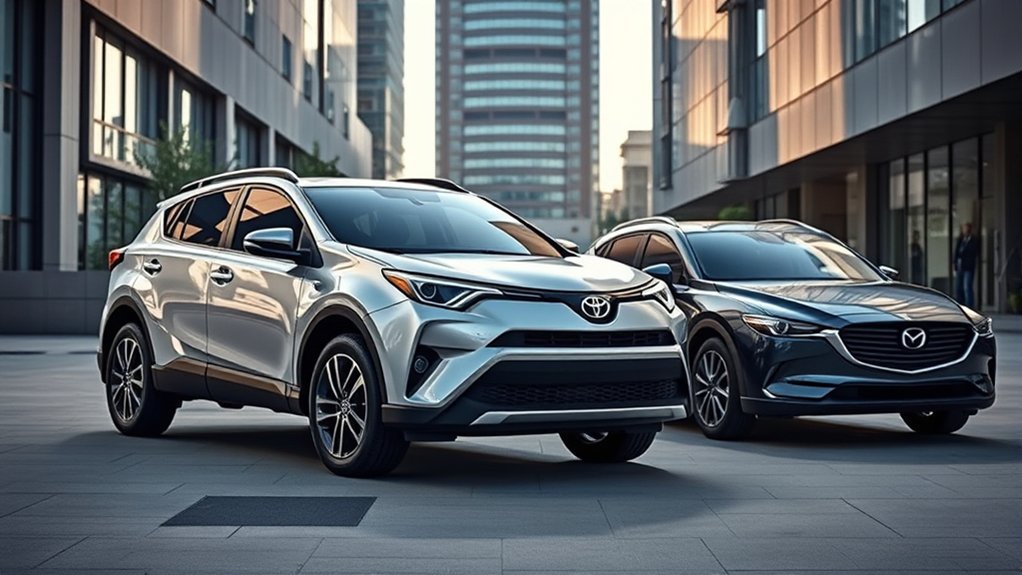
The Toyota RAV4 competes with compact SUVs that use different engine strategies. The 2026 Honda CR-V offers a 190-horsepower 1.5-liter turbo engine on gas trims and a 204-horsepower non-turbo hybrid system on hybrid trims. The 2026 Kia Sportage Hybrid combines a turbocharged 1.6-liter engine with electric assistance for 232 combined horsepower.
| Model | Engine Approach | System Output | Best Fit |
|---|---|---|---|
| 2026 Toyota RAV4 Hybrid | Non-turbo 2.5-liter hybrid | 226 hp FWD or 236 hp AWD | Fuel economy without external charging |
| 2026 Toyota RAV4 Plug-in Hybrid | Non-turbo 2.5-liter plug-in hybrid | 324 hp | Electric commuting and quick acceleration |
| 2026 Honda CR-V | 1.5-liter turbo gas or 2.0-liter hybrid | 190 hp turbo or 204 hp hybrid | Choice between gas-turbo and hybrid trims |
| 2026 Kia Sportage Hybrid | Turbocharged 1.6-liter hybrid | 232 hp | Turbo-hybrid response and a conventional automatic |
The RAV4 is the better match when fuel economy, hybrid availability, and a non-turbo engine matter most. The CR-V gas trims suit buyers who want a conventional turbo engine, while the Sportage Hybrid shows that a hybrid system can also use a turbocharger.
Is the RAV4 the Right SUV for You?
The 2026 Toyota RAV4 makes sense if you want a compact SUV with high fuel economy, a hybrid on every trim, and no turbocharged engine. The standard hybrid is the simplest choice for drivers who cannot charge at home. The plug-in hybrid is more compelling for drivers who can charge often and will use its electric range.
It may not fit you if you want a lower-cost gas-only trim, a traditional stepped automatic transmission, or the acceleration character of a turbocharged engine.
Pro Tip: Test-drive the standard hybrid, plug-in hybrid, and at least one turbocharged rival on the same day. Compare engine noise, low-speed response, brake feel, ride quality, and passing power rather than choosing from horsepower alone.
Performance and Handling Features
The AWD RAV4 Hybrid’s tested 7.1-second 0-to-60-mph time is adequate for merging and passing. The tested Woodland PHEV’s 5.2-second time makes it substantially quicker.
- Standard hybrid: Prioritizes smoothness and economy over aggressive acceleration.
- Plug-in hybrid: Delivers stronger acceleration and can operate on electric power for many local trips.
- AWD: Adds traction, but tires and driver inputs remain critical in rain, snow, and loose surfaces.
- Handling: Most RAV4 grades favor predictable control and comfort; the GR SPORT receives model-specific chassis tuning.
Fuel Efficiency Considerations
Choose the standard hybrid when you want strong fuel economy with no charging requirement. Choose the plug-in hybrid when you have reliable charging and most daily trips fit within its electric range.
Before buying the plug-in hybrid, compare your electricity rate, gasoline price, charging access, expected annual mileage, insurance cost, and price difference. A PHEV saves the most gasoline when it is plugged in consistently.
For either version, check the exact trim’s EPA label because wheel size, tires, AWD, and equipment affect efficiency.
Frequently Asked Questions
Does the 2026 RAV4 have a turbo engine?
No. Every 2026 Toyota RAV4 uses a non-turbo 2.5-liter four-cylinder engine with hybrid assistance. Toyota does not offer a gas-only or turbocharged RAV4 trim in the U.S. lineup.
What engine does the 2026 Toyota RAV4 Hybrid use?
It uses a non-turbo 2.5-liter four-cylinder engine with Toyota’s fifth-generation hybrid system and an electronically controlled continuously variable transmission. Output is 226 horsepower with FWD or 236 horsepower with AWD.
Does the lack of a turbo make the 2026 RAV4 slow?
Not necessarily. Car and Driver tested the AWD RAV4 Hybrid at 7.1 seconds from 0 to 60 mph and the Woodland Plug-in Hybrid at 5.2 seconds. Electric motors provide immediate assistance even though the gasoline engine is not turbocharged.
Which 2026 RAV4 Plug-in Hybrid trims support DC fast charging?
Toyota lists DC fast charging for the XSE and Woodland PHEV grades through a CCS1 port. The SE and GR SPORT use a J1772 port for Level 1 and Level 2 AC charging.
Are there lawsuits or recalls involving the Toyota RAV4?
Recalls, investigations, complaints, and legal cases vary by model year and issue. Check the NHTSA recall database and Toyota’s recall lookup with the vehicle identification number before buying or servicing a specific RAV4.
What RAV4 model year should you avoid?
Do not reject or recommend a used RAV4 by model year alone. Review open recalls, service records, accident history, ownership history, diagnostic codes, and a pre-purchase inspection for the exact vehicle.
Is a turbocharged SUV better than the RAV4 Hybrid?
A turbocharged SUV is not automatically better. Choose based on acceleration feel, fuel economy, charging access, maintenance priorities, price, towing needs, and the exact trim. The RAV4 Hybrid favors efficiency and electric assistance, while some rivals offer a conventional gas-turbo option.
Conclusion
The 2026 Toyota RAV4 does not have a turbocharged engine. Toyota uses a non-turbo 2.5-liter four-cylinder engine with electric motors in every trim, producing 226 horsepower with hybrid FWD, 236 horsepower with hybrid AWD, or 324 horsepower in the plug-in hybrid.
Choose the standard hybrid for high fuel economy without charging. Choose the plug-in hybrid if you can charge regularly and want electric range and stronger acceleration. Compare a turbocharged rival when you prefer a gas-only powertrain or a different acceleration feel.
Sources
- 2026 Toyota RAV4 — current trim and fuel-economy information.
- Toyota: The Next Adventure Begins, 2026 RAV4 — powertrain, drivetrain, charging, towing, and launch specifications.
- 2026 Toyota RAV4 Plug-in Hybrid — current plug-in hybrid lineup and efficiency information.
- RepairPal Toyota RAV4 Reliability Rating — historical repair-cost, frequency, and severity data.
- Car and Driver 2026 Toyota RAV4 Testing — independently measured acceleration and highway fuel economy.
- NHTSA Recall Lookup — recall, investigation, complaint, and manufacturer-communication searches.