Tire Pressure and Fuel Efficiency: How Inflation Impacts MPG
Keeping your tires at the vehicle manufacturer’s recommended cold pressure can reduce wasted fuel, but the improvement is usually modest. The larger benefits are safer handling, lower heat buildup, more even tread wear, and earlier detection of slow leaks. Use the pressure on the vehicle placard or in the owner’s manual, not the maximum number molded into the tire sidewall.
Quick Answer
Proper tire pressure can improve gas mileage by about 0.6% on average and up to 3% in some cases. FuelEconomy.gov also estimates a loss of about 0.2% for every 1 PSI drop in the average pressure of all tires. Always use your vehicle’s recommended cold PSI.
Key Takeaways
- Use the cold PSI on the driver-side door placard or in the owner’s manual, not the tire-sidewall maximum.
- Check every tire, including the spare, at least once a month and before long trips.
- FuelEconomy.gov estimates about 0.2% lower gas mileage for each 1 PSI reduction in the average pressure of all tires.
- Front and rear tires may have different recommended pressures, especially when the vehicle is heavily loaded.
- A tire that repeatedly loses pressure needs inspection for a puncture, valve, wheel, or bead-sealing problem.
What’s in This Article
- How Much Fuel Can Proper Tire Pressure Save?
- Why Tire Pressure Affects Fuel Economy
- What Recommended Cold Pressure Means
- What the Oak Ridge Test Found
- Safety and Tire-Wear Risks
- How to Check and Set Tire Pressure
- Useful Tire-Pressure Tools
- How to Calculate Your Fuel Savings
- Five Quick Actions
- Frequently Asked Questions
- Conclusion
At a Glance
| Time Required | About 10–15 minutes for four tires and the spare |
| Difficulty | Easy |
| Tools Needed | Reliable pressure gauge, air source, and the vehicle’s pressure placard or owner’s manual |
| Cost | Usually no additional cost when you already have a gauge and access to an air pump |
How Much Fuel Can Proper Tire Pressure Save?
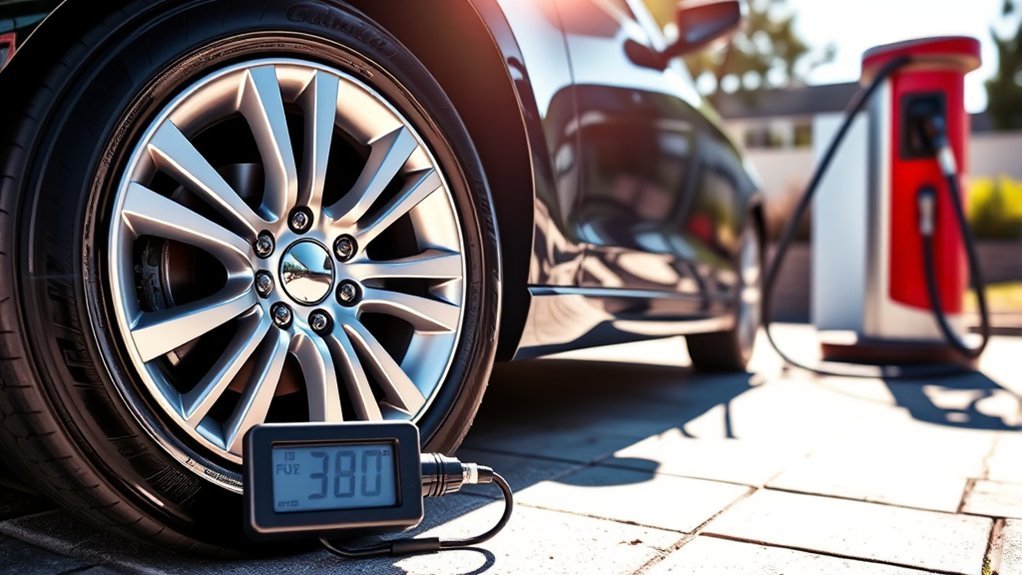
FuelEconomy.gov says properly inflated tires can improve gas mileage by 0.6% on average and up to 3% in some cases. It also estimates that underinflation lowers gas mileage by about 0.2% for every 1 PSI drop in the average pressure of all tires.
Keeping all tires at the proper pressure can improve gas mileage by about 0.6% on average and up to 3% in some cases.
The word average matters. The estimate does not mean that one tire sitting 1 PSI low automatically reduces fuel economy by 0.2%. It refers to the average pressure reduction across the complete set of road tires.
Your actual gain depends on how underinflated the tires were, the vehicle’s weight, tire construction, road speed, load, weather, alignment, and driving pattern. A driver correcting a very small pressure loss may not notice a measurable change at the pump. A driver correcting several consistently low tires may see a clearer improvement.
Fuel savings are only one reason to maintain pressure. Correct inflation also helps the tire carry its intended load, control heat, preserve handling, and wear more evenly.
Why Tire Pressure Affects Fuel Economy
A tire changes shape where it meets the road. When pressure is too low, the sidewall and tread flex more than intended. Some of the vehicle’s energy is then converted into heat instead of forward movement.
This added energy loss is part of rolling resistance. The engine, hybrid system, or electric motor must supply more energy to maintain the same speed, which can reduce fuel economy or driving range.
| Condition | Likely Effect |
|---|---|
| Recommended cold pressure | Supports the intended load capacity, contact patch, handling, and rolling resistance |
| Mild underinflation | Adds flex, heat, rolling resistance, and gradual fuel loss |
| Severe underinflation | Can create a larger efficiency penalty and increase the risk of tire damage or failure |
| Pressure above the vehicle specification | May create a harsher ride and reduce the balance of grip, wear, and load performance intended by the vehicle maker |
Do not deliberately overinflate tires to chase a small reduction in rolling resistance. The vehicle’s recommended pressure balances efficiency with braking, grip, comfort, wear, and load capacity.
What Recommended Cold Tire Pressure Means
The correct everyday pressure is the vehicle manufacturer’s recommended cold tire pressure. According to the National Highway Traffic Safety Administration, this pressure is normally shown on the Tire and Loading Information Label on the driver-side door edge or door jamb. It may also appear in the owner’s manual.
“Cold” generally means the vehicle has not been driven for at least three hours. Driving warms the tires and raises the measured pressure, so a warm reading cannot be compared directly with the cold placard value.
The front and rear recommendations may not be identical. Some vehicles also provide a separate setting for a full passenger or cargo load. Follow the exact axle and load instructions supplied for your vehicle rather than setting every tire to a generic number.
Warning: Do not use the maximum pressure molded into the tire sidewall as your normal target. That marking describes a tire limit associated with its rated load, not the pressure selected by the vehicle manufacturer for normal operation.
Pressure may be displayed in PSI, kilopascals (kPa), or bar. Use the same unit shown on your gauge and placard when possible. Many digital gauges can switch units, which is safer than relying on a hurried mental conversion.
Temperature changes also affect the reading. A useful seasonal rule is approximately 1 PSI for each 10°F change in ambient temperature, although the exact change varies with conditions. Recheck the tires after major weather changes instead of adding or releasing air solely from a temperature estimate.
What the Oak Ridge Tire-Pressure Test Found
Oak Ridge National Laboratory’s Vehicle Technologies Fact #826 summarizes a controlled test of a 2009 Toyota Corolla. Researchers tested all four tires at the recommended pressure, 75% of the recommended pressure, and 50% of the recommended pressure while the vehicle ran at steady speeds from 40 to 80 mph.
Measured MPG Results
| Speed | Recommended Pressure | 75% Pressure | 50% Pressure |
|---|---|---|---|
| 40 mph | 57.5 mpg | 56.3 mpg | 51.7 mpg |
| 60 mph | 42.5 mpg | 41.7 mpg | 39.5 mpg |
| 80 mph | 30.9 mpg | 29.8 mpg | 29.2 mpg |
At 75% of the recommended pressure, the fuel-economy penalty stayed near 2%–3% across the tested speeds. At 50% pressure, the penalty was about 10% at 40 mph and approximately 5% at 80 mph.
How to Interpret the Test
The larger percentage difference at 40 mph is a result from this vehicle and test procedure, not a rule that applies identically to every vehicle. The study does not support deliberately driving faster, and severe underinflation remains unsafe at any speed.
The test used steady-speed laboratory conditions after a warm-up procedure. Normal driving includes acceleration, braking, traffic, road grades, wind, temperature changes, and varying loads. Those factors can make your real-world result different.
Note: The Corolla figures show that tire pressure can produce a measurable fuel-economy penalty under controlled conditions. They are not a promise that every vehicle will gain the same number of MPG after inflation.
The underlying 2014 ORNL study reported that low-pressure cases produced effects ranging from negligible to about a 10% fuel-economy penalty, depending on the vehicle, pressure condition, and test point.
A 2007 Government Accountability Office review also reported a Department of Energy estimate that underinflation wasted approximately 1.2 billion gallons of fuel in the United States based on 2005 passenger-car and light-truck fuel use. That is a historical national estimate, not a current annual total.
Safety and Tire-Wear Risks Beyond MPG
Fuel savings are useful, but pressure maintenance is first a safety and durability issue. NHTSA says tire pressure affects safety, tire life, and fuel consumption.
An underinflated tire flexes more and can build excess heat. Continued operation may damage internal components even when the outside of the tire does not look flat. Low pressure can also reduce steering response, affect braking, and cause uneven shoulder wear.
Pressure above the vehicle recommendation can create its own problems, including a firmer ride, altered grip, and uneven center wear. More pressure is not automatically better.
NHTSA also advises drivers to inspect tire tread and visible condition during regular pressure checks. Look for cuts, punctures, cracks, bulges, exposed material, unusual wear, or objects lodged in the tread.
Pro Tip: Record the pressure of each tire once a month. A repeated loss in the same position is easier to recognize when you have previous readings instead of relying on memory.
Have a tire inspected when it repeatedly loses air, shows visible damage, vibrates, pulls the vehicle to one side, or produces a new thumping or humming sound. A slow loss may come from a puncture, valve stem, valve core, wheel damage, corrosion, or a leaking tire-to-wheel bead.
How to Check and Set Tire Pressure
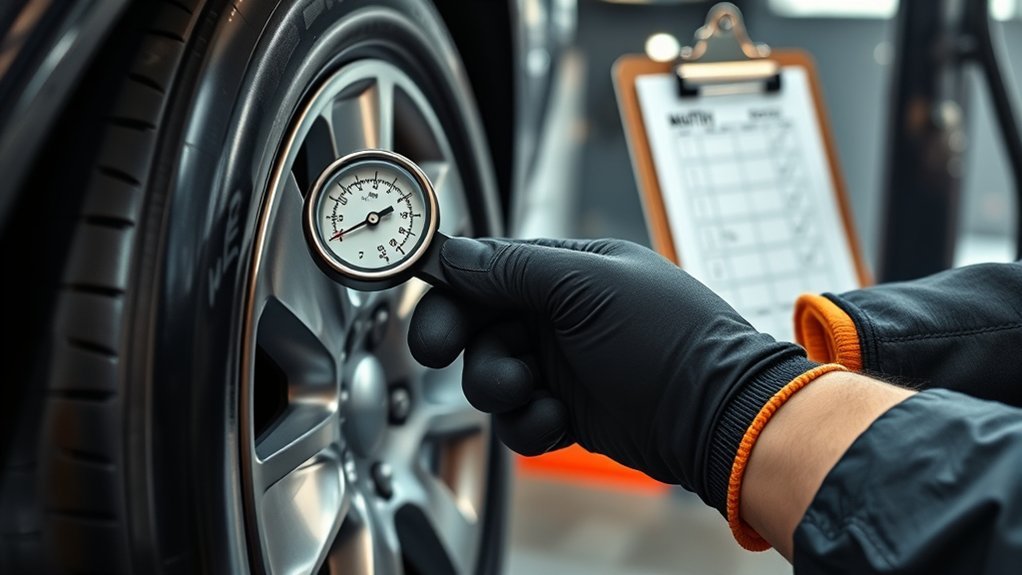
Check all road tires and the spare at least once a month, before long trips, and after a major temperature change. Use the same reliable gauge when possible so readings remain consistent.
1. Find the Correct Pressure
Read the Tire and Loading Information Label on the driver-side door edge or door jamb. Note whether the front and rear tires use different pressures and whether separate guidance is listed for a heavily loaded vehicle.
Do not copy the pressure from another vehicle, a generic online chart, or the tire sidewall.
2. Measure Each Cold Tire
- Park the vehicle for at least three hours when practical.
- Remove the valve cap from the first tire.
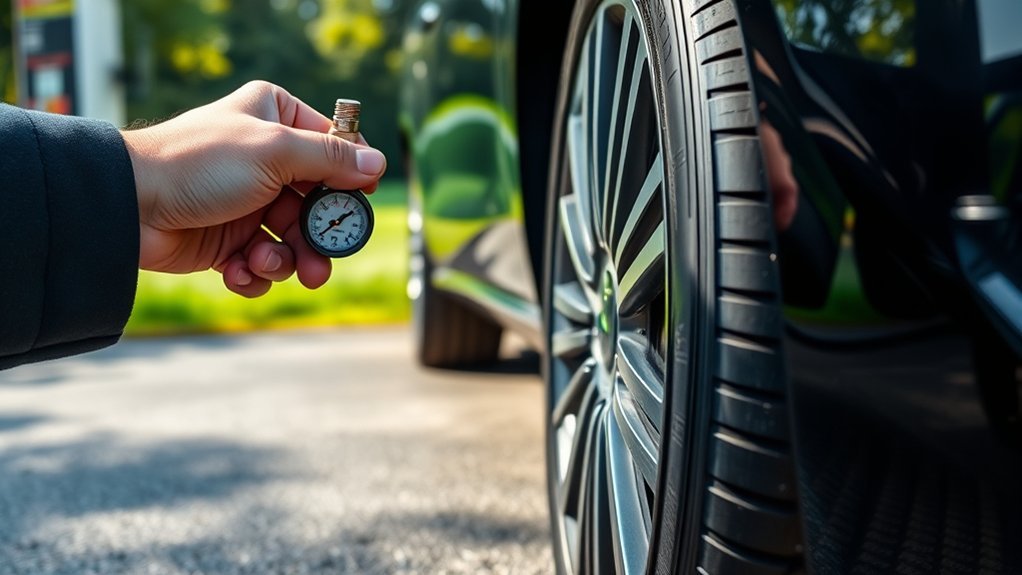
- Press the gauge squarely onto the valve until the hissing stops and the reading stabilizes.
- Compare the reading with the correct placard value for that axle.
- Repeat the process for every road tire and the spare.
A tire can be seriously underinflated without looking obviously flat, so appearance alone is not a reliable test.
3. Add or Release Air
If pressure is low, add air in short bursts and measure again. If pressure is high while the tire is cold, release a small amount and recheck. Continue until the reading matches the vehicle specification.
Replace each valve cap after checking. The cap helps keep dirt and moisture away from the valve mechanism.
4. Recheck and Record the Result
Take a final reading after inflation. Recording the date and each tire’s pressure can reveal a slow leak before the TPMS warning appears.
| Action | Correct Target |
|---|---|
| Measure | When the tires are cold whenever practical |
| Set pressure | Use the placard value for the correct axle and load |
| Check the spare | Use the spare-tire specification in the manual or on the vehicle label |
| Repeat | At least monthly and before long trips |
What If the Tires Are Warm?
Do not release air from a warm tire merely because its reading is above the cold placard number. Heat from driving normally raises pressure.
When a warm tire is clearly low, NHTSA advises adding enough air to reach the recommended cold pressure rather than continuing on a seriously underinflated tire. Recheck and correct the pressure after the vehicle has been parked long enough for a cold reading.
Warning: Do not continue driving on a tire that is visibly flat, has a bulge or sidewall damage, will not hold air, or produces severe vibration. Install the proper spare or arrange professional assistance.
Why TPMS Is Not Enough
Direct TPMS designs measure pressure with wheel-mounted sensors, while indirect systems estimate pressure changes from wheel-speed and vehicle data. The exact display and warning behavior vary by model.
NHTSA explains that TPMS warnings generally appear only after a tire becomes significantly underinflated. Treat the warning light as a backup alert, not a replacement for monthly gauge checks.
Tools That Help Maintain Correct Pressure
Most drivers need only three things: an accurate gauge, access to an air pump, and the vehicle’s pressure specification.
- Digital gauge: Easy to read and often able to switch between PSI, kPa, and bar.
- Dial gauge: Clear analog display, although it should be protected from drops and impact.
- Pencil gauge: Compact and inexpensive, but small markings can be harder to read.
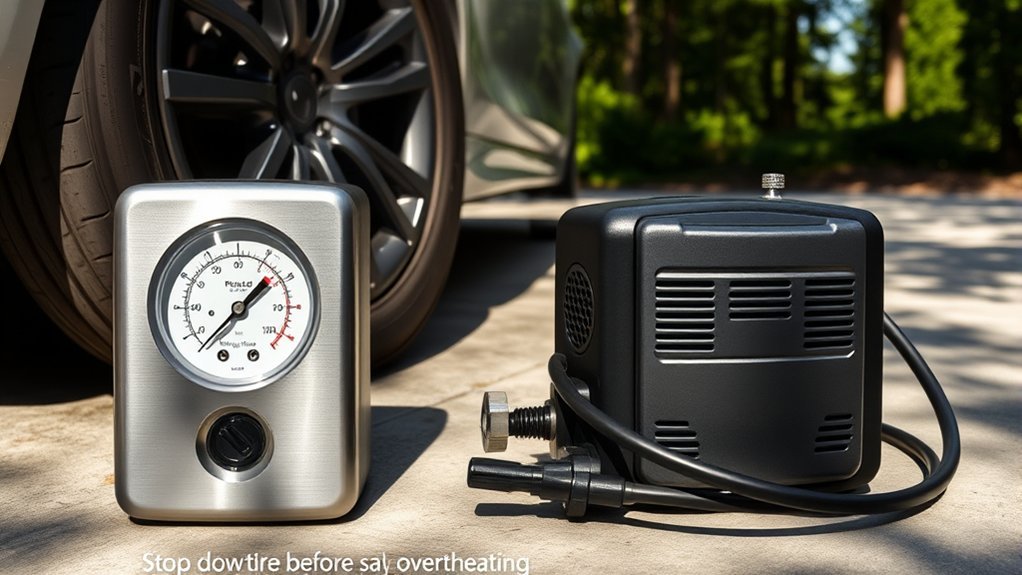
- Portable inflator: Useful at home or during travel, especially when paired with a separate verification gauge.
- TPMS: Provides a warning when the system detects significant underinflation or a malfunction.
For fleet and heavy-duty applications, an Automatic Tire Inflation System can monitor or maintain pressure while equipment operates. Most passenger-vehicle owners do not need an ATIS.
Nitrogen-filled tires still require normal checks. Nitrogen does not prevent punctures, valve leaks, wheel leaks, or pressure changes caused by temperature.
How to Calculate Your Own Fuel Savings
You can estimate potential savings in MPG, gallons, or money. Start with your normal fuel economy and annual distance.
Estimate the MPG Change
Use this formula:
Improved MPG = Current MPG × (1 + expected improvement percentage)
For a vehicle that averages 30 mpg:
- A 0.6% improvement equals 30 × 1.006 = 30.18 mpg.
- A 3% improvement equals 30 × 1.03 = 30.9 mpg.
Estimate Gallons Saved
Use these formulas:
Current annual gallons = Annual miles ÷ Current MPG
Improved annual gallons = Annual miles ÷ Improved MPG
Gallons saved = Current annual gallons − Improved annual gallons
Example: A driver travels 12,000 miles per year in a 30-mpg vehicle.
- Current fuel use: 12,000 ÷ 30 = 400 gallons.
- At 30.9 mpg: 12,000 ÷ 30.9 = approximately 388.35 gallons.
- Estimated annual saving: approximately 11.65 gallons.
Estimate Fuel-Cost Savings
Fuel-cost saving = Gallons saved × Fuel price per gallon
Using the example above, if fuel costs $3.50 per gallon, 11.65 gallons would equal approximately $40.78 per year.
This example uses the upper 3% estimate. A vehicle that was already close to the correct pressure would probably save less.
Pro Tip: To measure your own result, compare at least three full tanks before and after correcting pressure. Use similar routes and calculate MPG from odometer miles and fuel added, because one tank can be distorted by traffic, weather, idling, or an incomplete fill.
Five Quick Actions to Save Fuel and Protect Your Tires
- Check every tire cold: Include the spare and check before long trips.
- Use the placard pressure: Follow the listed front, rear, and loaded values.
- Verify after adding air: Do not rely only on an inflator’s automatic shutoff.
- Repair recurring losses: A tire that repeatedly drops needs inspection rather than repeated topping off.
- Track several tanks: Compare MPG over time instead of judging the result from one short drive.
These steps reduce avoidable rolling resistance while also making pressure checks part of routine tire inspection.
Frequently Asked Questions
How does temperature affect tire pressure and MPG?
Cold weather normally lowers measured pressure, while warmer conditions raise it. A common rule is about 1 PSI for each 10°F temperature change. Recheck the tires cold after major weather changes and restore them to the vehicle specification. Low seasonal pressure can increase rolling resistance and reduce MPG.
Can overinflating tires improve fuel economy?
Pressure above the recommended value may reduce some tire flex, but that does not make overinflation safe or beneficial overall. It can affect grip, ride comfort, contact-patch behavior, and tread wear. Use the vehicle maker’s specified cold pressure rather than adding extra air to chase a small efficiency change.
Does the spare tire affect fuel economy?
A stored spare’s pressure does not normally change rolling resistance because the spare is not touching the road. Its condition still matters because it must be ready during an emergency. Check its specified pressure during the same monthly routine as the road tires.
Does TPMS accuracy vary by vehicle?
Yes. Some vehicles use direct pressure sensors, while others estimate pressure changes indirectly through wheel-speed data. Displays, thresholds, reset procedures, and sensor accuracy can vary. Use TPMS as a warning system and confirm the actual pressure with a gauge.
Should I change pressure for heavy cargo or towing?
Follow the vehicle placard and owner’s manual. Some vehicles list a separate full-load setting or different front and rear values. Do not invent an increase or exceed vehicle, axle, wheel, or tire limits. Check pressure cold before departure.
Should I release air when a warm tire reads above the placard PSI?
Usually no. Driving heats the tire and raises pressure, while the placard lists a cold value. Do not bleed a normally warm tire down to the cold specification. Recheck it after the vehicle has been parked for at least three hours.
Do nitrogen-filled tires save more fuel?
The main fuel-economy benefit comes from maintaining the correct pressure, regardless of whether the tire contains ordinary compressed air or nitrogen. Nitrogen-filled tires can still lose pressure through punctures, valves, wheel leaks, and temperature changes, so monthly checks remain necessary.
Safety Disclaimer: This article is for informational purposes only and does not replace your vehicle owner’s manual, tire placard, or advice from a qualified tire professional. Always follow your vehicle maker’s instructions and get professional help if a tire leaks, shows damage, or handles poorly.
Conclusion
Proper tire pressure can improve fuel economy by reducing avoidable rolling resistance. FuelEconomy.gov estimates an average improvement of about 0.6% and up to 3% in some cases, but your result depends on how low the tires were and how the vehicle is used.
The most important habit is simple: check every tire cold at least once a month, use the exact pressure listed for the vehicle and load, and investigate repeated losses. Even when the fuel saving is small, correct inflation supports safer handling, longer tire life, and more dependable travel.
Sources
- FuelEconomy.gov: Keeping Your Vehicle in Shape — supports the 0.6% average, 3% upper estimate, and 0.2%-per-PSI fuel-economy figures.
- National Highway Traffic Safety Administration: TireWise — supports monthly cold-pressure checks, placard guidance, spare-tire checks, TPMS limitations, and tire-safety advice.
- Oak Ridge National Laboratory Vehicle Technologies Fact #826 — provides the 2009 Toyota Corolla pressure and steady-speed MPG results.
- Oak Ridge National Laboratory: Fuel Economy and Emissions Effects of Low Tire Pressure — describes the underlying 2014 vehicle-testing research.
- U.S. Government Accountability Office: Underinflated Tires in the United States — provides historical national safety and fuel-use context.
- Michelin: How to Check Tire Pressure — supports monthly checks, cold measurement, natural pressure loss, and seasonal pressure guidance.