Tire Temperature Behavior On Track: Complete Toyota Supra Guide

Understanding tire temperature behavior is essential for your Toyota Supra’s track performance. Preferred tire temperatures range between 180°F and 220°F, where grip and handling improve as rubber becomes pliable. Monitor temperatures closely, as overheating leads to degraded performance and handling issues. Adjust camber and tire pressure based on temperature readings to maintain ideal conditions. Accurate measurement during sessions allows you to fine-tune setup and enhance performance. Explore further to uncover more insights for maximizing your track experience.
Understanding the Importance of Tire Temperature on Track

Understanding tire temperature on track is essential for maximizing performance, as it directly influences grip and handling. Maintaining tire temperature within the ideal range enhances rubber pliability, improving contact with the track surface. Overheating can degrade tire performance, so regular monitoring during sessions is vital.
You should also note that temperature discrepancies across the tire can signal alignment or camber issues. Typically, the inside of the tire should register higher temperatures than the middle and outside. To achieve accurate measurements, use a pyrometer during your sessions, evaluating temperatures at the inner, middle, and outer edges for effective data analysis.
Ideal Tire Temperature Ranges for Optimal Performance
To achieve ideal performance, you need to maintain your tire temperatures between 180°F and 220°F, as this range varies by tire model and track conditions. If you push temperatures beyond 220°F, you risk overheating, which can severely compromise grip and tire integrity. Monitoring temperature distribution across the tire can also help guarantee proper alignment and contact patch for maximum efficiency.
Optimal Temperature Range
Achieving ideal tire performance hinges on maintaining temperatures between 180°F and 220°F, a range critical for maximizing grip and minimizing degradation. Staying within this effective range guarantees your tires perform efficiently, enhancing grip as heat excites rubber molecules. Be aware that tire pressure typically rises by about 6 psi for every 75°F increase in temperature, impacting handling characteristics. For 200-treadwear tires, consistent monitoring of tire temperatures during track sessions is essential. This allows you to make informed adjustments to tire pressure and camber settings, enhancing performance. Utilize a pyrometer to measure temperatures at the inner, middle, and outer edges to evaluate tire wear and guarantee even heat distribution across the contact patch, ultimately elevating your driving experience.
Effects of Overheating Tires
When tire temperatures exceed the ideal range of 180°F to 220°F, you’ll notice a rapid decline in performance that can jeopardize your track experience. Overheating tires lead to degraded rubber, compromising grip and responsiveness. A 75-degree spike can raise tire pressure by about 6 psi, altering the contact patch and handling characteristics. If you consistently monitor tire temperatures, you can prevent issues like uneven wear and vibrations. Tires running too hot may feel greasy during aggressive maneuvers, impairing your control. Ultimately, maintaining optimal tire temperatures is vital for maximizing performance and ensuring a liberated driving experience. Stay vigilant, and your Toyota Supra will reward you with the responsiveness and stability you crave on the track.
Camber’s Impact on Tire Temperature
Camber settings play an essential role in tire temperature management, directly affecting the contact patch during high-speed track conditions. When you apply excessive negative camber, the inside edge of the tire tends to overheat, while the outside edge remains cooler. This temperature imbalance can severely impact overall tire performance. Ideally, you want the inside temperature to be greater than the middle, which should be greater than the outside temperature. Monitoring tire temperatures is important; uneven readings can indicate alignment issues stemming from camber or pressure mismatches. Proper camber adjustments can help achieve a more even temperature distribution across the tire surface, optimizing grip and ensuring consistent performance during your track sessions. Striking the right camber balance is essential for revealing your Toyota Supra’s full potential, enhancing both tire longevity and track capability.
How to Adjust Tire Pressure for Optimal Track Conditions
Optimizing tire pressure is as critical as adjusting camber settings for achieving peak performance on the track. Start with an initial tire pressure of 38 psi, as recommended by OEM guidelines. For experienced drivers, consider lowering this to 34 psi to observe how your tires respond during the session. Aim for an end pressure of 38-40 psi. In warmer conditions, expect an increase of 3-6 psi due to heat; therefore, adjustments are essential to maintain ideal performance. If you notice your tires feeling greasy or developing flat spots, starting at lower pressures around 28 psi can help. Regularly monitor tire pressures based on track conditions, your skill level, and temperature data, making necessary adjustments throughout the day. This proactive approach not only enhances grip but also elevates overall handling, empowering you to release the full potential of your Toyota Supra.
Spotting Tire Temperature Overheating and Its Consequences

You need to recognize the signs of tire overheating, as excessive temperatures can drastically reduce grip and affect handling. Monitoring tire temperature distribution is essential; ideally, you want the inside to be warmer than the middle and outside. If you notice symptoms like vibrations or a “greasy” feel, it’s time to adjust your tire pressures or suspension settings to prevent further issues.
Symptoms Of Overheating Tires
How can you tell if your tires are overheating on the track? Keep an eye on your tire temperature; readings exceeding 200°F signal overheating tires. You’ll notice a marked decrease in performance, with traction feeling “greasy,” especially in tight turns. Additionally, post-session vibrations can indicate rubber gumming, risking flat spots if ignored. Monitoring tire temperatures is essential, as a rise of just 75°F can increase tire pressure by 6 psi, pushing your tires past ideal conditions. Uneven temperatures across the tire’s edges can also signal issues—hot inside edges hint at excessive negative camber, while a cool middle suggests insufficient pressure. Staying vigilant can prevent serious degradation and enhance your track experience.
Effects On Grip Performance
When tire temperatures exceed ideal levels, the consequences on grip performance become evident, as overheating greatly compromises tire pliability and responsiveness. A rise of approximately 75 degrees can increase tire pressure by about 6 psi, negatively affecting the contact patch and overall grip. You may notice excessively hot tires feeling greasy, leading to reduced traction, especially on tight tracks. Consistent monitoring of tire temperatures is essential; it allows you to identify overheating issues early. Effective heat management techniques, including tire warmers and strategic driving, help maintain peak grip throughout your sessions. Additionally, regularly recording and analyzing tire temperature data enables you to adjust tire pressure and camber settings for even heating, thereby enhancing your vehicle’s grip performance on track.
Mitigation Strategies And Solutions
While tire temperature management is critical for ideal performance, recognizing the signs of overheating and implementing effective mitigation strategies can greatly enhance grip and handling. Monitor tire temperatures closely during track sessions; a 3-6 psi increase indicates overheating, compromising your performance. A hot inside edge suggests excessive negative camber, leading to uneven wear, while a cool middle points to insufficient tire pressure. Aim for a balanced average tire temperature distribution: the inside should be hotter than the middle, which should be hotter than the outside. Adjusting suspension settings, like stiffening springs or sway bars on the cooler end, can equalize tire temperatures. Regularly measure temperatures with a pyrometer to make timely adjustments and prevent performance degradation.
Effective Techniques for Heating Tires on Track
Effective techniques for heating tires on track are essential for maximizing grip and performance. Start by utilizing tire warmers before sessions; they efficiently preheat tires, ensuring even temperature distribution, especially in cooler conditions. During your session, apply prolonged brake applications to generate additional heat through friction, as this method is more effective than relying on lateral friction while cornering.
Regularly monitor tire temperatures, making immediate adjustments if necessary to maintain peak grip. Remember, a temperature rise of approximately 75 degrees can increase tire pressure by about 6 psi, so keep an eye on both metrics for effective tire management. Additionally, heat cycling tires throughout the session enhances grip and aligns the molecular structure of the tire material, leading to consistent performance. By integrating these techniques, you can achieve the ideal tire temperature for peak track performance.
Using Tire Temperature Data for Chassis Adjustments
Understanding tire temperature behavior on track is essential for maximizing chassis performance. By closely monitoring tire temperature data during your sessions, you can pinpoint handling traits like understeer or oversteer, allowing for precise chassis tuning adjustments. Aim for a temperature distribution where the inside edge is hotter than the middle, which should be hotter than the outside edge—this signifies effective camber settings and proper tire pressure.
If you notice excessively hot inside temperatures, it may indicate too much negative camber, while cooler outside edges suggest a need for adjustment. Work towards consistent readings across all four tires; discrepancies often highlight imbalances in weight distribution. Such imbalances can guide necessary changes to springs or sway bars. Regular analysis of tire temperature data empowers you to make informed decisions, ensuring optimal tire contact with the track surface for enhanced grip and performance during racing sessions.
What to Do When Tire Temperatures Are Mismanaged
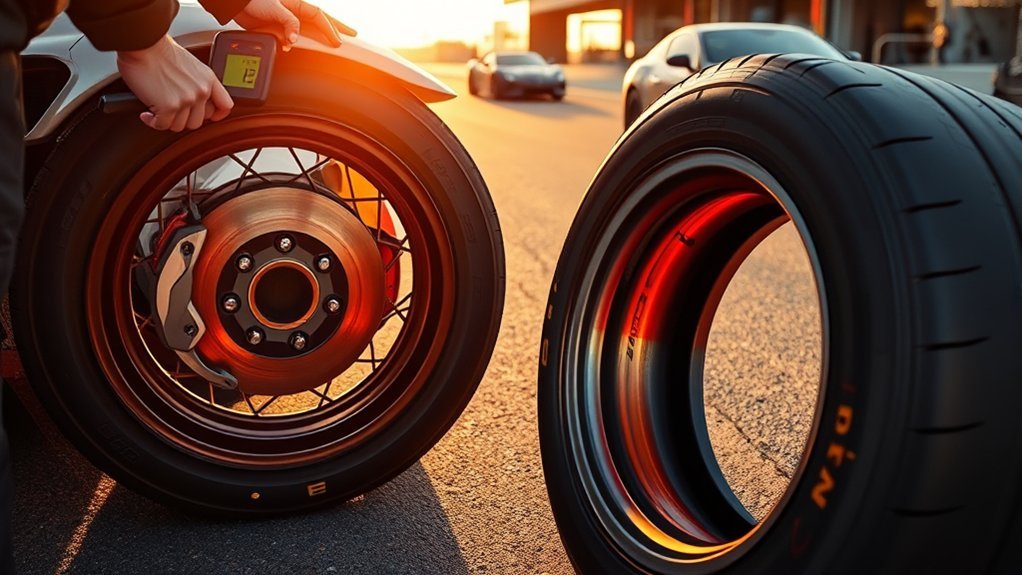
When tire temperatures are mismanaged, you risk compromising grip and overall performance on track. To regain control, follow these steps:
- Record tire temperatures and pressures regularly during your sessions. This data can pinpoint discrepancies needing immediate attention.
- If inside tire temperatures are considerably hotter than outside, adjust your negative camber to enhance the contact patch.
- A hot middle tire temperature often indicates over-inflation; lower the tire pressure to improve your contact with the track.
- If you notice uneven tire temperatures across all tires, consider adjusting your suspension settings or weight distribution for better balance.
Maintaining Tire Performance Throughout Race Sessions
To maintain tire performance throughout race sessions, you need to implement effective tire pressure monitoring techniques and heat management strategies. Regularly measuring temperatures with a pyrometer after several laps helps you fine-tune settings for ideal grip. By balancing tire temperatures across all four corners, you guarantee consistent handling and peak performance on track.
Tire Pressure Monitoring Techniques
Effective tire pressure monitoring is essential for maintaining ideal tire performance throughout race sessions, as even slight variations can greatly impact handling and grip. Here are key techniques to guarantee optimal tire pressures:
- Start at 38 psi, the OEM recommendation for beginners, and monitor pressures throughout the session.
- Record tire pressures immediately after each run; a 75-degree temperature rise correlates to about a 6 psi increase.
- Use a pyrometer to measure tire temperatures at the inner, middle, and outer edges, guaranteeing a proper gradient.
- Document ambient air and track temperatures alongside tire pressures to make informed adjustments and identify discrepancies that may indicate handling issues.
Stay vigilant and precise to liberate your performance on track.
Heat Management Strategies
Proper heat management is fundamental for sustaining tire performance throughout race sessions, as ideal temperatures enhance grip and handling. Monitoring tire temperatures is imperative; a rise of 75 degrees can increase tire pressure by about 6 psi, affecting overall performance. Use tire warmers before sessions to achieve even tire temperatures, especially in cooler conditions. Regularly check temperature readings during laps to guarantee inner temperatures remain hotter than outer ones, promoting peak performance. Adjust suspension settings and tire pressures based on these readings to maintain balanced temperature distribution. Techniques like friction heating during laps and monitoring pressure changes are essential for maintaining tire performance, ultimately prolonging tire life and enhancing your competitive edge on the track.
Temperature Measurement Best Practices
Accurate temperature measurement is essential for maintaining tire performance throughout race sessions. To achieve this, follow these best practices:
- Measure tire temperatures during the session, ideally in the hot pit lane, for optimal readings.
- Use a pyrometer with a needle, taking precise measurements from the inside, middle, and outside edges of each tire, and record them consistently.
- Immediately document tire pressures post-measurement to analyze how they correlate with tire performance and temperature distribution.
- Aim for an ideal temperature distribution: inside > middle > outside, indicating superior contact and grip.
Regularly analyze average tire temperatures across all four tires. Identifying discrepancies signals the need for adjustments in camber or weight distribution to enhance handling.
Measuring Tire Temperatures Accurately
While you’re on track, measuring tire temperatures accurately is essential for maximizing performance. To achieve this, take readings during the session, ideally in the hot pit lane after a few laps, avoiding cooldown laps that can mislead results. Use a needle pyrometer for precise measurements, checking the inside, middle, and outside edges of each tire. Record the temperatures in a consistent order for all four tires, then recheck the first tire’s temperature after measuring the others to verify accuracy. Calculate each tire’s average by adding the inner, middle, and outer temperatures and dividing by three, aiming for similar averages across all tires. Don’t forget to monitor ambient and track temperatures, documenting these alongside tire pressures. This thorough approach allows you to analyze performance and tire behavior effectively, ensuring you maintain ideal grip and handling during your session.
Frequently Asked Questions
What Is the Temperature for Track Tires?
For track tires, ideal performance occurs between 180-220°F. Effective tire heat management and understanding track surface effects are essential. Monitoring temperature helps you maximize grip with the right tire compounds, ensuring superior handling and control.
How to Use a Pyrometer at the Track?
Using a pyrometer at the track’s like tuning a fine instrument. Grab your needle pyrometer, take readings post-laps, and calibrate temperatures—inside, middle, outside—while tracking pressures. This guarantees your track tire performance stays sharp.
What Psi Should My Tires Be at When It’s Hot?
For hot conditions, aim for a tire pressure around 38 psi to guarantee peak performance and effective heat management. Monitoring and adjusting throughout your session can prevent overheating and maintain grip for better control.
How to Monitor Tire Temperature?
To monitor tire temperature, you’ll dance with a pyrometer, capturing readings mid-session. Log data meticulously; observe temperature effects against tire pressure. Analyze patterns, ensuring ideal contact and performance, guiding you toward track liberation.
Conclusion
In the high-stakes world of track racing, managing tire temperature is as essential as hitting the apex. By understanding your tire’s behavior and adjusting camber and pressure accordingly, you can optimize performance like a maestro conducting a symphony. Mismanaged temperatures lead to catastrophic failures, so keep a keen eye on your data. Remember, a well-tuned tire isn’t just an accessory; it’s the heartbeat of your Toyota Supra, ensuring every lap is a step towards victory.