
How To Know Toyota RAV4 Is In 4WD
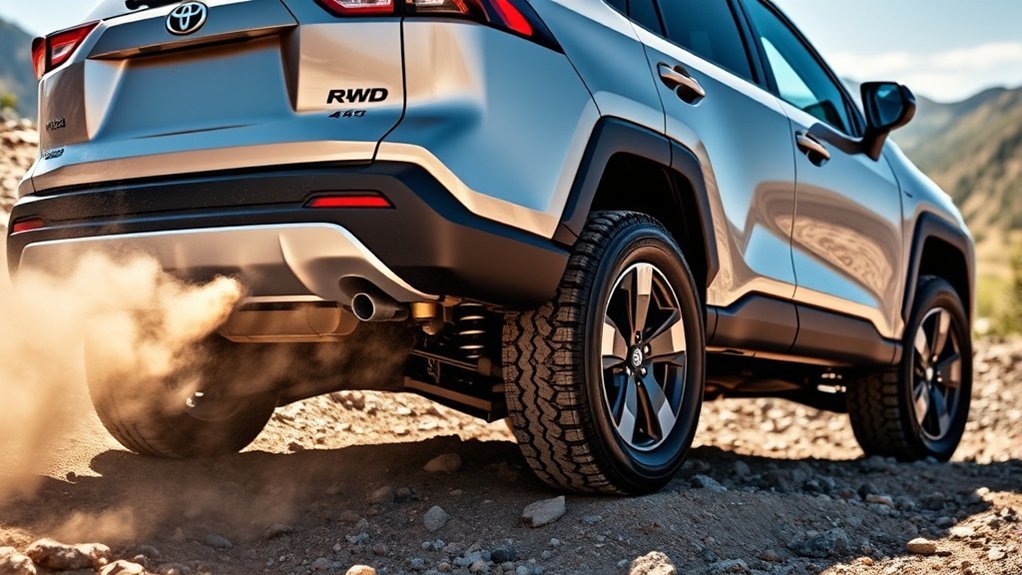
To know if your Toyota RAV4 is in 4WD, check for a driveshaft linking the transmission to the rear differential or look for a 4WD lock button on the dashboard. Monitor the Energy Monitor display; if the rear motor indicator lights up during acceleration, you’re likely in 4WD. You can also inspect the V5 document for drivetrain details. Keep exploring to uncover more about your RAV4’s capabilities and features!
How To Identify Your RAV4’s Drivetrain Type

How can you tell if your Toyota RAV4 has a 4WD drivetrain? Start by checking your V5 document; it clearly states your vehicle’s drivetrain type. If you can’t find it there, a visual inspection can help. Look under your RAV4 for a driveshaft connecting the main transmission to the rear differential—this indicates a 4WD or AWD setup. Another quick check is the dashboard: if you see a 4WD lock button, you likely have 4WD; if it’s missing, you probably have a 2WD model. You can also use your Vehicle Identification Number (VIN) online to confirm your drivetrain type. Finally, chassis codes are a great clue: SXA10 and SXA11 indicate 4WD, while SXA15 and SXA16 denote 2WD. Understanding your drivetrain empowers you, ensuring you harness your vehicle’s true potential.
Key Indicators of 4WD Functionality
To determine if your Toyota RAV4 is equipped with 4WD, start by checking the Energy Monitor display on your infotainment screen, which reveals power distribution to the rear motor in AWD models. Next, perform a visual inspection underneath the vehicle to locate the driveshaft linking the transmission to the rear differential. Finally, verify your RAV4’s drivetrain specifics through the V5 document or EU Certificate of Conformity for definitive confirmation.
Energy Monitor Display Insights
The Energy Monitor display serves as an essential tool in understanding your Toyota RAV4’s 4WD functionality. As you drive, keep an eye on the screen to see real-time power distribution. In AWD models, an additional electric motor indicator appears near the battery gauge, confirming that 4WD is engaged. You’ll notice power from the rear motor during acceleration or regeneration, enhancing your driving experience. If the rear motor isn’t visible, your vehicle may be operating in 2WD, especially at low speeds or idle. For an even deeper insight, utilize the G-force monitor available in Sport mode, which adds another layer to understanding your RAV4’s performance dynamics. Embrace the power of the Energy Monitor for ideal driving liberation.
Visual Inspection Techniques
While exploring your Toyota RAV4, a thorough visual inspection can reveal key indicators of its 4WD functionality. Start by checking underneath for a solid metal driveshaft connecting the gearbox to the rear axle; this is a clear sign of 4WD capability. Next, look for a rear differential nestled between the rear wheels, as its presence confirms that your vehicle is designed for 4WD operation. Also, don’t overlook the rubber boots on the ends of the driveshafts leading to the rear wheels; they’re critical components of the system. Finally, glance at the dashboard for a 4WD lock button, usually indicating the ability to engage 4WD when needed. These steps will empower you to confirm your RAV4’s capabilities!
Drivetrain Documentation Verification
How can you confidently verify whether your Toyota RAV4 is equipped with 4WD? Start by checking the V5 document, which clearly states if your vehicle is 2WD or 4WD, confirming the drivetrain type. You can also look at the braked towing capacity; AWD models typically support up to 1650 kg, while FWD versions only allow 800 kg. The EU Certificate of Conformity may include the AWD status, serving as an official reference for verification. Additionally, reviewing the logbook can provide insights into the drivetrain configuration. Finally, if you spot a 4WD lock button on the dashboard, it’s a strong indicator that your RAV4 boasts 4WD functionality. This drivetrain documentation verification guarantees you understand your vehicle’s capabilities fully.
How To Spot If Your RAV4 Is Running in 4WD?
To spot if your RAV4 is running in 4WD, start by checking the Energy Monitor display on the central infotainment screen; it’ll show when power’s sent to the rear wheels. You should also look for a 4WD lock button on the dashboard, which indicates the vehicle’s capability to engage 4WD. Finally, a quick inspection underneath the vehicle can reveal a driveshaft connecting the main transmission to the rear differential, confirming the presence of 4WD.
Energy Monitor Display
If you’re curious about whether your Toyota RAV4 is in 4WD, the Energy Monitor display provides key insights right on the central Infotainment screen. In AWD models, you’ll notice an extra electric motor/generator indicator near the battery gauge when the system engages. While driving, keep an eye on the display; it’ll show when power is being supplied by the rear motor, confirming your RAV4 is utilizing 4WD. If the Energy Monitor doesn’t indicate the rear motor is active, your vehicle might be in 2WD or AWD isn’t engaged. By observing the Energy Monitor in different driving conditions, you can guarantee your RAV4’s AWD system operates effectively, giving you the freedom to tackle various terrains confidently.
Physical Inspection Tips
While you might rely on the Energy Monitor display to check your RAV4’s 4WD status, a physical inspection can provide additional confirmation of your vehicle’s capabilities. Start by checking underneath your RAV4 for a solid metal driveshaft connecting the main transmission to the rear axle; this indicates 4WD capability. Look for rubber boots at both ends of the driveshafts, common in 4WD vehicles. Next, inspect for a rear differential between the rear wheels; its presence confirms you’re in a 4WD model. Additionally, check the dashboard for a 4WD lock button—if it’s there, you can switch between 2WD and 4WD. Finally, verify your VIN online or consult the V5 document to confirm your vehicle’s drivetrain configuration.
Visual Inspection: What To Look For Under Your RAV4
A thorough visual inspection of your Toyota RAV4’s undercarriage can reveal essential information about its drivetrain configuration. Start by looking for these key components:
- A solid metal tube running from the gearbox to the rear axle, indicating the presence of a driveshaft.
- Distinct driveshafts leading to the rear wheels, confirming a 4WD or AWD system.
- Rubber boots at either end of the driveshafts, typically found in vehicles equipped for 4WD.
- A rear differential, vital for transmitting power to the rear wheels in 4WD configurations.
If you don’t see a driveshaft or rubber boots leading to the rear wheels, it’s likely your RAV4 is a 2WD model. This visual check is important for understanding your vehicle’s capabilities, ensuring you’re ready for whatever driving conditions come your way.
How To Use the 4WD Lock Feature

To maximize your Toyota RAV4’s traction in challenging conditions, using the 4WD Lock feature is vital. Start by ensuring your vehicle is stationary, then shift the transmission to the “4WD Lock” position. This engages the system, enhancing traction by powering all four wheels, including the rear wheels, which is significant for maneuvering slippery surfaces, steep inclines, or off-road terrains. Keep in mind that you can only activate the 4WD Lock at speeds up to 25 MPH to prevent drivetrain damage.
When the 4WD Lock is engaged, a warning light will illuminate on your dashboard, confirming the system’s activation. Once driving conditions improve, remember to switch back to “2WD.” This helps optimize fuel efficiency and reduces wear on your drivetrain. Mastering the use of the 4WD Lock feature empowers you to conquer any terrain with confidence and ease.
AWD vs 2WD: Key Differences in RAV4 Models
Understanding the differences between AWD and 2WD models of the Toyota RAV4 can considerably impact your driving experience and capability. Here’s what sets them apart:
Knowing the distinctions between AWD and 2WD RAV4 models can greatly enhance your driving experience and performance.
- Drive Shaft: AWD models feature a drive shaft connecting to the rear axle, while 2WD models don’t have this component.
- Towing Capacity: If you need to tow, AWD can handle up to 1650 kg, whereas 2WD is limited to just 800 kg.
- Mode Selection: AWD RAV4s come with a mode wheel near the gear shifter; 2WD relies on buttons for mode changes.
- Energy Monitor: In AWD models, you can see power distribution to the rear motor, an option not available in 2WD.
These key differences can shape your driving experience, especially in varying road conditions. Choose wisely based on your needs!
Checking Your RAV4’s Vehicle Documentation
Checking your RAV4’s vehicle documentation is a straightforward way to determine if your model is equipped with 4WD. Key documents like the V5 and the EU Certificate of Conformity provide essential details about your drivetrain configuration.
| Document Type | What to Look For | Indication of Drivetrain |
|---|---|---|
| V5 Document | 2WD or 4WD specification | Clear indication |
| Braked Towing Weight | 1650 kg for AWD, 800 kg for FWD | Drivetrain configuration |
| Logbook | Detailed drivetrain information | Specific to your model |
Always cross-reference sales representatives’ claims with your vehicle documentation to verify accuracy. By doing this, you empower yourself with the knowledge needed to understand your RAV4’s capabilities and make informed decisions about its use.
Debunking Myths: What You Should Know About RAV4 4WD
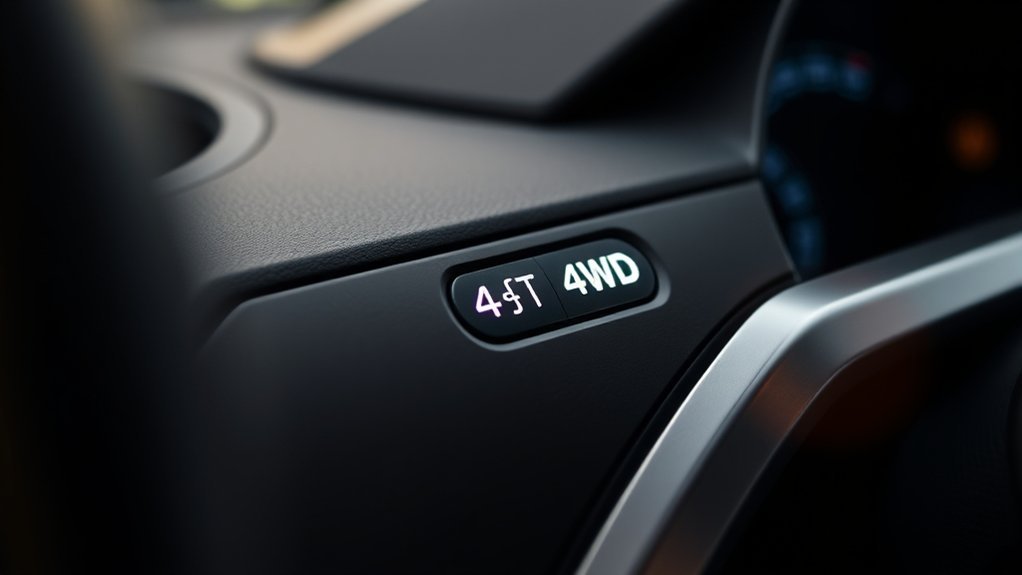
Many RAV4 owners find themselves confused about the vehicle’s 4WD capabilities, often due to misconceptions and the way terms like “4WD” and “AWD” are marketed. Understanding what your Toyota RAV4 can do is essential for effective driving, especially in challenging conditions. Here are some key points:
- The RAV4 primarily operates in front-wheel drive (FWD) unless you engage 4WD.
- 4WD lock can only be activated at speeds below 25 MPH.
- Unlike full-time AWD, RAV4’s part-time system kicks in automatically when slippage is detected.
- Many owners mistakenly equate “4WD” with full-time AWD, adding to the confusion.
Frequently Asked Questions
How to Tell if RAV4 Is 4WD?
To tell if your RAV4’s 4WD, check for 4WD indicators on the dashboard, inspect for a rear differential, and look for a solid driveshaft. These features confirm your vehicle’s capable 4WD system.
How Do I Turn on 4WD in My RAV4?
To turn on 4WD in your RAV4, press the 4WD lock button or adjust the RAV4 settings via the mode wheel. Check the 4WD indicators on your display to confirm it’s engaged properly.
Is the RAV4 Always in 4 Wheel Drive?
No, your RAV4 isn’t always in four-wheel drive. It primarily uses front-wheel drive, activating all-wheel drive only when needed. This drivetrain optimizes fuel efficiency while providing traction when conditions get slippery.
How Do You Tell if Your Car Is 4 Wheel Drive or Not?
To uncover your vehicle’s hidden strengths, check for 4WD indicators like a solid driveshaft or a rear differential. Dig into your paperwork and VIN to reveal the true drivetrain type, revealing your car’s potential.
Conclusion
So, there you have it—knowing whether your Toyota RAV4 is in 4WD doesn’t have to be rocket science. Just remember, if you’re not tearing up the trails or getting stuck in the snow, you might not need it anyway. But hey, who wouldn’t want to feel like an off-road hero on their daily commute? Just don’t forget to check those indicators, or you might end up in a mud pit, wondering why you’re not in 4WD after all!