Pick a 12V inflator if you need portability and roadside fixes. It’s compact, plugs into your vehicle, and handles quick top-ups. Choose 120V for garage or RV use when you want faster fills, continuous runtime, and higher CFM for larger tires. Battery models trade portability for limited run time and recharge needs. Watch duty cycle, gauge accuracy, and hose fittings when you buy, and keep thermal protection in mind for heavy use. More details follow.
Quick Answer: When to Choose 12V vs 120V Tire Inflators
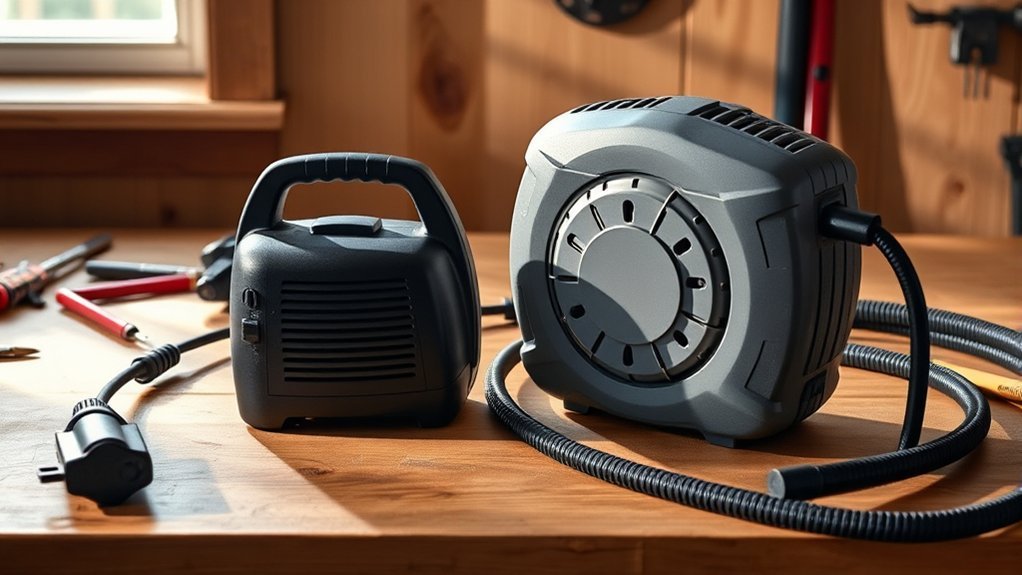
Need a portable solution or a faster, more powerful one? Pick a 12V tire inflator when mobility and immediate roadside readiness matter. It plugs into your vehicle’s power outlet so you can inflate on the spot without hauling extension cords.
Choose a 120V tire inflator when speed, continuous runtime, and higher output matter. Wall power lets it fill larger volumes faster and handle repeated use without overheating.
If you want the flexibility to work both on the road and at home, a combo 12V/120V unit gives both: vehicle-ready portability plus wall-powered efficiency.
Keep the limits in mind: 12V units can overheat under long cycles and are slower for high-volume tasks, while 120V units need an AC outlet but can run indefinitely. Match your choice to your operating environment and workload. Grab the portable 12V for roadside emergencies, the 120V for garage throughput, or the combo when you need both.
Match Inflator to Use: Roadside, Garage, RV, Bike
When you’re choosing an inflator, match its power source and size to where and how you’ll use it. 12V units give lightweight, vehicle-powered portability for roadside emergencies and on-the-go bike repairs. 120V models deliver faster, higher-volume inflation and unlimited runtime for garage work and RV tires.
For roadside use, 12V tire inflators are the practical choice. They plug into your vehicle, stay compact in a trunk, and get you back on the road without wall power. In a garage, 120V inflators excel. Higher flow rates and continuous runtime let you top off truck and car tires quickly and repeatedly.
RV owners benefit most from 120V inflators too, since multiple high-volume tires demand sustained pressure and endurance. For cyclists, portable 12V inflators combine minimal weight and on-the-go access, making quick fixes mid-ride easy. Match capability to task: prioritize portability for mobility, and power plus volume for stationary, heavy-duty inflation.
Power Options Explained: Battery, 12V DC, and 120V AC
Weigh portable battery pros and cons by balancing runtime, inflation speed, and emergency readiness against capacity for repeated use. Compare vehicle 12V models to 120V units by checking available power, inflation time, and whether you need on-the-road convenience or garage-grade performance. Use the runtime and output requirements of your typical tasks to pick the right power option.
Portable Battery Pros/Cons
Cordless inflators give you unmatched portability for roadside emergencies and remote jobs. But performance depends heavily on the power source. Battery packs deliver true mobility yet vary widely in speed. Built-in rechargeable units are convenient but often slow (1:16 to 3+ minutes per tire). 12V DC from a vehicle is reliable, though typically slower (~1:25.5). 120V AC offers the best speed and unlimited runtime for larger or multiple tires.
Portable battery pros: battery-powered inflators free you from cords and outlets, letting you carry an effective air compressor wherever you go. High-voltage batteries (18V+) can inflate quickly, supporting rapid roadside fixes. Cons: onboard rechargeable units often sacrifice power for size, stretching inflation time and limiting back-to-back uses. You’ll still want a 12V DC inflator or AC setup for heavier, repeated tasks.
Vehicle 12V vs 120V
If you need true roadside portability, 12V DC inflators plug into your vehicle’s power outlet and get you moving again without external power. The trade-off is speed and sustained output compared to 120V AC units. Choose 12V when mobility and independence matter; just expect longer inflation times due to limited flow.
120V suits home use and repetitive tasks with faster, sustained power. 18V battery tools sit between the two: fast, but dependent on charge level. Assess your needs and decide between freedom to move and high throughput. Below is a compact comparison to clarify power supply trade-offs for tire inflators.
| Feature | Note |
|---|---|
| Portability | 12V: vehicle-only |
| Speed | 120V: fastest |
| Runtime | 12V limited, 120V unlimited |
| Maintenance | 18V batteries need charging |
Inflation Speed & Performance (CFM, PSI, Example Fill Times)
Balance airflow (CFM) with maximum pressure (PSI). High CFM moves volume fast, while high PSI lets you reach truck and RV pressures. In real-world terms, a 120V unit typically beats a 12V on fill time (~31.7 s vs 1:25.5 for a car tire). High-performance 18V batteries can be even quicker (~26.7 to 29.2 s), but they need charging between sessions. Compare CFM and rated PSI against your tire size and target pressure to predict actual fill times.
Airflow vs Pressure
When speed and sustained pressure matter, choose an inflator based on its CFM (cubic feet per minute of airflow) and maximum PSI (pounds per square inch of pressure). 120V models deliver higher CFM and often exceed 100 PSI for rapid fills and heavy-duty use. 12V units provide lower CFM and typically top out near 65 PSI, making them slower and better suited for occasional roadside inflation.
Prioritize airflow for fast recovery and repeated cycles. 120V compressors push more air per minute, shortening fills and handling larger tires. Prioritize pressure capability when you need sustained high PSI. 120V units maintain higher pressure without overheating. A 12V inflator tied to a vehicle battery will work in a pinch, but expect longer runs and limited maximum pressure. Choose based on task intensity.
Real-World Fill Times
Performance varies by power source and design, but real-world fill times give the clearest picture of what to expect. Here are some measured examples:
- 18V battery inflators are typically the fastest at ~26.7 to 29.2 seconds per tire. A good battery inflator can beat many small power tools for quick roadside inflation.
- 12V options vary: direct battery connection hits about 31.7 s, while a cigarette lighter outlet can stretch to 1 m 25.5 s. Models like the VIAIR 400P need a direct battery hookup for their high amp draw (30A) but deliver up to 150 PSI.
- 120V and high-capacity rechargeable units fill larger tires in under 1 minute (120V is best for high-volume tasks). Some built-in batteries can take over 3 minutes.
Use these times to match gear to your actual needs.
Will It Keep Up? Overheating, Duty Cycle, and Tank vs No-Tank
12V inflators draw heavy current from a vehicle’s outlet, so they can heat up quickly and hit their duty cycle limits. Match unit amperage and run time to the job. 120V models run cooler and can operate continuously on proper mains power. Units with internal tanks deliver steadier pressure for multiple tires, while tankless designs may struggle under extended or high-volume use.
Assess overheating risk and duty cycle ratings before you buy. Small 12V units often have short duty cycles (for example, the VIAIR 400P has a 33% duty cycle at 100 PSI) to prevent motor damage. They’re best for occasional or emergency use. If you need to service several tires or large ATV/truck tires, choose a 120V inflator or a 12V model with a substantial tank.
Also confirm your vehicle’s outlet amperage. Undersized circuits will speed up overheating and cut performance. Look for systems that sustain pressure delivery so you can work fast without stalled compressors.
Noise Levels: What to Expect
Noise output varies a lot between inflator types. Most 12V portable inflators run between 80 and 100 dBA, which is loud enough to need hearing protection during extended use. Smaller battery-powered units are often quieter, typically in the 75 to 90 dBA range.
120V compressors, especially older piston models, can be among the loudest at 85 to 95 dBA. Newer “quiet” models have improved significantly though. The DEWALT DWFP55130, for example, runs at just 71.5 dBA, roughly the volume of a normal conversation.
If you plan to inflate tires in a shared garage, driveway, or campsite, check the decibel rating before you buy. Anything below 75 dBA is manageable without ear protection.
Key Features: Gauges, Auto-Shutoff, Hoses & Adapters
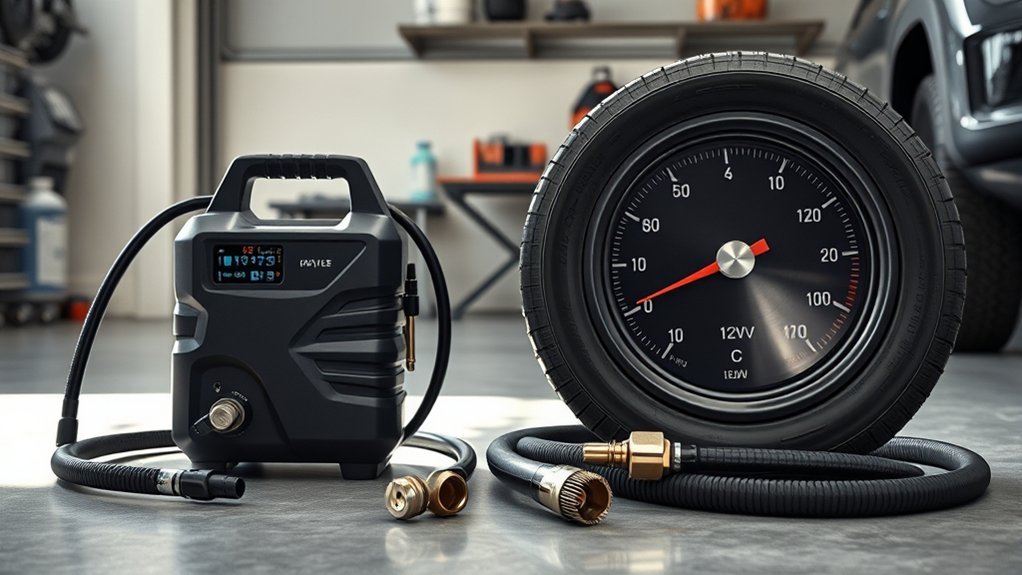
After you’ve matched capacity and duty cycle to the job, check the user-facing controls and fittings. Accurate gauges, reliable auto-shutoff, and well-made hoses/adapters determine how quickly and safely you can inflate tires. Verify gauge accuracy against a reference tool, or choose inflators with calibrated digital readouts. Auto-shutoff saves time and prevents over-inflation. Prefer units with repeatable, configurable cutoffs and clear status indicators.
- Gauge fidelity: real-time pressure reporting is essential. Low-quality gauges create wasted trips and risk.
- Auto-shutoff behavior: look for digital control with repeatable stopping, plus manual override for edge cases.
- Hoses & adapters: choose durable, kink-resistant hoses and a set of adapters that fit Schrader, Presta, and common inflatables. Longer hoses help with access on larger vehicles.
Inspect fittings and seals for leak-free performance. Prioritize components that let you work confidently and efficiently.
Long-Term Cost & Maintenance (Batteries, Repairs, Lifespan)
When you factor long-term costs into your inflator choice, batteries and repairability often dominate the total ownership expense. High-performance lithium packs typically need replacement after 3 to 5 years at $50 to $100 each. That recurring cost, plus the risk of getting locked into a single battery ecosystem, can quickly exceed the upfront price.
Budget for battery replacements if you pick a cordless 12V model. Those costs compound when manufacturers push proprietary packs. Compare that to a 120V inflator: with a direct power source and robust build, long-term maintenance costs stay low, and durability usually outlasts many cordless options.
If you want predictable expenses, factor in repairs, warranty terms, and availability of service parts when calculating total cost of ownership. Inspect seals, motor brushes, and hoses for serviceability. Choose models with modular batteries or accessible components to minimize repair bills.
Best Picks by Use Case and Budget
Anyone outfitting a car kit, garage, or work van should match an inflator to their typical use case and budget. Pick a portable 12V like the Viair 400P for roadside emergencies. Choose a 120V unit such as the DEWALT DWFP55130 for fast at-home inflation. Or grab a combo 12V/120V model for maximum flexibility. Budget buyers can get reliable performance from the Black & Decker Air Station (~$60). Midrange cordless options like the Ryobi One+ (~$100) suit occasional cordless needs. Heavy users should invest in a durable 120V pancake compressor to handle larger tires and frequent use.
- Roadside & minimal gear: choose a 12V portable tire inflator (Viair 400P), light and quick.
- Home & frequent use: prefer 120V compressors (DEWALT or pancake), higher flow, less runtime concern.
- Versatility & budget-conscious shoppers: opt for combo units or entry-level Black & Decker (~$60) or midrange Ryobi One+ (~$100) for cordless convenience without overspending.
Match power, duty cycle, and price to how you actually use your inflator.
Safety Tips & Final Buying Checklist
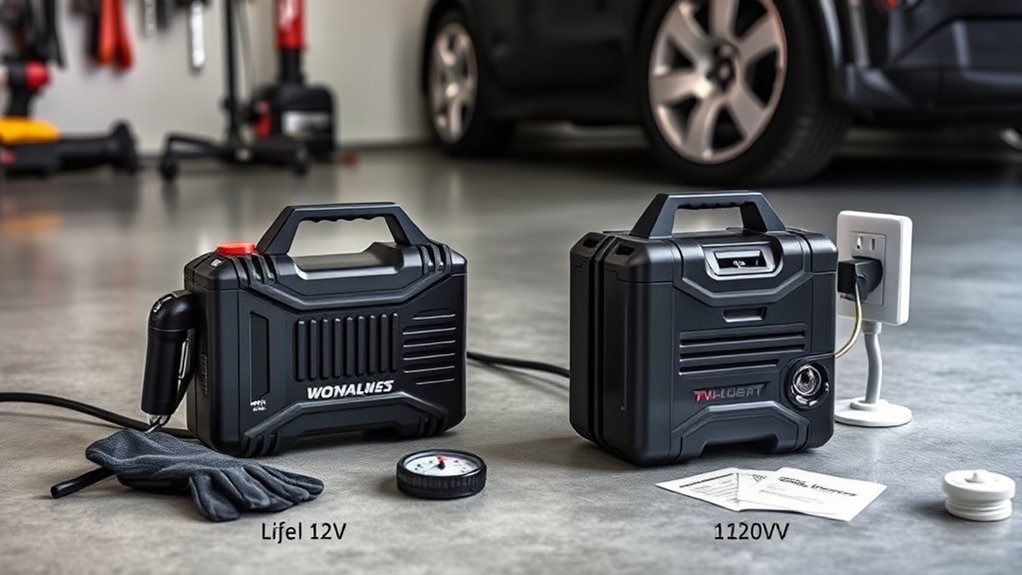
Tire inflation can cause sudden failure if done improperly. Always inspect the tire for cuts, bulges, or embedded objects and confirm the manufacturer’s recommended pressure before adding air. Verify tire pressure with a manual gauge as a cross-check, keep cords and power sources dry and clear, and if you use a 12V inflator, run the engine to avoid draining the battery. For a flat tire, prioritize safe roadside positioning and wear visible clothing.
Final buying checklist:
- Choose reliable air compressors with accurate gauges.
- Confirm port and connector compatibility with your vehicle.
- Prefer units with thermal and overpressure protection.
| Item | Check | Action |
|---|---|---|
| Gauge accuracy | Manual + built-in | Verify before use |
| Power type | 12V vs 120V | Match use case |
| Storage & maintenance | Cool, dry | Inspect periodically |
Buy for durability and reliability. The right inflator keeps you moving.
Frequently Asked Questions
What Is the Difference Between a 12V and 120V Tire Inflator?
A 12V inflator runs off your vehicle’s power outlet. It’s portable and great for emergencies, but slower and lower in output. A 120V inflator plugs into a wall outlet, delivering faster, more powerful inflation with continuous operation. It’s better suited for garage use and larger tires.
How Strong Should a Portable Tire Inflator Be?
Look for at least 100 PSI capacity, fast inflation speed, reliable pressure accuracy, and solid build quality for repeated use. Choose units that won’t overheat, include auto-shutoff, and match the tire sizes you’ll typically inflate.
How Many Volts Do You Need to Inflate a Car Tire?
You can inflate a car tire with either 12V or 120V, depending on your power source. Both reach the required pressure. The difference comes down to inflation time and convenience: 12V is portable, 120V is faster.
Which Is Better, Cordless or Corded Tire Inflator?
Cordless wins for on-the-go emergencies and convenience, but corded excels for frequent, heavy-duty use. Weigh battery life and portability against reliable, sustained power. Pick cordless for mobile independence or corded for steady, high-output inflation.
Conclusion
Pick the power option that fits how and where you’ll inflate. 12V for fast roadside fixes and RV trips. 120V for quicker, cooler garage work and heavy loads. Don’t overthink features. Prioritize true CFM/PSI performance, a realistic duty cycle, and a reliable gauge. Expect modest maintenance: batteries, brushes, hoses. One good inflator won’t solve every job, but the right choice will save you time, money, and flat-tire headaches for years to come.