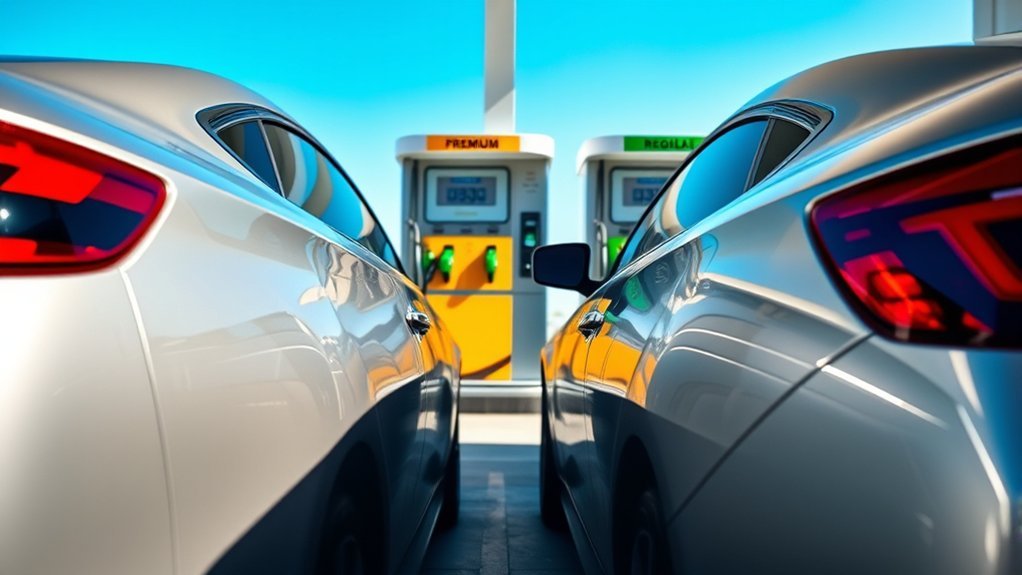
When deciding between premium and regular fuel, consider performance, cost, and your vehicle’s requirements. Premium fuel, with a higher octane rating, benefits high-performance and turbocharged engines, enhancing efficiency and preventing engine knock. However, using premium in vehicles designed for regular fuel can be a waste, costing you around $354 annually without noticeable gains. Regular gasoline efficiently meets standard vehicle needs, maximizing savings. Understanding these distinctions helps you choose wisely, and there’s more to learn about fuel compatibility and engine health.
Benefits and Limitations of Premium Gas

When considering whether to use premium gas, it’s essential to weigh its benefits against its limitations. Premium gas, with an octane rating of 91 or higher, excels in high-performance engines with high compression ratios, providing better stability against engine knock. This can enhance both engine performance and fuel efficiency in turbocharged vehicles. However, if your car’s manufacturer recommends regular gasoline, typically rated at 87 octane, using premium fuel may not yield significant benefits. You might end up spending an additional $354 annually without noticeable improvements. While using premium gas in a vehicle designed for regular fuel isn’t harmful, it often results in financial waste. Conversely, consistently using regular gas in high-performance vehicles can strain the engine and lead to long-term damage. Ultimately, adhering to manufacturer recommendations is essential for best performance and longevity.
The Role of Regular Gas in Everyday Vehicles
Regular gas, with its octane rating of 87, is engineered to meet the needs of most standard vehicles, ensuring compatibility without performance loss. When you choose regular gas, you benefit from a significant cost advantage, averaging $3.07 per gallon compared to premium options. For everyday driving, regular gasoline efficiently supports your vehicle’s engine specifications while also maximizing savings over time.
Regular Gas Advantages
Most vehicles on the road today operate efficiently using regular gas, which boasts an octane rating of 87. This type of fuel is designed for standard engines, allowing for ideal performance without the added cost of premium options. As an owner, you’ll appreciate the significant savings; filling a 15-gallon tank with regular gas can save you approximately $12.45 compared to premium fuel. Regular gas works effectively with lower compression engines, ensuring smooth operation without the risk of engine knocking. Additionally, mainstream models, including popular sedans and compact cars, typically don’t experience noticeable performance enhancements when using higher octane fuel. Consequently, for everyday driving, regular gas is often the most practical and economical choice for vehicle owners.
Compatibility With Standard Engines
Although many vehicles are engineered to perform ideally with regular gas, understanding this compatibility is crucial for maintaining engine health and performance. Regular gasoline, with an octane rating of 87, suffices for most standard engines, ensuring efficient operation without the need for premium fuel. If you drive a car that requires premium, using regular can lead to engine strain, reduced performance, and potential engine damage from knocking. Always consult your owner’s manual for the manufacturer’s recommendations on fuel type, as it’s designed to optimize your engine performance and longevity. Embracing regular gasoline in compatible vehicles allows you to enjoy a seamless driving experience while safeguarding your engine’s integrity.
Cost-Effectiveness Over Time
Choosing the right fuel can greatly impact your wallet over time, especially when it comes to everyday vehicles. Regular gasoline, with an octane rating of 87, offers considerable cost-effectiveness compared to premium gas, averaging $3.07 per gallon versus $3.90. By opting for regular, you can save up to $354 annually, based on driving 15,000 miles in a vehicle that achieves 25 mpg. Most standard engines, including those from Honda and Toyota, perform best on regular fuel, rendering unnecessary premium fuel a financial waste without enhancing performance and fuel economy. Consistently using the appropriate fuel type enables long-term savings, as the costs of premium gas can accumulate greatly over time, providing no real benefits for vehicles designed for regular gasoline.
How Premium Fuel Compares to Regular in Performance
When comparing premium fuel to regular, consider its superior engine knock resistance due to higher octane ratings. This quality can translate into fuel efficiency gains, particularly in high-performance vehicles designed for premium use. However, the benefits vary considerably based on your vehicle’s specific requirements and design.
Engine Knock Resistance
Premium fuel’s higher octane rating, typically ranging from 91 to 94, greatly enhances engine knock resistance compared to regular fuel’s 87 octane. This increased resistance is vital for high-compression engines that demand peak performance. Utilizing premium fuel allows these engines to operate more efficiently, reducing the risk of engine knock, which can cause significant damage over time.
- Premium fuel supports aggressive tuning and higher compression ratios.
- Engine knock can lead to costly repairs if not managed.
- Vehicles designed for premium fuel leverage advanced technologies, maximizing performance.
Fuel Efficiency Gains
While many drivers seek enhanced performance and efficiency from their vehicles, the benefits of premium fuel regarding fuel efficiency can vary considerably depending on the engine’s design. For high-performance vehicles engineered for higher octane levels, premium fuel can yield slight gains in fuel efficiency. For instance, a Honda CR-V showed a 1% increase in mpg when switching from regular gas to premium. However, standard engines, like the Dodge Charger R/T, often demonstrate negligible differences in performance metrics between fuel types. Notably, a BMW M5 exhibited a minor fuel economy advantage with lower-octane fuel but realized substantial performance improvements with premium gasoline. Ultimately, premium fuel’s impact on efficiency is minimal for many standard vehicles designed for regular gas.
Vehicle-Specific Performance Benefits
The performance benefits of premium fuel can be significant for vehicles specifically engineered to take advantage of higher octane ratings. For instance, high-compression or turbocharged engines like those in the BMW M5 and Ford F-150 can experience notable performance improvements, such as increased horsepower and quicker acceleration times. However, not all vehicles derive the same advantages:
- Vehicles designed for premium fuel can perform better regarding horsepower.
- Regular gasoline may lead to engine strain and long-term damage in high-performance engines.
- Mixing fuels is generally acceptable without immediate negative impacts.
In essence, while premium fuel enhances performance in certain vehicles, others, like the Dodge Charger R/T, show minimal differences, emphasizing the importance of vehicle-specific fuel choices.
Which Vehicles Need Premium Gas?
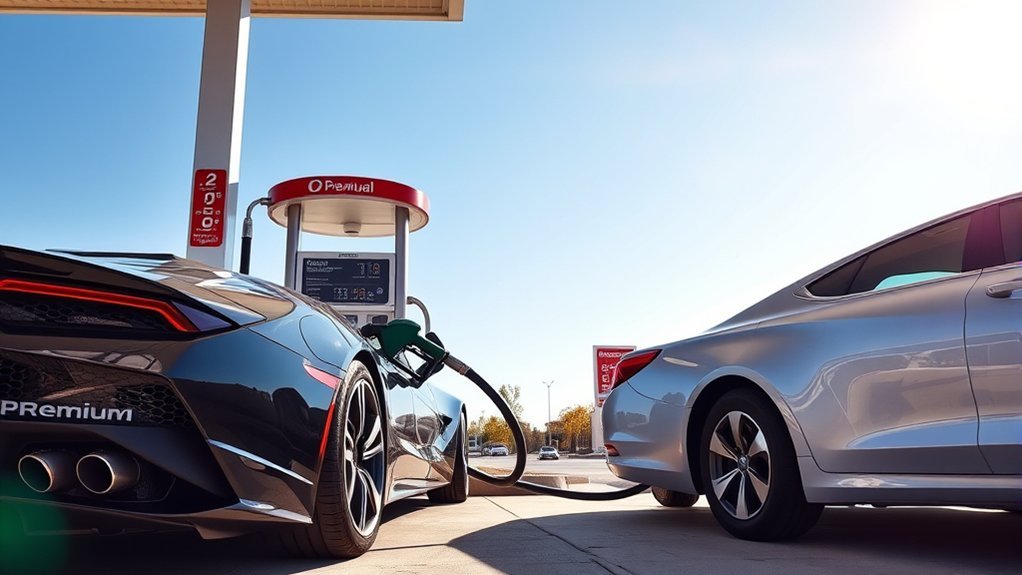
Certain vehicles require premium gas to achieve peak performance and efficiency, particularly those equipped with high-performance or high-compression engines. Turbocharged models like the Chevrolet Camaro, Subaru WRX, and Toyota Supra are designed to operate at an ideal level with premium fuel, as their engine specifications often mandate a minimum octane rating of 91 or 93. Luxury vehicles, such as the Audi A3, Cadillac XT5, and Range Rover Sport, also necessitate premium gas to uphold their performance standards and maintain engine efficiency. While some cars may only recommend premium fuel for enhanced performance, using regular gas can lead to long-term engine strain. Always consult your vehicle’s owner’s manual to determine if your car requires premium fuel or if it’s just a recommendation. Choosing the right fuel type is essential for preserving engine health and ensuring that your vehicle delivers the performance you expect.
Should You Pay More for Premium Gas?
Is it worth paying more for premium gas? The answer largely depends on your vehicle’s specifications and your financial priorities. If your owner’s manual recommends premium fuel, you may experience improved performance in turbocharged or high-compression engines. However, for most standard vehicles, regular gasoline suffices.
- Premium gas costs about $0.59 more per gallon, leading to a potential annual surcharge of $354 for average drivers.
- Using premium fuel in cars designed for regular gas doesn’t enhance performance and is often a financial waste.
- Always consult your owner’s manual to understand the appropriate fuel grade for your engine.
What Happens When You Mix Premium and Regular Fuels?
How does mixing premium and regular fuels impact your vehicle’s performance? When you mix premium and regular gasoline, you’re effectively creating an octane rating that’s an average of both fuels. This can still meet the requirements of vehicles designed for regular gasoline, but performance issues may arise in high-requirement engines if consistently using lower octane fuel. Engine knock, or pre-ignition, can occur when these vehicles demand higher octane gasoline but are supplied with regular.
For cars optimized for regular gasoline, using premium fuel doesn’t enhance performance; in fact, it often yields no significant benefits. While mixing fuels isn’t immediately harmful, it’s essential to weigh the long-term implications on engine health. If your vehicle requires higher octane, sticking to premium is advisable. Otherwise, the blend of premium and regular may suffice, keeping performance stable without unnecessary expense.
Frequently Asked Questions
Is There a Downside to Using Premium Gas?
Using premium gas isn’t cost-efficient for your vehicle unless it specifically requires it. You’ll likely see no real benefits in engine performance or fuel economy, risking long-term effects like carbon buildup due to compatibility issues.
What Happens if You Put 93 Octane in an 87 Octane Car?
Putting 93 octane in an 87 octane car won’t harm your engine, as modern engines handle various octane ratings. However, you’ll likely miss potential cost benefits without noticeable improvements in fuel performance or fuel economy.
Is There Really a Difference Between Regular Plus and Premium Gas?
Is there really a difference? Absolutely! Octane ratings impact engine performance and fuel efficiency. While premium may enhance driving conditions, a cost analysis often shows regular suffices, especially when following manufacturer recommendations and considering necessary fuel additives.
What Happens if I Put 91 Instead of 95?
If you put 91 instead of 95, your engine performance may decline due to lower octane rating, affecting combustion quality and fuel efficiency. Long-term effects could include damage, impacting vehicle compatibility and overall cost comparison.
Conclusion
In the end, choosing between premium and regular fuel is like selecting the right tool for a job. Just as a chef uses a sharp knife for precision, some vehicles thrive on premium gas for peak performance. However, if your car’s engine isn’t designed for it, premium fuel might be overkill, leading to unnecessary expenses. Ultimately, understanding your vehicle’s needs guarantees you’re fueling efficiently without wasting money on something it doesn’t require.