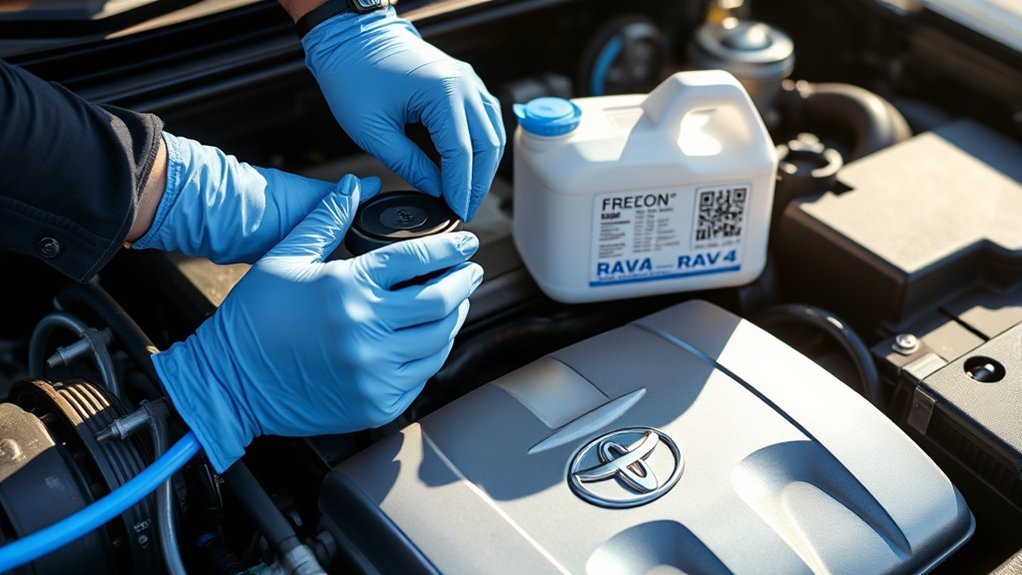
How to Refill Your Toyota RAV4 AC Refrigerant Safely
A weak Toyota RAV4 air conditioner can make every drive feel longer, but low refrigerant is not always the only cause. Before you add AC refrigerant, you need to confirm the correct refrigerant type, check for leaks, and avoid overcharging the system. This guide explains how to check the low-side port, connect a recharge hose, read the gauge, and know when a professional AC service is the safer choice.
What’s in This Article
- How to Refill Your Toyota RAV4 AC Refrigerant
- Before You Begin: RAV4 AC Recharge Safety
- What You’ll Need for a RAV4 AC Recharge
- Key Facts About AC Refrigerant for Your RAV4
- Locating the Low-Side AC Service Port on Your RAV4
- Preparing Your Vehicle for Refrigerant Refill
- Step-by-Step Guide to Connecting the Refrigerant Hose
- Monitor AC Pressure While Refilling
- How to Add AC Refrigerant Correctly
- Checking Air Temperature for Optimal AC Performance
- Common Mistakes to Avoid During a RAV4 AC Recharge
- What to Do After You’ve Refilled the AC?
- Frequently Asked Questions
- Safety Disclaimer
- Conclusion
Quick Answer
To add refrigerant to your Toyota RAV4, first check the under-hood AC label for the correct refrigerant type and charge amount. Many older RAV4 models use R-134a, while newer models may use R-1234yf. Connect the recharge hose only to the low-side service port, run the AC on max cool, and add refrigerant slowly while watching the gauge. Stop if the system is empty, leaking, overpressurized, or still not cooling.
Key Takeaways
- Check the under-hood label before adding refrigerant because RAV4 refrigerant type and capacity vary by model year.
- Use only the low-side AC service port when adding refrigerant from a DIY recharge hose.
- Add refrigerant slowly while the engine runs and the AC stays on the coldest setting.
- Do not rely on a single pressure number because correct pressure depends on outside temperature and system condition.
- Stop and get professional service if the AC system reads empty, leaks, or still blows warm air after charging.
How to Refill Your Toyota RAV4 AC Refrigerant
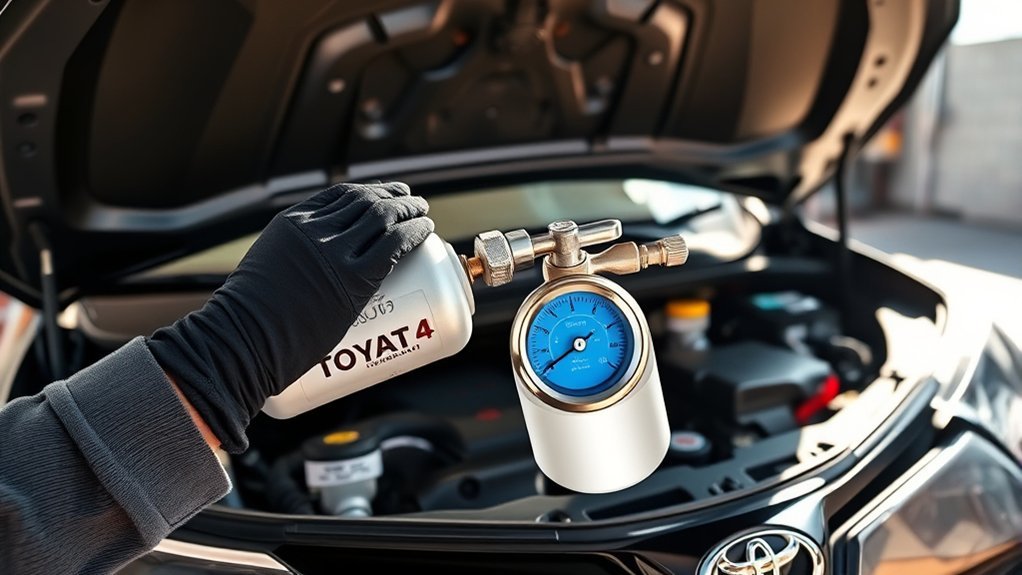
To refill your Toyota RAV4’s AC refrigerant, first check the label under the hood. That label tells you the correct refrigerant type and total system charge for your exact model. Do not assume every RAV4 uses R-134a refrigerant.
Next, locate the low-side AC service port. You’ll usually find it on the larger refrigerant line. Remove the dust cap, then connect the recharge hose with the engine off.
Start your RAV4 and set the air conditioning to max cool with the fan on high. Add refrigerant in short bursts while you monitor the pressure gauge and center vent temperature. Avoid filling past the safe range shown on your recharge gauge or the vehicle label.
Warning: If the system reads empty, do not keep adding refrigerant because the AC system may have a leak.
After filling, disconnect the hose and secure the dust cap. Check whether the center vent blows colder air. If the cooling still feels weak, your RAV4 may need leak testing, vacuum service, compressor checks, or a full professional recharge.
Before You Begin: RAV4 AC Recharge Safety
Estimated total time: 20 to 40 minutes if the system only needs a small top-off.
AC refrigerant can injure your skin or eyes, and an overcharged system can damage AC parts. Wear safety glasses and gloves before you handle a recharge can. Work in a well-ventilated area and keep the can away from heat.
You should not recharge a system that has lost all pressure. A fully empty system needs leak repair, air removal with a vacuum pump, and the correct refrigerant weight. A quick can top-off cannot fix that problem.
What You’ll Need for a RAV4 AC Recharge
Gather the right tools before you start. This helps you avoid wrong readings, unsafe handling, and wasted refrigerant.
- Safety glasses and gloves
- Correct refrigerant listed on your under-hood AC label
- Recharge hose with a low-side pressure gauge
- Vent thermometer
- Clean rag for wiping the service port area
- Your RAV4 owner’s manual or under-hood AC label
Some recharge cans include additives or sealers. Avoid leak sealer unless a qualified technician recommends it. Sealers can clog AC service equipment and may make later repairs harder.
Key Facts About AC Refrigerant for Your RAV4
What should you know before adding refrigerant to your Toyota RAV4? Your AC system needs the correct refrigerant type, the right charge amount, and a sealed system.
- Refrigerant type: Check the under-hood label first. Older RAV4 models commonly use R-134a, while newer models may use R-1234yf.
- Charge capacity: Use the capacity printed on the AC label. The correct amount can vary by model year, engine, and AC system.
- System condition: Low refrigerant often means a leak. A top-off may cool the cabin for a short time, but it will not repair the leak.
After refilling, check the air temperature from the center vents. Cool output often falls near the 40°F to 50°F range in good conditions, but outside heat, humidity, and fan speed can affect the reading.
Locating the Low-Side AC Service Port on Your RAV4
Locating the low-side AC service port matters because DIY recharge hoses fit only that port. You’ll usually find it on the larger refrigerant line between the evaporator and compressor. The cap may show an “L,” but cap colors can vary.
Wipe dirt from the area before you remove the cap. Twist the cap counterclockwise and place it somewhere safe. Dirt inside the port can affect the valve seal.
Connect the refrigerant hose to the low-side port with the engine off. Push the coupler on firmly until it locks. Tug it gently to confirm it sits securely before you start the engine.
Preparing Your Vehicle for Refrigerant Refill

Before you start the refrigerant refill, park your RAV4 on level ground. Set the parking brake and keep the hood open. Keep loose clothing away from belts, fans, and hot engine parts.
Gather Necessary Tools
To refill the AC refrigerant in your Toyota RAV4, gather your safety gear and charging tools first. You’ll need:
- Correct refrigerant: Match the refrigerant type printed on your under-hood label.
- Recharge hose: Use a hose designed for the refrigerant type in your RAV4.
- Pressure gauge: Use a gauge that shows a safe range for the outside temperature.
Keep a thermometer ready so you can check the center vent temperature. Review the under-hood sticker before you add any refrigerant.
Ensure Engine Off
Keep the engine off while you connect the recharge hose. This lowers the risk of injury while you work near moving parts. It also gives you time to confirm that the coupler locks onto the correct port.
You usually do not need to disconnect the battery for a basic hose connection. Instead, keep your hands clear of belts, pulleys, and fans. Start the engine only after the hose sits firmly on the low-side port.
Locate AC Ports
Your RAV4 has a low-side port and a high-side port. DIY recharge hoses should connect only to the low-side port.
- Find the low-side port: Look for the larger AC line and the service cap marked “L” when present.
- Identify the high-side port: Look for the smaller AC line, which may have a cap marked “H.”
- Remove only the low-side cap: Use the low-side port for a standard recharge hose.
Do not force the coupler onto any port. If it does not fit, stop and recheck the refrigerant type and port location.
Step-by-Step Guide to Connecting the Refrigerant Hose
Before you connect the refrigerant hose, confirm that you found the low-side AC port. This port sits on the larger AC line. Wear gloves and safety glasses before you handle the coupler or refrigerant can.
- Turn off the engine. Keep your hands away from belts, fans, and hot parts.
- Remove the low-side cap. Place the cap where dirt cannot stick to it.
- Attach the hose coupler. Push it onto the low-side port until it locks.
- Check the connection. Tug the hose lightly to confirm it stays attached.
- Start the RAV4. Set the AC to max cool and the fan to high.
Once the hose sits securely, read the gauge before you add refrigerant. A very low or zero reading can point to a leak or an empty system.
Monitor AC Pressure While Refilling
Once you’ve connected the refrigerant hose to the low-side port, watch the gauge closely. The correct low-side pressure depends on outside temperature, humidity, and system condition. Do not treat one pressure number as correct for every RAV4.
- Check the gauge before adding refrigerant.
- Add refrigerant in short bursts, not one long flow.
- Pause often so the system pressure can stabilize.
- Compare the gauge reading with the recharge kit chart.
- Stop if the pressure climbs too high or the air does not get colder.
Many recharge gauges show a color-coded range for the current outside temperature. Stay within the correct range for your kit and vehicle label. Too much refrigerant can reduce cooling and damage expensive AC parts.
Note: A gauge reading alone cannot confirm the exact refrigerant weight inside the AC system.
How to Add AC Refrigerant Correctly

To add AC refrigerant correctly, start by matching the refrigerant can to your RAV4’s under-hood label. Do not mix R-134a with R-1234yf. The fittings, oil, and service needs differ by refrigerant type.
- Set the AC to max cool. Turn the fan to high and open the doors or windows.
- Hold the can as directed. Follow the recharge kit instructions for can position and flow.
- Add refrigerant slowly. Use short bursts and pause between each burst.
- Watch the gauge. Stop before the pressure enters an unsafe range.
- Check vent temperature. Use a thermometer in the center vent.
When you finish, close the valve on the hose if your kit has one. Disconnect the coupler from the low-side port. Replace the dust cap tightly because it helps protect the service valve.
Checking Air Temperature for Optimal AC Performance
To check your Toyota RAV4’s AC performance, place a thermometer in the center vent. Run the AC on the coldest setting with the fan on high. Give the system a few minutes to stabilize.
Ideal Air Temperature Range
A healthy AC system should blow clearly colder air than the cabin air. In mild to warm weather, many systems can reach about 40°F to 50°F at the center vent. Very hot or humid weather can raise that number.
- Use a thermometer: Place it in the center vent for a direct reading.
- Watch the trend: The temperature should drop after the compressor starts working.
- Let it stabilize: Wait a few minutes before you judge the final vent temperature.
If the vent temperature stays warm, do not keep adding refrigerant. Your RAV4 may have a leak, weak compressor, clogged cabin filter, bad blend door, or electrical problem.
Measuring Vent Temperature
Measuring the vent temperature helps you judge whether the air conditioning system responds to the recharge. Insert the thermometer into the center vent while the AC runs on max cool. Avoid holding the thermometer in direct sunlight.
A steady drop in vent temperature usually shows that refrigerant is circulating. If the temperature drops only briefly, then rises again, the system may still have a fault. Schedule service if cooling remains weak after a careful top-off.
Common Mistakes to Avoid During a RAV4 AC Recharge
Small mistakes can turn a simple recharge into an expensive repair. Avoid these common problems before, during, and after the refill.
- Do not add refrigerant without checking the under-hood label first.
- Do not connect a recharge hose to the high-side service port.
- Do not add refrigerant to a fully empty system without leak repair.
- Do not overcharge the system to chase colder vent temperatures.
- Do not use refrigerant with sealer unless a technician recommends it.
Stop the refill if the compressor does not cycle, the gauge behaves strangely, or you hear hissing near AC parts. Those signs can point to a larger AC system problem.
Pro tip: Take a photo of the under-hood AC label before buying refrigerant so you choose the right type.
What to Do After You’ve Refilled the AC?
After you’ve refilled the AC, check the gauge and vent temperature again. Your goal is steady cooling, not the highest possible pressure. Follow these steps before you close the hood.
- Run the AC for several minutes. Keep the system on max cool so refrigerant can circulate.
- Check the center vent. Confirm that the air gets colder and stays colder.
- Inspect the service port. Listen for leaks and check that the valve area stays clean.
- Secure the dust cap. Tighten it by hand to protect the valve from dirt.
Dispose of empty refrigerant cans according to local rules. If the AC loses cooling again soon, do not keep topping it off. A repeated low charge means the system needs leak diagnosis.
Frequently Asked Questions
What Refrigerant Does a Toyota RAV4 Use?
Your Toyota RAV4 may use R-134a or R-1234yf, depending on the model year and AC system. Check the under-hood AC label before you buy or add any refrigerant. Do not mix refrigerant types.
How Do I Tell if My AC Is Low on Refrigerant?
Your AC may be low on refrigerant if it blows warm air, cools only while driving, or cycles on and off often. You may also see oily residue near an AC hose, fitting, or condenser. These signs can also point to other AC faults, so pressure testing helps confirm the cause.
Why Is My Toyota RAV4 AC Not Blowing Cold Air?
Your Toyota RAV4’s AC may not blow cold air because of low refrigerant, a leak, a weak compressor, a clogged cabin air filter, or an electrical fault. Start with simple checks, such as the cabin filter and visible leaks. Get professional service if the system pressure looks wrong or the compressor does not engage.
How Much AC Refrigerant Does a RAV4 Need?
The correct AC charge depends on your RAV4’s model year, engine, and refrigerant type. Use the exact amount printed on the under-hood AC label. A professional shop can recover, vacuum, and recharge the system by weight for the most accurate result.
Can I Drive My RAV4 With Low AC Refrigerant?
You can usually drive the vehicle, but you should avoid running the AC if the system has very low pressure. Low refrigerant can reduce oil circulation inside the compressor. That can lead to more wear or compressor damage.
When Should I Get Professional AC Service?
Get professional AC service if the system is empty, the refrigerant leaks out again, or the gauge shows unsafe pressure. You should also get service if your RAV4 uses R-1234yf and you do not have the correct tools. A shop can test for leaks and recharge the system by exact weight.
Safety Disclaimer
Safety Disclaimer: This article is for informational purposes only and does not replace professional automotive service. AC refrigerant can cause injury and may require regulated handling. Consult a qualified technician if you’re unsure about the refrigerant type, system pressure, leaks, or charging process.
Conclusion
Refilling your Toyota RAV4’s AC system starts with one key step: confirm the correct refrigerant type and charge amount before you add anything. Use the low-side service port, add refrigerant slowly, and watch both the gauge and vent temperature. Stop if the system reads empty, leaks, or fails to cool after a careful top-off. When in doubt, choose professional AC service so your RAV4 stays cool without risking compressor damage.