Overinflated tires can make a vehicle feel stiff or skittish, reduce its ability to absorb pothole impacts, and cause uneven tread wear over time. The reliable way to confirm high pressure is to check each tire cold with a gauge and compare the reading with the vehicle manufacturer’s specification.
Quick Answer
A tire is overinflated when its cold pressure is higher than the specification on the vehicle’s door placard or in the owner’s manual. Check it after the vehicle has been parked for at least three hours, then release air in short bursts. Never lower a warm tire to the cold-pressure target.
Key Takeaways
- Use the cold PSI on the vehicle placard or in the owner’s manual, not the maximum pressure molded into the tire sidewall.
- A pressure increase after driving is normal and does not automatically mean the tire was overfilled.
- Common clues include a harsh ride, skittish handling, and long-term wear concentrated near the center of the tread.
- Front, rear, and spare-tire pressure specifications may be different.
- A gauge confirms overinflation. Appearance, ride feel, and tread wear alone cannot prove it.
At a Glance
| Time Required | About 5 to 10 minutes |
| Difficulty | Easy |
| Tools Needed | A reliable tire pressure gauge; an inflator is optional if too much air is released |
| Cost | Usually no additional cost if you already own a gauge |
What Overinflated Tires Are and Why Pressure Matters
A tire is overinflated when its pressure, measured cold, is higher than the pressure specified by the vehicle manufacturer for that tire position and load condition. The correct number is normally listed on the Tire and Loading Information Label in the driver’s door area or in the owner’s manual.
The number molded into the tire sidewall is different. It identifies the tire’s maximum cold inflation pressure at its stated load rating. It is not the routine operating target for every vehicle that can use that tire. The National Highway Traffic Safety Administration advises drivers to follow the vehicle placard instead.
Correct pressure helps the tire maintain the shape, load capacity, ride comfort, and handling characteristics intended by the vehicle manufacturer. Excess pressure can make the tire less compliant over bumps and may concentrate more loading near the center of the tread.
Note: “Cold” generally means the vehicle has been parked for at least three hours. A short drive creates heat that can raise the gauge reading by several PSI.
| Pressure State | Possible Long-Term Wear Clue | Possible Ride Feel | Best Action |
|---|---|---|---|
| Underinflated | Wear on both shoulders | Soft, heavy, or sluggish | Add air to the correct cold PSI |
| Correctly inflated | More even wear, assuming alignment and suspension are correct | Stable and predictable | Recheck monthly |
| Overinflated | Wear concentrated near the center | Harsh, bouncy, or skittish | Release air only after confirming a high cold reading |
5 Signs Your Tires May Be Overinflated
A pressure gauge gives the clearest answer. Ride quality, handling, and tread appearance can warn you that something is wrong, but none of them can confirm the exact PSI.
- A cold gauge reading above the placard specification. This is the most reliable sign. Check the correct value for each axle because the front and rear specifications may differ.
- A noticeably harsher ride. Cracks, expansion joints, and small bumps may feel sharper because a highly inflated tire has less compliance.
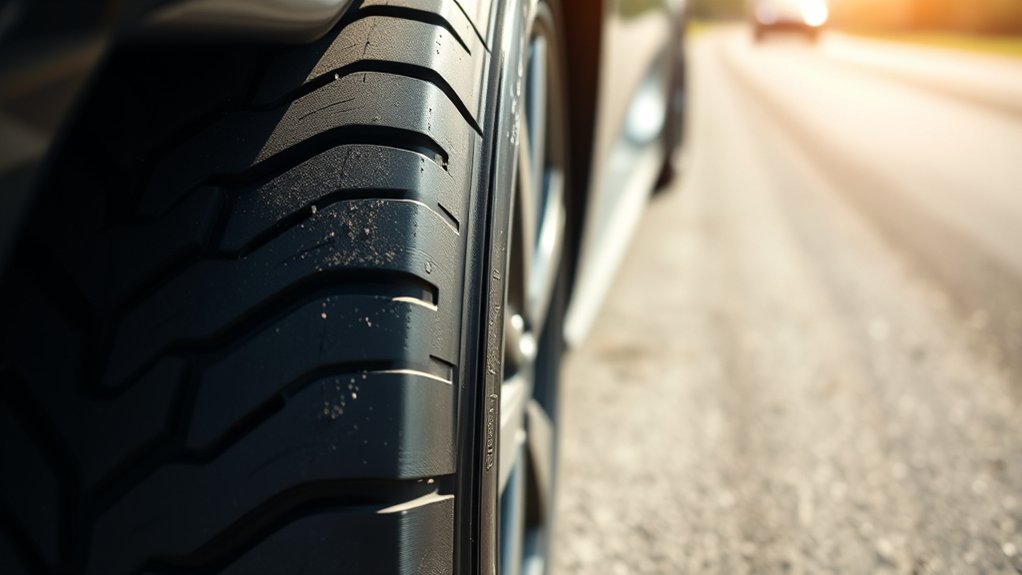
- Wear concentrated near the center of the tread. Chronic overinflation can make the center carry more of the load and wear faster.
- Skittish or less predictable handling. The vehicle may feel unusually sharp, bouncy, or unsettled during abrupt steering and on rough pavement.
- Greater sensitivity to pothole impacts. A tire with excessive pressure has less ability to flex around a road hazard, which can increase the chance of impact-related damage.
Center tread wear is a clue, not proof. Michelin notes that overinflation commonly causes center wear, but rim width, tire application, rotation history, and driving habits can also contribute.
Pro Tip: Measure tread depth across the inner shoulder, center, and outer shoulder. Comparing all three areas gives you more useful information than looking at the center alone.
How to Fix Overinflated Tires Safely
Warning: Do not lower a warm tire to the cold placard PSI. Driving heats the tire and naturally raises pressure. If you bleed that normal increase away, the tire may be underinflated after it cools.
- Find the correct pressure for each position. Read the driver’s door placard or owner’s manual. Do not assume the front, rear, and spare specifications are identical.
- Park safely and let the tires cool. For the most reliable reading, wait until the vehicle has been parked for at least three hours.
- Inspect the tire before adjusting it. Look for cuts, bulges, exposed cords, cracking, punctures, or obvious wheel damage.
- Remove the valve cap. Keep it somewhere clean so dirt does not enter the valve.
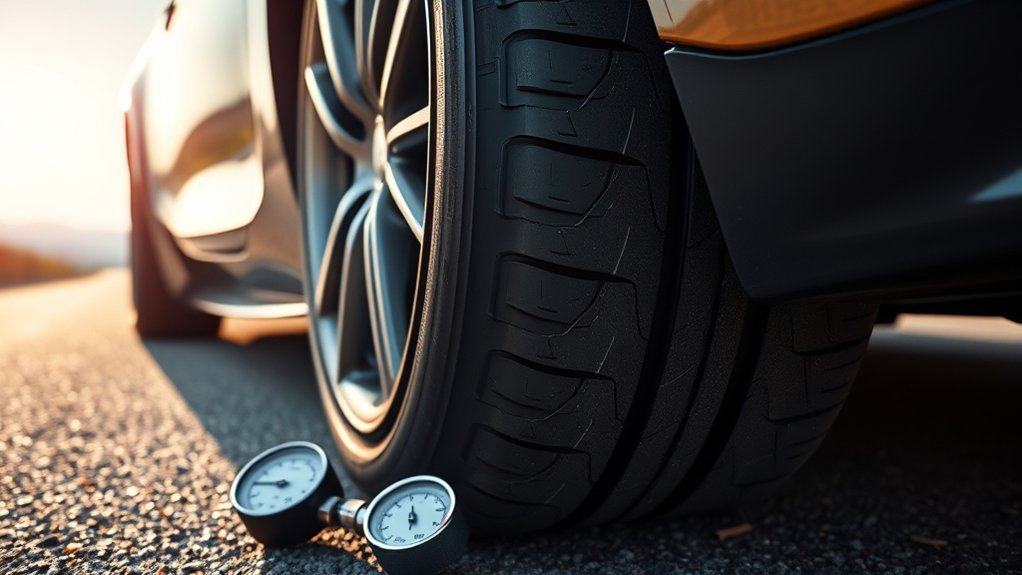
- Press the gauge squarely onto the valve stem. A brief hiss is normal while the gauge seals, but continued hissing means it is not seated correctly.
- Compare the reading with the placard. Match each tire to the correct front or rear value.
- Release air in short bursts. Gently press the center pin in the valve stem, then recheck after each brief release.
- Stop at the specified cold PSI. If you release too much air, add a small amount with an inflator and measure again.
- Replace the valve cap. Repeat the process for every road tire and check the spare using its own specification.
- Recheck the next time the tires are cold. This confirms that the adjustment was accurate and that your gauge is giving consistent readings.
NHTSA provides the same basic process: compare each cold reading with the vehicle specification and slowly release air when pressure is too high.
What to Do If the Tires Are Hot
If you have just driven, record the reading but do not reduce it to the cold placard number. Let the vehicle sit for at least three hours and check again. Michelin also advises drivers not to reduce pressure when tires are hot because the reading will fall as the tires cool.
If you know the tires were deliberately filled far above the vehicle specification, the vehicle handles dangerously, or a tire shows visible damage, stop using the vehicle normally and have the tire inspected by a qualified technician.
A pressure reading taken after driving cannot be compared directly with a cold door-placard specification.
Why Overinflated Tires Happen
Most cases of overinflation come from an incorrect inflation method rather than a mechanical problem.
- Using the sidewall maximum as the target: The sidewall number is not a substitute for the vehicle placard.
- Adding air without measuring first: Repeated “top-offs” can slowly move a tire above its proper cold pressure.
- An inaccurate gauge: A damaged, low-quality, or poorly handled gauge can give misleading readings.
- Adjusting a hot tire incorrectly: A driver may add or remove air based on a pressure that has already risen from driving heat.
- Seasonal temperature changes: Cold pressure often changes by about 1 to 2 PSI for every 10°F change in ambient temperature, according to the U.S. Tire Manufacturers Association.
- Incorrect advice for loads or towing: Adding an arbitrary number of PSI is not a safe substitute for the vehicle’s load-specific instructions.
Altitude has much less practical effect than temperature for most drivers. During mountain travel, the colder air at higher elevations is usually the main reason the measured pressure changes. Continue using the vehicle manufacturer’s specification rather than applying an altitude correction formula.
Can Hot Weather Make a Tire Overinflated?
Hot weather can raise a tire’s cold pressure if the tire was originally set during much cooler conditions. That is why seasonal pressure checks matter. However, the temporary increase that occurs while driving is normal and should not be bled away.
For example, a tire set correctly on a cool morning may read several PSI higher after highway driving. That higher hot reading alone does not show that the tire was incorrectly inflated. Let it cool and compare the next cold reading with the placard.
Safety Risks of Overinflated Tires
Overinflation changes the way a tire carries load and responds to the road. The seriousness depends on how far the cold pressure is above specification, the tire’s condition, vehicle load, speed, road surface, and whether the tire receives an impact.
| Risk | Why It Can Happen | Prevention |
|---|---|---|
| Reduced ride comfort | The tire has less compliance over bumps | Set pressure when cold |
| Less predictable grip | The contact patch and tread loading can change | Follow the vehicle placard |
| Center-biased tread wear | Too much load may be concentrated near the tread center | Check pressure monthly and rotate as specified |
| Impact-related damage | The tire has less ability to flex around potholes and debris | Correct high cold pressure and avoid road hazards |
| Loss of control | Grip and response may be less predictable during abrupt maneuvers | Correct pressure before normal driving |
Overinflation can contribute to road-hazard damage, but blowouts have many possible causes. Underinflation, overloading, punctures, structural damage, tire age, heat, and previous impacts must also be considered.
How Much PSI Is Too High?
There is no single number that is dangerously high for every passenger car, SUV, truck, and tire. Tire designs, vehicle weights, axle loads, and recommended pressures vary.
The practical rule is simple: if a valid cold reading is above the pressure specified for that tire position, adjust it to the listed value. Do not wait for the pressure to reach the tire’s sidewall maximum before correcting it.
A one- or two-PSI difference may reflect gauge accuracy, temperature, or the timing of the reading. Recheck under the same cold conditions with a reliable gauge. A large unexplained difference, severe handling change, or pressure near an incorrect shop setting should be corrected before normal driving.
Will TPMS Warn You About Overinflated Tires?
Do not rely on the Tire Pressure Monitoring System to identify ordinary overinflation. Standard TPMS systems are primarily designed to warn when one or more tires become significantly underinflated.
Some vehicles display individual pressure readings, but the displayed numbers still need to be compared with the door placard. NHTSA advises drivers to perform monthly manual checks because TPMS is not a replacement for a pressure gauge.
Does Center Tread Wear Always Mean Overinflation?
No. Chronic overinflation is a common cause, but it is not the only possibility. Center wear can also be affected by:
- An incorrect wheel width for the tire
- A tire that is not appropriate for the application
- Improper or infrequent rotation
- Aggressive acceleration
- Vehicle alignment or suspension problems
- The design and normal wear behavior of some performance tires
Once an uneven wear pattern develops, lowering the pressure will not restore the missing tread. Correct the cause, measure the remaining tread depth across the full tire, and ask a tire professional whether the tire can remain in service.
How to Prevent Tire Overinflation
- Check every tire at least once a month when cold.
- Check again before long trips, towing, or carrying a heavy load.
- Use the pressure listed for the vehicle and load condition.
- Do not add a guessed amount of extra PSI for cargo or towing.
- Check front and rear specifications separately.
- Check the spare according to its own specification.
- Use the same reliable gauge for routine comparisons.
- Recheck pressure after large seasonal temperature changes.
- Do not depend on visual appearance or TPMS alone.
- Inspect tread, sidewalls, valve stems, and wheels while checking pressure.
Safety note: Tire pressure is only one part of tire safety. Also inspect tread depth, cracks, cuts, bulges, punctures, exposed cords, tire age, and vehicle load. Do not continue normal driving on a tire with a bulge, exposed cord, major cut, or suspected structural damage. Have it checked by a qualified tire technician.
Frequently Asked Questions
Do overinflated tires have less grip?
They can. Excess pressure changes the contact patch and tread loading, which may reduce grip and make handling less predictable. The effect depends on the tire, road surface, temperature, load, and how far the cold pressure is above specification.
Does increasing tire pressure improve grip?
Increasing pressure above the vehicle specification is not a safe way to improve normal road grip. Steering may feel sharper, but the ride can become harsher and the tire may be less compliant over uneven or wet pavement.
Is the 3% tire pressure rule a safety standard?
No official passenger-vehicle inflation rule allows pressure to vary by 3% above the placard. A 3% guideline is more commonly discussed when comparing replacement-tire diameters. For pressure, use the vehicle manufacturer’s cold specification.
What are the effects of overinflated tires?
Possible effects include a harsher ride, center-biased tread wear, less predictable handling, and greater vulnerability to pothole or road-debris impacts. The severity depends on the amount of excess pressure and the condition of the tire.
How much PSI is too high for tires?
Any confirmed cold reading above the specification for that tire position should be corrected. There is no universal dangerous threshold because tires and vehicles have different limits. The sidewall maximum is not the normal target.
Should I check tire pressure hot or cold?
Check it cold, ideally before driving or after the vehicle has been parked for at least three hours. A hot tire normally reads higher, so lowering it to the cold target can leave it underinflated after cooling.
Can hot weather make tires overinflated?
Seasonal heat can raise the tire’s cold pressure, so rechecking during major weather changes is useful. Pressure that rises only because the tire was driven and warmed is normal. Let it cool before deciding whether air should be released.
Why do overinflated tires wear in the center?
Excess pressure can cause more of the tire’s load to be carried near the middle of the tread. Over time, that area may wear faster than the shoulders. Other fitment, rotation, and driving factors can produce a similar pattern.
Can overinflated tires cause a blowout?
Severe overinflation can make a tire more vulnerable to impact-related damage, especially if it is worn, overloaded, or already damaged. Blowouts also result from underinflation, heat, punctures, age, overloading, and structural defects.
Should I use the PSI on the tire sidewall?
No. The sidewall normally shows the tire’s maximum cold pressure at its stated load rating. Use the vehicle’s Tire and Loading Information Label or owner’s manual for normal operation.
Will TPMS warn me when pressure is too high?
Usually not. Standard TPMS warnings focus on significant underinflation. Some vehicles display individual PSI readings, but you must still compare them with the placard and confirm questionable readings with a gauge.
Should front and rear tires have the same pressure?
Not always. Many vehicles specify different front and rear pressures because the axle loads differ. Follow the values printed for each position rather than making all four tires match automatically.
Conclusion
Correct tire pressure supports predictable handling, ride comfort, even wear, and protection from avoidable road-hazard damage. Overinflation should be confirmed with a gauge rather than judged only by appearance or driving feel.
Check every tire cold, compare each position with the driver’s door placard, and release air in short bursts only when the cold reading is too high. Repeat the check monthly, before long trips, and after major seasonal temperature changes.
Sources
- National Highway Traffic Safety Administration: TireWise — recommended pressure, cold checks, TPMS limitations, and pressure-adjustment steps
- NHTSA Summer Driving and Road Trip Tips — cold-tire definition, placard pressure, spare checks, and tire-damage inspection
- U.S. Tire Manufacturers Association: Tire Care Essentials — monthly checks, temperature-related pressure changes, and TPMS guidance
- Michelin: How to Check Tire Pressure — gauge use, cold readings, placard pressure, and inflation adjustment
- Michelin: Center Tread Wear — overinflation-related center wear and corrective action